
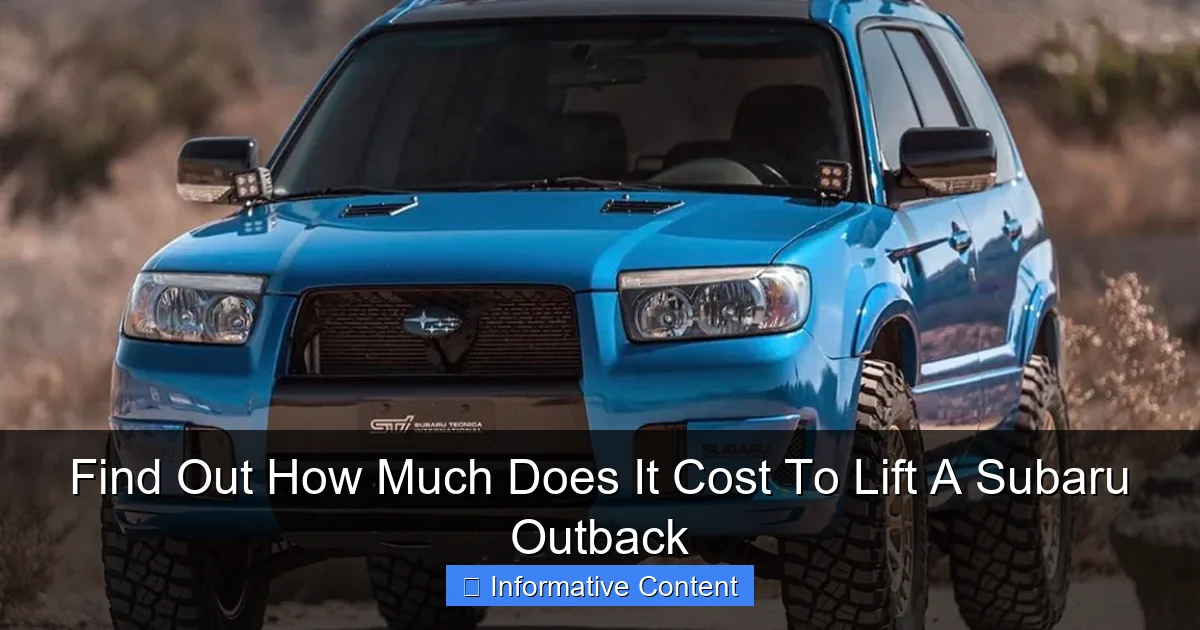
Lifting a Subaru Outback typically costs between $1,000 and $3,000, with the final price heavily influenced by lift kit quality, installation labor, and additional upgrades. This investment dramatically improves ground clearance and off-road performance, transforming your vehicle for rugged adventures.
So, you’re thinking about lifting your Subaru Outback. That’s awesome! I remember when I first got the itch to take my Outback off the beaten path. It was a rainy weekend, and a friend convinced me to try a forest trail. My stock Outback did okay, but I kept hearing that dreaded scrape of the undercarriage on a rocky section. That sound was like a wake-up call. I realized that for true adventure, I needed a bit more height.
Maybe you’ve had a similar moment. The Subaru Outback is a fantastic vehicle—reliable, comfortable, and surprisingly capable. But for those who crave more rugged terrain, a lift kit can transform it from a suburban cruiser into a trail-conquering explorer. The big question, though, is about the investment. How much does it cost to lift a Subaru Outback? It’s not just about the parts; it’s about the journey, the installation, and the long-term joy of driving something you’ve personalized.
In this guide, I’ll walk you through everything. We’ll talk about why you might want to lift your Outback, the different ways to do it, and most importantly, the costs involved. I’ll share insights from my own experience and from fellow Outback owners. By the end, you’ll have a clear picture of what to expect, both in your wallet and on the road. Let’s dive in!
In This Article
- 1 Key Takeaways
- 2 📑 Table of Contents
- 3 Why Lift Your Subaru Outback? More Than Just Looks
- 4 Types of Lift Kits for Subaru Outback: Choosing Your Path
- 5 How Much Does It Cost To Lift A Subaru Outback? Breaking Down the Numbers
- 6 Installation: DIY vs. Professional – Weighing the Costs
- 7 Practical Tips and Maintenance After Lifting Your Outback
- 8 Making the Decision: Is Lifting Your Outback Worth It?
- 9 Frequently Asked Questions
- 9.1 How much does it cost to lift a Subaru Outback?
- 9.2 What factors influence the cost to lift a Subaru Outback?
- 9.3 Is lifting a Subaru Outback worth the investment?
- 9.4 Can I install a lift kit on my Subaru Outback myself?
- 9.5 How does lifting a Subaru Outback affect off-road performance?
- 9.6 What are the pros and cons of lifting a Subaru Outback?
Key Takeaways
- Cost varies widely: Expect $500 to $3000 for parts and labor.
- DIY saves on labor: Self-installation cuts costs but needs skill.
- Invest in quality kits: Higher cost improves durability and performance.
- Budget for extra expenses: Include alignment, tires, and potential modifications.
- Check warranty impacts: Modifications may void factory coverage.
- Expect handling changes: Alters stability, ride, and fuel economy.
- Research thoroughly first: Consult reviews and experts for best fit.
📑 Table of Contents
- Why Lift Your Subaru Outback? More Than Just Looks
- Types of Lift Kits for Subaru Outback: Choosing Your Path
- How Much Does It Cost To Lift A Subaru Outback? Breaking Down the Numbers
- Installation: DIY vs. Professional – Weighing the Costs
- Practical Tips and Maintenance After Lifting Your Outback
- Making the Decision: Is Lifting Your Outback Worth It?
Why Lift Your Subaru Outback? More Than Just Looks
Lifting your Outback isn’t just for show. It’s about unlocking potential. Think of it as giving your car a pair of sturdy hiking boots. Suddenly, paths that were once intimidating become inviting.
Gain Ground Clearance for Adventure
The most obvious benefit is ground clearance. A stock Subaru Outback has about 8.7 inches. That’s good, but a lift kit can add 1 to 4 inches more. This means you’re less likely to hit rocks, logs, or deep ruts. It protects your engine and exhaust system. For me, that peace of mind on remote trails is priceless.
Improve Off-Road Capability
With more height, you can fit larger tires. Bigger tires provide better traction and a smoother ride over rough ground. This combo—lift plus tires—turns your Outback into a more confident off-roader. You’ll tackle sand, mud, and snow with greater ease.
Enhance Visibility and Presence
It’s a practical perk. Sitting higher gives you a better view of the road ahead. In traffic, you see over other cars. Plus, let’s be honest, a lifted Outback has a tough, adventurous look. It stands out in a sea of standard SUVs.
But before you get too excited, remember that lifting isn’t without trade-offs. It can affect fuel economy, handling, and even warranty. We’ll cover that later. For now, know that the reasons to lift are solid, especially if adventure calls your name.
Types of Lift Kits for Subaru Outback: Choosing Your Path
Not all lift kits are created equal. The type you choose greatly impacts performance, comfort, and cost. Think of it as picking the right tool for the job.

Visual guide about How Much Does It Cost To Lift A Subaru Outback
Image source: cdn.shopify.com
Spacer Lift Kits: The Budget-Friendly Option
These are the most common for beginners. Spacer kits use polyurethane or aluminum blocks to create space between the suspension and the body or struts. They’re relatively inexpensive and easy to install. However, they don’t improve suspension travel; they just raise the body. For mild off-roading and a modest lift, they’re a great start.
Strut and Spring Lift Kits: The Balanced Upgrade
This is a more integrated approach. These kits replace your entire strut assembly with longer ones and include stiffer springs. They offer better ride quality and maintain more of the original suspension geometry. They’re ideal if you plan on carrying heavy loads or want a smoother off-road experience. The cost is higher, but so is the performance.
Full Suspension Lift Kits: The Ultimate Transformation
For the serious enthusiast, full suspension kits replace shocks, springs, and sometimes control arms. They provide the most lift and the best off-road performance. They’re designed to handle extreme conditions. This is the most expensive option, but it turns your Outback into a true overlanding vehicle.
There are also subframe drop kits to correct alignment after a big lift. Choosing the right type depends on your budget and how you plan to use your Outback. Each has its own price tag, which leads us to the core question: how much does it cost to lift a Subaru Outback?
How Much Does It Cost To Lift A Subaru Outback? Breaking Down the Numbers
This is the heart of the matter. The cost to lift a Subaru Outback varies widely. It depends on the kit type, brand, and whether you install it yourself. Let’s break it down piece by piece.

Visual guide about How Much Does It Cost To Lift A Subaru Outback
Image source: i.pinimg.com
The Cost of the Lift Kit Itself
The kit is your biggest expense. Prices range from about $200 to over $2,500.
- Basic Spacer Kits: $200 – $600. Brands like Rough Country or Anderson Design & Fabrication offer entry-level options.
- Strut/Spring Kits: $800 – $1,800. Brands like LP Adventure, Primitive Racing, or Flatout Suspension are popular here.
- Full Suspension Kits: $1,500 – $2,500+. These are from specialized brands like King Springs or custom shops.
Remember, a higher price often means better materials, more included parts, and improved durability. Don’t just go for the cheapest; think about long-term value.
Additional Parts and Accessories
A lift kit alone isn’t always enough. You might need:
- Larger Tires: $600 – $1,500 for a set. This is almost a must for a balanced look and function.
- Wheel Alignment: $80 – $150. Crucial after any lift to prevent tire wear.
- Extended Brake Lines or CV Axle Boots: $100 – $300. For larger lifts to ensure safety and reliability.
- Skid Plates: $200 – $500. To protect your newly exposed undercarriage.
These add-ons can significantly increase the total cost. When planning your budget, factor them in from the start.
A Handy Cost Comparison Table
To give you a clearer picture, here’s a table summarizing typical costs. This is based on average market prices and my research.
| Lift Type | Kit Cost Range | Installation Cost (Pro) | Total Estimated Cost (With Basics) | Best For |
|---|---|---|---|---|
| Spacer Lift (1-2″) | $200 – $600 | $300 – $600 | $500 – $1,200 | Beginners, mild off-road, budget-conscious |
| Strut/Spring Lift (2-3″) | $800 – $1,800 | $600 – $1,000 | $1,400 – $2,800 | Enthusiasts, improved ride, frequent off-road |
| Full Suspension Lift (3-4″+) | $1,500 – $2,500+ | $1,000 – $1,500+ | $2,500 – $4,000+ | Serious overlanding, extreme terrain |
Note: “With Basics” includes kit, professional installation, and alignment. It does not include tires or other major accessories. As you can see, the total cost to lift a Subaru Outback can span from a few hundred to several thousand dollars. It all depends on your goals.
Installation: DIY vs. Professional – Weighing the Costs
Once you have the kit, you need to get it on your car. This is where costs can diverge dramatically. Your choice here affects both your wallet and your sanity.

Visual guide about How Much Does It Cost To Lift A Subaru Outback
Image source: i.ytimg.com
The DIY Route: Saving Money, Gaining Experience
If you’re handy with tools, DIY can save you a lot. You’ll need a good jack, jack stands, wrenches, and maybe a spring compressor. For a spacer lift, a weekend in the garage might suffice. The cost is just your time and maybe a pizza for a helper.
Pros: Lower cost, personal satisfaction, learning experience.
Cons: Risk of errors, time-consuming, no warranty on labor. If you mess up, it could lead to costly repairs.
Tip: Watch online tutorials specific to your Outback model year. Join forums like SubaruOutback.org for advice.
Professional Installation: Peace of Mind at a Price
Hiring a pro ensures the job is done right. Shops that specialize in Subarus or off-road modifications are best. Labor costs vary by region and shop rates.
- Spacer Lift Installation: $300 – $600. Usually takes 3-5 hours.
- Strut/Spring Lift Installation: $600 – $1,000. Can take 5-8 hours due to more complex work.
- Full Suspension Installation: $1,000 – $1,500+. May require multiple days.
Pros: Expertise, warranty on labor, saves time, often includes alignment.
Cons: Higher upfront cost, need to find a trusted shop.
When calculating how much does it cost to lift a Subaru Outback, don’t overlook installation. It’s a significant part of the total. For most people, especially with complex kits, professional help is worth it.
Practical Tips and Maintenance After Lifting Your Outback
You’ve made the investment. Now, how do you keep your lifted Outback running smoothly? Here are some hard-earned tips from the community.
Immediate Post-Installation Checks
After the lift is on, don’t just hit the trail. Take it slow for the first 100 miles. Listen for unusual noises. Get an alignment done immediately—this is non-negotiable. Check that all bolts are torqued to spec. A loose part can cause big problems off-road.
Ongoing Maintenance Considerations
A lifted vehicle stresses different components. Be prepared for:
- More Frequent Tire Rotations: Every 5,000 miles to ensure even wear.
- CV Axle Inspections: Lifting can increase the angle on axles. Look for torn boots or clicking sounds when turning.
- Suspension Checks: Regularly inspect struts and springs for leaks or damage.
- Fuel Economy Impact: Expect a drop of 1-3 MPG due to increased drag and heavier tires. It’s a trade-off for capability.
Driving Dynamics and Safety
Your Outback will handle differently. It might feel taller in corners. Take turns a bit slower until you’re used to it. Braking distance can increase slightly. Be mindful of parking garages and drive-thrus—your new height might not fit everywhere!
Personal Anecdote: After my lift, I scraped the roof on a low branch I didn’t see. It was a humble reminder to always be aware of my new dimensions. A small price for the freedom it gives me.
Making the Decision: Is Lifting Your Outback Worth It?
So, after all this, where do you stand? Lifting your Subaru Outback is a personal choice. It’s about matching your vehicle to your lifestyle.
Reflect on your needs. Are you a weekend warrior hitting light trails? A spacer lift might be perfect. Do you plan cross-country overland trips? Investing in a full suspension kit could be your best bet. Always balance your dreams with your budget.
Remember, the cost to lift a Subaru Outback is more than money. It’s about the adventures you’ll have, the places you’ll go, and the community you’ll join. I’ve met some of my closest friends through off-road Subaru groups. That value is immeasurable.
Start small if you’re unsure. Research thoroughly. Talk to other owners. And most importantly, enjoy the process. Your Outback is a canvas for your adventures. A lift kit is just one brushstroke in that masterpiece.
I hope this guide has shed light on the question, “How much does it cost to lift a Subaru Outback?” You now have the knowledge to make an informed decision. Get out there and explore!
Frequently Asked Questions
How much does it cost to lift a Subaru Outback?
The cost to lift a Subaru Outback typically ranges from $500 to $3,000, depending on the lift kit quality and installation fees. For a basic spacer lift, you might pay around $500, while a full suspension lift with professional installation can cost up to $3,000 or more.
What factors influence the cost to lift a Subaru Outback?
Several factors affect the cost, including the type of lift kit (spacer vs. suspension), brand quality, and whether you opt for professional installation. Additional expenses may arise from necessary alignments, upgraded components like shocks or struts, and any custom modifications required.
Is lifting a Subaru Outback worth the investment?
Lifting a Subaru Outback can be worth it if you frequently drive off-road or need extra ground clearance for rough terrain. However, it may reduce fuel efficiency and affect handling on paved roads, so consider your driving needs before investing.
Can I install a lift kit on my Subaru Outback myself?
Yes, if you have mechanical experience and the right tools, you can install a lift kit yourself. However, improper installation can lead to safety issues, so it’s often recommended to have a professional handle it, especially for complex suspension lifts.
How does lifting a Subaru Outback affect off-road performance?
Lifting a Subaru Outback improves off-road performance by increasing ground clearance, allowing you to navigate over obstacles more easily. It also provides better approach and departure angles, enhancing your vehicle’s capability on rugged trails.
What are the pros and cons of lifting a Subaru Outback?
The pros include enhanced off-road ability, better visibility, and a more aggressive look. Cons can involve reduced fuel economy, potential warranty voids, and increased wear on suspension components if not properly maintained.

At CarLegit, we believe information should be clear, factual, and genuinely helpful. That’s why every guide, review, and update on our website is created with care, research, and a strong focus on user experience.