
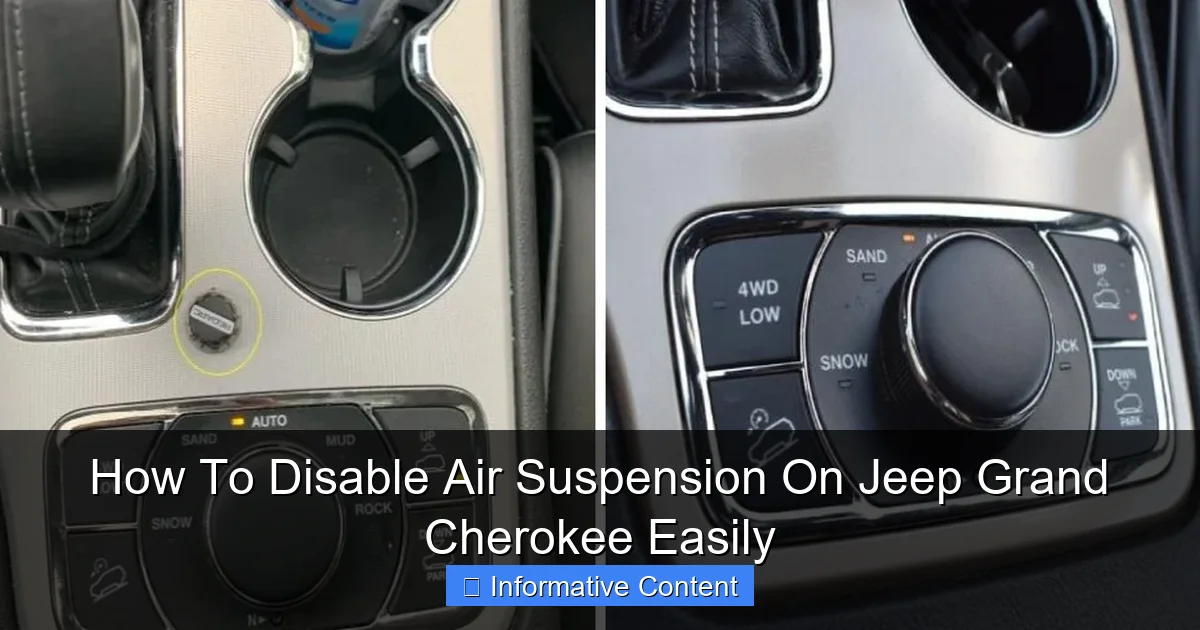
Disabling the air suspension on a Jeep Grand Cherokee is straightforward and can be accomplished with basic tools or a diagnostic scanner. This process safely converts the system to a traditional coil spring setup, enhancing reliability for off-road use or preventing future component failure. Taking control of this modification empowers you to customize your vehicle’s performance and avoid expensive repairs.
In This Article
- 1 Key Takeaways
- 2 📑 Table of Contents
- 3 How To Disable Air Suspension On Jeep Grand Cherokee Easily
- 4 Why Would You Want to Disable the Air Suspension?
- 5 Getting Ready: What You’ll Need to Disable Air Suspension
- 6 Two Main Paths: The Mechanical vs. The Electrical Disable
- 7 Comparing Your Options: A Handy Data Table
- 8 Life After the Conversion: What to Expect
- 9 Final Thoughts: Taking Control of Your Jeep’s Journey
- 10 Frequently Asked Questions
- 10.1 Why would I want to disable the air suspension on my Jeep Grand Cherokee?
- 10.2 Is it safe to disable the air suspension on a Jeep Grand Cherokee?
- 10.3 How do I disable air suspension on Jeep Grand Cherokee easily?
- 10.4 What tools are needed to disable the air suspension on a Jeep Grand Cherokee?
- 10.5 Will disabling the air suspension void my Jeep Grand Cherokee’s warranty?
- 10.6 Can I revert the disablement if I change my mind later?
Key Takeaways
- Prioritize Safety: Disconnect the battery first to avoid electrical hazards.
- Locate Key Components: Identify the air compressor and control module easily.
- Use Diagnostic Tools: A scan tool reads and clears essential fault codes.
- Consider Conversion Kits: Aftermarket kits permanently replace air springs with coils.
- Understand System Impact: Disabling affects ride height, comfort, and stability.
- Follow Model-Specific Guides: Procedures vary by year; consult your manual.
- Test Thoroughly Afterward: Ensure the vehicle is level and warning lights are off.
📑 Table of Contents
- How To Disable Air Suspension On Jeep Grand Cherokee Easily
- Why Would You Want to Disable the Air Suspension?
- Getting Ready: What You’ll Need to Disable Air Suspension
- Two Main Paths: The Mechanical vs. The Electrical Disable
- Comparing Your Options: A Handy Data Table
- Life After the Conversion: What to Expect
- Final Thoughts: Taking Control of Your Jeep’s Journey
How To Disable Air Suspension On Jeep Grand Cherokee Easily
Let’s talk about your Jeep Grand Cherokee. It’s more than a vehicle; it’s your adventure partner, your daily commuter, your trusty steed. But if you’re reading this, that trust might be feeling a little shaky. Maybe you’ve noticed the dreaded “Service Air Suspension Immediately” warning glowing on your dash. Perhaps you heard a strange hissing sound from a wheel well overnight, only to find your Jeep looking like it’s kneeling in prayer one morning. Or maybe you’re just planning ahead, knowing that the complex air suspension system is a common—and expensive—point of failure as these fantastic vehicles age.
If any of that sounds familiar, you’re not alone. I’ve been there, staring at a repair quote that made my eyes water, wondering if there was another way. The good news? There is. Disabling the air suspension system and converting to a traditional coil spring setup is a popular and practical solution for many Grand Cherokee owners. It trades the self-leveling ride height for proven simplicity, reliability, and a much lighter hit on your wallet in the long run.
This guide is here to walk you through the entire process of how to disable air suspension on Jeep Grand Cherokee. We’ll cover the “why,” the “how,” and everything in between. I’ll share the insights I wish I’d had, from the tools you’ll need to the little tricks that make the job smoother. Whether you’re a seasoned DIYer or a determined novice ready to tackle your biggest project yet, let’s get your Jeep back on the road—reliably and confidently.
Why Would You Want to Disable the Air Suspension?
Before we grab the wrenches, it’s important to understand the “why.” Jeep’s Quadra-Lift air suspension is an engineering marvel when it works, offering a silky-smooth ride and incredible versatility. But when it fails, it often fails big. Converting to coils isn’t about rejecting innovation; it’s often a pragmatic choice for long-term ownership.

Visual guide about How To Disable Air Suspension On Jeep Grand Cherokee
Image source: suspensionhq.com
The most common driver is, unsurprisingly, cost. A single failing air strut or a leaky air spring can cost hundreds of dollars just for the part. The compressor, dryer, valve blocks, and height sensors are all additional points of potential failure. A full OEM system replacement at a dealership can easily run into multiple thousands of dollars. For an older Jeep, that repair bill can exceed the vehicle’s value. Switching to a quality coilover kit is often a one-time, fixed cost that provides peace of mind for years to come.
Next is reliability. Simple coil springs have no air bags to puncture, no compressors to wear out, and no intricate air lines to develop leaks. If you use your Jeep for remote camping, overlanding, or simply don’t want to worry about being stranded by a suspension fault, the mechanical certainty of coils is incredibly appealing. It’s about knowing your suspension will work, every single time, without relying on a network of sensors and pneumatic parts.
Finally, there’s the issue of intended use. If you never use the “Off-Road 2” lift setting or the “Aero” mode for highway driving, you might not be utilizing the system’s key features. For someone who wants a predictable ride height, plans to add heavy aftermarket bumpers or a winch, or desires a more traditional off-road suspension setup for serious modifications, disabling the air suspension is the necessary first step.
Weighing the Trade-Offs Honestly
It’s only fair to mention what you lose. The automatic leveling function is gone—if you load the rear with heavy gear, it will squat. You’ll manually need a jack to change a tire instead of using the “Access” height setting. The ultra-plush, magic-carpet ride quality might firm up slightly depending on the coil kit you choose. It’s a trade-off, but for many, the gains in durability and cost savings far outweigh these conveniences.
Getting Ready: What You’ll Need to Disable Air Suspension
Failing to prepare is preparing to fail, especially when working on your vehicle’s suspension. Safety is paramount. This isn’t a race. Gather your tools and parts first, clear a good workspace, and let’s do this right.

Visual guide about How To Disable Air Suspension On Jeep Grand Cherokee
Image source: suspensionhq.com
Essential Tools and Parts
Parts: The heart of the conversion is the coilover conversion kit. Do not simply remove the air springs and expect the vehicle to hold itself up. You must install a proper kit designed for your specific model year and engine. Popular options include kits from brands like Strutmasters, Arnott, or Old Man Emu. These kits include new shock/coil spring assemblies for all four corners.
- Coilover Conversion Kit (Front & Rear)
- Optional: New sway bar end links (often recommended due to changed ride height)
- Optional: Fuse taps or electrical connectors for the bypass method (more on that later).
Tools:
- Floor Jack and High-Quality Jack Stands (at least two, four is better). Never work under a vehicle supported only by a jack.
- Basic Socket Set & Wrenches (including Torx bits, common on Jeeps)
- Spring Compressors (sometimes needed for front strut assembly, depending on the kit)
- Torque Wrench
- Trim Removal Tools (for interior fuse panel access)
- Wire Cutters/Strippers & Electrical Tape or Heat Shrink (for electrical method)
- Scan Tool or Programmer (if using the electronic disable method).
Safety First: The Golden Rules
Always disconnect the negative battery terminal before starting. This de-energizes the suspension system. Chock the wheels you are not lifting. Always lift the vehicle from designated frame points, not the suspension arms or axle. When lowering the vehicle onto jack stands, give it a gentle rock test to ensure it’s stable before crawling underneath.
Two Main Paths: The Mechanical vs. The Electrical Disable
There are two fundamental approaches to disable air suspension on Jeep Grand Cherokee. You can do the full mechanical replacement, which is the most common and complete solution. Or, in some cases, you can use an electronic trick to tell the computer the system is gone. Let’s break down both.

Visual guide about How To Disable Air Suspension On Jeep Grand Cherokee
Image source: cdn.shopify.com
Method 1: The Full Mechanical Conversion (Most Common)
This is the “rip the band-aid off” method. You physically remove every component of the air suspension system and install a complete coil spring kit. The vehicle’s computer will still throw error codes, but with the physical components gone, it can’t try to operate them.
Step-by-Step Overview:
- Disconnect the Battery: Always step one.
- Remove the Air Springs/Struts: Jack up the vehicle, secure it on stands, and remove the wheels. For the rear, you’ll typically disconnect the electrical connector and air line from the solenoid on the air spring, then unbolt the spring from the axle and body. The front is similar but integrated into a strut assembly.
- Install the Coilovers: Follow your kit’s instructions precisely. This usually involves transferring mounting hardware and often using spring compressors to assemble the front strut/coil unit before installation.
- Address the Air Lines and Compressor: Once the new suspension is supporting the vehicle, you can remove the air lines. The compressor, usually located under the front passenger seat area, can be unplugged and removed to free up space. Some people leave it in place but disconnected.
- Lower the Vehicle and Torque: With wheels back on, lower the Jeep to the ground. Then, with the vehicle’s weight on its wheels (this is crucial), go back and final-torque all suspension bolts to the factory specifications.
Method 2: The Electronic Bypass (A Temporary or Diagnostic Fix)
This method tricks the vehicle’s computer (the Totally Integrated Power Module, or TIPM) into thinking the air suspension is still operational and functioning normally. It’s less invasive but requires comfort with vehicle electronics.
How it Works: The system uses height sensors to monitor ride height. By unplugging a sensor and inserting a small resistor (often called a “simulator”) across the connector terminals, you can send a fixed, “normal height” signal to the computer. Simultaneously, you need to disable the air suspension fuse or relay to prevent the compressor from trying to correct a non-existent problem.
A Practical Tip – The Fuse Tap Trick: A common and clever workaround is to use a “fuse tap” in the interior fuse panel. You locate the fuse for the air suspension compressor (often a 40A or 50A fuse, check your manual), remove it, and insert a fuse tap with a much lower amperage fuse (like a 5A). This provides enough power for the computer to see the circuit but not enough to ever engage the compressor. Combined with height sensor simulators, this can effectively silence warnings. Important: This method varies wildly by model year. Research your specific Jeep’s wiring diagrams thoroughly.
Comparing Your Options: A Handy Data Table
To help visualize the two main paths, here’s a quick comparison. This data table breaks down the key factors to consider when deciding how to disable air suspension on Jeep Grand Cherokee.
| Method | Full Coil Conversion | Electronic Bypass / Simulators |
|---|---|---|
| Primary Goal | Permanent, reliable mechanical replacement. | Temporary fix or electronic disable to avoid dash lights. |
| Cost | Higher upfront cost for the physical kit. | Lower upfront cost for simulators/wiring. |
| Difficulty | Moderate to High (mechanical skill required). | Moderate (electrical diagnostic skill required). |
| End Result | No air components remain. Traditional suspension. | Air components remain in place but are inactive. |
| Reliability | Very High. Eliminates all air system failure points. | Variable. Depends on quality of simulators and wiring. Old air bags can still physically fail. |
| Reversibility | Difficult and expensive to reverse. | Easy to reverse; just unplug simulators. |
| Best For | Owners keeping the vehicle long-term, dealing with multiple failures, or wanting ultimate simplicity. | Diagnosing issues, temporarily silencing warnings, or for owners who may sell soon and want a reversible option. |
Life After the Conversion: What to Expect
You’ve done it! The tools are put away, and your Jeep is sitting pretty on its new coil springs. Here’s what happens next and how to ensure everything is perfect.
The Dreaded Dash Lights and the Scan Tool Solution
Even after a perfect mechanical install, your dashboard will likely still show the “Service Air Suspension” warning. The computer is looking for its missing system. To clear this permanently, you need to tell the Jeep’s computer the air suspension is no longer installed. This requires a professional-grade scan tool like an Autel, Snap-on, or a dedicated programmer like the AlphaOBD app with a compatible Bluetooth adapter. You’ll go into the body computer settings and change the vehicle configuration from “Air Suspension” to “Coil Spring” or “Standard Suspension.” This step is what truly completes the disable air suspension on Jeep Grand Cherokee process, turning off the warnings for good.
Alignment is Not Optional
This is critical. Any time you significantly alter suspension components, you must get a professional wheel alignment. The new ride height, even if it targets “Normal” height, will have changed your toe, camber, and caster settings. Driving without an alignment will cause uneven tire wear and potentially affect handling. Budget for this as a mandatory final step.
The First Drive and Break-In
Take it easy for the first 50-100 miles. Listen for any unusual noises like clunks or squeaks. Go over a few speed bumps and listen. It’s not uncommon to need to re-torque a bolt or two after the initial settle-in period. Your ride feel will be different—often slightly firmer and more connected to the road. Many owners come to prefer this more traditional SUV feel.
Final Thoughts: Taking Control of Your Jeep’s Journey
Deciding to disable the air suspension on your Jeep Grand Cherokee is a significant choice. It’s born from a desire for reliability, cost control, and simplicity. While the Quadra-Lift system is fantastic technology, its complexity becomes a liability as the vehicle ages. Converting to a tried-and-true coil spring suspension is a proven path taken by thousands of owners to extend the life and enjoyment of their vehicles.
Remember, the best method depends on your goals, skills, and budget. The full mechanical conversion is the gold standard for a permanent fix. The electronic methods can be clever stopgaps or diagnostic aids. Whichever path you choose, the power is now in your hands. You’re no longer at the mercy of a single failing air bag or a staggering repair quote. You’ve taken a proactive step to ensure your Grand Cherokee remains the capable, dependable partner you bought it to be. So, grab your tools, take your time, and get ready to hit the road with a newfound sense of confidence. Happy wrenching!
Frequently Asked Questions
Why would I want to disable the air suspension on my Jeep Grand Cherokee?
Disabling the air suspension is common for off-road modifications or to avoid expensive repairs from system failures. It allows for a switch to traditional coil springs, which can be more durable and cost-effective in the long run.
Is it safe to disable the air suspension on a Jeep Grand Cherokee?
Yes, it is generally safe if done correctly using proper methods and tools. However, improper disablement can lead to electrical issues or suspension damage, so consulting a professional or detailed guide is advisable.
How do I disable air suspension on Jeep Grand Cherokee easily?
The easiest way is to locate and remove the air suspension fuse in the fuse box, which halts the compressor. For a more seamless disablement, consider an aftermarket bypass module that prevents system errors without permanent changes.
What tools are needed to disable the air suspension on a Jeep Grand Cherokee?
You’ll typically need basic tools like a socket set, pliers, and a fuse puller. Depending on your approach, a bypass kit or multimeter may also be helpful for ensuring electrical connections are properly managed.
Will disabling the air suspension void my Jeep Grand Cherokee’s warranty?
It might void parts of your warranty, especially if related suspension issues arise later. Always check with your dealership or warranty terms before making modifications to avoid potential coverage problems.
Can I revert the disablement if I change my mind later?
Yes, if you use non-destructive methods like fuse removal or a bypass module, you can easily re-enable the system. Simply reinstall the fuse or remove the module to restore the air suspension functionality.

At CarLegit, we believe information should be clear, factual, and genuinely helpful. That’s why every guide, review, and update on our website is created with care, research, and a strong focus on user experience.