

Featured image for How To Turn On Night Vision Jeep Grand Cherokee
Image source: adventurejeep.com
Activating night vision in your Jeep Grand Cherokee is straightforward: access the feature via the dedicated button on the overhead console or within the Uconnect infotainment system‘s safety menu. Once enabled, this system projects a thermal image onto your dashboard, dramatically improving visibility and safety in low-light conditions.
Picture this. You’re driving home on a dark, winding road after a long day. The headlights cut a decent path, but just beyond that pool of light, shadows play tricks on your eyes. Was that a deer? A raccoon? Or just a mailbox? Your shoulders tense up, your grip on the wheel tightens, and the last thirty minutes of your drive become an exercise in stress. If this sounds familiar, you’re not alone. Night driving is one of the most common anxieties for drivers.
Now, imagine having a superpower. A way to see over 300 feet down the road, cutting through the darkness to highlight pedestrians, animals, and obstacles long before your headlights ever catch them. That’s not science fiction. That’s the available Night Vision system in the Jeep Grand Cherokee. It’s like having a thermal camera for the road, and it can be an absolute game-changer for safety and peace of mind.
But here’s the thing I learned firsthand: having this incredible tech and knowing how to use it are two different things. When I first got my Grand Cherokee, I knew it had Night Vision, but I fumbled with the settings. It wasn’t immediately obvious. If you’re sitting in your driver’s seat right now, wondering how to unlock this feature, you’ve come to the right place. This guide is the friendly, step-by-step walkthrough I wish I’d had. We’ll cover everything from figuring out if your Jeep has it, to turning it on, understanding what you’re seeing, and getting the most out of it. Let’s turn those nighttime worries into confident drives.
In This Article
- 1 Key Takeaways
- 2 📑 Table of Contents
- 3 What Exactly Is Jeep Grand Cherokee Night Vision?
- 4 First Things First: Does YOUR Grand Cherokee Have Night Vision?
- 5 Your Step-by-Step Guide to Activating Night Vision
- 6 Understanding the Night Vision Display and Alerts
- 7 Tips and Best Practices for Effective Use
- 8 Jeep Grand Cherokee Night Vision: Availability by Model Year and Trim
- 9 Conclusion: Drive Confidently Into the Night
- 10 Frequently Asked Questions
- 10.1 How do I activate night vision in my Jeep Grand Cherokee?
- 10.2 Is night vision standard on the Jeep Grand Cherokee?
- 10.3 Can I use Jeep Grand Cherokee night vision in all weather conditions?
- 10.4 Why is my Jeep Grand Cherokee night vision not turning on?
- 10.5 What are the benefits of night vision in the Jeep Grand Cherokee?
- 10.6 How does the Jeep Grand Cherokee night vision system enhance safety?
Key Takeaways
- Check Vehicle Compatibility: Confirm your model has the optional night vision package.
- Access Uconnect Settings: Navigate to the safety or vision menu on your touchscreen.
- Activate via Menu or Button: Turn on night vision using the designated control.
- View on Digital Cluster: The night vision image displays in your instrument panel.
- Use in Dark Conditions: Enhance visibility during nighttime or low-light driving.
- Combine with High Beams: For best results, use alongside your headlights.
- Maintain System Cleanliness: Keep the camera lens free of dirt and debris.
📑 Table of Contents
- What Exactly Is Jeep Grand Cherokee Night Vision?
- First Things First: Does YOUR Grand Cherokee Have Night Vision?
- Your Step-by-Step Guide to Activating Night Vision
- Understanding the Night Vision Display and Alerts
- Tips and Best Practices for Effective Use
- Jeep Grand Cherokee Night Vision: Availability by Model Year and Trim
- Conclusion: Drive Confidently Into the Night
What Exactly Is Jeep Grand Cherokee Night Vision?
Before we dive into the buttons and screens, let’s understand what we’re working with. This isn’t a simple camera with a night mode. Jeep’s Night Vision uses a thermal imaging camera. This is key.
Think of it like this: your regular headlights rely on reflected light. If there’s no light to reflect, you can’t see it. A thermal camera, however, detects heat signatures. Living things—like people, dogs, or deer—and objects like recently-stopped cars emit heat. The Night Vision system picks up these heat signatures and displays them as a clear, glowing image on your dashboard screen.
How the Magic Happens: The Tech Behind the Scenes
The thermal camera itself is discreetly mounted behind the grille of your Grand Cherokee. It constantly scans the road ahead. Sophisticated software then analyzes the thermal data, and here’s the cool part: it can classify what it sees. Using icon overlays, it will distinguish between a pedestrian, a large animal (like a deer or cow), and even a cyclist.
This classification is crucial. A simple glowing blob is helpful, but a clear “Pedestrian” icon with a yellow highlight? That’s actionable information that lets you know exactly what you’re dealing with, giving you precious extra seconds to react safely.
First Things First: Does YOUR Grand Cherokee Have Night Vision?
This is the most important step, and it’s where many owners get stuck. Night Vision is not a standard feature on every Jeep Grand Cherokee. It’s an available piece of advanced technology, typically bundled in higher-tier packages on higher trim levels.

Visual guide about How To Turn On Night Vision Jeep Grand Cherokee
Image source: jeepfixes.com
How to Check for Compatibility
Don’t worry, you don’t need to be a mechanic to figure this out. Here are a few easy ways to check:
- Look at Your Grille: Peer through the front grille. If you see a small, square-ish lens module centrally mounted behind the slats, that’s likely the thermal camera.
- Check Your Window Sticker: Dig out your Monroney label (the official sticker that was on the window when you bought it). Look for keywords like “Advanced Technology Group,” “Night Vision,” or “Thermal Camera.”
- Scroll Through Your Digital Cluster: Start your Jeep and use the buttons on your steering wheel to scroll through the different pages and views on your digital instrument cluster (the screen behind the wheel). If you see a page or setting related to “Night Vision” or “Thermal,” you’ve got it!
If after checking you find your Jeep doesn’t have it, don’t be too disappointed. It’s a premium feature, and your Grand Cherokee is still packed with incredible standard safety tech. But if you do have it, let’s get it turned on!
Your Step-by-Step Guide to Activating Night Vision
Activating Night Vision is straightforward once you know where to look. The system is primarily controlled through your Uconnect touchscreen and, in some models, your digital instrument cluster. Remember, for safety, some features may only be accessible when the vehicle is in PARK.

Visual guide about How To Turn On Night Vision Jeep Grand Cherokee
Image source: jeepfixes.com
Method 1: Using the Uconnect Touchscreen (The Main Way)
This is your command center. Here’s the play-by-play:
- Start Your Vehicle: Get the Jeep running. You can be in Park for initial setup.
- Locate the “Settings” App: On your Uconnect screen (the large center screen), tap the “Settings” icon. It usually looks like a gear or a set of sliders.
- Navigate to “Safety & Driving Assistance”: Within Settings, you’ll find a menu option with this or a similar name. Tap on it.
- Find “Night Vision”: Scroll through the safety options. You should see a dedicated “Night Vision” menu item. Select it.
- Toggle It On: You will likely see a master switch to enable the system. Tap it to turn it ON. In this menu, you can also often adjust settings like the alert sensitivity or choose when warnings appear.
Method 2: Using the Instrument Cluster Display (For Quick Access)
Some model years allow you to add Night Vision as a view in your digital gauge cluster.
- Use the arrow or menu buttons on the left side of your steering wheel.
- Navigate to the “Off-Road” or “Information” pages (the name varies by year).
- Look for an option to add or select “Night Vision” as a widget or full-screen display.
- Once added, you can often cycle to this view directly from the wheel for a quick glance.
Pro Tip: I recommend setting it up via the Uconnect Settings first. Once enabled, you can often use a shortcut, like a long-press of the “Vehicle” button on the dash, to pull up the Night Vision display while driving.
Understanding the Night Vision Display and Alerts
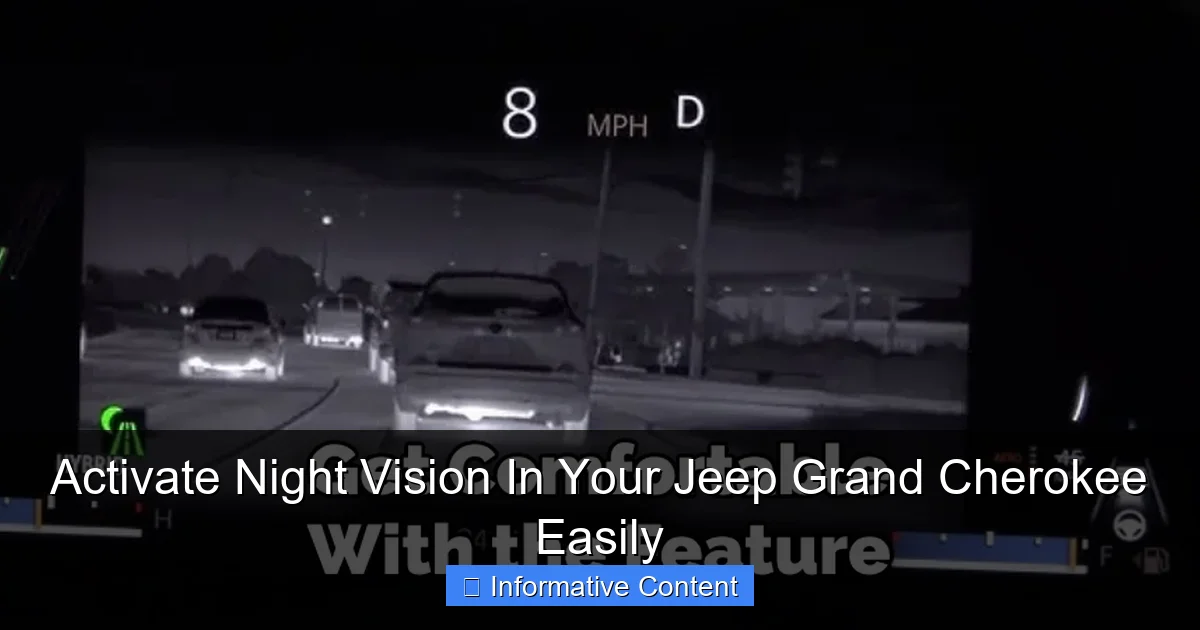
So you’ve turned it on. Now what does it all mean? When active, the display will appear either in your digital cluster or as a pop-up on your Uconnect screen, depending on your settings and model year.
Visual guide about How To Turn On Night Vision Jeep Grand Cherokee
Image source: jeepfixes.com
The view will be a black-and-white or colorized thermal image of the road ahead. Warm objects appear white or yellow/red, while cool areas are dark. It takes a minute to get used to “reading” the heat signatures, but the system helps immensely with icons.
Decoding the Warning Icons
This is the genius part. The system doesn’t just show heat; it tells you what the heat is:
- Yellow Pedestrian Icon: A person detected near your path. The icon will be placed directly over the thermal image of the person.
- Yellow Animal Icon: A large animal, like a deer, is detected. This is incredibly valuable on rural roads.
- Red Highlighting: If a detected pedestrian or animal is calculated to be on a potential collision course, the icon and the area around it may flash or turn red, and you will hear an audible alert. This is your cue to brake or steer safely.
The system is smart. It generally won’t alert you to every squirrel or rabbit, focusing on larger heat signatures that pose a real risk.
Tips and Best Practices for Effective Use
Having the tool is one thing; using it well is another. Based on my experience, here’s how to make Night Vision your trusted co-pilot.
When to Rely on It (And When Not To)
Night Vision excels in specific, tricky conditions:
- Dark, Unlit Rural Roads: This is its prime habitat. Spotting animals before they leap into your headlights.
- Fog or Light Rain: Thermal can sometimes see through visual obscurants better than visible light.
- Urban Areas with Pedestrians: Seeing people between parked cars or in poorly lit crosswalks.
Its limitations are just as important to know:
- It’s a Supplement, Not a Replacement: Always use your headlights. Night Vision enhances your existing vision, it doesn’t replace it.
- Weather Matters: Heavy, pouring rain or snow can limit its effectiveness as water absorbs thermal energy.
- Keep the Lens Clean: That camera behind the grille can get dirty. A quick wipe during a car wash helps.
Setting Up Your Alerts for Peace of Mind
Head back into that Settings menu. Play with the alert timing. I found the “Early” setting perfect for my comfort level on country roads. It gives me more time. In the city, a “Normal” setting might prevent frequent alerts. Tailor it to your driving environment.
Jeep Grand Cherokee Night Vision: Availability by Model Year and Trim
To give you a clearer picture, here’s a simplified breakdown of when Night Vision typically became available and on which models. Remember, packaging changes yearly, so your window sticker is the final authority.
| Model Generation (Years) | Typical Availability | Notes |
|---|---|---|
| WK2 (2017-2021) | Limited, Summit, and High-Altitude trims, often as part of the Advanced Technology Group IV package. | First introduced as an option in the later years of the WK2 generation. Not available on Laredo or Limited trims. |
| WL (2022-Present) | Summit, Summit Reserve, and Overland trims (as part of the Advanced Pro-Tech Group). | Carried forward as a premium feature on the latest generation. Generally not found on base Laredo or Altitude models. |
This table shows a clear trend: Night Vision is a hallmark feature of the most well-equipped, luxurious Grand Cherokees. If you’re shopping for a used model and this feature is a must-have, focusing your search on Summit or Limited (with the right package) trims from 2019 onward is a good strategy.
Conclusion: Drive Confidently Into the Night
Activating and using the Night Vision in your Jeep Grand Cherokee is about more than just following steps. It’s about embracing a layer of safety that actively works to protect you, your passengers, and everyone on the road. The process is simple—a few taps in your Uconnect system—but the impact is profound.
It transformed my night drives from tense sessions of squinting into darkness into much more relaxed journeys. That mental relief, knowing there’s an extra set of “eyes” scanning for dangers I can’t see, is invaluable. While it’s a premium feature, if your Grand Cherokee is equipped with it, it’s absolutely worth learning and using.
So tonight, take a moment to hop in your Jeep, go through the settings, and turn it on. Start in your driveway or a quiet street to get familiar with the display. Then, on your next evening drive, let it do its thing. You might just be surprised at what—or who—you see. Drive safe out there.
Frequently Asked Questions
How do I activate night vision in my Jeep Grand Cherokee?
To activate night vision, locate the dedicated button on your dashboard or access the feature through the Uconnect infotainment system’s safety menu. Once selected, the thermal imaging display will appear on your instrument cluster or central screen to enhance visibility in low light.
Is night vision standard on the Jeep Grand Cherokee?
No, night vision is not standard; it is an optional feature typically available on higher trims like Summit or Overland. Check your vehicle’s specifications or owner’s manual to confirm if your model includes the Jeep Grand Cherokee night vision system.
Can I use Jeep Grand Cherokee night vision in all weather conditions?
Jeep Grand Cherokee night vision works well in most conditions, but heavy rain, fog, or snow may limit its effectiveness by obscuring the infrared sensors. For best results, keep the camera lens clean and rely on it as a supplement to your headlights.
Why is my Jeep Grand Cherokee night vision not turning on?
If your Jeep Grand Cherokee night vision isn’t turning on, ensure the feature is enabled in the vehicle settings and that the front grille sensor is unobstructed. If issues persist, consult your owner’s manual or visit a Jeep dealer for a diagnostic check to resolve any system errors.
What are the benefits of night vision in the Jeep Grand Cherokee?
Night vision in the Jeep Grand Cherokee improves safety by detecting pedestrians, animals, and objects beyond the reach of your headlights. It provides visual alerts on the display, giving you more time to react and avoid potential hazards during nighttime driving.
How does the Jeep Grand Cherokee night vision system enhance safety?
The Jeep Grand Cherokee night vision system uses thermal imaging to identify heat signatures from living beings and vehicles in dark environments. By projecting these images onto your dashboard, it offers early warnings, helping you drive more cautiously and reduce collision risks.

At CarLegit, we believe information should be clear, factual, and genuinely helpful. That’s why every guide, review, and update on our website is created with care, research, and a strong focus on user experience.