

Featured image for Bugatti Veyron Acceleration
Image source: i.ytimg.com
The Bugatti Veyron’s astounding acceleration is not just a speed record, but a profound testament to unparalleled engineering prowess. Achieving its incredible 0-60 mph times demanded overcoming immense technical hurdles in powertrain, aerodynamics, and thermal management, truly pushing the boundaries of what was thought possible. This triumph of physics and design showcases a relentless pursuit of perfection, solidifying the Veyron’s legacy as a benchmark of hypercar innovation.
In the realm of automotive engineering, there are benchmarks, and then there are monuments. The Bugatti Veyron, a name synonymous with hypercar aristocracy, stands as a colossal monument to what is achievable when human ingenuity, boundless resources, and an audacious vision converge. More than just a luxury vehicle, the Veyron shattered records and redefined expectations, its incredible Bugatti Veyron acceleration time serving as the ultimate testament to an engineering tour de force.
For many, the allure of a hypercar lies in its top speed – a thrilling, albeit often theoretical, benchmark. Yet, it is the blistering acceleration from a standstill that truly showcases the depth of engineering prowess. It’s a violent, visceral ballet of power, grip, and control, demonstrating not just raw horsepower, but the meticulous orchestration of every single component. The Veyron’s ability to rocket from 0 to 60 mph in under 2.5 seconds, and to 186 mph (300 km/h) in under 17 seconds, wasn’t merely impressive; it was a defiant statement, a declaration of intent from a team of engineers who dared to push beyond known limits.
This blog post delves into the intricate symphony of design, material science, and sheer mechanical brilliance that allowed the Bugatti Veyron to achieve such groundbreaking acceleration. We will explore the challenges faced and the innovative solutions implemented across its powertrain, aerodynamics, chassis, and braking systems. Understanding these elements offers invaluable insights into the pinnacle of automotive engineering and provides a roadmap for appreciating the complexities behind world-beating performance. Let’s unpackage the secrets behind the Veyron’s legendary sprint.
In This Article
- 1 Key Takeaways
- 2 📑 Table of Contents
- 3 The Quest for Unprecedented Power: The W16 Engine
- 4 Harnessing the Horses: Drivetrain and Transmission Mastery
- 5 Beyond Raw Power: Aerodynamics and Downforce
- 6 Stopping Power and Chassis Dynamics: Control at Extreme Velocity
- 7 The Art of Integration: Crafting a Hypercar Ecosystem
- 8 Data Table: Bugatti Veyron Key Performance Statistics
- 9 Conclusion: A Legacy Forged in Acceleration
- 10 Frequently Asked Questions
- 10.1 What makes the Bugatti Veyron’s acceleration so extraordinary?
- 10.2 How did Bugatti engineers achieve such phenomenal acceleration times?
- 10.3 What specific engineering challenges were overcome to enable the Bugatti Veyron’s acceleration?
- 10.4 Why is the Bugatti Veyron’s acceleration considered a symbol of engineering prowess?
- 10.5 Is the Bugatti Veyron’s acceleration still impressive by today’s hypercar standards?
- 10.6 Beyond raw speed, what else does the Bugatti Veyron’s acceleration signify for automotive engineering?
Key Takeaways
- Extreme Power Requires Control: Sheer horsepower is useless without sophisticated traction management.
- Aerodynamics Are Crucial: High-speed acceleration demands masterful air resistance reduction.
- Heat Management Is Key: Dissipating immense engine heat ensures sustained peak performance.
- Materials Science Matters: Lightweight yet robust components handle extreme forces safely.
- Systems Integration Defines: Harmonizing complex subsystems achieves ultimate automotive synergy.
- Reliability Underpins Feats: Engineering ensures components withstand repeated, immense stress.
- Pushing Limits Elevates: The Veyron redefined automotive engineering performance benchmarks.
📑 Table of Contents
- The Quest for Unprecedented Power: The W16 Engine
- Harnessing the Horses: Drivetrain and Transmission Mastery
- Beyond Raw Power: Aerodynamics and Downforce
- Stopping Power and Chassis Dynamics: Control at Extreme Velocity
- The Art of Integration: Crafting a Hypercar Ecosystem
- Data Table: Bugatti Veyron Key Performance Statistics
- Conclusion: A Legacy Forged in Acceleration
The Quest for Unprecedented Power: The W16 Engine
At the very heart of the Bugatti Veyron‘s astonishing acceleration lies an engine of unparalleled complexity and might: the W16. This isn’t just a powerful engine; it’s a statement of engineering ambition, a brute force mechanism refined to an astonishing degree. To achieve the kind of forward thrust that could warp time and space, Bugatti engineers knew they needed a power plant unlike anything seen before in a road car.
The Quad-Turbocharged Heart
The Veyron’s engine is essentially two narrow-angle V8 engines joined at the crankshaft, forming a “W” configuration. This unique design allows for 16 cylinders to be packaged relatively compactly. But raw cylinder count alone isn’t enough. To generate its initial 1,001 horsepower (and later 1,200 hp in the Super Sport), the W16 is force-fed air by no fewer than four turbochargers. These quad turbos work in sequence to ensure a linear power delivery, minimizing turbo lag and providing an immediate, colossal surge of power crucial for breathtaking acceleration. Each turbocharger is a miniature engineering marvel, spinning at incredible speeds to cram vast quantities of air into the combustion chambers, optimizing efficiency and power output across the entire rev range.
Managing the Power Output
Generating 1,000+ horsepower is one challenge; managing it reliably is another entirely. The heat generated by such an engine operating at full tilt is immense. The Bugatti Veyron employs an incredibly sophisticated cooling system, comprising no less than 10 radiators dedicated to cooling the engine, intercoolers, transmission, and differential oils. This intricate network is vital not only for preventing catastrophic failure but also for ensuring consistent performance, which is paramount for repeatable, record-breaking acceleration runs. The engine’s structural integrity, from its forged internals to its robust block, was meticulously engineered to withstand the extraordinary forces and temperatures inherent in producing such power.
Tip: Appreciating Engine Scale
When studying high-performance engines like the Veyron’s W16, remember that sheer horsepower is only one metric. Practical engineering tips include considering the power-to-weight ratio, the engine’s physical dimensions, its thermal management capabilities, and its reliability under extreme stress. These often-overlooked aspects are just as crucial as the peak power figure in determining real-world performance and longevity. The Veyron’s engine isn’t just powerful; it’s an incredibly robust and well-managed system, a testament to comprehensive engineering.
Harnessing the Horses: Drivetrain and Transmission Mastery
An engine, no matter how powerful, is useless without an equally sophisticated system to transfer its monumental torque to the wheels. The Bugatti Veyron‘s drivetrain and transmission are as revolutionary as its W16 engine, meticulously engineered to handle unprecedented forces while delivering seamless, relentless acceleration.
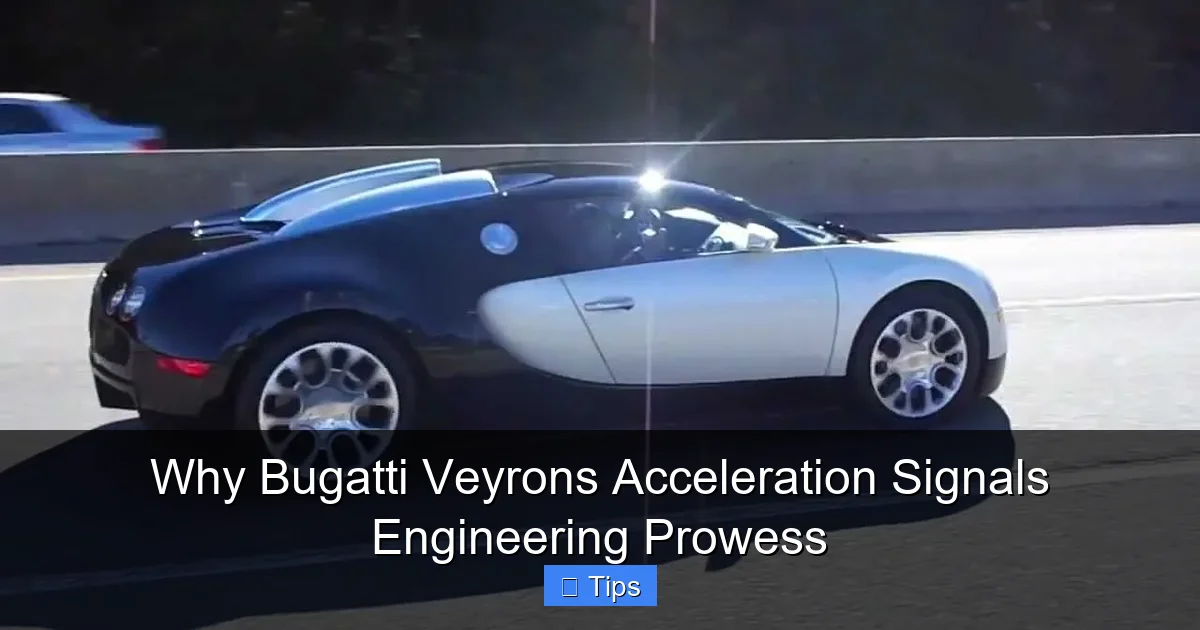
Visual guide about Bugatti Veyron Acceleration
Image source: i.ytimg.com
The Dual-Clutch Revolution
At the time of its inception, the Veyron debuted with one of the most advanced production car transmissions ever made: a seven-speed dual-clutch gearbox (DSG) developed by Ricardo. This wasn’t merely an incremental improvement; it was a fundamental shift. Unlike traditional automatic transmissions, which suffer from power interruptions during gear changes, a DSG pre-selects the next gear, allowing for near-instantaneous shifts without any break in power delivery. This “seamless” characteristic is absolutely critical for the Veyron’s ballistic acceleration, ensuring that the engine’s power is continuously applied to the wheels, minimizing any loss of momentum. The incredible speed and precision of these shifts contribute directly to its rapid 0-60 and 0-100 mph times.
All-Wheel Drive: A Necessity, Not a Luxury
With 1,000+ horsepower and immense torque available from idle, putting all that power down effectively to just two wheels would be an impossible task, resulting in uncontrollable wheelspin. This is why the Bugatti Veyron employs a permanent all-wheel-drive (AWD) system. Distributing power to all four wheels dramatically increases available traction, allowing the car to translate its engine’s immense output into forward motion with astounding efficiency. The differential systems within the AWD setup are precisely tuned to manage torque distribution between the axles, optimizing grip under hard acceleration and ensuring stability even at extreme speeds. This isn’t just about grip off the line; it’s about maintaining traction and control throughout the entire acceleration curve.
Tip: Understanding Power Delivery Systems
When evaluating vehicle performance, don’t just look at engine output. Always consider how that power is delivered to the ground. Engineering insights reveal that a powerful engine is only half the battle; an efficient, robust transmission and a traction-optimizing drivetrain are equally vital. For example, the choice of a dual-clutch transmission over a manual or traditional automatic for the Veyron was a deliberate engineering decision focused purely on maximizing continuous power delivery during acceleration, a key lesson for anyone designing for ultimate performance.
Beyond Raw Power: Aerodynamics and Downforce
While a colossal engine and sophisticated drivetrain are essential, they are only part of the equation for a car capable of the Bugatti Veyron‘s incredible acceleration and top speed. As speeds increase, air resistance becomes a formidable foe, and maintaining stability becomes a critical challenge. Bugatti engineers tackled these issues with an incredibly advanced and active aerodynamic package.
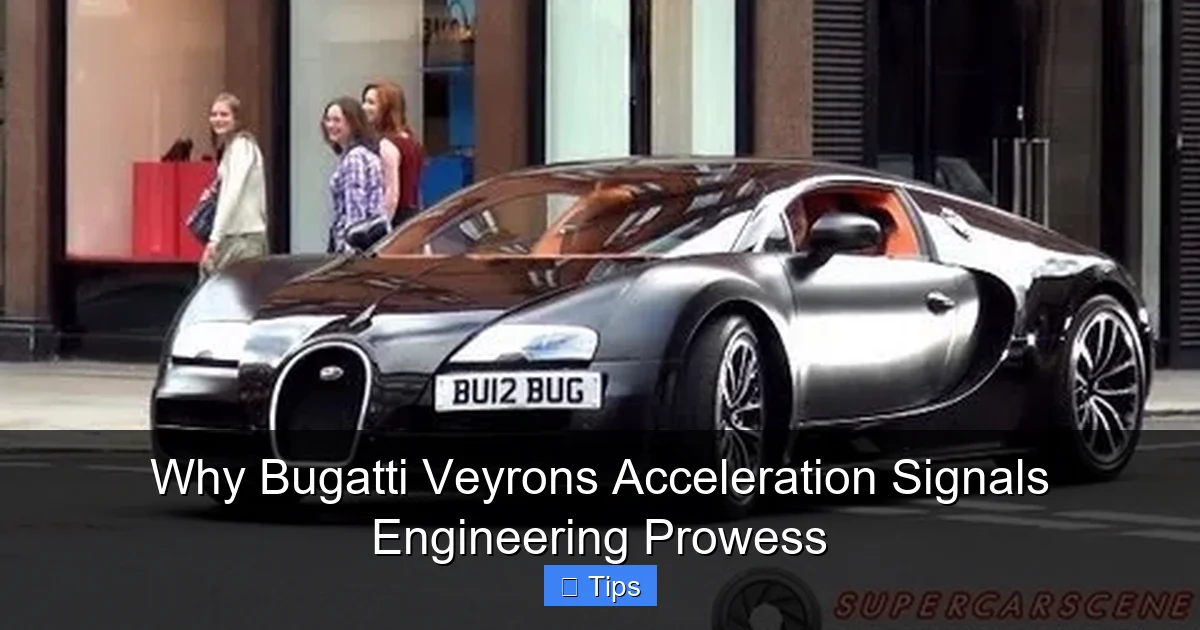
Visual guide about Bugatti Veyron Acceleration
Image source: i.ytimg.com
Active Aerodynamics: The Dynamic Dance
The Veyron isn’t just designed to be slippery; it actively adapts to varying speed demands. Its aerodynamics are a marvel of active engineering. At lower speeds, the car is configured for maximum downforce, crucial for initial grip and stability during blistering acceleration. As speeds climb, elements like the rear wing and diffuser adjust automatically. For example, when entering “Top Speed” mode (requiring a special key), the car lowers itself significantly, and the rear wing retracts almost entirely to minimize drag, allowing the car to punch through the air with minimal resistance. Conversely, under heavy braking, the rear wing deploys vertically, acting as an air brake to assist in rapid deceleration. This constant, dynamic adjustment of aerodynamic elements is critical for optimizing both straight-line speed and stability, making the Veyron incredibly predictable and safe even at velocities few cars can dream of reaching.
Cooling Systems: An Aerodynamic Challenge
The need for cooling the W16 engine and its associated components (intercoolers, transmission oil, etc.) presented a significant aerodynamic dilemma. Large air intakes are necessary for cooling, but they also create drag. Bugatti engineers meticulously designed the Veyron’s bodywork to channel air efficiently not only around the car but also through its many openings to cool the vast array of heat exchangers, without excessively compromising its aerodynamic slipperiness. The famous horseshoe grille, for instance, is not just a styling cue; it’s a functional intake for the main radiator. This intricate balance of cooling efficiency and aerodynamic sleekness is a testament to the immense engineering effort involved, ensuring the Bugatti Veyron could perform its brutal acceleration runs repeatedly without overheating.
Tip: The Unseen Force of Air
When thinking about high-performance vehicles, practical engineering tips include remembering that air is a fluid, and its interaction with a moving object is immensely complex. Aerodynamics is not just about reducing drag for top speed; it’s equally about generating downforce for grip and stability, managing airflow for cooling, and even directing air for brake cooling. The Veyron demonstrates that sophisticated aerodynamic design is a crucial enabler for extreme acceleration and overall dynamic performance.
Stopping Power and Chassis Dynamics: Control at Extreme Velocity
Achieving mind-bending acceleration is only half the battle; controlling and stopping a vehicle capable of such speeds presents an equally daunting engineering challenge. The Bugatti Veyron‘s chassis and braking systems are just as over-engineered as its powertrain, designed to provide unparalleled stability, control, and deceleration capabilities.
Carbon-Ceramic Brakes: Decelerating Dominance
To halt the Bugatti Veyron from its incredible speeds, Bugatti turned to advanced materials and massive braking surfaces. The Veyron is equipped with immense carbon-ceramic brake discs – up to 400mm (15.7 inches) at the front and 380mm (15 inches) at the rear – clamped by multi-piston calipers (eight-piston front, six-piston rear). Carbon-ceramic brakes offer several advantages: they are lighter than traditional steel brakes, reducing unsprung mass; they are incredibly resistant to fade under extreme heat, ensuring consistent stopping power even after repeated heavy use; and they provide immense friction. Coupled with the active rear wing acting as an air brake, the Veyron can decelerate with forces exceeding 1.3 G, bringing it to a halt from 250 mph (400 km/h) in mere seconds – a feat almost as impressive as its acceleration.
Chassis Rigidity and Suspension Tuning
The foundation of the Veyron’s stability and handling is its incredibly stiff and strong chassis. Built around a carbon fibre monocoque (a single-piece structural shell), the chassis offers exceptional torsional rigidity, meaning it resists twisting forces. This stiffness is vital for providing a stable platform for the suspension to work effectively. The sophisticated suspension system, featuring double wishbones at all four corners, is precisely tuned to manage body roll, pitch, and squat, particularly under the extreme forces of hard acceleration and braking. The adaptive dampers constantly adjust to road conditions and driving modes, ensuring optimal tyre contact patch and driver control, even when exploiting the car’s full Bugatti Veyron acceleration potential.
Tip: Balance is Key to Performance
A crucial engineering tip for aspiring designers or automotive enthusiasts is to always remember that ultimate performance is a holistic endeavor. A car that accelerates phenomenally but cannot stop or handle safely is not truly fast. The Veyron exemplifies this principle: its world-beating acceleration is matched by equally revolutionary braking and chassis dynamics, creating a complete package of control and capability. The balance between power, braking, and handling is what truly defines a high-performance vehicle.
The Art of Integration: Crafting a Hypercar Ecosystem
The Bugatti Veyron is not merely a collection of high-performance parts; it is an exquisitely integrated ecosystem where every component is designed to work in perfect harmony with every other. This seamless integration is perhaps the greatest testament to its engineering prowess, transforming a myriad of complex systems into a cohesive, brutally effective machine capable of its legendary acceleration.
Materials Science: The Lightweight Imperative
Achieving extreme acceleration demands not only immense power but also minimal mass. Bugatti engineers scoured the globe for the lightest, strongest, and most heat-resistant materials. The Veyron’s monocoque chassis is made of carbon fibre, known for its exceptional strength-to-weight ratio. Magnesium and titanium alloys are used extensively in the engine, suspension components, and even fasteners, shaving off crucial kilograms wherever possible. Even seemingly minor components like brake calipers or exhaust systems are crafted from exotic materials. This obsessive pursuit of lightness, combined with structural integrity, directly impacts the power-to-weight ratio, which is a fundamental metric for understanding a vehicle’s acceleration capability. Every gram saved is a gram less for the W16 engine to propel forward.
The Human-Machine Interface
Despite its terrifying performance, the Bugatti Veyron is remarkably docile and easy to drive, thanks to an exceptional human-machine interface. The sophisticated electronic stability control, traction control, and anti-lock braking systems are not intrusive but rather work seamlessly in the background, allowing the driver to confidently exploit the car’s potential. The steering is precise, the brakes are powerful yet progressive, and the transmission shifts with seamless efficiency. This user-friendliness, even at the limits of adhesion and speed, is a critical engineering achievement. It ensures that the driver can focus on the road and safely command the immense power and acceleration at their disposal, rather than constantly battling the car.
Tip: Systems Thinking in Engineering
A valuable engineering insight derived from the Veyron’s development is the power of “systems thinking.” It’s not enough to design an incredible engine, then an amazing transmission, and then great brakes. True engineering prowess lies in designing all these components as an integrated whole, anticipating how they will interact and optimizing them for collective performance. The Veyron’s world-beating acceleration is a direct result of this holistic, integrated approach to automotive design. Every part exists to support and enhance the others, creating a symbiotic relationship that maximizes overall capability.
Data Table: Bugatti Veyron Key Performance Statistics
To truly grasp the magnitude of the Bugatti Veyron‘s engineering achievements, let’s look at some key performance figures that highlight its remarkable capabilities, particularly its legendary acceleration.
| Metric | Bugatti Veyron (Base Model) | Bugatti Veyron Super Sport |
|---|---|---|
| Engine | 8.0-liter Quad-Turbo W16 | 8.0-liter Quad-Turbo W16 |
| Horsepower | 1,001 hp (736 kW) | 1,200 hp (882 kW) |
| Torque | 1,250 Nm (922 lb-ft) | 1,500 Nm (1,106 lb-ft) |
| 0-60 mph (0-97 km/h) | ~2.5 seconds | ~2.5 seconds |
| 0-100 mph (0-161 km/h) | ~5.5 seconds | ~4.9 seconds |
| 0-186 mph (0-300 km/h) | ~16.7 seconds | ~14.6 seconds |
| 0-249 mph (0-400 km/h) | ~55 seconds | ~32.6 seconds |
| Top Speed | 253 mph (407 km/h) | 268 mph (431 km/h) |
| Braking 60-0 mph | ~103 ft (31.4 m) | ~103 ft (31.4 m) |
| Curb Weight | ~1,888 kg (4,162 lbs) | ~1,838 kg (4,052 lbs) |
These numbers vividly illustrate the sheer force and precision required to achieve such performance. The minimal difference in 0-60 mph times between the base Veyron and the Super Sport highlights the challenge of putting enormous power down effectively at launch, even with 1,000+ hp. The more significant gains at higher speeds (0-186 mph and 0-249 mph) for the Super Sport directly reflect its increased power output and refined aerodynamics, demonstrating the cumulative effect of engineering improvements on sustained acceleration.
Conclusion: A Legacy Forged in Acceleration
The Bugatti Veyron’s acceleration time isn’t just a number on a specification sheet; it is a profound symbol of engineering prowess, a tangible representation of what can be achieved when innovation, relentless pursuit of perfection, and massive investment converge. From its colossal W16 quad-turbocharged engine to its revolutionary dual-clutch transmission and advanced all-wheel-drive system, every facet of the Veyron was meticulously engineered to generate and manage immense power for blistering forward momentum. Its active aerodynamics ensured stability and minimal drag at extreme speeds, while its carbon-ceramic brakes provided equally astonishing deceleration, completing the full circle of performance capability.
The Veyron’s journey from a bold concept to a record-breaking reality involved overcoming unprecedented technical hurdles. It required a holistic engineering approach, where every component – from the materials used in its chassis to the sophisticated electronics managing its myriad systems – was designed in perfect harmony to create a cohesive, high-performance ecosystem. This integration, the “systems thinking” that underpinned its development, is a masterclass in automotive design.
In essence, the Bugatti Veyron’s incredible acceleration is more than just raw speed; it’s a dynamic testament to human ingenuity. It stands as a timeless reminder that with enough determination and engineering brilliance, seemingly impossible performance benchmarks can not only be met but utterly redefined. Its legacy continues to inspire, pushing the boundaries of what is thought possible in the world of hypercars and cementing its place as an icon of engineering excellence.
Frequently Asked Questions
What makes the Bugatti Veyron’s acceleration so extraordinary?
The Bugatti Veyron’s acceleration was extraordinary because it wasn’t just about raw power; it was the unprecedented ability to harness over 1,000 horsepower and put it efficiently to the ground in a road-legal production car. This demonstrated a mastery of aerodynamics, traction control, and power delivery that redefined automotive limits.
How did Bugatti engineers achieve such phenomenal acceleration times?
They combined an 8.0-liter, quad-turbocharged W16 engine with a sophisticated all-wheel-drive system and a robust dual-clutch transmission. Every component, from its advanced chassis to its custom tires, was meticulously designed and calibrated to handle the immense forces generated during extreme acceleration.
What specific engineering challenges were overcome to enable the Bugatti Veyron’s acceleration?
Engineers faced immense hurdles, including managing the extreme heat generated by the massive engine and designing a drivetrain capable of transmitting over 1,000 hp without disintegrating. Ensuring aerodynamic stability at very high speeds, along with tire durability and structural integrity, were critical considerations for the Bugatti Veyron’s acceleration capabilities.
Why is the Bugatti Veyron’s acceleration considered a symbol of engineering prowess?
The Bugatti Veyron’s acceleration represents the pinnacle of what was thought possible for a road-legal production car at the time. Achieving such intense speed required pioneering solutions across multiple disciplines, showcasing Bugatti’s no-compromise approach to automotive design and manufacturing excellence as true engineering prowess.
Is the Bugatti Veyron’s acceleration still impressive by today’s hypercar standards?
Absolutely. While newer hypercars have surpassed its top speed, the Veyron’s initial Bugatti Veyron’s acceleration figures remain astonishingly competitive, often outperforming many modern vehicles in short bursts. Its ability to accelerate with such ferocity, even decades later, underscores the timeless brilliance of its original engineering.
Beyond raw speed, what else does the Bugatti Veyron’s acceleration signify for automotive engineering?
The Bugatti Veyron’s acceleration signifies the relentless pursuit of perfection and the pushing of material science limits. It demonstrated that a comfortable, luxurious grand tourer could also possess hypercar-level performance, inspiring future generations of engineers to blend extreme power with everyday usability and groundbreaking innovation.

At CarLegit, we believe information should be clear, factual, and genuinely helpful. That’s why every guide, review, and update on our website is created with care, research, and a strong focus on user experience.