
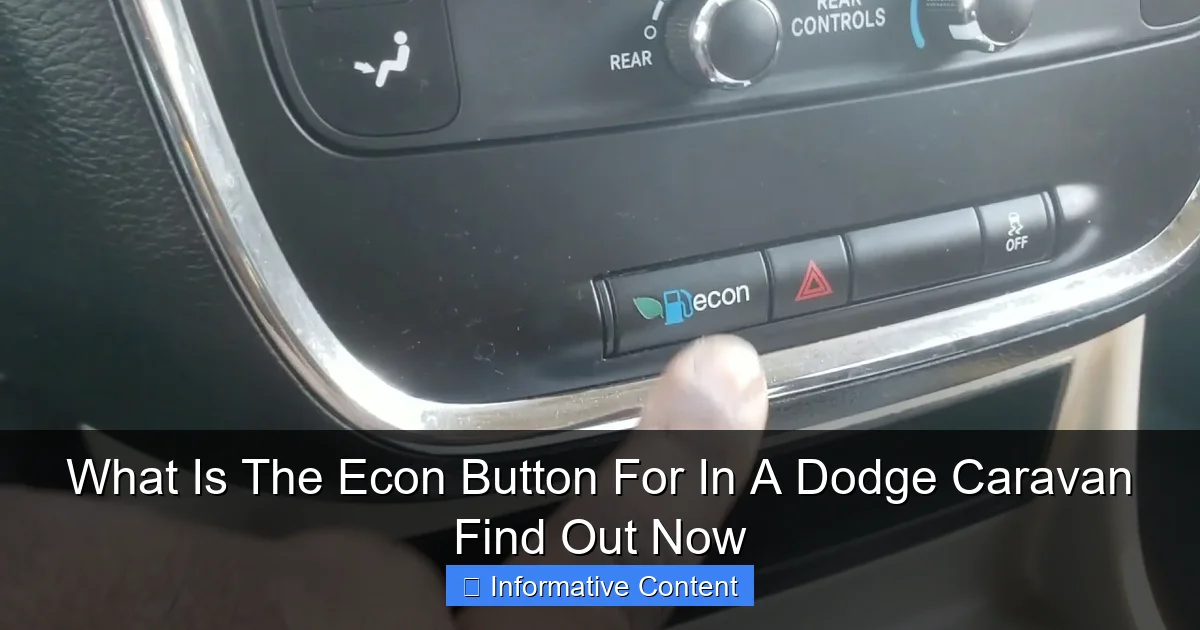
Featured image for what-is-the-econ-button-for-in-a-dodge-caravan
Image source: i.ytimg.com
The Econ button activates Economy Mode in your Dodge Caravan, optimizing fuel efficiency by adjusting transmission shifts and throttle response for smoother driving. Engage it during highway cruising or city traffic to maximize your fuel savings with minimal performance trade-offs.
In This Article
- 1 What Is The Econ Button For In A Dodge Caravan? Find Out Now.
- 1.1 Key Takeaways
- 1.2 📑 Table of Contents
- 1.3 The Simple Answer: What Does The Econ Button Do?
- 1.4 How The Econ Button Works Its Magic
- 1.5 When Should You Use The Econ Button? Practical Tips
- 1.6 The Real-World Pros and Cons: An Honest Look
- 1.7 Econ Mode vs. Other Driving Modes: A Quick Data Comparison
- 1.8 Quick Troubleshooting: What If My Econ Button Doesn’t Work?
- 1.9 Conclusion: Mastering Your Econ Button
- 1.10 Frequently Asked Questions
- 1.10.1 What is the Econ button for in a Dodge Caravan?
- 1.10.2 When should I use the Econ button in my Dodge Caravan?
- 1.10.3 Does pressing the Econ button actually improve fuel economy?
- 1.10.4 How does the Econ button affect my Dodge Caravan’s performance?
- 1.10.5 Can I leave the Econ button on all the time in my Dodge Caravan?
- 1.10.6 Is the Econ button useful for city driving in a Dodge Caravan?
What Is The Econ Button For In A Dodge Caravan? Find Out Now.
You’re cruising down the highway in your trusty Dodge Caravan. The kids are finally quiet, the road is clear, and you’re settling in for a long drive. Then your thumb brushes a button on the dash you’ve never really paid attention to before. It says “Econ.”
You’ve probably seen it a hundred times. Maybe you’ve even pressed it once, felt the van get a little… different… and then turned it right back off, unsure of what you just did. You’re not alone. For many drivers, the Econ button is a mystery. It sits there, quietly promising something about the economy, but what does it actually do? Is it a magic fuel-saving tool, or does it just make your minivan feel sluggish?
Well, wonder no more. Today, we’re going on a deep dive into that little button. I’ll explain exactly what the Econ button for in a Dodge Caravan is, how it changes your driving experience, and when you should (and shouldn’t) use it. By the end of this, you’ll be an Econ expert, ready to squeeze every last mile out of your tank with confidence. Let’s get started.
Key Takeaways
- Activate for fuel savings: Press Econ to optimize engine and transmission efficiency.
- Adjusts transmission shift points: Promotes earlier shifts to lower engine RPM.
- Moderates throttle response: Reduces power for smoother, efficient acceleration.
- Optimizes climate control: A/C runs less aggressively to conserve energy.
- Use on highways for best results: Most effective during steady-speed cruising.
- Disable for more power: Turn off when towing or needing full performance.
📑 Table of Contents
- The Simple Answer: What Does The Econ Button Do?
- How The Econ Button Works Its Magic
- When Should You Use The Econ Button? Practical Tips
- The Real-World Pros and Cons: An Honest Look
- Econ Mode vs. Other Driving Modes: A Quick Data Comparison
- Quick Troubleshooting: What If My Econ Button Doesn’t Work?
- Conclusion: Mastering Your Econ Button
The Simple Answer: What Does The Econ Button Do?
In the simplest terms, pressing the Econ button for in a Dodge Caravan tells the vehicle’s computer to prioritize fuel efficiency over performance. It’s like switching your van from “eager to please” mode into “smart saver” mode.
Think of it this way. Normally, your Caravan’s engine and transmission are tuned for a balance of power and efficiency. When you need to merge onto a fast highway or pass a slow truck, it’s ready to deliver power quickly. The Econ mode shifts that balance. It makes several key adjustments to how the van operates, all aimed at reducing fuel consumption.
When you press the button, you’ll usually see a small green light or an “ECON” message appear on your instrument cluster. That’s your signal that the system is active. It doesn’t mean you’ll instantly see your miles per gallon double, but it sets the stage for more efficient driving.
It’s a Computer Tweak, Not a Magic Wand
It’s crucial to understand that the Econ button doesn’t add new parts or physically modify your engine. It’s a software function. It changes the “rules” the onboard computer follows when deciding how much fuel to use, when to shift gears, and how to manage other systems. You’re simply telling the computer, “Hey, let’s try to save some gas today.”
How The Econ Button Works Its Magic
So, how does pushing one little button save fuel? It’s not one big change, but a combination of several smart tweaks. Here’s a breakdown of what’s happening under the hood when you engage Econ mode.

Visual guide about what-is-the-econ-button-for-in-a-dodge-caravan
Image source: i.ytimg.com
1. It Changes Transmission Shift Points
This is the most noticeable change for most drivers. Your automatic transmission is programmed to shift gears at specific speeds and engine RPMs (revolutions per minute).
- In Normal Mode: The transmission might hold a lower gear longer to keep the engine in its “power band,” giving you quicker acceleration when you press the gas pedal.
- In Econ Mode: The computer tells the transmission to shift to a higher gear much sooner. It aims to keep the engine RPM as low as possible because a slower-turning engine generally uses less fuel. Your van will feel like it’s “lugging” a bit more from a stop, but it’s working efficiently.
2. It Adjusts Throttle Response
Have you ever noticed how sensitive your gas pedal can be? A light tap can sometimes make the van jump forward. The Econ button modifies this.
It makes the throttle response less aggressive. When you press the pedal in Econ mode, the van interprets your input as a suggestion for gentle acceleration rather than a demand for immediate power. You have to press the pedal down further to get the same amount of acceleration you’re used to. This encourages smoother, more gradual driving, which is a cornerstone of good fuel economy.
3. It Manages Accessory Power (In Some Models)
On newer Caravan models, the Econ system might also slightly reduce the power draw from major electrical accessories like the air conditioning compressor. Don’t worry, your A/C won’t shut off entirely on a hot day, but it may run a bit less aggressively to reduce the load on the engine, saving a small amount of fuel.
When Should You Use The Econ Button? Practical Tips
Now that you know what it does, the big question is: when should you use it? Using the Econ button for in a Dodge Caravan effectively is all about choosing the right situation. Here are my best tips from years of driving with it.
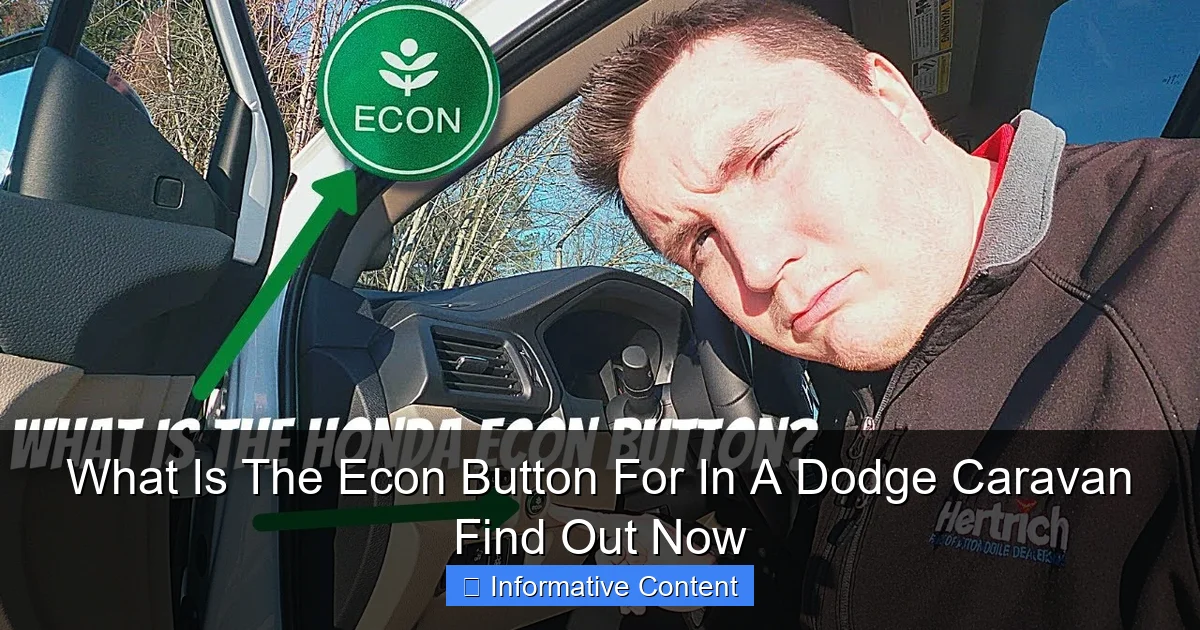
Visual guide about what-is-the-econ-button-for-in-a-dodge-caravan
Image source: i.ytimg.com
The Perfect Scenarios for Econ Mode
- Steady Highway Cruising: This is Econ’s sweet spot. Once you’re up to speed on the interstate and just maintaining it, the system works beautifully. The transmission stays in top gear, and the relaxed throttle helps prevent unnecessary speeding.
- Long Road Trips: If you’re loading up the family for a multi-hour drive, turn it on at the start. The small savings add up over hundreds of miles.
- City Driving with Light Traffic: In stop-and-go traffic where you can’t go fast anyway, Econ can help. Its gentle acceleration can actually make the driving experience smoother and less jerky.
- When Fuel Prices Are High: This one’s a no-brainer. Every little bit of savings helps when filling the tank hurts your wallet.
When to Turn Econ Mode OFF
Just as important is knowing when not to use it. The Econ button isn’t always your friend.
- Merging onto High-Speed Highways: You need predictable power and acceleration to merge safely. Turn Econ off before the on-ramp.
- Driving in Hilly or Mountainous Terrain: Econ mode can make your van feel very sluggish going uphill, as it resists downshifting. This can be frustrating and potentially unsafe if you’re struggling to maintain speed.
- When Towing or Carrying a Heavy Load: If you have the Caravan packed to the roof or you’re pulling a small trailer, you need all the performance you can get. Econ mode will hinder you significantly.
- If You Find It Annoying: Seriously, if the slower response stresses you out or you feel it’s causing you to drive unsafely, just turn it off. Stressed driving isn’t efficient driving.
The Real-World Pros and Cons: An Honest Look
Let’s be real. No feature is perfect. Here’s a balanced view of what you gain and what you give up when you hit that Econ button for in a Dodge Caravan.
Visual guide about what-is-the-econ-button-for-in-a-dodge-caravan
Image source: i.ytimg.com
Advantages of Using the Econ Button
- Potential Fuel Savings: This is the whole point. In the right conditions, you might see a 1-3 MPG improvement. It’s not huge, but over a year, it can add up to a free tank of gas.
- Smoother Driving Habits: It actively trains you to be a less aggressive driver. The lazy throttle encourages you to plan your maneuvers further in advance.
- Less Engine Strain (Sometimes): By encouraging lower RPMs, it can potentially reduce long-term wear on the engine, though modern engines are designed to handle normal driving just fine.
The Downsides and Drawbacks
- Reduced Power and Responsiveness: This is the big trade-off. The van will feel noticeably slower to accelerate. Passing maneuvers require more planning and pedal.
- Can Feel “Sluggish” or “Laggy”: That delayed throttle response is the number one reason people turn it off. It can make the van feel disconnected from your inputs.
- Minimal Benefit in Short Trips: If you only drive a few miles to the store, the system hardly has time to work, and the fuel saved will be negligible.
- May Cause More Downshifting on Hills: Ironically, because it tries to stay in a high gear, when you do need power on a hill, it may have to make a more dramatic downshift than it would in normal mode.
Econ Mode vs. Other Driving Modes: A Quick Data Comparison
While the Dodge Caravan typically just has Normal and Econ modes, understanding how it compares to common modes in other vehicles can be helpful. Here’s a simple look at the philosophy behind different driver-selectable modes.
| Mode Name | Primary Goal | Throttle Response | Transmission Behavior | Best For |
|---|---|---|---|---|
| Econ (Caravan) | Maximize Fuel Efficiency | Very Relaxed / Delayed | Shifts Early, High Gears | Highway cruising, light traffic |
| Normal (Caravan) | Balance of Power & Efficiency | Responsive & Predictable | Standard Shift Points | Everyday mixed driving |
| Sport (Other Vehicles) | Maximize Performance & Response | Hyper-Sensitive & Sharp | Holds Gears Longer, Downshifts Quicker | Spirited driving, winding roads |
| Tow/Haul (In Trucks/SUVs) | Provide Power for Heavy Loads | Aggressive for Low-End Power | Holds Gears, Uses Engine Braking | Towing, heavy payloads, mountain driving |
Note: This table illustrates general concepts. The Dodge Caravan’s Econ and Normal modes are the two directly applicable to your vehicle.
Quick Troubleshooting: What If My Econ Button Doesn’t Work?
Usually, the Econ button for in a Dodge Caravan is a simple, reliable feature. But if you press it and nothing happens, here are a few things to check.
Common Non-Issues
- No Dramatic Change: Remember, the changes are subtle. If you were expecting a huge transformation, you might just not be noticing the smaller throttle adjustments.
- Light is On: If the green Econ light is illuminated on your dash, the system is active, even if it feels mild.
Things to Actually Check
- Fuse: Like all electronic functions, it has a fuse. A blown fuse could disable the button. Your owner’s manual will have the fuse box diagram.
- Transmission Issues: Since Econ mode heavily affects transmission behavior, if your transmission is already having problems (slipping, harsh shifts), the computer may prevent Econ mode from engaging to avoid making the issue worse.
- Check Engine Light: If your “Check Engine” light is on, the vehicle’s computer may have disabled certain non-essential functions, including Econ mode, as part of a “limp-home” strategy.
If you’ve checked these and the button still does nothing, a visit to a mechanic or dealership for a diagnostic scan might be needed, though this is rare.
Conclusion: Mastering Your Econ Button
So, there you have it. The mystery of the Econ button for in a Dodge Caravan is solved. It’s not a gimmick, but a thoughtful tool designed to help you save fuel by making your van’s engine and transmission operate more efficiently. It rewards patience and smooth driving with potential savings at the pump.
The key takeaway? It’s a situational tool. Don’t just set it and forget it. Be an active driver. Engage it for those long, flat highway stretches where it can work uninterrupted. Disengage it when you need the full power and responsiveness of your family hauler for merging, climbing, or hauling.
The next time you’re in your Caravan, give it a try with this new knowledge. Head out on a familiar stretch of road, press the button, and feel the difference. You might just find that “Econ” becomes your favorite co-pilot for those long, easy miles. Happy driving, and here’s to getting a little bit more from every gallon!
Frequently Asked Questions
The Econ button in a Dodge Caravan is designed to optimize your vehicle for better fuel efficiency. When engaged, it adjusts systems like transmission shift points and throttle response to reduce energy consumption during driving.
Use the Econ button during steady-speed driving, such as on highways or in light traffic conditions. It helps maximize fuel savings by promoting smoother acceleration and efficient gear changes, making it ideal for longer trips.
Yes, the Econ button can improve fuel economy by moderating engine power and optimizing transmission shifts for efficiency. However, the extent of savings depends on factors like driving style and road conditions.
The Econ button may slightly reduce acceleration responsiveness by softening throttle input and altering shift patterns. This trade-off prioritizes fuel efficiency over brisk performance, which is noticeable during quick acceleration.
Yes, you can safely leave the Econ button engaged continuously without damaging your vehicle. It consistently applies fuel-saving settings, though you might prefer to turn it off for situations requiring more power, like merging onto highways.
The Econ button can be beneficial for city driving by encouraging smoother stops and starts, which may aid fuel efficiency. In heavy stop-and-go traffic, however, the impact might be less significant compared to highway use.

At CarLegit, we believe information should be clear, factual, and genuinely helpful. That’s why every guide, review, and update on our website is created with care, research, and a strong focus on user experience.