
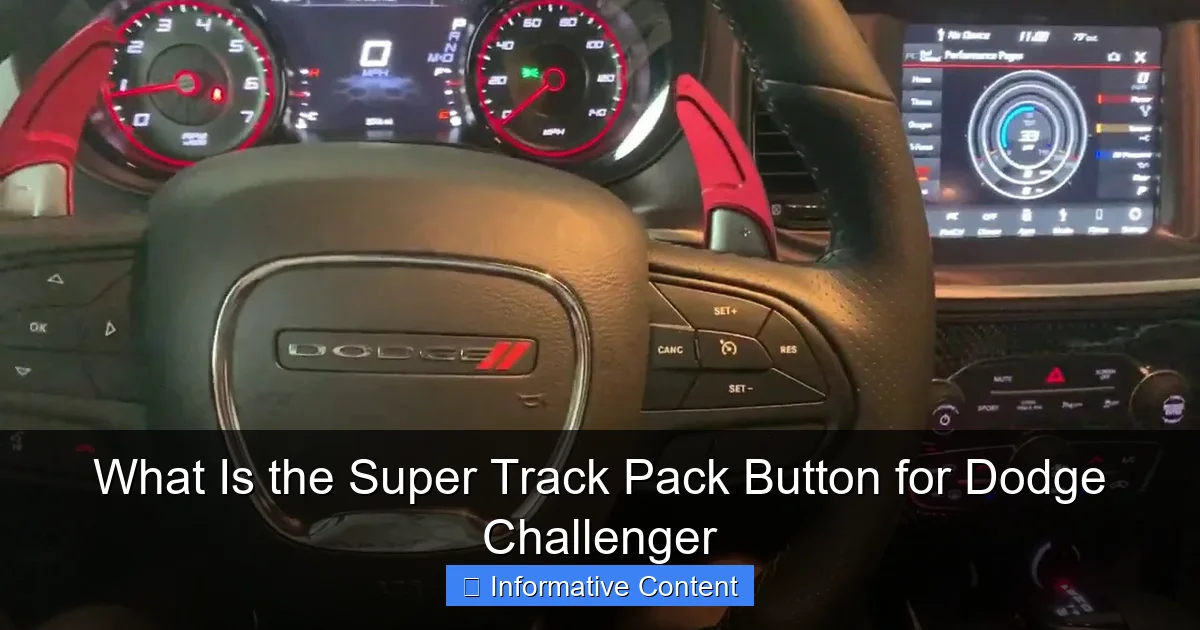
Featured image for what-is-the-super-track-pack-button-for-dodge-challenger
Image source: i.ytimg.com
The Super Track Pack button instantly transforms the Dodge Challenger into a track-ready beast by optimizing performance settings like suspension, traction control, and transmission shift points. This engaging feature sharpens responsiveness and maximizes grip, unleashing the car’s full potential for aggressive driving.
In This Article
- 1 What Is the Super Track Pack Button for Dodge Challenger
- 1.1 Key Takeaways
- 1.2 📑 Table of Contents
- 1.3 Unpacking the Mystery: What Exactly Is the Super Track Pack?
- 1.4 What Happens When You Press the Red Button?
- 1.5 Breaking Down the Super Track Pack’s Core Components
- 1.6 Super Track Pack vs. Other Drive Modes: When to Use It
- 1.7 Performance Data and Mode Comparisons
- 1.8 Owner Tips and Important Considerations
- 1.9 Conclusion: The Heart of the Modern Muscle Car Experience
- 1.10 Frequently Asked Questions
- 1.10.1 What is the Super Track Pack button on a Dodge Challenger?
- 1.10.2 How does the Super Track Pack button enhance performance?
- 1.10.3 When should I use the Super Track Pack button?
- 1.10.4 Is the Super Track Pack button available on all Challenger trims?
- 1.10.5 What changes when I press the Super Track Pack button?
- 1.10.6 Can the Super Track Pack button be retrofitted to older models?
What Is the Super Track Pack Button for Dodge Challenger
Picture this: you’re sitting in the driver’s seat of a modern Dodge Challenger. The rumble of the HEMI V8 is a constant, thrilling heartbeat beneath you. You’ve explored the steering wheel, admired the retro gauges, and found the familiar drive mode selector. But then, your eye catches something else. A red button, often positioned near the gear shifter or on the center console, marked with a simple yet powerful icon: a chequered flag inside a circle. It’s not just any button. It’s the Super Track Pack button.
If you’ve ever wondered what that enticing red button actually does, you’re not alone. For many Challenger owners and enthusiasts, it’s a source of curiosity and excitement. Is it a simple sport mode? A secret horsepower unlock? A magic “go faster” switch? The truth is more interesting. This button is the gateway to transforming your Challenger from a powerful cruiser into a focused, track-ready performance machine with a single push.
In this deep dive, we’ll peel back the layers of the Super Track Pack button for the Dodge Challenger. We’ll explore what systems it commands, how it changes the character of the car, and when you might want to use it. Whether you’re a new owner, a prospective buyer, or just a muscle car fan, understanding this feature is key to unlocking the full, thrilling potential of one of America’s last true muscle cars.
Key Takeaways
- Activates performance mode: Optimizes engine, transmission, and suspension for track use.
- Enhances driving dynamics: Sharpens steering and stiffens suspension for better control.
- Use only on closed tracks: Aggressive settings are unsafe for public roads.
- Adjusts stability control: Reduces intervention for more driver input and slides.
- Improves throttle response: Delivers immediate, aggressive acceleration for lap times.
- Customizes exhaust note: Often opens valves for a louder, sportier sound.
📑 Table of Contents
- Unpacking the Mystery: What Exactly Is the Super Track Pack?
- What Happens When You Press the Red Button?
- Breaking Down the Super Track Pack’s Core Components
- Super Track Pack vs. Other Drive Modes: When to Use It
- Performance Data and Mode Comparisons
- Owner Tips and Important Considerations
- Conclusion: The Heart of the Modern Muscle Car Experience
Unpacking the Mystery: What Exactly Is the Super Track Pack?
Let’s start with the basics. The Super Track Pack is not a physical pack you add on, like a spoiler or stripes. It’s an integrated performance technology suite, and the red button is its master control. Think of it as the “Director’s Cut” mode for your Challenger’s driving dynamics. With one press, it simultaneously adjusts several key vehicle systems to prioritize maximum performance and driver engagement over comfort and daily drivability.
This feature was introduced as part of Dodge’s relentless focus on making its muscle cars more capable and competitive. It’s typically found on higher-performance trims like the R/T Scat Pack, the SRT 392, and, of course, the fire-breathing SRT Hellcat and Demon variants. The goal is simple: give the driver a single, instant command to configure the car for aggressive driving, whether on a closed track or a favorite stretch of twisty road.
Pressing the Super Track Pack button for your Dodge Challenger doesn’t just do one thing. It initiates a coordinated shift across multiple domains of the car’s computer brain. It tells the engine, transmission, suspension, steering, and stability systems, “It’s go time.”
Key Systems Controlled by the Button
The magic of the Super Track Pack lies in its holistic approach. It doesn’t just firm up the suspension or sharpen the throttle. It does it all, in harmony. Here are the primary systems it takes command of:
- Transmission Logic: This is a huge one. Shift patterns become dramatically more aggressive, holding gears longer and downshifting more eagerly.
- Electronic Stability Control (ESC): It allows for much more slip and rotation before intervening, putting more control in the driver’s hands.
- Steering Feel: The electric power steering is recalibrated to provide heavier, more direct feedback.
- Suspension Damping: On models with adaptive damping (like the SRT variants), the suspension firms up significantly to reduce body roll and improve handling.
- Torque Management: In some modes, it alters how power is delivered for optimal traction and acceleration.
What Happens When You Press the Red Button?
So, you muster the courage and press it. The dashboard display changes, often showing a unique graphic or a “Track” mode confirmation. The engine note might become more pronounced as the active exhaust (if equipped) opens up. But the real transformation is felt through the seat of your pants and the steering wheel in your hands.

Visual guide about what-is-the-super-track-pack-button-for-dodge-challenger
Image source: i.ytimg.com
The first thing you’ll notice is the throttle response. It becomes hyper-sensitive. The slightest pressure on the accelerator pedal results in an immediate, urgent surge from the engine. The car feels instantly more alive and connected to your right foot.
Next, try shifting. In automatic models, the transmission will hold each gear right to the redline before snapping off a fierce, immediate upshift. It will also blip the throttle on downshifts, matching revs perfectly for smooth, jar-free deceleration. If you’re using the paddle shifters, the shifts become crisper and faster. The transmission essentially behaves like a professional co-pilot who understands your need for speed.
The Feel on the Road and Track
As you turn the wheel, the steering feels weightier and more communicative. You get a better sense of what the front tires are doing. If your Challenger has adaptive suspension, the ride becomes taut and firm. You’ll feel more of the road surface, and body lean in corners is drastically reduced. The car feels hunkered down, planted, and ready to change direction.
Perhaps the most significant change for spirited driving is the Electronic Stability Control (ESC) setting. In normal driving modes, ESC acts early to prevent skids and slides. In the Super Track Pack mode, it moves to a “Full Off” or “Track” setting. This means the system will allow the car to slide and rotate much more before stepping in. It gives an experienced driver the freedom to manage the car’s balance with the throttle and steering, which is essential for fast lap times or controlled drifts.
Breaking Down the Super Track Pack’s Core Components
To truly appreciate the Super Track Pack button for the Dodge Challenger, it helps to look at each component it affects. It’s the sum of these parts that creates such a transformative experience.
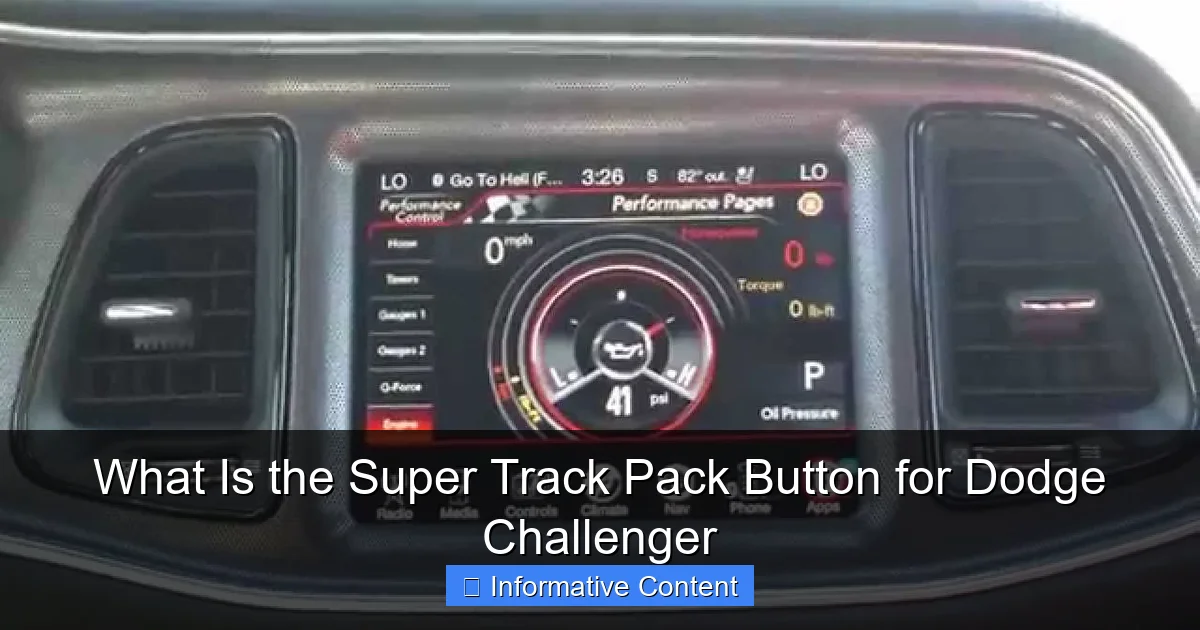
Visual guide about what-is-the-super-track-pack-button-for-dodge-challenger
Image source: i.ytimg.com
Performance Transmission and Gear Logic
The transmission is the star player. In Track mode, the shift mapping is completely rewritten. It prioritizes acceleration above all else. It will downshift multiple gears under braking to keep the engine in its power band. It also enables features like launch control on suitable models, providing optimal, repeatable acceleration off the line.
Sport Mode Steering and Adaptive Damping
These two systems redefine the Challenger’s feel. The heavier steering provides more confidence and precision at high speeds. The adaptive damping, when tightened up, transforms the Challenger’s historically comfortable ride into one that’s race-car firm. It controls the massive weight and power of the car, allowing it to corner with surprising agility for its size.
Track-Tuned Electronic Stability Control
This is the safety net that becomes a performance tool. In its Track setting, ESC intervenes only when it detects a potentially unrecoverable loss of control. This allows for power-oversteer exits from corners and more playful handling—key for drivers who want to explore the car’s limits in a safe environment.
Super Track Pack vs. Other Drive Modes: When to Use It
Most modern Challengers come with a drive mode selector (often a dial) offering settings like Auto, Sport, and maybe even a custom setting. This can cause confusion. How is the Super Track Pack button different?
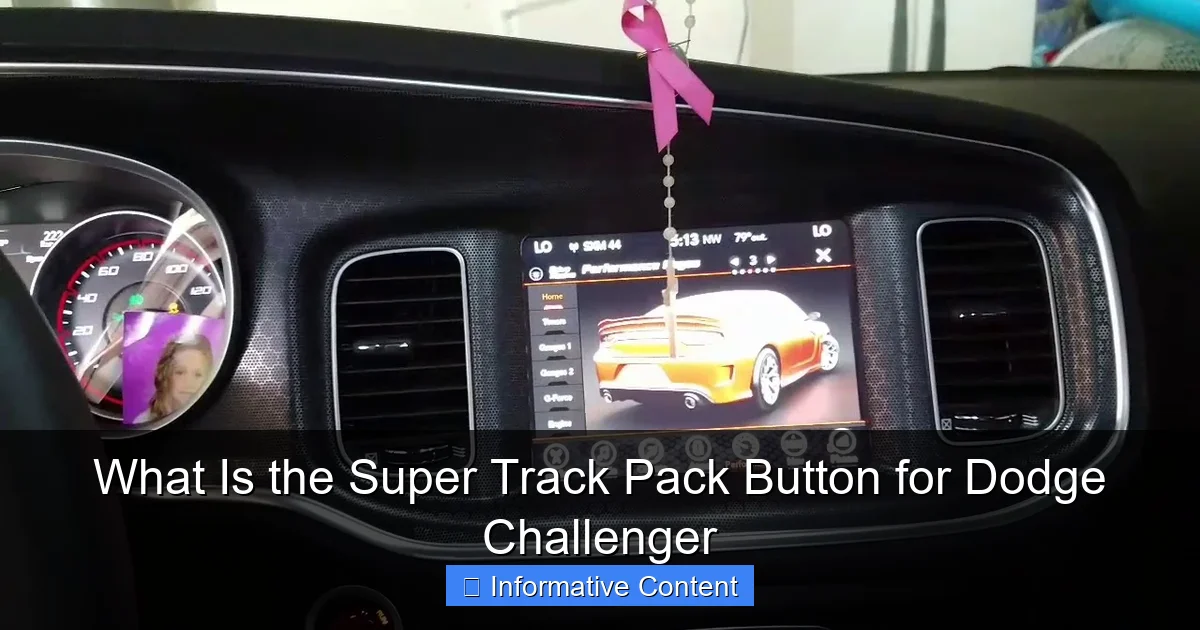
Visual guide about what-is-the-super-track-pack-button-for-dodge-challenger
Image source: i.ytimg.com
Think of the drive mode dial as a spectrum of daily usability. “Auto” is for commuting and comfort. “Sport” sharpens things up for a fun backroad. The Super Track Pack button, however, is a dedicated, all-in-one performance switch. It’s a more extreme and comprehensive setting than even the “Sport” mode on the dial. It’s designed for when you are serious about performance, not just for a slightly more engaging drive to the store.
Practical Scenarios for the Red Button
- Closed-Course Track Days: This is its natural habitat. The firm suspension, aggressive gearing, and relaxed stability control are all optimized for lap times.
- Spirited Canyon Runs: On a smooth, twisty road where you can focus on driving, it heightens engagement and control.
- Drag Strip Use: For automatic models, it activates optimal launch control and shift points for the quickest possible quarter-mile times.
- Experienced Driver Fun: If you understand car control and want to practice throttle-steer or drifting in a safe, open area.
When NOT to use it: Avoid the Super Track Pack button in daily traffic, on wet or slippery roads, or if you’re not prepared for the immediate and sharp responses. The firm ride can be jarring on broken pavement, and the reduced ESC intervention requires more driver skill.
Performance Data and Mode Comparisons
How does this all translate into real-world performance? While the exact figures depend on the specific Challenger model (Scat Pack, Hellcat, etc.), the impact of the Super Track Pack is measurable and significant.
For example, on a drag strip, using launch control in Track mode can shave crucial tenths of a second off the 0-60 mph and quarter-mile times by ensuring perfect grip and shift points. On a handling circuit, the combination of firmer damping, sharper steering, and optimized torque delivery can lead to noticeably higher cornering speeds and more consistent lap times. The system is engineered to make the car not just faster in a straight line, but more capable and balanced overall.
Mode Function Comparison Table
Here’s a simplified look at how key behaviors change across different settings. This is a general guide; specific functions vary by model year and trim.
| Vehicle System | Auto / Street Mode | Sport Mode (via dial) | Super Track Pack Mode |
|---|---|---|---|
| Transmission Shift Logic | Comfort-oriented, early upshifts | Firmer, later shifts | Ultra-aggressive, holds to redline |
| Steering Weight | Light, easy | Moderately increased | Heaviest, most direct |
| Suspension (if adaptive) | Soft / Comfort | Firmer | Firmest / Track |
| ESC Intervention | Full intervention | Moderate intervention | Minimal / Track intervention |
| Throttle Response | Linear, smooth | Sharper | Hyper-sensitive / Instant |
| Exhaust Sound (if active) | Quiet / Normal | Louder | Loudest / Fully open |
Owner Tips and Important Considerations
Owning a car with this feature is a thrill, but a little knowledge goes a long way. Based on experience and common owner wisdom, here are some key tips.
First, get to know the car in standard modes first. Build familiarity with its power and weight. Only engage the Super Track Pack button in a safe, controlled environment where you can learn its responses without pressure or danger.
Second, understand that fuel economy will plummet in this mode. The aggressive shift logic and constant high rpm are the opposite of eco-driving. This is a feature for short, intense bursts of fun, not for highway cruising.
Third, tires are critical. The advanced performance systems of the Super Track Pack rely on good grip. Worn or low-quality tires will negate the benefits and could be dangerous, especially with reduced ESC.
Maximizing Your Experience
- Check Your Fluids: Before a track day or aggressive drive, ensure engine oil, brake fluid, and coolant are at proper levels. Performance driving puts extra stress on these systems.
- Brake Awareness: You will be driving faster and braking harder. Make sure your brake pads and rotors are in good condition. The stock Brembo brakes on performance trims are excellent, but they have limits.
- It’s a Tool, Not a Toy: Respect the power unleashed by the Super Track Pack button. It makes an already fast car exceptionally capable, and that capability demands responsibility and respect for public roads.
Conclusion: The Heart of the Modern Muscle Car Experience
The Super Track Pack button for the Dodge Challenger is far more than a gimmick or a simple sport switch. It is the crystallization of modern performance engineering applied to the classic muscle car formula. It acknowledges that today’s enthusiasts want earth-shaking straight-line speed and the agility to tackle a corner with confidence.
With one push of that red button, you are not just changing a setting; you are reconfiguring the car’s personality. You are telling your Challenger to set aside its comfortable, daily-driver civility and unleash its full, untamed potential. The steering tightens, the suspension firms, the transmission wakes up, and the safety systems take a step back to let you, the driver, take center stage.
For the right driver in the right setting, it is the key to a more immersive, exciting, and rewarding driving experience. It embodies the spirit of Dodge’s “Never Lift” philosophy, transforming a legendary muscle car into a true performance athlete. So, the next time you see that red button with the chequered flag, you’ll know exactly what it’s for: it’s for the pure, unadulterated joy of driving.
Frequently Asked Questions
The Super Track Pack button is a performance feature that optimizes the Challenger’s settings for track driving. It adjusts parameters like suspension stiffness, transmission shift points, and traction control to provide a more aggressive and responsive driving experience.
By pressing the Super Track Pack button, you activate specialized settings that improve handling and acceleration. It firms up the suspension, sharpens throttle response, and modifies the transmission for quicker shifts, making the car more capable on a race track.
The Super Track Pack button is best used on closed circuits or track days where you can push the car to its limits. It’s not recommended for daily driving as the settings may make the ride too harsh for normal roads.
No, the Super Track Pack button is typically found on high-performance trims like the Challenger SRT Hellcat or Demon. It’s part of optional packages that focus on track-ready enhancements, so check your specific model and package details.
Pressing the Super Track Pack button alters various vehicle systems to prioritize performance. You’ll notice stiffer suspension, more aggressive transmission behavior, and reduced traction control intervention, all designed to maximize lap times.
Retrofitting the Super Track Pack button to older Challenger models is complex and often not recommended. It requires significant modifications to the vehicle’s ECU, suspension, and other systems, so it’s best to consult with a professional or consider a model that includes it from the factory.

At CarLegit, we believe information should be clear, factual, and genuinely helpful. That’s why every guide, review, and update on our website is created with care, research, and a strong focus on user experience.