
Featured image for how-to-fix-electronic-throttle-control-chrysler-town-and-country
Image source: nc-tw-prod.kagoyacloud.com
To fix Chrysler Town and Country electronic throttle control issues, start by thoroughly cleaning the throttle body to remove carbon deposits that commonly cause poor performance. If problems persist, diagnose and replace faulty components like the throttle position sensor or the entire throttle assembly. Always clear error codes with a scan tool after repairs to ensure a permanent fix and restore normal operation.
In This Article
- 1 Fix Chrysler Town And Country Electronic Throttle Control Issues
- 1.1 Key Takeaways
- 1.2 📑 Table of Contents
- 1.3 What Is The Electronic Throttle Control System?
- 1.4 Common Symptoms of a Failing Electronic Throttle Control
- 1.5 Step-by-Step Diagnosis: Finding the Root Cause
- 1.6 How To Fix Chrysler Town And Country Electronic Throttle Control Problems
- 1.7 The Critical Step: Throttle Body Relearn/Idle Relearn Procedure
- 1.8 Preventive Maintenance and Helpful Tips
- 1.9 Tools and Cost Comparison
- 1.10 Conclusion: Taking Back Control of Your Drive
- 1.11 Frequently Asked Questions
- 1.11.1 What are the symptoms of Electronic Throttle Control issues in a Chrysler Town and Country?
- 1.11.2 How can I reset the electronic throttle control on my Chrysler Town and Country?
- 1.11.3 Is it safe to drive with a faulty electronic throttle control?
- 1.11.4 What causes Electronic Throttle Control failures in a Chrysler Town and Country?
- 1.11.5 Can I fix the Chrysler Town and Country Electronic Throttle Control myself?
- 1.11.6 How much does it cost to repair the Electronic Throttle Control in a Chrysler Town and Country?
Fix Chrysler Town And Country Electronic Throttle Control Issues
You’re driving your trusty Chrysler Town and Country, maybe with the kids in the back or a trunk full of groceries, when it happens. Out of nowhere, a warning light flashes on your dashboard. It’s the little lightning bolt inside a circle, or maybe the dreaded “Electronic Throttle Control” message. The van might feel sluggish, or worse, it goes into a protective “limp mode” where you can barely get home. Your heart sinks.
If this sounds familiar, take a deep breath. You are far from alone. This is one of the most common and frustrating issues for owners of these versatile minivans. The good news is that it’s often fixable, sometimes even without a huge repair bill. This guide is here to walk you through it, step by step, in plain English. We’ll demystify the electronic throttle control system, show you how to figure out what’s wrong, and explore your options for getting your Town and Country back to smooth, reliable driving.
Key Takeaways
- Clean the throttle body: Removes carbon buildup that causes poor throttle response.
- Inspect the throttle position sensor: A common failure point triggering error codes.
- Check all electrical connections: Corrosion or loose wires disrupt signal integrity.
- Use an OBD-II scanner: Crucial for reading specific diagnostic trouble codes.
- Perform a throttle relearn: Required after cleaning or replacing components.
- Consider full throttle body replacement: Necessary if cleaning doesn’t resolve issues.
- Verify battery and charging system: Prevents voltage-related ECU malfunctions.
📑 Table of Contents
- What Is The Electronic Throttle Control System?
- Common Symptoms of a Failing Electronic Throttle Control
- Step-by-Step Diagnosis: Finding the Root Cause
- How To Fix Chrysler Town And Country Electronic Throttle Control Problems
- The Critical Step: Throttle Body Relearn/Idle Relearn Procedure
- Preventive Maintenance and Helpful Tips
- Tools and Cost Comparison
- Conclusion: Taking Back Control of Your Drive
What Is The Electronic Throttle Control System?
Gone are the days of a simple cable connecting your gas pedal to the engine. In your Chrysler Town and Country, the electronic throttle control system is a computer-managed network that decides how much air gets into the engine. When you press the accelerator, you’re not pulling a cable. You’re sending an electronic request.
Here’s how it works. You press the pedal. Sensors at the pedal send a signal to the main computer, the Powertrain Control Module (PCM). The PCM checks this request against data from other sensors (like engine speed and temperature). Then, it commands a small electric motor on the throttle body to open the throttle plate precisely the right amount. It’s a smart system designed for efficiency and emissions control, but like any tech, it can have hiccups.
Key Components of the System
Understanding the players helps you understand the game. The main parts are:
- Accelerator Pedal Position (APP) Sensor: Under your foot, it tells the PCM how hard and fast you’re pressing.
- Throttle Body: The metal housing on your engine that contains the throttle plate.
- Throttle Position (TP) Sensor: Attached to the throttle body, it reports the exact angle of the plate back to the PCM.
- Powertrain Control Module (PCM): The vehicle’s main brain, processing all the data and making the final call.
- Wiring and Connectors: The nervous system that carries all these vital signals.
Common Symptoms of a Failing Electronic Throttle Control
How do you know your Chrysler Town and Country electronic throttle control is acting up? It usually doesn’t fail silently. Look for these telltale signs:
Visual guide about how-to-fix-electronic-throttle-control-chrysler-town-and-country
Image source: i.ytimg.com
Dashboard Warning Lights
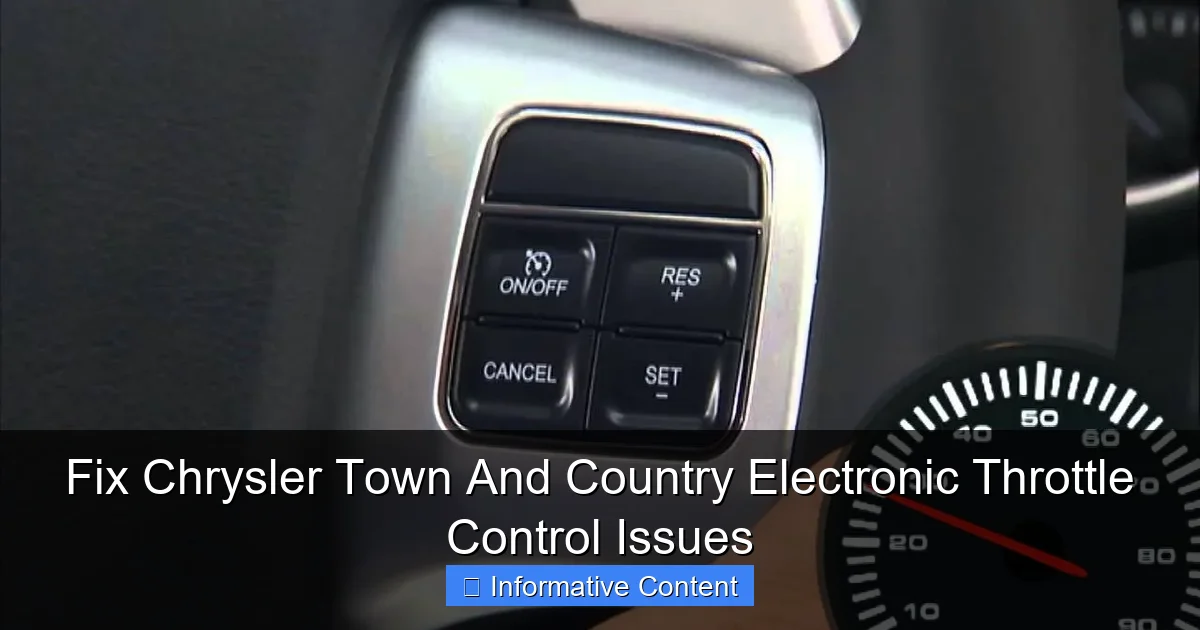
The most obvious clue. You’ll likely see the Electronic Throttle Control (ETC) warning light, which looks like a lightning bolt in a half-circle. Almost always, the Check Engine Light will also illuminate. This is your van’s way of saying, “I have a problem, and I’ve logged a code about it.”
Limp Mode or Reduced Power
This is the scary one. To protect the engine from potential damage due to faulty signals, the PCM will severely limit power. Your Town and Country might not rev past 2,000 RPM, won’t shift gears properly, and will feel like it’s crawling. Your only goal becomes getting to a safe place.
Poor Idle and Stalling
Before a major failure, you might notice the engine idle is rough or erratic. It might surge up and down while stopped. In some cases, it can even stall when you come to a stoplight, which is not only annoying but dangerous.
Unresponsive or “Sticky” Acceleration
You press the gas, and there’s a delay before the van responds. Or, the acceleration feels jerky and uneven, not the smooth power you’re used to. Sometimes, the throttle might even seem to stick at a certain RPM.
Step-by-Step Diagnosis: Finding the Root Cause
Before you throw parts at the problem, let’s play detective. A methodical approach can save you hundreds of dollars. Always start with the simplest possibilities.
Visual guide about how-to-fix-electronic-throttle-control-chrysler-town-and-country
Image source: cdn.langeek.co
Step 1: Read the Diagnostic Trouble Codes (DTCs)
This is your roadmap. You must read the codes stored in the PCM. A generic OBD2 scanner can often do this, but a more advanced scanner that can read Chrysler-specific body and powertrain codes is better. Common codes related to the electronic throttle control include P0121, P0122, P0123, P0221, P0222, P0223, and P2135. The code points you in the right direction—like which sensor circuit is out of range.
Step 2: The Visual and Physical Inspection
Pop the hood. Look at the throttle body, usually mounted on the intake manifold. Is it filthy with a black, oily carbon buildup? This is a huge culprit. Also, carefully inspect all the wiring connectors going to the throttle body and the accelerator pedal. Look for cracks, bent pins, or corrosion. A loose connection is a common and easy fix.
Step 3: Checking for Simple Electrical Issues
With the battery disconnected, you can check for continuity in wires if you have a multimeter and some know-how. More commonly, check related fuses. A blown fuse in the throttle control circuit can cause immediate failure. Your owner’s manual will have the fuse box diagram.
Step 4: Live Data Monitoring (Advanced)
If you have a scanner that can read live data, you can watch the APP sensor and TP sensor values in real-time. As you slowly press the accelerator, the pedal sensor percentage should increase smoothly from 0% to 100%. The throttle position sensor should mirror this movement smoothly. Any jumps, gaps, or inconsistencies point to a bad sensor.
How To Fix Chrysler Town And Country Electronic Throttle Control Problems
Now for the solutions. The fix depends entirely on what your diagnosis uncovered. Here are the most common repair paths.
Visual guide about how-to-fix-electronic-throttle-control-chrysler-town-and-country
Image source: standoutauthority.com
Fix 1: Cleaning the Throttle Body
This is the number one first step and fixes a surprising number of issues. Over time, carbon gunk builds up around the throttle plate, preventing it from moving smoothly. The PCM sees this resistance as a fault.
How to do it: Disconnect the battery. Remove the air intake hose to access the throttle body. Use a good quality throttle body cleaner (not carburetor cleaner) and a soft cloth or brush. Spray the cleaner on the cloth and gently clean the bore and the edges of the plate. Do not force the plate open! After cleaning, reconnect everything. You will likely need to perform an idle relearn procedure (see next section).
Fix 2: Replacing a Faulty Sensor
If diagnosis points to a failed APP or TP sensor, replacement is the answer. The APP sensor is usually located on the accelerator pedal assembly inside the cabin. The TP sensor is often integrated into the throttle body assembly. Sometimes, you replace the whole throttle body to get a new TP sensor and motor.
Fix 3: Addressing Wiring and Connector Problems
Found a broken wire or a green, corroded connector? You can repair wires with solder and heat shrink tubing for a permanent fix. For corroded terminals, electrical contact cleaner and a small pick to gently tighten the terminal grip can work wonders.
Fix 4: The Professional Nuclear Option: PCM Reflash or Replacement
Sometimes, the problem is a software glitch in the PCM itself. A dealership can often reflash (reprogram) the PCM with updated software. In rare cases, the PCM hardware fails and needs replacement, which is a costly repair best left to professionals with the right programming tools.
The Critical Step: Throttle Body Relearn/Idle Relearn Procedure
This is where many DIYers get stuck. After cleaning the throttle body, replacing it, or disconnecting the battery, the PCM loses its “memory” of the throttle’s resting position. It needs to relearn this. If you skip this, your van may idle poorly or even stall.
The Basic Relearn Process (Procedure can vary by model year):
- Ensure the engine is at normal operating temperature.
- Turn off all accessories (A/C, radio, lights).
- Put the transmission in Park (or Neutral for manual).
- Turn the ignition to “ON” but do not start the engine. Wait 10-15 seconds.
- Turn the ignition fully OFF. Wait another 10-15 seconds.
- Start the engine and let it idle in Park for 2-3 minutes until the idle stabilizes. Do not touch the accelerator.
- Sometimes, a drive cycle is needed: Drive at a steady speed between 40-60 mph for a few minutes, then come to a stop and let it idle for 45 seconds.
Note: Some years require a dealer scan tool to initiate the relearn. If the basic steps don’t work, this may be your case.
Preventive Maintenance and Helpful Tips
An ounce of prevention is worth a pound of cure, especially with your Chrysler Town and Country electronic throttle control.
- Regular Air Filter Changes: A clean air filter lets in clean air, reducing the amount of grime that can stick to the throttle body.
- Periodic Throttle Body Inspection: Every 30,000 miles or so, take a peek during an oil change. If you see buildup around the edges, it’s cleaning time.
- Battery Health: A weak or dying battery can cause voltage fluctuations that confuse sensitive electronic systems like the throttle control. Keep your battery terminals clean and test it regularly.
- Use Quality Fuel: While debated, some additives in top-tier gasoline can help reduce carbon deposits.
Tools and Cost Comparison
Wondering what you’ll need to spend? Here’s a quick breakdown to help you decide between DIY and professional repair.
| Item / Service | Approximate Cost (USD) | Notes |
|---|---|---|
| Basic OBD2 Code Reader | $25 – $80 | Essential for first step. |
| Throttle Body Cleaner | $8 – $15 | A cheap first attempt. |
| New Throttle Body Assembly | $150 – $400 (part only) | Aftermarket to OEM range. |
| Accelerator Pedal Sensor | $50 – $150 | Usually an easy swap. |
| Professional Diagnosis (Shop) | $100 – $150 | Hourly labor rate. |
| Complete Throttle Body Replacement at Shop | $400 – $800+ | Parts + 1-2 hours labor. |
Conclusion: Taking Back Control of Your Drive
Dealing with an electronic throttle control warning on your Chrysler Town and Country can feel overwhelming. But as we’ve walked through, it’s often a manageable problem. Start simple—read the codes and clean the throttle body. These two actions resolve a majority of the issues. Remember the crucial idle relearn step afterward.
If the problem is deeper, with a failed sensor or wiring fault, you now have the knowledge to understand what’s happening and communicate effectively with a mechanic if needed. Don’t let the “electronic” part intimidate you. With patience and a logical approach, you can fix this common problem and get your family hauler back to being the reliable, road-trip-ready van you depend on. Safe driving!
Frequently Asked Questions
What are the symptoms of Electronic Throttle Control issues in a Chrysler Town and Country?
Common symptoms include reduced engine power, erratic idling, the check engine light coming on, and unresponsive acceleration. These often point to problems with the throttle body, sensors, or wiring that need diagnosis and repair.
How can I reset the electronic throttle control on my Chrysler Town and Country?
To reset it, turn the ignition to the “on” position without starting the engine, wait 10-15 seconds, then turn it off. Repeating this process a few times can help the system recalibrate and may clear minor glitches in the Electronic Throttle Control.
Is it safe to drive with a faulty electronic throttle control?
No, driving with a faulty electronic throttle control is risky as it can cause sudden power loss or unpredictable acceleration. It’s best to have the vehicle inspected and repaired promptly to ensure safety on the road.
What causes Electronic Throttle Control failures in a Chrysler Town and Country?
Failures are commonly due to carbon buildup in the throttle body, worn throttle position sensors, or loose electrical connections. Environmental factors like moisture and dirt can also contribute to these issues over time.
Can I fix the Chrysler Town and Country Electronic Throttle Control myself?
Simple tasks like cleaning the throttle body or checking connections can be DIY, but for complex diagnostics or part replacements, professional help is recommended. Using a scan tool to read error codes is often necessary for accurate repairs.
How much does it cost to repair the Electronic Throttle Control in a Chrysler Town and Country?
Repair costs typically range from $200 to $600, depending on parts like the throttle body or sensors and labor rates. For major issues, prices may be higher, so getting a detailed estimate from a mechanic is advisable.

At CarLegit, we believe information should be clear, factual, and genuinely helpful. That’s why every guide, review, and update on our website is created with care, research, and a strong focus on user experience.