

Featured image for how-fast-can-you-drive-in-4wd-auto-dodge-ram
Image source: i.ytimg.com
Dodge Ram‘s 4WD Auto mode is safe for highway speeds, but sustained driving above 55-65 mph is not recommended to avoid drivetrain stress. It excels in variable conditions like rain or gravel by automatically engaging 4WD when needed. For dry pavement, switch to 2WD to optimize fuel economy and reduce wear.
In This Article
- 1 The Truth About How Fast Can You Drive In 4wd Auto Dodge Ram
- 1.1 Key Takeaways
- 1.2 📑 Table of Contents
- 1.3 What Exactly Is 4WD Auto On A Dodge Ram?
- 1.4 The Million-Dollar Question: How Fast Can You Drive?
- 1.5 Practical Tips for Using 4WD Auto Safely and Effectively
- 1.6 4WD Auto vs. Other 4WD Modes: Knowing the Difference
- 1.7 Data Table: Dodge Ram 4WD Modes At A Glance
- 1.8 Conclusion: Driving Smart with Confidence
- 1.9 Frequently Asked Questions
- 1.9.1 What is the recommended top speed for 4WD Auto mode in a Dodge Ram?
- 1.9.2 How fast can you drive in 4WD Auto Dodge Ram on dry pavement?
- 1.9.3 Can you safely use 4WD Auto at highway speeds?
- 1.9.4 What are the risks of driving too fast in 4WD Auto?
- 1.9.5 When should I engage 4WD Auto in my Dodge Ram?
- 1.9.6 Is there a specific speed limit for 4WD Auto in a Dodge Ram?
The Truth About How Fast Can You Drive In 4wd Auto Dodge Ram
So, you’re cruising down a wet highway in your Dodge Ram, rain sheeting across the windshield. You feel a slight wiggle in the rear end. A flick of a switch from 2WD to 4WD Auto, and suddenly, the truck feels planted, secure, like it’s on rails. It’s a brilliant feeling, this mastery over traction. But then a question pops into your head, one I’ve asked myself countless times: how fast can you drive in 4wd Auto Dodge Ram?
If you’re like me, you’ve probably heard a jumble of advice. “Don’t go over 55 mph!” “It’s fine for any speed!” The conflicting info is enough to make your head spin. I remember my first long trip with my Ram in a sleet storm, my knuckles white on the wheel, wondering if I was harming my truck by doing 65 mph in that magical 4WD Auto mode. I’ve dug deep into manuals, talked to mechanics, and learned through years of driving in everything from desert sand to mountain snow. Let’s clear the air and get to the truth, together.
This isn’t about pushing limits for the sake of it. It’s about understanding your vehicle, using its technology safely, and getting the most out of your investment without an expensive trip to the shop. Buckle up; we’re going to demystify the 4WD Auto setting on your Dodge Ram once and for all.
Key Takeaways
- Use 4WD Auto for variable conditions: Ideal for changing traction, not dry pavement.
- Speed should be moderate: Avoid high speeds; check manual for limits.
- Dry pavement risks damage: Prolonged use can harm drivetrain components.
- Engage 4WD Auto proactively: Switch before losing traction for best performance.
- Monitor system indicators: Watch dashboard lights for proper 4WD operation.
📑 Table of Contents
What Exactly Is 4WD Auto On A Dodge Ram?
Before we talk speed, we have to understand the tool. 4WD Auto isn’t your grandfather’s rugged, part-time four-wheel drive. It’s a sophisticated, on-demand system designed for the modern driver who faces changing conditions.
The Brains Behind the Brawn: How The System Works
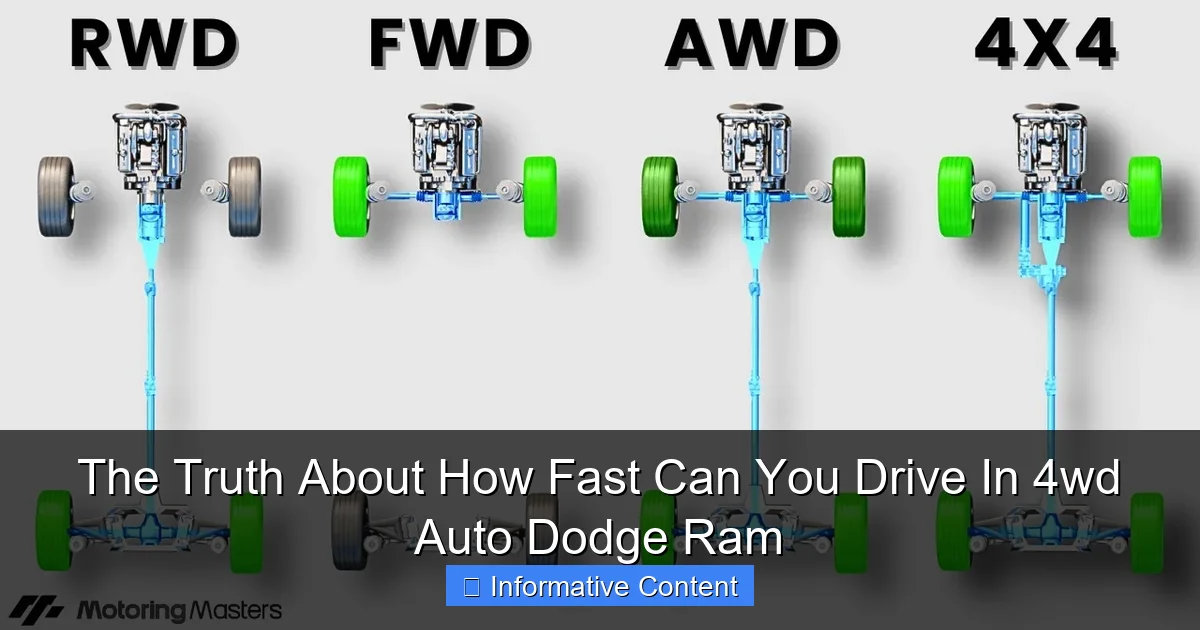
Think of 4WD Auto as a smart, proactive co-pilot. In a traditional 4WD High, the front and rear axles are locked together, turning at the same speed. That’s great for deep snow or dirt, but terrible on dry pavement because it causes “binding” in the drivetrain. 4WD Auto is different.
Here’s the simple breakdown: In 4WD Auto, your Ram primarily operates in rear-wheel drive (2WD) for maximum efficiency. But, a transfer case clutch pack and a network of sensors are constantly on duty. They monitor wheel speed, throttle position, and steering angle dozens of times per second. The moment the system detects rear wheel slip—even a tiny amount—it can automatically engage the front axle, sending torque forward to regain traction. This happens in milliseconds. Once grip is restored, it disengages just as smoothly.
When To Use It: The Perfect Scenarios
This mode is your go-to for variable-traction surfaces. It’s brilliantly useful for:
- Wet or icy highways: Where patches of black ice or standing water can surprise you.
- Light snow or slush on paved roads: The classic “snowy commute” condition.
- Gravel or dirt roads with occasional slick spots: When the surface is mostly hard but can get loose.
- Heavy rain: To prevent hydroplaning and improve stability.
In short, 4WD Auto is for when you need enhanced stability and safety but aren’t in a constant, deep-traction environment like a rock crawl or a snowdrift.
The Million-Dollar Question: How Fast Can You Drive?
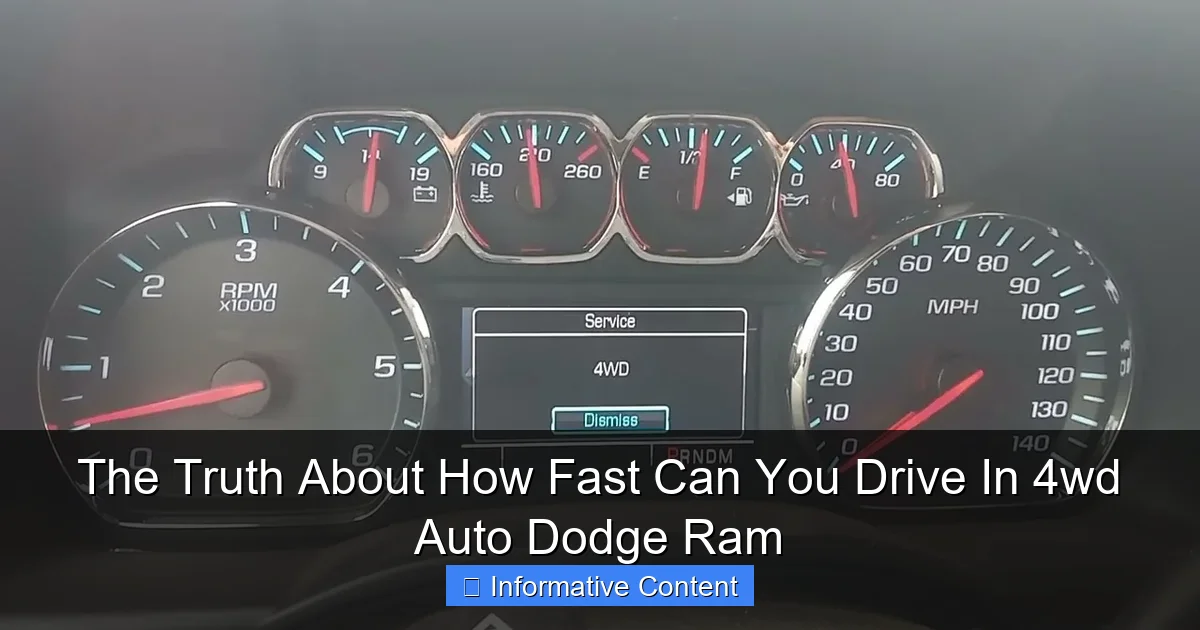
Here’s the core truth, straight from the source and backed by experience: You can drive at normal highway speeds in 4WD Auto. There is no mandated, hard-coded speed limit like “55 mph” for using this mode on a modern Dodge Ram.
Visual guide about how-fast-can-you-drive-in-4wd-auto-dodge-ram
Image source: i.ytimg.com
What The Manual Actually Says
Dodge Ram owner’s manuals are clear. They state that shifts between 2WD and 4WD Auto can be made “at any speed.” This is the key distinction from 4WD High or Low, which have specific recommended maximums (typically 55-60 mph for 4WD High on dry, loose surfaces only). The system is engineered to engage and disengage seamlessly whether you’re going 25 mph or 75 mph.
The Real-World Speed Limit: Common Sense
While the truck can mechanically handle high speeds in 4WD Auto, your practical limit is dictated by road conditions. You should never drive faster than conditions allow, regardless of your drive mode. If you’re in 4WD Auto because of heavy rain or ice, your safe speed might be 45 mph, even though the system is capable of 80 mph. The mode is a safety enhancer, not an invincibility shield.
My rule of thumb? If the road surface is consistently slippery enough to warrant 4WD Auto, you should already be driving significantly below the posted speed limit. Let the conditions, not the capability of the transfer case, govern your speed.
Practical Tips for Using 4WD Auto Safely and Effectively
Knowing you can drive fast in 4WD Auto is one thing. Using it wisely is another. Here are some hard-earned tips from the road.
Visual guide about how-fast-can-you-drive-in-4wd-auto-dodge-ram
Image source: i.ytimg.com
Listening to Your Truck: The Feel of the System
You’ll become attuned to how it feels. When 4WD Auto engages, you might feel a very slight pull or change in steering weight. It’s subtle. The dashboard light will be steadily illuminated. If you feel harsh jerking, binding (especially when turning sharply on dry pavement), or hear clunking, you should switch back to 2WD immediately, as you may be on a surface with too much grip for any 4WD mode.
The Golden Rule: Dry Pavement = 2WD
This cannot be overstated. The number one mistake people make is leaving their truck in 4WD Auto all the time “just in case.” Don’t do this. On clean, dry pavement, the system can experience unnecessary wear as it constantly微-adjusts the clutch pack, even without a slip event. It also reduces fuel economy. Use it when you need it, and switch back when you don’t.
Maintenance Is Key: Keeping The System Happy
A neglected system won’t work when you need it most. Follow your Ram’s severe service schedule if you use 4WD often. Key items:
- Transfer Case Fluid: Change it at the intervals specified in your manual. This fluid is critical for the clutch pack operation in 4WD Auto.
- Front Differental Fluid: Keep it fresh, as the front axle components spin and are engaged periodically.
- Matching Tires: This is absolutely critical. All four tires must be within 3/32nds of an inch of tread depth. Mismatched tires cause different rotational speeds, confusing the system and causing premature wear or failure.
4WD Auto vs. Other 4WD Modes: Knowing the Difference
Confusion often arises because the Ram has multiple 4WD settings. Using the wrong one at high speed is a recipe for damage.
Visual guide about how-fast-can-you-drive-in-4wd-auto-dodge-ram
Image source: i.ytimg.com
4WD High: The True “Don’t Exceed 55 MPH” Mode
This locks the front and rear driveshafts together. It’s for deep, consistent low-traction environments: deep snow, sand, mud. On dry or even damp pavement, this causes severe drivetrain binding, especially when turning. Speed should be kept lower, and it should never be used on dry pavement.
4WD Low: The Crawler Gear
This drastically reduces gear ratios for massive torque at very low speeds (rock crawling, pulling stumps, extreme inclines). You should only be going 5-25 mph max in this mode. It’s not for pavement or speed.
The takeaway? 4WD Auto is the only high-speed, on-pavement-friendly 4WD mode. Don’t mix them up.
Data Table: Dodge Ram 4WD Modes At A Glance
This table summarizes the key differences to keep your thinking clear.
| Drive Mode | Best Use Case | Recommended Max Speed* | Dry Pavement Safe? | Key Mechanic |
|---|---|---|---|---|
| 2WD | Normal dry/clear roads for best fuel economy. | Vehicle Max | YES | Rear-wheel drive only. |
| 4WD Auto | Wet, icy, or variably slippery paved roads. | Governed by Road Conditions | YES, but not ideal for extended use. | On-demand AWD. Engages front axle automatically upon slip. |
| 4WD High | Deep snow, sand, mud, off-road trails. | ~55-60 mph (on loose surfaces only) | NO | Locked center. Front & rear axles turn together. |
| 4WD Low | Extreme off-road, rock crawling, heavy towing at low speed. | ~25 mph max | NO | Locked center with drastically reduced gearing. |
*Always consult your specific model year owner’s manual for the most accurate information.
Conclusion: Driving Smart with Confidence
So, after all that, what’s the final verdict on how fast can you drive in 4wd Auto Dodge Ram? You can drive at responsible highway speeds. The system is designed for it. The real expertise isn’t in knowing the mechanical limit, but in developing the judgment to know when to use it and when to turn it off.
Your Dodge Ram’s 4WD Auto is a fantastic piece of technology. It gives you a layer of security when the weather turns or the road gets sketchy. Respect it by using it for its intended purpose—variable conditions—and maintaining it diligently. Don’t fear the switch. Use it with understanding, let it do its job, and always, always let the actual conditions outside your window be the final boss of your speedometer. Now, go enjoy that confident, planted feeling on your next journey, knowing you and your truck are perfectly in sync.
Frequently Asked Questions
What is the recommended top speed for 4WD Auto mode in a Dodge Ram?
Manufacturers typically recommend a maximum speed of 55-65 mph in 4WD Auto to ensure drivetrain safety and vehicle stability. Exceeding this can cause binding and premature wear on components.
How fast can you drive in 4WD Auto Dodge Ram on dry pavement?
It’s not advisable to drive fast in 4WD Auto on dry pavement; switch to 2WD for normal conditions. Using 4WD Auto here at high speeds may lead to handling issues and unnecessary strain.
Can you safely use 4WD Auto at highway speeds?
While brief highway use is possible, sustained speeds over 55 mph in 4WD Auto are not recommended. This mode is optimized for variable traction, not for constant high-speed cruising.
What are the risks of driving too fast in 4WD Auto?
Driving too fast in 4WD Auto can cause drivetrain damage, reduced tire life, and compromised control. The system may not adapt quickly to sudden traction changes, increasing accident risk.
When should I engage 4WD Auto in my Dodge Ram?
Use 4WD Auto in conditions with changing traction, such as rain, gravel, or light snow. It automatically adjusts power distribution, providing better grip without manual intervention.
Is there a specific speed limit for 4WD Auto in a Dodge Ram?
Yes, Dodge often specifies a limit around 55 mph for 4WD Auto operation. Always check your owner’s manual for exact figures, as exceeding this can harm the vehicle’s systems.

At CarLegit, we believe information should be clear, factual, and genuinely helpful. That’s why every guide, review, and update on our website is created with care, research, and a strong focus on user experience.