
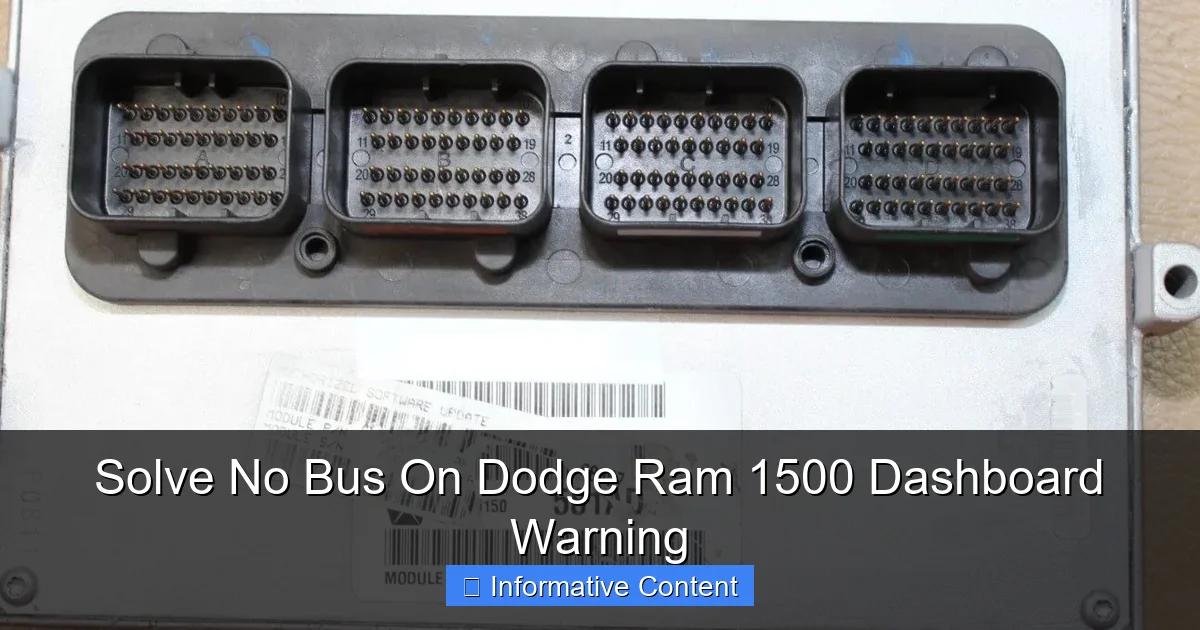
Featured image for what-does-no-bus-mean-on-a-dodge-ram-1500
Image source: psychoautos.com
The ‘No Bus‘ warning on a Dodge Ram 1500 signals a critical communication failure in the vehicle’s CAN bus network, often causing a no-start or dead dashboard. It typically stems from issues like faulty wiring, bad grounds, or module failures. Solving it requires a systematic diagnostic approach to isolate and repair the compromised part of the network.
You’re cruising down the highway in your trusty Dodge Ram 1500, the engine humming along. Then, out of nowhere, your dashboard lights up like a Christmas tree. The speedometer and tachometer drop to zero. The gas gauge is dead. And staring back at you from the odometer display are three ominous words: NO BUS. Want to protect your engine and keep your car running smoothly? Visit Cardetailflow for simple, expert-backed car care tips that help you avoid costly mistakes before they happen.
Your heart sinks. What does that even mean? Is it safe to drive? Is this a repair that’s going to cost a fortune? If you’ve been here, you’re not alone. This is a classic, and frankly, frustrating issue for many Ram 1500 owners, particularly in models from the early 2000s to around 2010.
Take a deep breath. That “NO BUS” message isn’t a death sentence for your truck. It’s a cry for help from its internal communication network. In this guide, we’re going to demystify this warning, walk you through what it means, why it happens, and—most importantly—how you can troubleshoot and solve the No Bus on Dodge Ram 1500 problem yourself. Consider me your virtual mechanic friend, here to help you get your dashboard back to normal and your truck back on the road.
In This Article
- 1 Key Takeaways
- 2 📑 Table of Contents
- 3 What Exactly Does “No Bus” Mean on Your Dodge Ram?
- 4 Common Culprits: What Causes the No Bus Warning?
- 5 How to Diagnose the No Bus Problem: A Step-by-Step Approach
- 6 Fixes and Solutions: From Simple to Complex
- 7 Can You Drive With a No Bus Warning?
- 8 Preventive Measures to Avoid Future No Bus Headaches
- 9 A Quick Reference: No Bus Symptoms and Likely Causes
- 10 Conclusion: Taking Back Control of Your Dashboard
- 11 Frequently Asked Questions
- 11.1 What does the “No Bus” message mean on my Dodge Ram 1500?
- 11.2 What are the most common causes of a No Bus error?
- 11.3 Can I still drive my Ram 1500 with a No Bus warning?
- 11.4 How do I diagnose a No Bus problem myself?
- 11.5 Is fixing a No Bus warning expensive?
- 11.6 Why is the No Bus warning specific to Dodge and Chrysler vehicles?
Key Takeaways
- No Bus indicates network failure: It means the CAN bus system isn’t communicating properly.
- Check all related fuses first: Blown fuses are a common and easy fix.
- Inspect wiring and connectors: Loose or corroded connections often cause errors.
- Scan for diagnostic trouble codes: Use an OBD-II scanner to identify failures.
- Focus on the TIPM: The Totally Integrated Power Module is a frequent culprit.
- Bad grounds can trigger it: Ensure all ground connections are clean and tight.
- Professional diagnosis may be needed: Complex electrical issues might require a mechanic.
📑 Table of Contents
- What Exactly Does “No Bus” Mean on Your Dodge Ram?
- Common Culprits: What Causes the No Bus Warning?
- How to Diagnose the No Bus Problem: A Step-by-Step Approach
- Fixes and Solutions: From Simple to Complex
- Can You Drive With a No Bus Warning?
- Preventive Measures to Avoid Future No Bus Headaches
- A Quick Reference: No Bus Symptoms and Likely Causes
- Conclusion: Taking Back Control of Your Dashboard
What Exactly Does “No Bus” Mean on Your Dodge Ram?
Let’s break down the tech talk into plain English. Your Dodge Ram 1500, like all modern vehicles, is a network of smart computers called modules. You have the Powertrain Control Module (PCM—the engine’s brain), the Transmission Control Module, the Body Control Module, and the cluster of gauges on your dashboard (the Instrument Panel Cluster, or IPC).
These modules need to talk to each other constantly. They share vital info like engine RPM, vehicle speed, coolant temperature, and fuel level. They don’t chat over Wi-Fi or Bluetooth; they use a special, robust communication system called the Controller Area Network (CAN) bus.
Think of the CAN bus as a party line or a conference call where every module is connected. When your dashboard says “NO BUS,” it’s the Instrument Panel Cluster screaming, “I’ve been disconnected from the conference call! I can’t hear the PCM or anyone else!” Without that data stream, your gauges go dead, warning lights flare up, and you’re left with that confusing message.
The CAN Bus: Your Truck’s Nervous System
This network uses two wires (CAN High and CAN Low) that twist around each other (twisted pair) to reduce electrical interference. The message isn’t sent to one module at a time; it’s broadcast to the entire network. It’s a brilliant system, but when there’s a break in the line or a module malfunctions, the whole conversation can collapse. That’s your No Bus on Dodge Ram 1500 event.
Common Culprits: What Causes the No Bus Warning?
Over the years, a pattern has emerged. Certain failures are much more common than others. Let’s start with the usual suspects, ordered from the most frequent and easiest to check to the more complex.
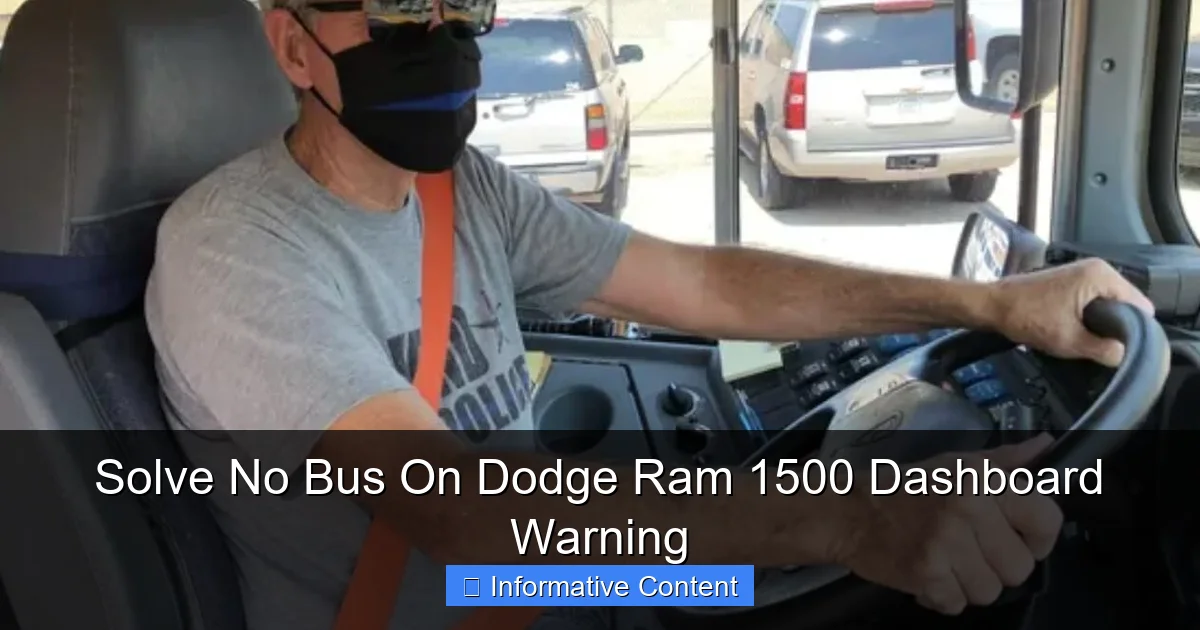
Visual guide about what-does-no-bus-mean-on-a-dodge-ram-1500
Image source: psychoautos.com
1. A Failing Totally Integrated Power Module (TIPM)
If your Ram is from the 2006-2010 era, point your finger here first. The TIPM (often called the fuse box under the hood) is notorious. It’s not just a fuse box; it’s a complex computer that controls power distribution and contains gateway circuitry for the CAN bus. Solder joints inside can crack, or components can fail, severing the instrument cluster’s connection to the network. Many mechanics will tell you this is Public Enemy #1 for the NO BUS message.
2. Bad Ground Connections (The #1 DIY Fix)
Electricity needs a complete path to work. A poor ground connection is like trying to have that conference call with a terrible phone line—everything breaks up. The Ram 1500 has several critical ground points that can corrode or loosen over time.
- Main Ground Straps: The big braided cable from the engine to the firewall or frame.
- Ground G104: This is a superstar. It’s typically located on the driver’s side front of the engine block, near the oil filter housing. Corrosion here is a prime cause.
- Chassis Grounds: Points where modules ground to the truck’s body.
A simple cleanup of these grounds has solved countless No Bus on Dodge Ram 1500 problems.
3. Faulty Instrument Panel Cluster (IPC)
Sometimes, the messenger is the problem. The cluster itself can fail. Internal circuit board issues, failed stepper motors for the gauges, or damage from moisture can cause it to lose its ability to communicate on the CAN bus. This is more likely if your gauges were acting quirky before the full NO BUS appeared.
4. Problems with Other Control Modules
Any module on the network can fail and drag the whole bus down. The Powertrain Control Module (PCM) is a key player. If it goes offline, the cluster will definitely complain. Issues with the Transmission Control Module or Body Control Module can also cause communication errors.
5. Wiring Harness Damage
The physical wires of the CAN bus can get damaged. Look for chafing where the harness passes through the firewall, gets pinched, or has been chewed by a rodent. A short or open circuit in these tiny wires will stop the data flow.
How to Diagnose the No Bus Problem: A Step-by-Step Approach
Don’t just start throwing parts at it. A logical, step-by-step diagnosis will save you time and money. Grab a multimeter—it’s your best friend for this job.
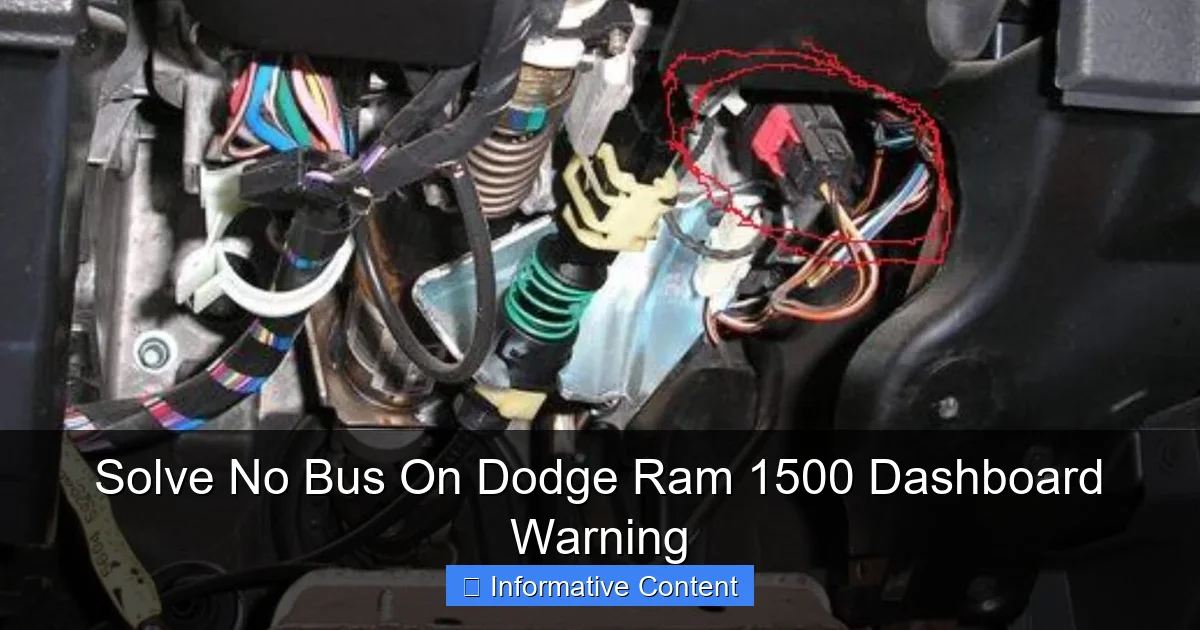
Visual guide about what-does-no-bus-mean-on-a-dodge-ram-1500
Image source: psychoautos.com
Step 1: The Preliminary Check (The Easy Stuff)
Always start simple. Turn the key off and on a few times. Sometimes it’s a random glitch. Disconnect the battery negative terminal for 15 minutes to reset all the modules. Check every single fuse in both the under-hood TIPM and the interior fuse panel. A blown fuse supplying a module will silence it on the network.
Step 2: Inspect and Clean Critical Grounds
This is the most productive free fix you can do. Locate ground G104 on the engine block. Disconnect the battery, then unbolt the ground wire. Clean the ring terminal and the mounting point on the block until they are shiny metal. Rebolt tightly. Do the same for the main engine-to-frame ground strap. It sounds too simple, but you’d be amazed how often this works.
Step 3: Listen for the Fuel Pump Prime
This is a great quick test. When you first turn the key to “RUN” (but don’t start the engine), you should hear the fuel pump whir for about 2 seconds from the rear of the truck. If you hear no fuel pump prime, it strongly suggests the PCM is not powering up or communicating. This points back to a power/ground issue, a faulty TIPM, or a bad PCM.
Step 4: Access a Scan Tool
A basic OBD2 scanner from the parts store often won’t help here, as it uses the same CAN bus that’s down. You need a more advanced scanner that can try to communicate with individual modules. If a professional scanner can talk to the PCM but not the cluster, it points to a cluster or wiring issue. If it can’t talk to any module, the problem is likely a network power or ground issue, or a catastrophic TIPM failure.
Step 5: The Voltage Drop Test (For the Determined DIYer)
With a multimeter, you can check the CAN bus wiring. At the connector on the back of the instrument cluster (with the key on), you should find the CAN High and CAN Low wires (you’ll need a wiring diagram for your year). With the meter set to DC volts, measure between each CAN wire and ground. You should see a stable reference voltage (usually around 2.5V). If you see 0V or 12V, there’s a short or break.
Fixes and Solutions: From Simple to Complex
Once you’ve narrowed down the cause, here’s what the fix typically involves.
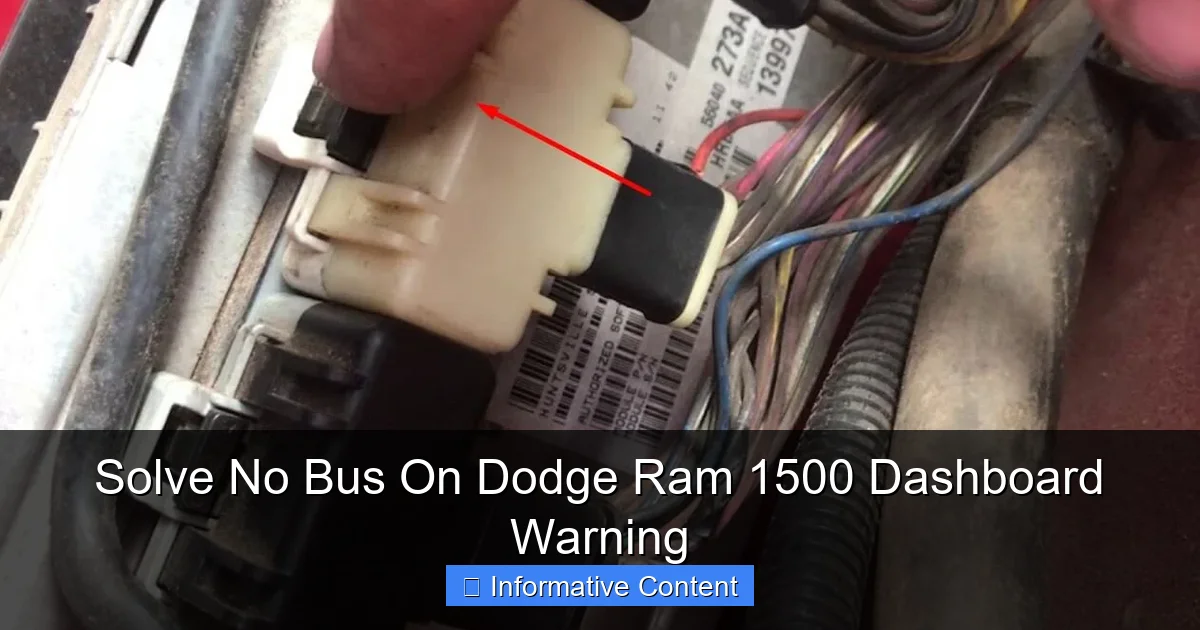
Visual guide about what-does-no-bus-mean-on-a-dodge-ram-1500
Image source: psychoautos.com
Fixing Ground and Connection Issues
Cleaning grounds is the fix. For damaged wiring, careful soldering and sealing with heat-shrink tubing is required. Always disconnect the battery before working on wiring.
Dealing with a Suspect TIPM
This is a pricey part from the dealer, but there are alternatives. Specialist companies offer rebuilt TIPM units with improved solder and components. You can also send yours out for repair. Replacement requires programming to your truck’s VIN, so it’s not always a simple plug-and-play job for a novice.
Repairing or Replacing the Instrument Cluster
Clusters can be sent out for repair, or you can source a used one from a salvage yard. A used cluster will often need to be professionally “virginized” and programmed to match your truck’s mileage and VIN, which requires special software.
Replacing the PCM or Other Modules
Module replacement is a last resort. A new PCM needs to be flashed with your truck’s exact software. This is almost always a job for a professional mechanic or dealership with the right diagnostic and programming tools.
Can You Drive With a No Bus Warning?
This is the big safety question. Technically, the engine might start and run if the NO BUS message is isolated to the instrument cluster. But I strongly advise against driving it any farther than absolutely necessary.
- You Have No Gauges: You won’t know your speed, engine RPM, coolant temperature, or fuel level. Overheating the engine can cause catastrophic damage in minutes.
- Safety Systems May Be Disabled: Systems like ABS, airbags, and stability control may not function because they rely on data from the network.
- It Could Stall: If the PCM is having communication issues, the engine could shut off unexpectedly while driving.
Treat a No Bus on Dodge Ram 1500 warning as a “get home carefully or get towed” situation, not a “I’ll drive it to work all week” scenario.
Preventive Measures to Avoid Future No Bus Headaches
An ounce of prevention is worth a pound of cure, especially with electrical gremlins.
- Keep Those Grounds Clean: Make inspecting and cleaning the main engine grounds part of your annual maintenance routine, especially if you live in a rust-prone area.
- Battery Health is Key: A weak or failing battery can cause wild voltage spikes that can damage sensitive modules. Replace your battery every 4-5 years.
- Address Electrical Issues Promptly: If you notice a gauge acting funny or a light flickering, don’t ignore it. It could be the first sign of a failing connection.
- Be Careful with Aftermarket Accessories: Poorly installed stereos, light bars, or other electronics that tap into the truck’s wiring can introduce noise or shorts onto the CAN bus.
A Quick Reference: No Bus Symptoms and Likely Causes
This table summarizes the common correlations to help guide your diagnosis.
| Symptom | Most Likely Cause | Check This First |
|---|---|---|
| NO BUS appears intermittently, often when hot or on bumps | Loose or corroded ground connection | Ground G104, main ground straps |
| NO BUS is constant, no fuel pump prime, no start | Major network failure (TIPM, PCM, main power feed) | Fuses, TIPM power relays, PCM power/ground |
| NO BUS is constant, but engine starts and runs | Cluster failure or cluster-specific wiring/communication fault | Connector at back of instrument cluster, cluster itself |
| Gauges were flickering or acting dead before NO BUS | Failing Instrument Panel Cluster (IPC) | IPC circuit board or power supply |
Conclusion: Taking Back Control of Your Dashboard
Seeing that NO BUS message on your Dodge Ram 1500 dashboard is unsettling, but it’s not an unsolvable mystery. Remember, it’s almost always a communication breakdown, not necessarily a failure of the engine itself. Start with the simple, free fixes—the battery reset and, crucially, cleaning those ground connections. These steps resolve a huge percentage of these issues.
If the problem persists, use the diagnostic steps to follow the trail of evidence. Whether it leads you to a corroded wire, a problematic TIPM, or a faulty cluster, you now have the knowledge to understand what’s happening and communicate effectively with a mechanic if needed. With patience and a methodical approach, you can silence the “NO BUS” warning and restore the vital conversation happening within your truck, getting you back to the confident, in-control driver you are.
Frequently Asked Questions
What does the “No Bus” message mean on my Dodge Ram 1500?
The “No Bus” warning on your Dodge Ram 1500 dashboard indicates a critical communication failure on the vehicle’s Controller Area Network (CAN bus). This network is like the nervous system of your truck, allowing all the electronic control modules to talk to each other and the instrument cluster. When this communication is lost, the cluster displays “No Bus” because it cannot receive data from other systems.
What are the most common causes of a No Bus error?
The most frequent causes include a failing TIPM (Totally Integrated Power Module), a bad instrument cluster itself, or a damaged wiring harness. Issues can also stem from faulty engine control modules, corroded grounds, or a dead battery, as low voltage can disrupt the sensitive network communication. Diagnosing the specific culprit often requires a professional scan tool.
Can I still drive my Ram 1500 with a No Bus warning?
It is not recommended to drive with an active “No Bus” warning. While the engine may run, you will likely have no functional gauges, warning lights, or modules like ABS and airbags. This makes it unsafe as you cannot monitor vehicle speed, fuel level, or engine temperature, and critical safety systems may be disabled.
How do I diagnose a No Bus problem myself?
Start with the basics: check your battery voltage and connections, inspect all related fuses, and look for obvious wire damage. A common first step is to disconnect the battery for 15 minutes to force a network reset. For deeper diagnosis, you will need an advanced OBD-II scanner capable of reading network codes, as standard code readers often won’t connect during this fault.
Is fixing a No Bus warning expensive?
The cost to fix a No Bus error can vary dramatically, from a few hundred dollars for a simple wiring repair or new battery to over a thousand dollars if it requires replacing the TIPM or instrument cluster. Labor costs for diagnosis can also be significant due to the complexity of tracking down the communication break in the network.
Why is the No Bus warning specific to Dodge and Chrysler vehicles?
The “No Bus” terminology is specific to Chrysler, Dodge, Jeep, and Ram vehicles because it is the specific message their instrument cluster software is programmed to display when a CAN bus fault is detected. Other manufacturers have different warning messages or lights for similar network communication failures, but the underlying problem is a common automotive network issue.

At CarLegit, we believe information should be clear, factual, and genuinely helpful. That’s why every guide, review, and update on our website is created with care, research, and a strong focus on user experience.