
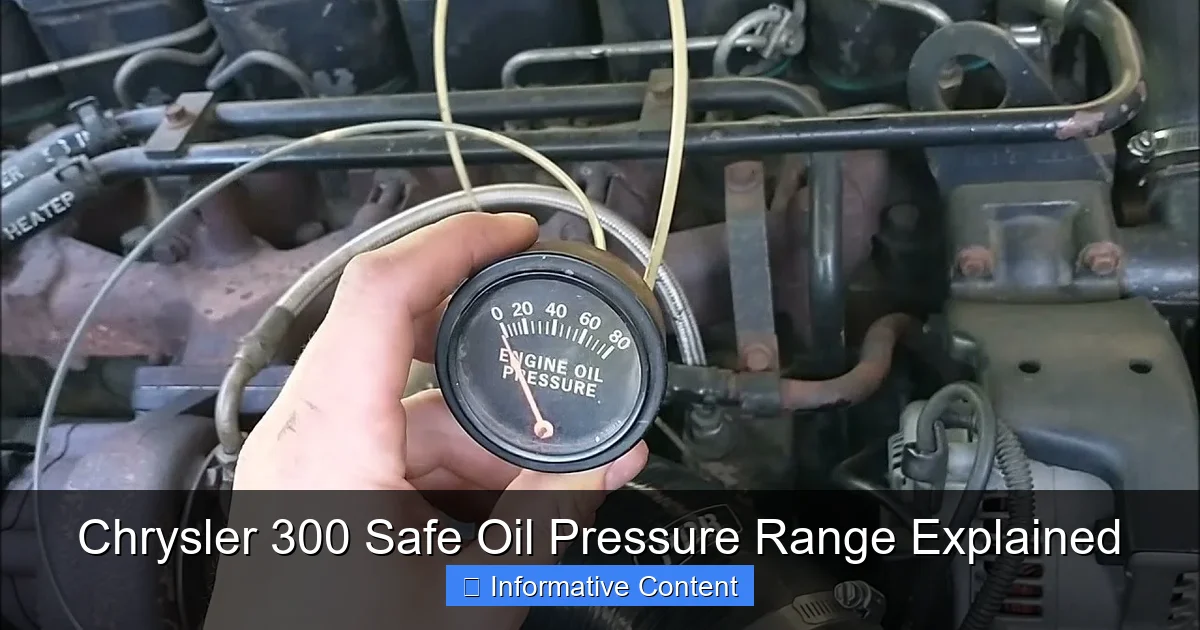
Featured image for what-should-the-oil-pressure-be-in-a-chrysler-300
Image source: i.ytimg.com
The safe oil pressure for a Chrysler 300 is typically between 25 and 65 PSI when the engine is at normal operating temperature. Consistently low pressure below 20 PSI at idle or spikes above 80 PSI are critical warnings that demand immediate inspection to prevent severe engine damage.
In This Article
- 1 Chrysler 300 Safe Oil Pressure Range Explained
- 1.1 Key Takeaways
- 1.2 📑 Table of Contents
- 1.3 Understanding Oil Pressure: The Engine’s Lifeblood
- 1.4 The Chrysler 300 Safe Oil Pressure Range: The Numbers You Need
- 1.5 Factors That Affect Your 300’s Oil Pressure Reading
- 1.6 Warning Signs of Oil Pressure Problems
- 1.7 What To Do If You Suspect Low Oil Pressure
- 1.8 Maintaining Healthy Oil Pressure: A Proactive Guide
- 1.9 Chrysler 300 Oil Pressure Data Reference
- 1.10 Conclusion: Your Key to a Long-Lasting Engine
- 1.11 Frequently Asked Questions
- 1.11.1 What is the normal oil pressure range for a Chrysler 300?
- 1.11.2 Why is my Chrysler 300 oil pressure low at idle?
- 1.11.3 What causes high oil pressure in a Chrysler 300?
- 1.11.4 How do I know if my Chrysler 300 has oil pressure problems?
- 1.11.5 What should the oil pressure be when driving on the highway?
- 1.11.6 Is it safe to drive with fluctuating oil pressure in a Chrysler 300?
Chrysler 300 Safe Oil Pressure Range Explained
You’re cruising down the highway in your Chrysler 300, enjoying that classic American sedan feel. The ride is smooth, the V6 (or maybe that mighty HEMI V8) is purring. Then, your eyes drift to the instrument cluster. You see the oil pressure gauge, or maybe just a warning light. Suddenly, a question pops into your head that can turn any drive from relaxed to anxious: What should the oil pressure be in my car? Is that number okay?
If you’ve been there, you’re not alone. That moment of dashboard doubt is a universal car owner experience. The oil pressure gauge is one of those mysterious dials we know is important, but its meaning isn’t always clear. Unlike the fuel gauge, it doesn’t give a simple “full” or “empty.” It shows a range, and that range changes depending on what you and your engine are doing.
Understanding your Chrysler 300’s oil pressure isn’t about becoming a master mechanic. It’s about peace of mind. It’s about knowing what’s normal so you can spot what’s not. In this guide, we’ll walk through everything you need to know. We’ll talk about the safe oil pressure range for your 300, why it changes, what the warning lights really mean, and what to do if things don’t look right. Think of me as your friend who’s been under the hood a few times, here to translate the engine’s language into something simple and useful.
Key Takeaways
- Normal Operating Range: Maintain 25-65 PSI while driving at normal speeds.
- Idle Pressure: Expect 10-15 PSI at idle; it should rise with RPM.
- Low Pressure Action: If pressure drops below 10 PSI, stop the engine immediately.
- Check Oil Level First: Low oil is a common cause; inspect and top up.
- Monitor Consistently: Watch the gauge for sudden drops or sustained changes.
- High Pressure Warning: Persistent high pressure may indicate a blockage or fault.
- Seek Professional Help: Any abnormal reading requires a mechanic’s diagnosis.
📑 Table of Contents
- Understanding Oil Pressure: The Engine’s Lifeblood
- The Chrysler 300 Safe Oil Pressure Range: The Numbers You Need
- Factors That Affect Your 300’s Oil Pressure Reading
- Warning Signs of Oil Pressure Problems
- What To Do If You Suspect Low Oil Pressure
- Maintaining Healthy Oil Pressure: A Proactive Guide
- Chrysler 300 Oil Pressure Data Reference
- Conclusion: Your Key to a Long-Lasting Engine
Understanding Oil Pressure: The Engine’s Lifeblood
Before we get to specific numbers, let’s talk about why oil pressure matters so much. You can think of engine oil as your engine’s circulatory system. It doesn’t just lubricate. It cleans, cools, and protects. But for that oil to do its job, it needs to be pushed with force into all the tiny, critical spaces between moving parts—like the bearings, camshafts, and piston rings.
Oil pressure is simply the force the oil pump creates to move that oil throughout the engine. Without sufficient pressure, the oil can’t reach everywhere it needs to go. The result is metal-on-metal contact, extreme heat, and rapid, catastrophic wear. In short, good oil pressure is non-negotiable for a healthy engine.
How the System Works in Your Chrysler 300
Your 300’s oil system is a masterpiece of engineering simplicity. The oil pump (driven by the engine) sucks oil from the pan at the bottom. It then pushes this oil under pressure through the oil filter (to catch debris) and into a network of galleries—tiny passageways machined into the engine block. These galleries deliver the oil to the crankshaft, camshafts, valve train, and other components. After its journey, the oil drips back down into the pan to start the cycle again. The pressure is regulated by a relief valve that opens if pressure gets too high, preventing damage.
The Chrysler 300 Safe Oil Pressure Range: The Numbers You Need
Now, let’s answer the core question. The exact safe oil pressure range can vary slightly depending on your specific engine (3.6L Pentastar V6, 5.7L HEMI V8, or the 6.4L SRT), model year, and whether you have a real gauge or just an idiot light. However, the following ranges are widely accepted as normal for a properly functioning Chrysler 300.
Visual guide about what-should-the-oil-pressure-be-in-a-chrysler-300
Image source: i.ytimg.com
- At Idle (Engine Warm): 25 to 35 PSI (pounds per square inch). When the engine is hot and you’re at a stoplight, the oil is thinner and the pump is spinning slower. Pressure will be at its lowest point here. Anything above 20 PSI at a hot idle is generally considered acceptable, but 25+ is ideal.
- At 2000 RPM (Cruising): 45 to 70 PSI. This is your typical highway cruising pressure. The pump is spinning faster, pushing more oil volume, resulting in higher, stable pressure.
- At High RPM (Acceleration): 55 to 75+ PSI. Under hard acceleration, the engine demands maximum protection. The oil pump speed increases with RPM, sending pressure toward its peak. It’s normal to see it near the high end of the gauge momentarily.
A Critical Note on “Normal”: The most important thing is consistent pressure within a reasonable range. A gauge that shows 30 PSI at idle and 60 PSI at 2000 RPM is perfect. A gauge that flutters wildly, drops to 10 at idle, or never gets above 30 is telling you there’s a problem.
Idiot Light vs. Real Gauge: What Your Chrysler is Telling You
Many modern Chrysler 300s use a warning light instead of a full gauge. This light is typically labeled “OIL” or shows an old-style oil can icon.
- If the Light is OFF: The system has detected oil pressure above a minimum threshold (usually around 5-10 PSI). It does not mean your pressure is optimal, just that it’s above the “dangerously low” level.
- If the Light is ON (Solid) at Idle or Low Speed: This indicates low oil pressure. You should take immediate action (see troubleshooting section below).
- If the Light is FLASHING at Higher RPM: This is a serious warning of unstable or critically low pressure under load. Pull over and shut off the engine immediately to prevent damage.
Factors That Affect Your 300’s Oil Pressure Reading
Your oil pressure isn’t a fixed number. It’s a live reading of a dynamic system. Here’s what causes it to move:
Visual guide about what-should-the-oil-pressure-be-in-a-chrysler-300
Image source: i.ytimg.com
1. Engine Temperature (The Biggest Factor)
Cold oil is thick like syrup. The oil pump has to work hard to push it, resulting in higher oil pressure on a cold start. You might see 70+ PSI. As the engine warms up, the oil thins out (becomes less viscous), flows more easily, and pressure settles into the normal operating ranges mentioned above.
2. Engine RPM
The oil pump is mechanically linked to the engine speed. Faster engine speed = faster pump speed = higher oil pressure. This is why pressure climbs when you rev the engine and drops at idle.
3. Oil Viscosity and Type
Using the wrong oil can directly impact pressure. If you use a thicker oil (like a 10W-40) in an engine designed for 5W-20, you might see higher-than-normal pressure, especially when cold. Conversely, oil that is overly thin or has broken down from extended use can lead to lower pressure.
4. The Health of Your Engine
As engines age, internal wear can affect pressure. Worn main or rod bearings create larger gaps for oil to flow through, which can reduce overall pressure. This is often a gradual process you might notice as slowly declining idle pressure over the years.
Warning Signs of Oil Pressure Problems
Knowing the safe oil pressure range helps you spot the red flags. Here are the symptoms of trouble:
Visual guide about what-should-the-oil-pressure-be-in-a-chrysler-300
Image source: i.ytimg.com
- The Dreaded Oil Pressure Warning Light: The most obvious sign. Never ignore it.
- A Gauge Reading Consistently Low: If hot idle pressure is always below 20 PSI or cruising pressure stays below 40 PSI, it’s time for a check-up.
- A Gauge Reading Extremely High: Consistently pegging the gauge at the max, especially when warm, could indicate a faulty pressure relief valve, a blockage, or the wrong oil.
- Gauge Fluttering or Erratic Behavior: Pressure should be smooth and stable relative to RPM. A needle that jumps around can signal a failing oil pump, a clogged pickup tube, or very low oil level.
- Engine Noise: Ticking, tapping, or knocking sounds, particularly at idle, can be a symptom of low oil pressure not properly cushioning the moving parts.
A Real-World Example
My neighbor’s 2014 Chrysler 300S with the 3.6L started showing an intermittent oil light at stoplights. The light would come on for a second, then go off. He checked the dipstick, and the level was fine. This is a classic sign of low idle pressure. The cause? After a diagnosis, it turned out to be a combination of slightly worn bearings (common at higher mileage) and an oil filter that was on too tight, partially collapsing its internal anti-drain back valve. A simple filter change with a quality part and slightly thicker oil (as a temporary measure) brought his idle pressure back into a safe zone and eliminated the warning light.
What To Do If You Suspect Low Oil Pressure
If your gauge shows low pressure or that warning light glows, don’t panic, but act swiftly and safely.
Immediate Action Steps:
- Do Not Ignore It. Driving with low oil pressure can destroy your engine in minutes.
- Pull Over Safely. As soon as you can, get off the road.
- Turn Off the Engine. This stops further damage from occurring.
- Check the Oil Level. Use the dipstick. This is the most common cause of low pressure warnings. If it’s low, add the correct oil to the full mark. If you had to add a quart or more, start the engine carefully and see if the light goes out and pressure returns. If it does, you likely found the issue, but you should still investigate why it was low (leak or consumption).
- If the Oil Level is Full: Do not continue driving. The problem is mechanical (pump, sensor, blockage). This is a “tow to the shop” situation.
Maintaining Healthy Oil Pressure: A Proactive Guide
Prevention is always better (and cheaper) than a cure. Follow these tips to keep your Chrysler 300’s oil pressure in the safe range for years to come.
1. Adhere to a Strict Oil Change Schedule
Use the manufacturer’s recommended oil type (e.g., 5W-20 for most modern 300s) and a high-quality filter. Changing the oil regularly prevents sludge buildup that can clog the oil pickup tube, starving the pump.
2. Check Your Oil Level Monthly
Make it a habit. Park on level ground, wait a few minutes after turning off the engine, and pull the dipstick. Catching a slow leak early can save you from a low-pressure episode.
3. Listen to Your Engine
Unusual new noises are often the first audible sign of lubrication issues.
4. Consider a Mechanical Gauge Test
If you’re suspicious of your dashboard gauge or warning light, a mechanic can attach a direct, mechanical pressure gauge to an engine port. This gives a definitive, accurate reading of your true oil pressure, ruling out a faulty electrical sender (a common failure item).
Chrysler 300 Oil Pressure Data Reference
This table summarizes the key pressure expectations under different conditions for a typical, healthy Chrysler 300 engine. Remember, these are guidelines, and consistency is key.
| Engine Condition | Engine Speed (RPM) | Expected Oil Pressure Range (PSI) | Notes |
|---|---|---|---|
| Cold Start (Idle) | ~800 | 60 – 80+ | Pressure will be high due to thick, cold oil. Should drop as engine warms. |
| Fully Warmed Up (Idle) | ~600-800 | 25 – 35 | The critical “low pressure” point. Should be stable and not drop below ~20. |
| Normal Cruising | 1500 – 2500 | 45 – 70 | The most common operating range during driving. |
| Hard Acceleration | 3000+ | 55 – 75+ | Pressure will rise with RPM and may approach the gauge maximum. |
Conclusion: Your Key to a Long-Lasting Engine
Understanding your Chrysler 300’s safe oil pressure range is one of the most powerful bits of knowledge you can have as an owner. It transforms that mysterious gauge or warning light from a source of stress into a useful tool. You now know that a reading between 25-35 PSI at a warm idle and 45-70 PSI while cruising is a sign of a happy, well-lubricated engine.
Remember, the goal isn’t to obsess over every single PSI fluctuation. It’s to know the normal pattern so you can clearly spot the abnormal. Listen to your car. Check your oil regularly. And if that light ever comes on, you know exactly what steps to take to protect your investment. Your Chrysler 300 is built for the long haul—with a little attention to its lifeblood, you’ll be enjoying that commanding drive for many miles to come.
Frequently Asked Questions
What is the normal oil pressure range for a Chrysler 300?
The safe oil pressure range for a Chrysler 300 is typically between 20-30 PSI at idle and 40-60 PSI at operating RPMs. Always consult your owner’s manual for exact specifications, as values can vary by engine model and year.
Why is my Chrysler 300 oil pressure low at idle?
Low oil pressure at idle in a Chrysler 300 is often due to worn engine bearings, a failing oil pump, or incorrect oil viscosity. Addressing this quickly is crucial to prevent engine damage from insufficient lubrication.
What causes high oil pressure in a Chrysler 300?
High oil pressure in a Chrysler 300 can be caused by a stuck pressure relief valve, clogged oil passages, or using oil that is too thick. Consistently high pressure may strain engine seals and lead to leaks.
How do I know if my Chrysler 300 has oil pressure problems?
Signs of oil pressure issues include dashboard warning lights, unusual engine noises like ticking or knocking, and decreased performance. If these occur, have the oil pressure system inspected promptly to avoid major repairs.
What should the oil pressure be when driving on the highway?
At highway speeds, oil pressure in a Chrysler 300 should generally be in the 40-60 PSI range. Significant drops below 20 PSI or spikes above 60 PSI indicate a problem that needs immediate attention.
Is it safe to drive with fluctuating oil pressure in a Chrysler 300?
Driving with fluctuating oil pressure is not safe, as it often signals a failing oil pump, faulty sensor, or air in the system. Reduce driving and seek professional diagnosis to prevent potential engine failure.

At CarLegit, we believe information should be clear, factual, and genuinely helpful. That’s why every guide, review, and update on our website is created with care, research, and a strong focus on user experience.