
Featured image for how-do-you-reset-the-ecm-on-a-dodge-ram
Image source: i.ytimg.com
Resetting the ECM on your Dodge Ram is straightforward: disconnect the battery for 10-15 minutes or use a professional scan tool to clear error codes. This quick procedure often resolves check engine lights and restores engine performance, making it a vital first step for many drivability issues.
In This Article
- 1 How Do You Reset The ECM On A Dodge Ram? Find Out Now
- 1.1 Key Takeaways
- 1.2 📑 Table of Contents
- 1.3 What Exactly Is The ECM In Your Dodge Ram?
- 1.4 When Should You Consider Resetting Your Dodge Ram’s ECM?
- 1.5 Step-By-Step Guide: How Do You Reset The ECM On A Dodge Ram
- 1.6 Comparing Your Reset Options: A Quick Guide
- 1.7 Important Precautions And What To Expect After The Reset
- 1.8 Troubleshooting: What If The Reset Doesn’t Work?
- 1.9 Wrapping Up: Empowerment Through Understanding
- 1.10 Frequently Asked Questions
- 1.10.1 What is the ECM in a Dodge Ram?
- 1.10.2 Why should I reset the ECM on my Dodge Ram?
- 1.10.3 How do you reset the ECM on a Dodge Ram?
- 1.10.4 Is it safe to reset the ECM on a Dodge Ram at home?
- 1.10.5 What happens after resetting the ECM on a Dodge Ram?
- 1.10.6 Do I need any tools to reset the ECM on a Dodge Ram?
How Do You Reset The ECM On A Dodge Ram? Find Out Now
Let’s be real for a second. There’s nothing quite like the feeling of your trusty Dodge Ram rumbling to life, ready to tackle the day’s work or a weekend adventure. But what happens when that trusty rumble turns into a sputter, a stall, or the dreaded check engine light staring back at you from the dash? It’s frustrating, right? I’ve been there, scratching my head in my own driveway, wondering if this meant an expensive trip to the mechanic.
More often than not, folks start hearing about this mysterious fix called an “ECM reset.” Maybe a buddy mentioned it, or you saw it on a forum. The idea of simply “resetting” your truck’s computer to solve problems sounds almost too good to be true. Is it a magic cure-all? Not exactly. But can it solve a surprising number of quirky issues? Absolutely. In this guide, we’re going to walk through exactly what an ECM reset is, when you should (and shouldn’t) do it, and the safe, step-by-step methods to try yourself. No scare tactics, no confusing jargon—just clear info to get you and your Ram back on the road.
Key Takeaways
- Disconnect the battery: The most common method to reset the ECM.
- Use an OBD-II scanner: A professional tool for a precise, controlled reset.
- Always clear trouble codes: After a reset, scan to confirm codes are gone.
- Allow the vehicle to relearn: Drive normally so the ECM can recalibrate.
- Avoid frequent resets: This is a diagnostic step, not a permanent fix.
- Consult a professional: For persistent issues, seek expert mechanical diagnosis.
📑 Table of Contents
- What Exactly Is The ECM In Your Dodge Ram?
- When Should You Consider Resetting Your Dodge Ram’s ECM?
- Step-By-Step Guide: How Do You Reset The ECM On A Dodge Ram
- Comparing Your Reset Options: A Quick Guide
- Important Precautions And What To Expect After The Reset
- Troubleshooting: What If The Reset Doesn’t Work?
- Wrapping Up: Empowerment Through Understanding
What Exactly Is The ECM In Your Dodge Ram?
Before we start pulling fuses or disconnecting batteries, it’s crucial to understand what we’re dealing with. Think of the ECM—the Engine Control Module—as the brain of your truck. It’s a sophisticated computer that lives, typically, in the engine bay.
The Brain Behind The Brawn
The ECM isn’t just a simple chip. It’s constantly gathering data from a network of sensors all over your engine. We’re talking about the oxygen sensors, mass airflow sensor, coolant temperature sensor, throttle position sensor, and many more. Every millisecond, it’s calculating the perfect air-fuel mixture, ignition timing, and idle speed based on this real-time data. It’s what makes your modern Ram run efficiently and powerfully.
Why Would Its Memory Need Resetting?
Over time, as it adapts to your driving style, component wear, and even fuel quality, the ECM stores “adaptive memory” or “learned values.” This is generally a good thing—it helps your truck run smoothly. However, sometimes this memory can get corrupted. Maybe after a repair, the old data conflicts with the new part. Perhaps a temporary sensor glitch taught the computer a bad habit. A reset clears this adaptive memory, forcing the ECM to relearn everything from scratch. It’s like giving your truck’s brain a fresh cup of coffee and a clean slate to work with.
When Should You Consider Resetting Your Dodge Ram’s ECM?
A reset isn’t a fix for every mechanical problem. You can’t reset a broken piston back to health. But for certain electronic and driveability gremlins, it can be the perfect solution. Here are the most common and appropriate times to try an ECM reset.

Visual guide about how-do-you-reset-the-ecm-on-a-dodge-ram
Image source: i.ytimg.com
After Replacing A Major Sensor Or Component
This is the #1 reason. If you’ve just installed a new throttle body, mass airflow sensor, oxygen sensor, or even the battery, the ECM needs to reset its baseline for that component. The old learned values are for the worn-out part. A reset allows it to immediately start learning with the new, clean data from the fresh part, often smoothing out idle or hesitation issues.
Addressing Persistent Idle Or Hesitation Issues
Is your Ram idling rough, surging, or hesitating when you press the gas? If there are no vacuum leaks or obvious mechanical faults, the adaptive memory might be stuck in a bad loop. A reset can clear out those poor driving adaptations and often restore smooth operation.
Following A Battery Disconnection Or Voltage Spike
Interestingly, simply disconnecting the battery for other work performs a basic reset. So, if your battery died or you had it disconnected for stereo install, the ECM has already been reset. The “relearning” process happens as you drive. Sometimes, a voltage spike from a jump-start or alternator issue can scramble the ECM’s memory, making a deliberate reset necessary.
Step-By-Step Guide: How Do You Reset The ECM On A Dodge Ram
Alright, let’s get to the hands-on part. There are a few methods to reset the ECM on a Dodge Ram, ranging from simple to more involved. We’ll start with the easiest and most common.

Visual guide about how-do-you-reset-the-ecm-on-a-dodge-ram
Image source: i.ytimg.com
Method 1: The Battery Disconnect Reset (The Simple Way)
This is the classic, no-tools-required method. It’s effective for clearing adaptive memory and trouble codes that aren’t “hard” failures.
- Step 1: Safety First. Park your Ram on a level surface, put it in “Park,” and engage the parking brake. Turn the ignition completely OFF and remove the key.
- Step 2: Locate the Battery. Pop the hood and find the battery. On most Rams, it’s in the front right corner of the engine bay.
- Step 3: Disconnect the Cables. Using a wrench (usually 10mm), loosen the nut on the NEGATIVE (-) battery terminal. Remove the cable from the terminal and secure it away so it cannot accidentally touch the battery post. You only need to disconnect the negative terminal.
- Step 4: The Waiting Game. This is crucial. Leave the battery disconnected for at least 15-30 minutes. For older models, some recommend 30-60 minutes. This ensures all residual power drains from the capacitors in the ECM, guaranteeing a full reset.
- Step 5: Reconnect and Relearn. Reconnect the negative cable to the battery terminal and tighten it securely. Start the truck. It may idle high or a bit rough at first—this is normal. The ECM is now in “relearn mode.”
The Drive Cycle: To complete the reset, you need to drive. Take your Ram for a 20-30 minute drive with a mix of city and highway speeds. Include a few gentle stops and accelerations. This allows the ECM to relearn all its critical parameters.
Method 2: Using An OBD2 Scanner (The Precise Way)
If you have access to a basic OBD2 code scanner or a more advanced diagnostic tool, this is a very clean method.
- Step 1: Locate the OBD2 Port. It’s usually under the dashboard on the driver’s side, near the steering column.
- Step 2: Connect Your Scanner. Plug the scanner into the port, turn the ignition to the “ON” position (but don’t start the engine).
- Step 3: Navigate the Menu. Use the scanner’s menu to find options like “Clear Codes,” “Reset ECU,” or “Clear Adaptive Memory.” The exact wording varies by tool.
- Step 4: Execute and Drive. Select the reset function and confirm. The scanner will tell you when it’s done. Just like with the battery method, you must complete a drive cycle for the relearn process.
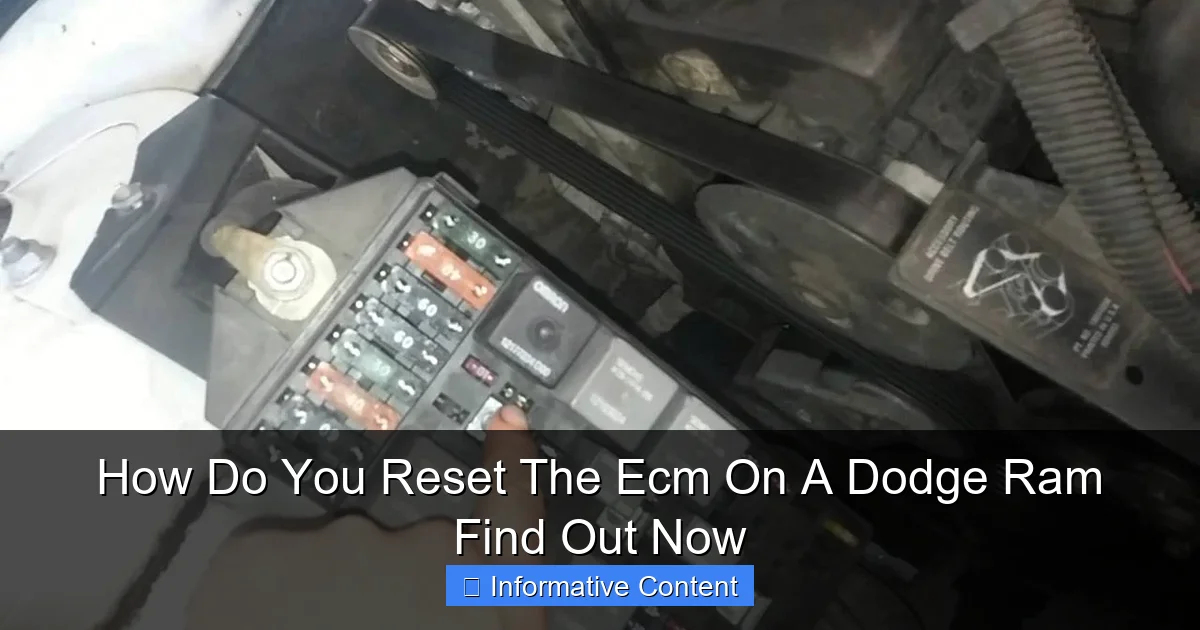
Method 3: The Fuse Pull Reset (An Alternative)
Some models may allow you to reset the ECM by removing a specific fuse. This accomplishes a similar power interruption as the battery method but is less messy.
- Step 1: Consult Your Manual. Check your owner’s manual or a reliable repair database to identify which fuse powers the ECM/PCM. It’s often labeled “ECM,” “PCM,” or “Engine Control.”
- Step 2: Pull the Fuse. With the truck OFF, use the fuse puller from your fuse box or a pair of needle-nose pliers to remove the identified fuse.
- Step 3: Wait and Reinsert. Wait 5-10 minutes, then reinsert the fuse firmly. Start the truck and perform the drive cycle.
Comparing Your Reset Options: A Quick Guide
Not sure which method is right for your situation? This table breaks down the pros and cons to help you decide.

Visual guide about how-do-you-reset-the-ecm-on-a-dodge-ram
Image source: i.ytimg.com
| Method | Best For | Pros | Cons |
|---|---|---|---|
| Battery Disconnect | General adaptive memory reset, post-repair procedures, most DIYers. | Requires no special tools. Guarantees a full power cycle. Effective. | Resets radio presets/clocks. May require recalibration of power windows/sunroof on some models. |
| OBD2 Scanner | Precise control, clearing trouble codes, avoiding other system resets. | Quick. Preserves radio, clock, and other memory settings. Can read codes first. | Requires purchasing or borrowing a scanner. |
| Fuse Pull | A quicker alternative to battery disconnect if the correct fuse is known. | Faster than battery method. Less disruptive to other systems. | Must identify the correct fuse. Not as universally guaranteed as a full battery disconnect. |
Important Precautions And What To Expect After The Reset
Resetting the ECM on your Dodge Ram is generally safe, but it’s not a magic wand. Going in with the right expectations will save you a headache.
What Will Be Reset (And What Won’t)
A reset clears adaptive memory and pending/soft trouble codes. It does not erase permanent manufacturer programming. Your VIN, calibration, and core software remain. Do expect to reset your radio stations, clock, and possibly the learned positions for power windows (you may need to manually cycle them up and down to restore auto-up/auto-down).
The Crucial Relearn Drive Cycle
I can’t stress this enough: the reset isn’t complete until you drive. For the first few miles, your truck might not drive perfectly. The idle may hunt, the transmission shifts might feel off, or fuel economy may be poor. This is the ECM gathering new data. Follow the mixed driving pattern mentioned earlier. This process is essential for the computer to re-optimize everything.
When A Reset Is NOT The Answer
If you reset the ECM and the check engine light or a severe driveability problem returns immediately, you have a hard fault. This means there is an active, ongoing problem—a failed sensor, a major leak, a wiring issue. The reset temporarily cleared the symptom, but the root cause is still there. This is your truck’s way of telling you it’s time for proper diagnosis.
Troubleshooting: What If The Reset Doesn’t Work?
So you followed all the steps, took the drive, and your Ram is still acting up. Don’t panic. This is actually valuable information.
The Check Engine Light Comes Right Back
This is the biggest clue. It means the ECM is detecting a fault in real-time. Your next step is to get the trouble codes read with an OBD2 scanner. Write down the specific code (e.g., P0301 – Cylinder 1 Misfire). This code is the roadmap to your actual problem—a bad spark plug, a faulty coil, an injector issue, etc.
Performance Issues Persist
If the driveability problem remains but there’s no check engine light, the issue may be mechanical or require deeper diagnosis. Think about things like clogged fuel injectors, a failing fuel pump, low compression, or vacuum leaks. An ECM reset can’t fix physical wear and tear.
In these cases, it’s wise to consult a reputable mechanic or delve deeper into the specific symptom with the help of Ram-specific forums and repair guides. The reset helped you rule out a corrupted memory as the cause, which is progress.
Wrapping Up: Empowerment Through Understanding
Learning how to reset the ECM on a Dodge Ram is a fantastic piece of DIY knowledge to have in your toolbox. It’s a simple, free, and often effective first step for tackling electronic gremlins and post-repair tuning. Remember, it’s a “relearn,” not a “repair.” The goal is to give your truck’s brain a fresh start.
Start with the battery disconnect method—it’s straightforward and works for the vast majority of situations. Just be patient during the drain period and diligent with the relearn drive cycle. If the problem vanishes, you’ve saved yourself time and money. If the issue comes back, you’ve gained valuable diagnostic info that points you toward the real fix.
Your Dodge Ram is a powerful machine, and understanding its nuances makes you a better owner. With this guide, you’re now equipped to handle one of its most common electronic hiccups confidently. Here’s to many more smooth, powerful miles down the road.
Frequently Asked Questions
What is the ECM in a Dodge Ram?
The ECM, or Engine Control Module, is the computer that manages your Dodge Ram’s engine functions. It controls fuel injection, ignition timing, and emissions to ensure optimal performance.
Why should I reset the ECM on my Dodge Ram?
Resetting the ECM can resolve issues like poor fuel economy, rough idling, or check engine lights. It clears stored error codes and allows the system to relearn adaptive settings for better performance.
How do you reset the ECM on a Dodge Ram?
To reset the ECM, disconnect the negative battery cable for about 15-30 minutes. This drains residual power and resets the module, but be aware that it may also reset other systems like radio presets.
Is it safe to reset the ECM on a Dodge Ram at home?
Yes, it’s generally safe if you follow proper procedures. However, ensure the engine is off and you disconnect the battery correctly to avoid electrical shorts or damage.
What happens after resetting the ECM on a Dodge Ram?
After resetting, the ECM will clear all fault codes and revert to default settings. You may need to drive the vehicle for a short period to allow the ECM to relearn and adapt to your driving habits.
Do I need any tools to reset the ECM on a Dodge Ram?
Typically, no special tools are required; a wrench to disconnect the battery terminal is sufficient. However, for some models, a scan tool might be needed for a more precise reset.

At CarLegit, we believe information should be clear, factual, and genuinely helpful. That’s why every guide, review, and update on our website is created with care, research, and a strong focus on user experience.