

Bugatti’s quad-turbocharged W16 engine achieves its staggering performance through relentless, lag-free power delivery. This ingenious layout uses sequential turbocharging, where smaller turbos provide immediate response before larger ones unleash immense top-end power, creating a seamless torrent of acceleration that defines hypercar dominance.
In This Article
- 1 Key Takeaways
- 2 📑 Table of Contents
- 3 How Bugatti’s Quad Turbocharged Engine Layout Achieves Top Performance
- 4 The Heart of the Beast: Understanding the W16 Layout
- 5 The Turbo Squadron: A Four-Stage Breathing System
- 6 Taming the Inferno: Advanced Cooling and Thermal Management
- 7 Strength from Within: Forged Internals and Precision Engineering
- 8 The Symphony of Control: Electronics and Software Integration
- 9 By the Numbers: A Data Table on Bugatti’s Turbo Evolution
- 10 Conclusion: More Than Just a Sum of Its Parts
- 11 Frequently Asked Questions
- 11.1 How does a quad-turbo setup differ from twin-turbo engines?
- 11.2 What is the key to the Bugatti quad-turbo engine’s incredible horsepower?
- 11.3 Why does Bugatti use four turbos instead of just one or two?
- 11.4 How does the quad-turbo system manage heat and reliability?
- 11.5 What role does the engine layout play in the Bugatti quad-turbo’s performance?
- 11.6 How does the Bugatti quad-turbo engine achieve such high top speeds?
Key Takeaways
- Sequential Turbocharging: Eliminates lag for instant power.
- Four Smaller Turbos: Provide faster spool than two large ones.
- Precise Boost Staging: Delivers seamless, relentless acceleration.
- Advanced Intercooling System: Maintains optimal air density and temperature.
- Engineered Exhaust Manifolds: Optimize gas flow to each turbocharger.
- Massive Airflow: Enables extreme horsepower and torque figures.
📑 Table of Contents
- How Bugatti’s Quad Turbocharged Engine Layout Achieves Top Performance
- The Heart of the Beast: Understanding the W16 Layout
- The Turbo Squadron: A Four-Stage Breathing System
- Taming the Inferno: Advanced Cooling and Thermal Management
- Strength from Within: Forged Internals and Precision Engineering
- The Symphony of Control: Electronics and Software Integration
- By the Numbers: A Data Table on Bugatti’s Turbo Evolution
- Conclusion: More Than Just a Sum of Its Parts
How Bugatti’s Quad Turbocharged Engine Layout Achieves Top Performance
Let’s talk about speed. Not the kind you feel when you’re late for a meeting. I mean the earth-bending, heart-stopping, physics-defying kind of speed. The kind that turns a stretch of road into a blur and makes you question everything you know about cars.
For over a century, one name has been synonymous with that feeling: Bugatti. And at the heart of their modern legends—the Veyron and the Chiron—beats a mechanical masterpiece so audacious it makes other supercars blush. We’re talking about the quad-turbocharged W16 engine.
You might have seen the numbers: 1,000, 1,500, even 1,600 horsepower. But how? How does an engine with four turbochargers not just work, but dominate? It’s not about brute force alone. It’s a ballet of precision engineering, thermal management, and sheer willpower. Today, we’re going to pull back the curtain. We’ll explore how this incredible layout breathes, manages immense heat, and delivers power so smoothly it feels supernatural. Buckle up.
The Heart of the Beast: Understanding the W16 Layout
Before we dive into the turbos, we need to understand the stage they perform on. The foundation is the W16 configuration. It’s as exotic as it sounds.
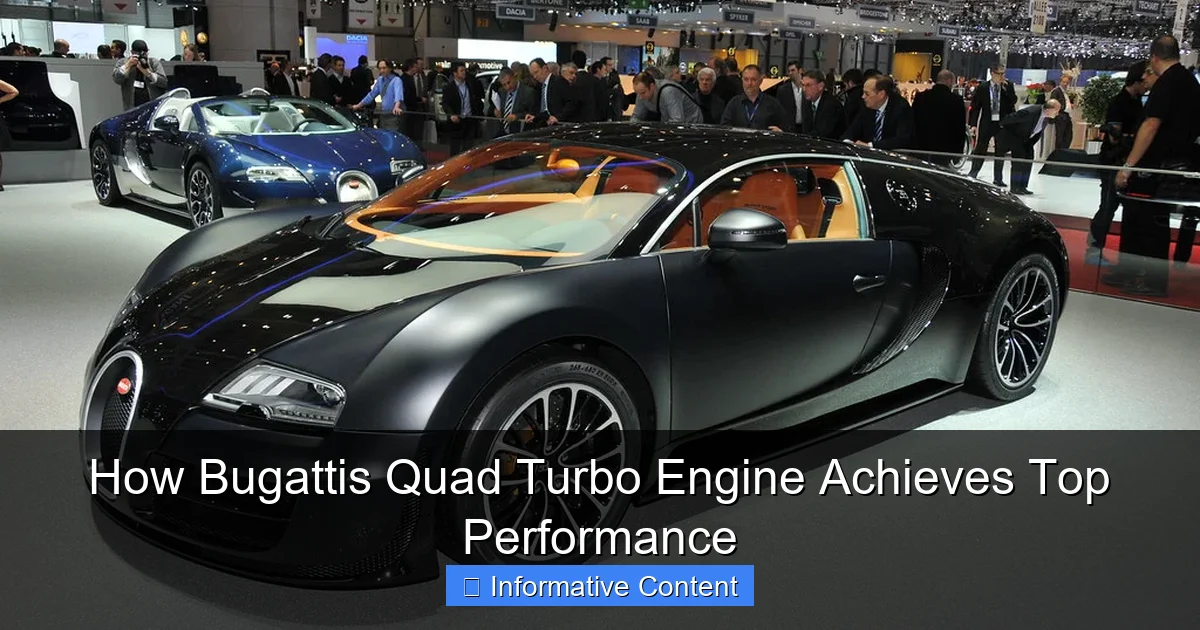
Visual guide about Bugatti quad turbo engine
Image source: c2.staticflickr.com
What is a W16 Engine?
Think of it as two narrow-angle V8 engines sharing a common crankshaft. The cylinders are arranged in a “W” shape when viewed from the front. This design is a packaging miracle. It allows Bugatti to fit 16 cylinders, 64 valves, and a colossal displacement of 8.0 liters into an engine bay without the engine being impossibly long (like a V16) or impossibly wide (like a flat-16).
This compact power base is crucial. It leaves room for the supporting cast of components needed to manage four turbochargers and the immense power they generate.
The Foundation for Force-Feeding
A naturally aspirated 8.0-liter W16 would be powerful, sure. But to reach the stratospheric power targets Bugatti engineers dreamed of, they needed to force-feed it a massive amount of air. That’s where forced induction comes in. And for Bugatti, one turbo wasn’t enough. Two would be a challenge. They went for four. This decision is the key to overcoming turbo lag and building power in a way that feels both immense and linear.
The Turbo Squadron: A Four-Stage Breathing System
Four turbochargers. It sounds like overkill. In most applications, it would be. But for Bugatti, it’s a meticulously choreographed system for managing airflow and response. Let’s break down how they work together.
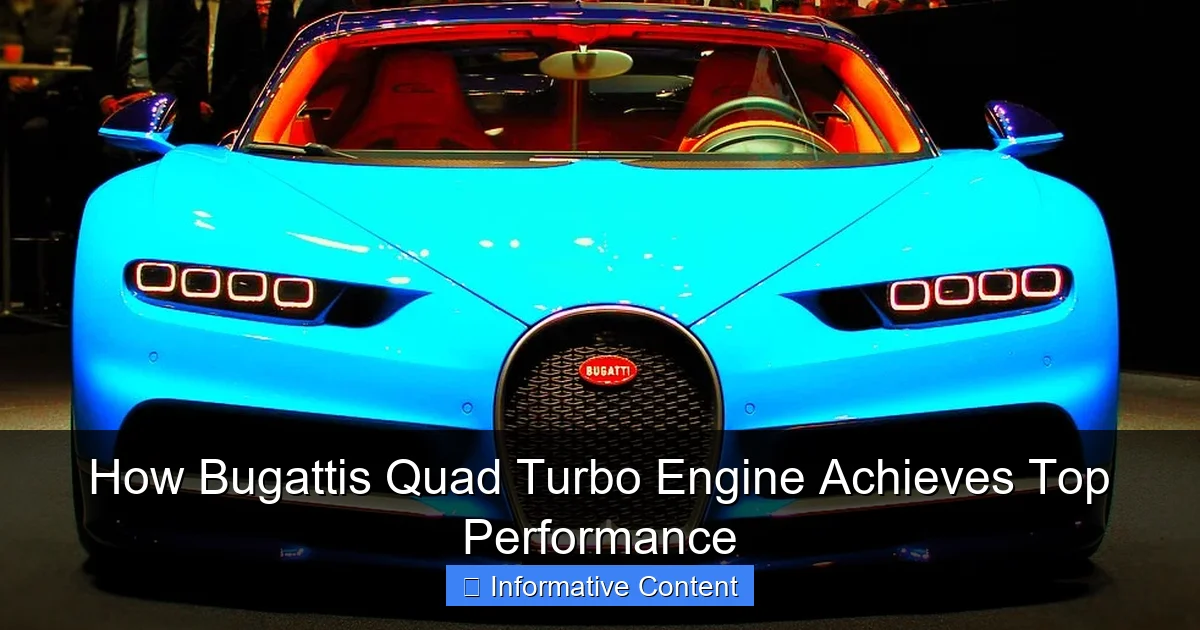
Visual guide about Bugatti quad turbo engine
Image source: live.staticflickr.com
Sequential Staging: The Secret to Seamless Power
This is the genius part. The four turbos aren’t all spooling up at the same time from idle. In the original Veyron, they operated in a sequential two-stage system.
- Stage 1 (Low RPM): At lower engine speeds, only two smaller turbochargers were active. These smaller turbos spool up very quickly, providing immediate throttle response and eliminating the dreaded “lag” you might feel in a single-turbo car.
- Stage 2 (High RPM): As the engine revs climbed and demanded more air, the two larger turbochargers would kick in. All four turbos would then work in unison to cram an astonishing volume of air into the cylinders, unlocking the full, four-digit horsepower figure.
By the time of the Chiron, the technology evolved. With advanced engine management and tougher components, all four turbos could be used across a wider range, but the philosophy remained: use multiple turbos to cover the entire RPM band with relentless, lag-free boost.
The Numbers Behind the Breath
To appreciate the scale, consider the airflow. At peak power, the engine’s four intercoolers are dissipating heat equivalent to several household air conditioners. The turbos themselves are spinning at over 200,000 RPM, compressing air to pressures that would destroy a lesser engine. This orchestrated chaos is what allows the W16 to breathe like an Olympic sprinter in the middle of a race—deep, powerful, and efficient breaths at full tilt.
Taming the Inferno: Advanced Cooling and Thermal Management
With great power comes great heat. This is perhaps the biggest challenge with a quad-turbo setup. Compressing air heats it up, and hot air is less dense and prone to causing engine-destroying detonation. Bugatti’s solution is a cooling system of epic complexity.
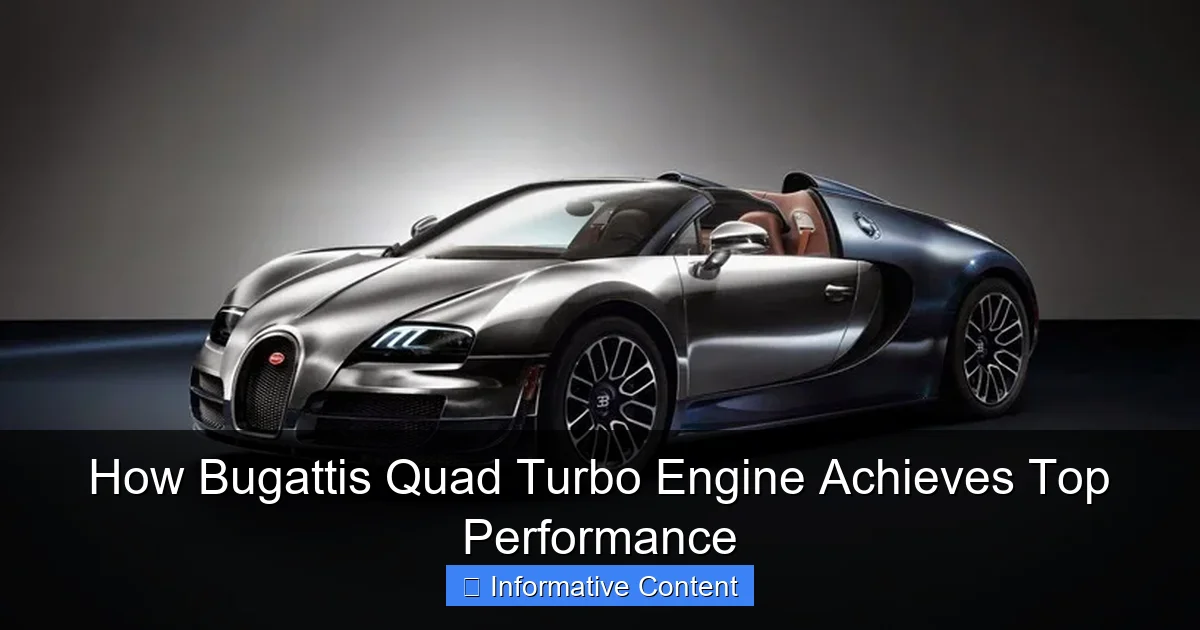
Visual guide about Bugatti quad turbo engine
Image source: 1.bp.blogspot.com
A Radiator for Every Challenge
Pop the hood on a Veyron or Chiron, and you’ll see more radiator than engine. There are ten separate radiators in total:
- Three for the main engine coolant.
- One for each of the four turbo intercoolers (that’s four more).
- One for the engine oil.
- One for the transmission oil.
- One for the differential oil.
This isn’t overengineering; it’s essential engineering. Each system runs at its optimal temperature, ensuring the engine, turbos, and drivetrain can handle repeated bursts of extreme performance.
Intercooling: The Key to Density
The intercoolers are the unsung heroes. After the turbos compress the intake air, it’s incredibly hot. The four dedicated intercoolers—each fed by its own radiator—cool that air down before it enters the cylinders. Colder air is denser, meaning more oxygen molecules can be packed into each cylinder for combustion. This directly translates to more power and protects the engine. It’s a constant battle to manage thermal energy, and Bugatti’s army of radiators wins it.
Strength from Within: Forged Internals and Precision Engineering
You can’t just bolt four turbos onto any engine block and hope for the best. The internal forces at play inside a quad-turbo W16 are apocalyptic. To survive, every component must be a masterpiece of material science.
The Building Blocks of Reliability
The engine block itself is a work of art, made from a hyper-strong aluminum alloy. But the real stars are the internal components:
- Forged Pistons and Titanium Connecting Rods: These parts endure incredible pressure and acceleration. Forged pistons are stronger than cast ones, and titanium rods are incredibly light and strong, allowing the engine to rev more freely and withstand the brutal cylinder pressures.
- Overbuilt Crankshaft: The crankshaft is a massive, precision-machined piece of steel that has to handle the force from 16 cylinders and the resistance from four turbochargers. Its balance and strength are non-negotiable.
Think of it like building a skyscraper in an earthquake zone. The foundation and frame (the block and crankshaft) must be immovable, while the interior walls (pistons and rods) must be both light and flexible enough to handle the shocks. Bugatti’s engine is that skyscraper.
Precision Assembly
These engines aren’t just assembled; they’re crafted. Each engine is built by a single technician in Molsheim, France, taking days to complete. This human touch ensures tolerances are perfect, clearances are exact, and every component works in flawless harmony. In an engine making 1,500+ horsepower, a mistake measured in microns can lead to catastrophic failure.
The Symphony of Control: Electronics and Software Integration
All this hardware would be unmanageable without a genius software conductor. The Engine Control Unit (ECU) in a Bugatti is one of the most sophisticated in the world.
The Digital Maestro
The ECU doesn’t just manage fuel and spark. It’s constantly monitoring hundreds of parameters: boost pressure from each turbo bank, intake air temperature at multiple points, coolant temps for all ten radiators, exhaust gas temperature, and much more. It makes millions of calculations per second to adjust variables, ensuring optimal performance and, most importantly, safety.
For example, if the system detects the intercooler efficiency dropping on a very hot day, it might subtly adjust boost pressure or ignition timing to protect the engine, all without the driver noticing a drop in performance.
Harnessing the Power Band
The software is also key to delivering that legendary Bugatti power curve. It manages the transition between turbo stages (in the Veyron) and the precise control of all four turbos in the Chiron. The result is power that builds with a terrifying linearity. It doesn’t hit you in one big shove; it feels like an endless wave, pulling you forward harder and harder until you reach its astronomical top speed.
By the Numbers: A Data Table on Bugatti’s Turbo Evolution
Seeing the progression from the Veyron to the Chiron and its derivatives helps illustrate how Bugatti refined the quad-turbo concept. Here’s a look at the key performance metrics.
| Model | Engine | Peak Power | Peak Torque | Turbo System Key Feature |
|---|---|---|---|---|
| Veyron 16.4 | 8.0L Quad-Turbo W16 | 1,001 HP | 922 lb-ft | Sequential 2-stage turbo system |
| Chiron | 8.0L Quad-Turbo W16 | 1,500 HP | 1,180 lb-ft | Parallel operation, larger turbos, advanced materials |
| Chiron Super Sport 300+ | 8.0L Quad-Turbo W16 | 1,600 HP | 1,180 lb-ft | Revised turbo geometry, improved breathing |
This table shows a clear trajectory. The core quad-turbo layout remained, but through better turbos, stronger internals, and smarter software, Bugatti extracted over 50% more power from the same basic architecture. That’s the mark of a deeply effective original design.
Conclusion: More Than Just a Sum of Its Parts
So, how does Bugatti’s quad turbo engine achieve top performance? It’s not one magic trick. It’s the relentless pursuit of balance in a world of extremes.
It’s the compact W16 foundation offering a stable platform. It’s the squadron of four turbos working in sequence to banish lag and deliver relentless boost. It’s an entire cooling system worthy of a power plant, taming the incredible heat. It’s internal components forged to be indestructible. And it’s all woven together by software smarter than most computers.
This engine is a reminder that true hypercar performance isn’t found in a single part. It’s found in the harmony of thousands of parts, each pushed to its limit, all working together to create something that feels less like a machine and more like a force of nature. The quad-turbo W16 isn’t just an engine; it’s a statement—a proof that with enough ingenuity, even the laws of physics can be persuaded to bend.
Frequently Asked Questions
How does a quad-turbo setup differ from twin-turbo engines?
A twin-turbo engine typically uses two turbochargers to reduce lag and boost power. Bugatti’s quad-turbo engine employs four smaller turbos, which allows for a more immediate and seamless delivery of immense boost pressure across the entire rev range, eliminating lag almost entirely and enabling its extreme power output.
What is the key to the Bugatti quad-turbo engine’s incredible horsepower?
The key lies in the combination of forced induction and massive displacement. The four turbochargers force a tremendous volume of air into the 8.0-liter W16 engine, allowing it to burn fuel at an extraordinary rate. This synchronized boost from all four turbos is what generates the iconic 1,000+ horsepower figures.
Why does Bugatti use four turbos instead of just one or two?
Using four smaller turbos instead of one or two large ones is a strategic engineering choice. Smaller turbos spool up faster, dramatically reducing turbo lag. This configuration provides a rapid, linear power delivery essential for a hypercar, ensuring instant throttle response at any speed while still achieving peak boost for top-end performance.
How does the quad-turbo system manage heat and reliability?
Managing immense heat is critical for reliability. Bugatti employs an advanced and intricate cooling system with multiple radiators and dedicated circuits for the engine, turbos, and intercoolers. The precise engineering of exhaust manifolds and turbo placement also helps dissipate heat efficiently, ensuring consistent performance under extreme stress.
What role does the engine layout play in the Bugatti quad-turbo’s performance?
The unique W16 layout—essentially two narrow-angle V8s sharing a crankshaft—provides the compact foundation needed to mount four turbochargers effectively. This compact yet large-displacement design, combined with the quad-turbo system, creates an incredibly dense power package that is both physically manageable and capable of producing stratospheric power.
How does the Bugatti quad-turbo engine achieve such high top speeds?
The quad-turbo engine achieves its legendary top speed by sustaining massive horsepower output all the way to its redline. The sequential or parallel operation of the four turbos ensures a relentless supply of boost, allowing the engine to overcome immense aerodynamic drag at speeds exceeding 250 mph, a feat impossible without this specific forced-induction strategy.

At CarLegit, we believe information should be clear, factual, and genuinely helpful. That’s why every guide, review, and update on our website is created with care, research, and a strong focus on user experience.