

Bugatti’s monumental W16 engine delivers an unprecedented 1,500 horsepower and 1,180 lb-ft of torque, a figure that redefined the hypercar landscape. This quad-turbocharged, 8.0-liter masterpiece generates its earth-shattering power through a unique W-configuration of 16 cylinders, enabling mind-bending acceleration and a top speed exceeding 300 mph. It stands as a triumphant engineering landmark of pure, unadulterated force.
In This Article
- 1 Key Takeaways
- 2 📑 Table of Contents
- 3 Unleashing the Power of Bugatti’s W16 Engine
- 4 The Anatomy of a Legend: Understanding the W16 Configuration
- 5 By the Numbers: Decoding the Staggering Power Output
- 6 More Than Horsepower: The Torque and Delivery Character
- 7 The Engineering Marvels That Make It Possible
- 8 The Physical and Experiential Impact of W16 Power
- 9 The Data Table: W16 Power Evolution Across Key Models
- 10 Conclusion: The Last of Its Kind, A Power Untamed
- 11 Frequently Asked Questions
- 11.1 What is the power output of Bugatti’s W16 engine?
- 11.2 How does the W16 engine’s design contribute to its power?
- 11.3 What kind of torque does the Bugatti W16 engine produce?
- 11.4 Why is the W16 engine being retired?
- 11.5 What is the top speed enabled by the W16’s power?
- 11.6 How does the W16 compare to other hypercar engines?
Key Takeaways
- Unmatched Power Density: Four turbochargers force-feed the 8.0L engine.
- Extreme Power Output: It generates over 1,500 horsepower in production models.
- Unique Engineering Marvel: The W16 configuration is essentially two V8s merged.
- Uncompromising Performance: Enables acceleration from 0-60 mph in under 2.5 seconds.
- Peak Torque at Low RPM: Delivers massive pulling power early for explosive launches.
- Technical Tour de Force: Represents the pinnacle of internal combustion engineering.
📑 Table of Contents
- Unleashing the Power of Bugatti’s W16 Engine
- The Anatomy of a Legend: Understanding the W16 Configuration
- By the Numbers: Decoding the Staggering Power Output
- More Than Horsepower: The Torque and Delivery Character
- The Engineering Marvels That Make It Possible
- The Physical and Experiential Impact of W16 Power
- The Data Table: W16 Power Evolution Across Key Models
- Conclusion: The Last of Its Kind, A Power Untamed
Unleashing the Power of Bugatti’s W16 Engine
Imagine a sound so profound it vibrates in your chest before you even see the source. Picture a machine that doesn’t just accelerate but warps your perception of speed itself. This isn’t science fiction. This is the reality crafted around a single, monumental piece of engineering: the Bugatti W16 engine.
For over two decades, this engine has been the beating heart of the fastest production cars on the planet. It’s more than a motor; it’s a statement. A declaration that in a world shifting to efficiency, there is still a throne for unadulterated, mechanical majesty. I remember the first time I stood next to a Bugatti Veyron. It wasn’t just a car; it felt like a living monument. The sheer presence of that wide rear end, knowing the W16 engine lay within, was humbling. It promised an experience beyond mere driving.
Today, we’re going to pop the hood, figuratively speaking, on this legend. We’ll explore what the Bugatti W16 engine truly delivers in terms of power. Not just the staggering numbers—which we will get to—but the how and the why. The engineering genius, the physical sensation, and the undeniable price of such perfection. Buckle up; it’s going to be a thrilling ride.
The Anatomy of a Legend: Understanding the W16 Configuration
To grasp the power of the Bugatti W16 engine, you first need to understand its bizarre and brilliant architecture. Most supercars use V8 or V12 engines. The “V” describes the cylinder arrangement. Bugatti’s founder, Ettore Bugatti, once called engines with many cylinders “the work of the devil.” How ironic, then, that the modern brand created one of the most complex cylinder layouts ever.
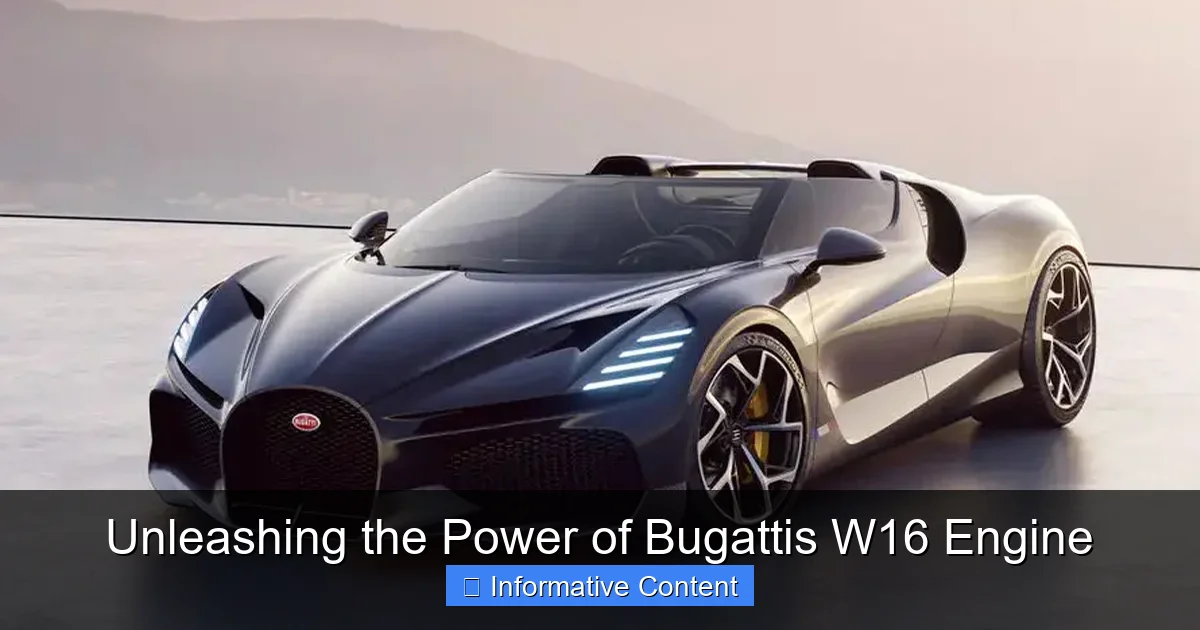
Visual guide about Bugatti W16 power
Image source: cdni.autocarindia.com
It’s Essentially Two V8s in a “W”
Think of the W16 not as a single engine, but as two compact V8 engines sharing a common crankshaft in a “W” formation. This isn’t just bolting two engines together. It’s an incredibly dense, intricate packaging marvel. This configuration allows Bugatti to fit 16 cylinders, 64 valves, and four turbochargers into an engine bay without building a car the size of a bus. The compactness is a key part of its power delivery, allowing for a lower center of gravity and better weight distribution.
The Role of Quad-Turbocharging
Sixteen cylinders alone aren’t enough for Bugatti’s goals. Each bank of cylinders gets its own pair of turbochargers. Why four turbos? It’s all about eliminating lag and building a seamless, tsunami of power. Smaller turbos spool up faster, so the engine responds instantly to your right foot. There’s no waiting, no hollow feeling before the boost kicks in. From a low rpm, the W16 engine is already building pressure, ensuring that when you demand power, it’s already there. This setup is central to what the W16 delivers: monstrous power that is also incredibly accessible and smooth.
By the Numbers: Decoding the Staggering Power Output
Now, let’s talk about the figures that define this engine’s legacy. These aren’t just specs on a page; they are physical laws rewritten.
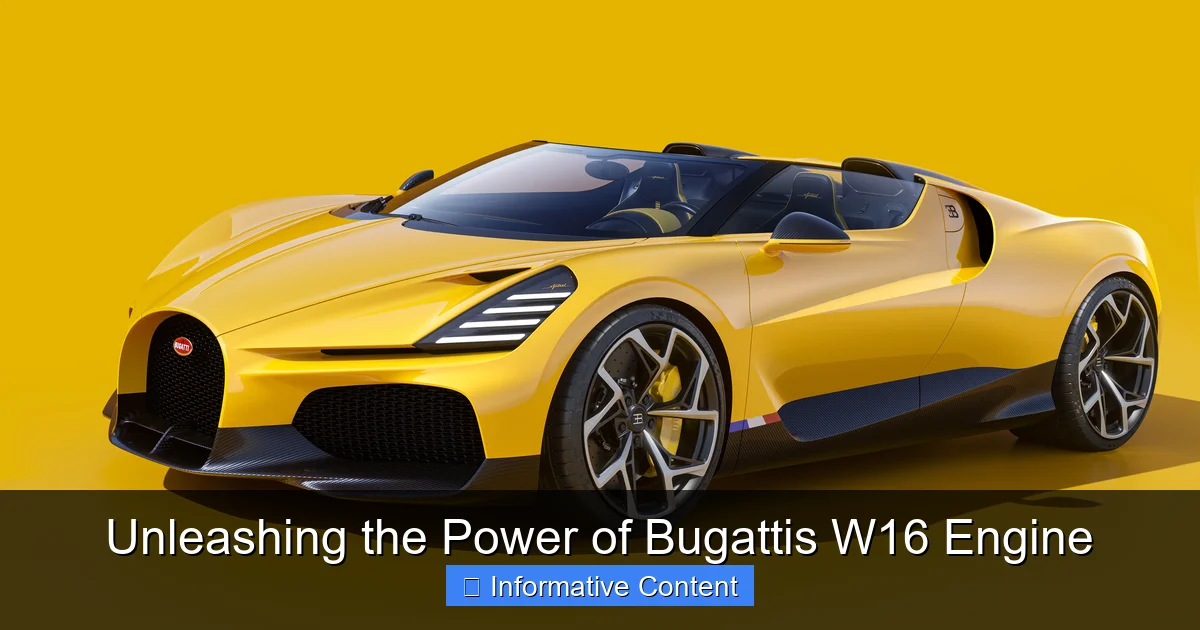
Visual guide about Bugatti W16 power
Image source: hdcarwallpapers.com
From the Veyron to the Chiron: An Evolution of Force
The W16 engine’s journey is a story of relentless pursuit. In the 2005 Veyron 16.4, it produced 1,001 metric horsepower (or 987 brake horsepower) and 922 lb-ft of torque. The world was stunned. A four-digit horsepower figure from a factory car was unheard of. But Bugatti wasn’t done.
Through continuous refinement—better turbos, improved intercooling, advanced materials—the power climbed. The Chiron debuted with 1,479 hp. The Super Sport 300+ and Centodieci models pushed it further. The final, ultimate expression is the Bugatti Bolide’s track-only W16 engine, tuned to a mind-bending 1,824 hp on racing fuel. This evolution shows the engine’s incredible potential, a testament to its over-engineered foundation.
A Practical Example of What That Power Means
Numbers can feel abstract. Let’s make them real. The Bugatti Chiron Super Sport’s 1,577 hp propels it from 0 to 60 mph in about 2.3 seconds. But more impressively, it can go from 60 to 120 mph in roughly the same time. Most cars are finishing their 0-60 run as the Chiron is hitting 120. Its power isn’t just for launch; it’s relentless, pushing you back into the seat with undiminished force well past 200 mph. This is the core of what the W16 engine delivers: not a short burst, but a continuous, overwhelming surge of acceleration.
More Than Horsepower: The Torque and Delivery Character
If horsepower sells cars, torque wins races. And the torque of the W16 engine is its secret weapon. This is where you feel the engine’s personality.
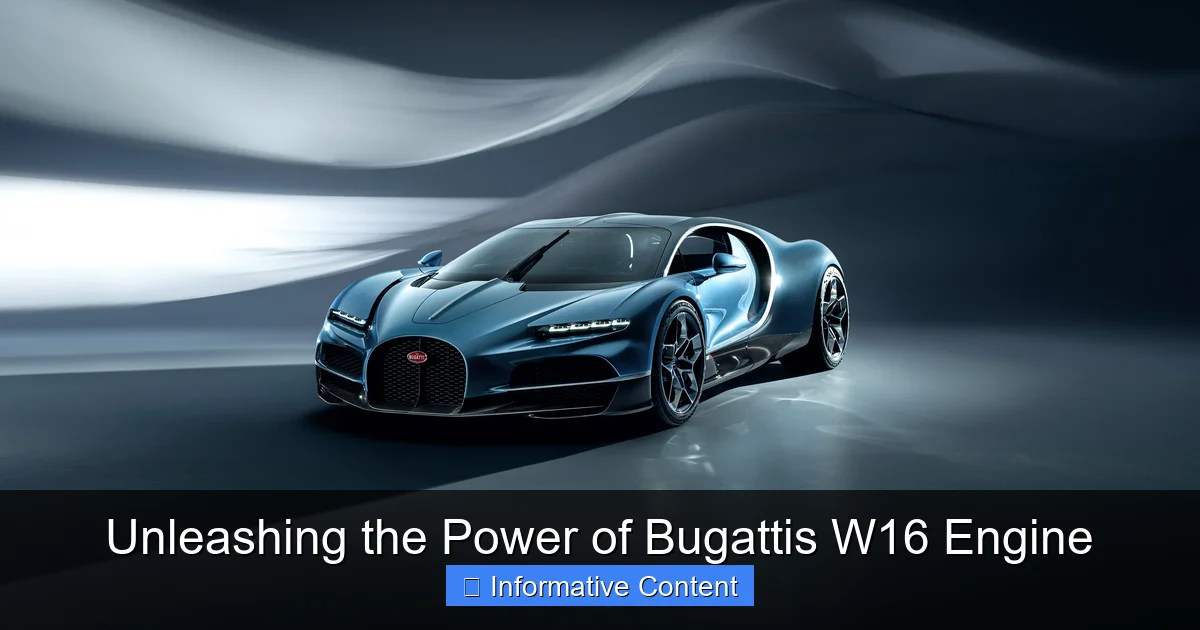
Visual guide about Bugatti W16 power
Image source: images8.alphacoders.com
A Mountain of Torque, Available Everywhere
From as low as 2,000 rpm, the W16 engine delivers over 1,000 lb-ft of torque. That’s more pulling power than a heavy-duty diesel truck, but in a package that revs to 7,000 rpm. This means you don’t need to be at a specific “power band” to feel the force. Whether you’re pulling out of a slow corner or already at triple-digit speeds, a gentle press of the throttle unleashes an immediate, colossal shove. The power delivery isn’t peaky or frantic; it’s authoritative and effortless.
The Sensation of “Effortless” Power
Drivers often describe the W16 experience as “effortless.” This is the true magic. The car gathers speed so quickly and so smoothly that your brain struggles to keep up. There’s no drama, no screaming engine note (it’s more of a turbine-like roar), just a silent, g-force-induced awe as the world blurs. It feels less like a piston engine straining and more like a natural force has been harnessed. This seamless, linear delivery is a direct result of that W16 configuration and quad-turbo system working in perfect, sophisticated harmony.
The Engineering Marvels That Make It Possible
Such power and smoothness don’t happen by accident. The W16 engine is a masterpiece of problem-solving. Here are a few key challenges Bugatti’s engineers conquered.
Taming the Heat of a Small Star
An engine making over 1,000 hp generates tremendous heat. At top speed, the W16 engine’s radiators dissipate enough heat to warm several houses. The cooling system is a work of art in itself, with multiple circuits and a capacity of over 50 liters. Without this, the engine would literally melt. This is a crucial tip for understanding supercar engineering: ultimate power is meaningless without ultimate cooling.
Materials and Craftsmanship
This isn’t a mass-produced block. Components like the titanium turbochargers, forged pistons, and the crankshaft machined from a single steel billet are works of precision art. Each engine is assembled by hand by a single technician in Molsheim, France, taking nearly a week. The commitment to craftsmanship ensures that every component can withstand the astronomical forces at play. When you hear about the cost of a Bugatti, remember you are paying for this level of obsessive, human-led engineering.
The Physical and Experiential Impact of W16 Power
Owning or driving a W16-powered Bugatti is about more than statistics. It’s a full-body experience that changes your perspective.
A Symphony of Force, Not Just Noise
The sound is unique. It’s not the high-pitched wail of a V12 or the raw bark of a large V8. It’s a deep, complex, mechanical symphony. You hear the whoosh of four turbos, the whir of countless gears, and a bass-heavy exhaust note. At low speed, it’s surprisingly muted—a sleeping giant. At full throttle, it becomes a roaring, industrial soundtrack that perfectly matches the visual blur.
The Emotional Payoff
The power of the W16 engine delivers an unmatched emotional payoff. It represents a human triumph over physics. There’s a profound sense of confidence and capability. You know you are in control of one of the most capable machines ever built. It’s an experience of pure, unapologetic joy and a connection to a pinnacle of mechanical achievement that is soon to become history.
The Data Table: W16 Power Evolution Across Key Models
This table illustrates the relentless evolution of the W16 engine’s output across its most iconic applications.
| Model | Year | Power (HP) | Torque (lb-ft) | Top Speed (mph) | Key Note |
|---|---|---|---|---|---|
| Veyron 16.4 | 2005 | 987 | 922 | 253 | The original, broke the 1,000 HP barrier. |
| Veyron Super Sport | 2010 | 1,184 | 1,106 | 268 | Held the production car speed record. |
| Chiron | 2016 | 1,479 | 1,180 | 261 (limited) | Redesigned turbos & components. |
| Chiron Super Sport 300+ | 2019 | 1,577 | 1,180 | 304+ | First production car over 300 mph. |
| Bolide (Track Only) | 2020 | 1,824 | 1,364 | >310 | Ultimate, lightweight track evolution. |
Conclusion: The Last of Its Kind, A Power Untamed
As we reach the end of our deep dive, it’s clear the Bugatti W16 engine delivers something far beyond simple power. It delivers a benchmark. It showed the world what was possible when budget, physics, and ego are given free rein. It delivers a seamless, effortless, and terrifyingly fast experience that redefines acceleration.
Yet, its time is ending. The era of the massive, multi-cylinder, internal combustion masterpiece is closing. The next chapter for Bugatti involves hybrid power and likely a different configuration. This makes the W16 engine not just a powerhouse, but a poignant symbol. It is the glorious final roar of a type of engineering that may never be seen again.
So, what does the Bugatti W16 engine deliver in terms of power? It delivers a legend. It delivers an experience that sits at the very peak of automotive history. It delivers proof that sometimes, the most audacious dreams—even those with 16 cylinders and four turbos—can be forged into breathtaking reality. And for that, every car enthusiast owes it a moment of awe.
Frequently Asked Questions
What is the power output of Bugatti’s W16 engine?
The most powerful production iteration, found in the Bugatti Chiron Super Sport 300+, delivers an astonishing 1,600 horsepower. This immense power is what enables these hypercars to achieve their legendary top speeds and acceleration.
How does the W16 engine’s design contribute to its power?
The unique W16 configuration essentially combines two narrow-angle V8 banks into a single engine with 16 cylinders, four turbochargers, and a massive displacement. This complex architecture allows it to generate immense power and torque from a relatively compact package.
What kind of torque does the Bugatti W16 engine produce?
Alongside its phenomenal horsepower, the engine generates a colossal 1,180 lb-ft of torque. This massive twisting force is available from a low 2,000 rpm, providing devastating and immediate acceleration at virtually any speed.
Why is the W16 engine being retired?
Bugatti is retiring the W16 primarily due to the global shift towards electrification and increasingly stringent emissions regulations. The engine represents the pinnacle of internal combustion, but future models will focus on hybrid powertrains to meet new standards.
What is the top speed enabled by the W16’s power?
The extreme power of Bugatti’s W16 engine has propelled models like the Chiron Super Sport 300+ to a verified top speed of over 304 mph. This makes it one of the fastest production cars ever built.
How does the W16 compare to other hypercar engines?
In terms of raw power output, Bugatti’s W16 engine stands in a league of its own for production cars, significantly outpacing most V12 and V8 competitors. Its combination of 16 cylinders, four turbos, and 8.0 liters of displacement creates an unrivaled benchmark for internal combustion.

At CarLegit, we believe information should be clear, factual, and genuinely helpful. That’s why every guide, review, and update on our website is created with care, research, and a strong focus on user experience.