

Resetting the low washer fluid light on your Nissan Altima is a quick, tool-free process you can do in seconds. Simply refill the windshield washer reservoir to the top, then press and hold the washer lever on the steering column for approximately three seconds until the warning light on your dashboard turns off. This immediate reset ensures your alert system is accurate and ready for the next time fluid runs low.
In This Article
- 1 Reset Your Nissan Altima Washer Fluid Light Fast: A Simple, Stress-Free Guide
- 1.1 Key Takeaways
- 1.2 📑 Table of Contents
- 1.3 Why Your Washer Fluid Light Stays On After Refilling
- 1.4 General Reset Method for Most Nissan Altima Models
- 1.5 Model-Specific Reset Procedures
- 1.6 What to Do If the Reset Doesn’t Work
- 1.7 Preventative Tips and Helpful Data
- 1.8 Conclusion: Enjoy a Clear Dashboard Again
- 1.9 Frequently Asked Questions
- 1.9.1 Why is my Nissan Altima washer fluid light on when the reservoir is full?
- 1.9.2 How do I reset the low washer fluid light on my Nissan Altima?
- 1.9.3 Will the light reset itself if I just add fluid?
- 1.9.4 What should I do if the reset procedure doesn’t work?
- 1.9.5 Is it safe to drive with the washer fluid warning light on?
- 1.9.6 Could a problem other than low fluid cause this light?
Reset Your Nissan Altima Washer Fluid Light Fast: A Simple, Stress-Free Guide
Picture this: you’re cruising down the highway in your trusty Nissan Altima, the sun is shining, and your favorite song is on the radio. Suddenly, a little orange or yellow light pops up on your dashboard—the one that looks like a windshield with squiggly lines. It’s the low washer fluid light. You sigh, make a mental note to grab some fluid, and pull into the gas station later to fill it up. But when you get back in the car… the light is still on. It’s stubbornly staring back at you, even though the reservoir is now full to the brim. Sound familiar?
If you’re nodding your head, you’re not alone. This is one of the most common, yet surprisingly perplexing, little quirks for many Nissan Altima owners. It’s not a sign of a major problem, but it is an annoying distraction on your otherwise clean dashboard. The good news? Resetting the low washer fluid light on your Nissan Altima is almost always a quick and easy fix. You don’t need to be a mechanic or have any special tools. In most cases, you just need to know the right sequence of actions.
This guide is here to walk you through every step, for every major model year. We’ll cover why the light stays on, the simple reset procedures, and what to do if the light just won’t budge. By the end, you’ll have the confidence to reset your Nissan Altima washer fluid light fast and get back to a warning-light-free drive. Let’s dive in and clear that dashboard!
Key Takeaways
- Refill the reservoir first: Always top off washer fluid before resetting.
- Locate the INFO button: Find it on your steering wheel or dash.
- Navigate the display menu: Cycle through settings to find warnings.
- Select and clear the warning: Confirm to reset the low fluid light.
- Consult your owner’s manual: Steps can vary by model year.
- The light is a reminder: It does not indicate a system fault.
📑 Table of Contents
Why Your Washer Fluid Light Stays On After Refilling
Before we jump into the “how,” let’s quickly understand the “why.” Knowing why the low washer fluid light on your Nissan Altima didn’t turn off automatically helps demystify the process and prevents unnecessary worry.
The Simple Sensor System
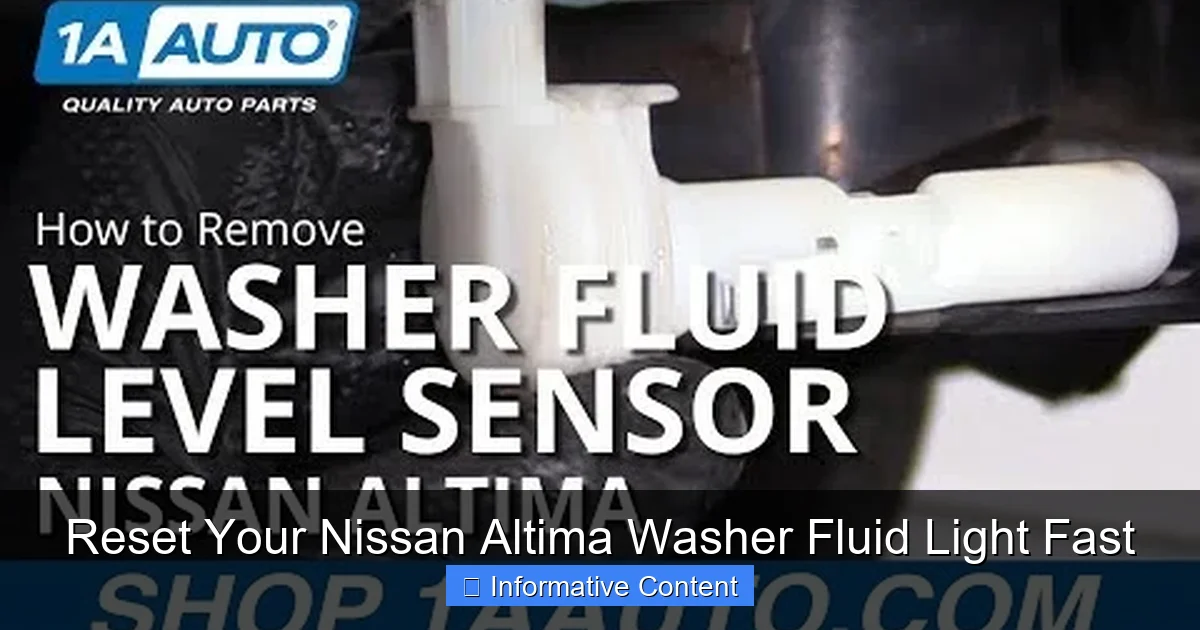
At the heart of this system is a small, float-style sensor inside the washer fluid reservoir. Think of it like the float in your toilet tank. When the fluid level is high, the float is up, and the circuit is open—no light. As the fluid drops, the float sinks, eventually closing a circuit and triggering the dashboard warning. Sometimes, after refilling, this float can get stuck in the “down” position, or the sensor itself needs a moment to recalibrate. It’s a simple mechanical part that occasionally needs a nudge.
It’s a Reminder, Not an Alarm
It’s important to remember this light is a low fluid indicator, not a “fluid has been refilled” indicator. In many Nissan models, the system isn’t designed to instantly recognize the new fluid level. It often requires you to complete the circuit by using the washers or following a specific reset procedure. This is by design, ensuring you’ve actually addressed the issue.
General Reset Method for Most Nissan Altima Models
For a large number of Nissan Altimas, particularly models from the early 2000s through the 2010s, there is a universal, first-thing-to-try method. This process is the easiest and most common fix.
Visual guide about reset washer fluid light Nissan Altima
Image source: i.ytimg.com
Step-by-Step “Use the Washers” Method
This method is so straightforward you might kick yourself for not trying it sooner. It uses the car’s own normal operation to reset the sensor.
- Step 1: Ensure your washer fluid reservoir is completely full. Don’t just top it off; fill it to the “Max” line if visible.
- Step 2: Get into your Altima, close the door, and insert the key into the ignition. Turn it to the “ON” or “ACC” position (where the dashboard lights are on, but the engine isn’t started).
- Step 3: Pull and hold the windshield washer stalk toward you (the same action you use to spray the windshield). Hold it for a full 5 to 10 seconds.
- Step 4: Release the stalk. Turn the ignition off, wait about 30 seconds, and then start your car normally.
In most cases, the low washer fluid light will now be off. The extended spray cycle helps free a stuck float and allows the system to recognize the full reservoir. If this doesn’t work, your model might need a more specific approach.
Model-Specific Reset Procedures
Nissan has tweaked its systems over the years. If the general method didn’t work, find your Altima’s generation below for a tailored solution.
Visual guide about reset washer fluid light Nissan Altima
Image source: dash-lights.com
For 5th Generation Altimas (2007-2012)
This generation can sometimes be trickier. A common successful procedure involves a specific ignition cycle.
- Fill the washer tank completely.
- Turn the ignition to the “ON” position (do not start the engine).
- Immediately press the washer stalk to spray fluid for 2-3 seconds.
- Turn the ignition to “OFF.”
- Wait 5 seconds, then start the engine. The light should reset.
If it persists, try disconnecting the negative terminal of your car battery for 5 minutes. This resets the car’s computer and will almost certainly clear the light (along with your radio presets, so be prepared).
For 6th & 7th Generation Altimas (2013-Present)
Newer models with more integrated electronics often respond best to a drive cycle reset.
- After filling the reservoir, ensure your gas cap is on tight and all doors are closed.
- Start the engine and drive the vehicle at a steady speed above 30 mph for at least 5-10 minutes.
- During this drive, use your windshield washers 2 or 3 times in short bursts.
- Park, turn off the car, and lock the doors with the key fob. Wait a few minutes before restarting.
The combination of driving and using the system allows the Body Control Module (BCM) to re-check all sensor statuses, including the washer fluid level.
What to Do If the Reset Doesn’t Work
If you’ve tried the methods above and that pesky low washer fluid light on your Nissan Altima is still glowing, don’t panic. It’s time for some simple troubleshooting. The issue is usually minor.
Visual guide about reset washer fluid light Nissan Altima
Image source: carmechan.com
Check for a Stuck Float or Clog
Pop the hood and locate the washer fluid reservoir (usually a white, blue, or translucent plastic tank near the firewall). Open the cap and peek inside. Gently use a clean, long tool like a plastic zip-tie to prod around the area where the sensor is (typically a small module sticking into the tank). You might free a float that’s hung up on the side of the reservoir.
Inspect the Sensor Connector
Follow the wires from the reservoir to a small electrical connector. Unplug this connector (you may need to press a tab), inspect it for any corrosion or bent pins, clean it with electrical contact cleaner if needed, and firmly reconnect it. A loose or dirty connection is a very common culprit.
Consider the Sensor Itself
While less common, the sensor can fail. If everything else checks out, the sensor may need replacement. This is typically an inexpensive part and a straightforward DIY job—often just unbolting the old sensor from the reservoir and plugging in the new one.
Preventative Tips and Helpful Data
A little care can prevent future issues with your washer fluid system and keep your dashboard clear of false warnings.
Use the Right Fluid
Always use a proper automotive washer fluid, especially in winter. Using plain water can lead to mineral deposits, mold growth, and freezing, which can all interfere with the sensor and the pump. In summer, a bug-removing formula can help keep the system clean.
Regular System Flush
Once a year, consider flushing the system. When the reservoir is nearly empty, add a quart of distilled water, use the washers until it’s empty, and then refill with fresh, high-quality fluid. This clears out any sediment that could cause problems.
Nissan Altima Washer Fluid System Overview
The table below provides a quick-reference snapshot of key details about the system across recent generations. This can help you understand what you’re working with.
| Model Generation | Years | Typical Reset Method | Reservoir Capacity (Approx.) | Sensor Type |
|---|---|---|---|---|
| 5th Gen | 2007-2012 | Ignition Cycle or Battery Disconnect | 4.0 Liters (1.06 Gallons) | Float Switch |
| 6th Gen | 2013-2018 | Drive Cycle & Washer Use | 4.5 Liters (1.19 Gallons) | Float Switch / Integrated Sensor |
| 7th Gen | 2019-Present | Drive Cycle & Washer Use | 4.5 Liters (1.19 Gallons) | Integrated Electronic Sensor |
Conclusion: Enjoy a Clear Dashboard Again
Dealing with a dashboard warning light, even a minor one like the low washer fluid light, can be a subtle source of driving stress. You’ve now got all the knowledge you need to tackle it head-on. Remember, the journey to reset your Nissan Altima washer fluid light fast almost always starts with the simplest solution: filling the tank and using the washers in a specific way. For most of you, that will be the end of the story.
If your particular model needs a more specific approach, the model-year guides and troubleshooting tips have you covered. This isn’t a complex repair; it’s a simple reset procedure or a minor fix. By understanding how the system works and following these clear steps, you’ve saved yourself a trip to the dealership and the bill that comes with it. So, go give it a try. Fill that reservoir, try the reset, and get back to enjoying your Nissan Altima—with one less light on your mind and on your dash.
Frequently Asked Questions
Why is my Nissan Altima washer fluid light on when the reservoir is full?
This often indicates a faulty washer fluid level sensor. The sensor, located inside the reservoir, can become stuck or fail, sending an incorrect signal to the dashboard. You may need to reset the light or eventually replace the sensor to permanently resolve the issue.
How do I reset the low washer fluid light on my Nissan Altima?
First, ensure the washer fluid reservoir is completely full. Then, start the vehicle’s engine and press the windshield washer stalk for a continuous 5-10 seconds. The system should re-check the fluid level and, if full, the light will typically turn off.
Will the light reset itself if I just add fluid?
In most cases, simply adding washer fluid will not automatically reset the light. The system requires a specific action, like activating the windshield washers for an extended period with the engine running, to trigger the sensor to re-check and clear the warning.
What should I do if the reset procedure doesn’t work?
If the light persists after trying the standard reset, check for a clogged or disconnected sensor wire. As a temporary fix, you can disconnect the car’s battery for a few minutes to force a system reset, but this will also clear other memory settings.
Is it safe to drive with the washer fluid warning light on?
Yes, it is mechanically safe to drive, but it reduces your visibility safety. You won’t be able to clean your windshield effectively if it becomes dirty, which is a significant hazard. Address the light promptly to ensure your washer system is operational.
Could a problem other than low fluid cause this light?
Absolutely. Common causes include a malfunctioning fluid level sensor, a wiring issue to the sensor, or a problem with the instrument cluster. If the reservoir is confirmed full and the reset fails, one of these components likely needs diagnosis.

At CarLegit, we believe information should be clear, factual, and genuinely helpful. That’s why every guide, review, and update on our website is created with care, research, and a strong focus on user experience.