
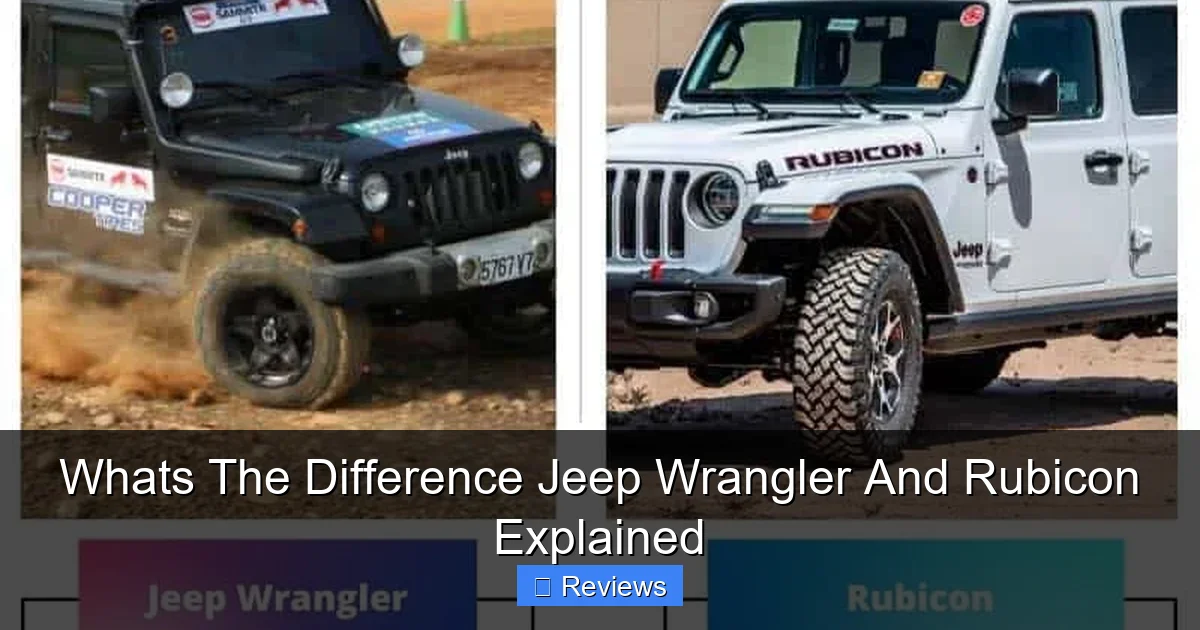
Featured image for whats the difference between a jeep wrangler and a rubicon
Image source: askanydifference.com
Essentially, a Jeep Rubicon is a premium, specialized trim level of the iconic Jeep Wrangler, not a separate model entirely. While every Rubicon is a Wrangler, it distinguishes itself with factory-installed heavy-duty off-road features like locking differentials, a disconnecting sway bar, and enhanced articulation, making it purpose-built for tackling the toughest trails. Therefore, choosing a Rubicon means opting for the Wrangler’s most extreme and capable off-road package.
<h2>Whats The Difference Jeep Wrangler And Rubicon Explained</h2>
<p>The iconic silhouette of a <strong>Jeep Wrangler</strong> is instantly recognizable – a symbol of freedom, adventure, and unparalleled off-road capability. For decades, the <strong>Jeep Wrangler</strong> has been the vehicle of choice for enthusiasts yearning to conquer rugged trails, explore remote landscapes, and experience the thrill of open-air motoring. However, within the diverse <strong>Jeep Wrangler</strong> family, one name frequently sparks confusion and curiosity: the <strong>Rubicon</strong>. Many assume the <strong>Rubicon</strong> is a completely separate model, while others use “Jeep Wrangler” and “<strong>Rubicon</strong>” interchangeably, unaware of the distinct differences.</p>
<p>This common misunderstanding leads to a crucial question for anyone considering joining the <strong>Jeep</strong> family: <em>what exactly is the difference between a <strong>Jeep Wrangler</strong> and a <strong>Rubicon</strong>?</em> The answer is simpler than you might think, yet profoundly impactful on the vehicle’s capabilities and your driving experience. The <strong>Rubicon</strong> is not a standalone model; rather, it is a highly specialized, top-tier trim level <em>within</em> the <strong>Jeep Wrangler</strong> lineup, engineered with specific enhancements to make it the most off-road capable vehicle directly from the factory.</p>
<p>In this comprehensive guide, we will unravel the intricacies of the <strong>Jeep Wrangler</strong> range, pinpointing exactly what sets the <strong>Rubicon</strong> apart from its siblings. Whether you’re an aspiring off-roader, a daily commuter who loves the <strong>Jeep</strong> aesthetic, or simply looking to understand the legend, this explanation will equip you with the knowledge to make an informed decision and appreciate the engineering marvel that is the <strong>Jeep Wrangler</strong> family.</p>
<h3>Understanding the Jeep Wrangler Lineup: The Foundation</h3>
<p>To truly grasp the essence of the <strong>Rubicon</strong>, one must first understand the broader <strong>Jeep Wrangler</strong> ecosystem. The term “<strong>Jeep Wrangler</strong>” refers to a specific model produced by the <strong>Jeep</strong> brand, renowned for its rugged design, open-air freedom, and legendary off-road prowess. Since its inception, the <strong>Wrangler</strong> has evolved, maintaining its core philosophy while introducing advancements in technology, comfort, and safety. However, its fundamental character as a purpose-built adventure vehicle remains unchanged.</p>
<p>Within the <strong>Jeep Wrangler</strong> model line, <strong>Jeep</strong> offers a variety of trim levels, each designed to cater to different needs, budgets, and levels of off-road ambition. These trims range from the entry-level <strong>Wrangler</strong> Sport to the more luxurious <strong>Wrangler</strong> Sahara, and of course, the specialized <strong>Wrangler Rubicon</strong>. Think of it like a ladder: all trims share the fundamental <strong>Jeep Wrangler</strong> DNA, but as you move up the ladder, <strong>Jeep</strong> adds more features, greater sophistication, and significantly enhanced off-road capabilities.</p>
<p>The <strong>Jeep Wrangler</strong> stands out for its unique combination of features: its iconic seven-slot grille, round headlights, removable doors, fold-down windshield, and choice of soft or hard tops. This modular design provides an unparalleled open-air driving experience that is central to the <strong>Jeep Wrangler</strong> appeal. Underneath, a body-on-frame construction and solid front and rear axles provide the durability and articulation essential for tackling tough terrain. Every <strong>Jeep Wrangler</strong> is designed to be capable, but the <strong>Rubicon</strong> takes that capability to an entirely different level, making it the undisputed king of the hill when it comes to factory-equipped off-road readiness.</p>
<h3>What Makes a Rubicon a Rubicon? The Off-Road Prowess</h3>
<p>The heart of the difference between a standard <strong>Jeep Wrangler</strong> and a <strong>Rubicon</strong> lies in a series of highly specialized, heavy-duty components and technologies specifically engineered for extreme off-road performance. The <strong>Rubicon</strong> is named after the Rubicon Trail in California, one of the most challenging off-road trails in the world, and it lives up to that namesake with an array of features that make it ready to tackle almost anything straight from the showroom floor.</p>
<ul>
<li><strong>Heavy-Duty Axles: Dana 44 Front and Rear</strong><br>
Perhaps the most significant upgrade on the <strong>Rubicon</strong> is its robust axle setup. While lower <strong>Jeep Wrangler</strong> trims (like the Sport and Sahara) typically come with Dana 30 front and Dana 35 rear axles, the <strong>Rubicon</strong> is equipped with stronger, heavy-duty Dana 44 axles both front and rear. These axles feature larger axle tubes, stronger shafts, and larger ring and pinion gears. Why does this matter? Stronger axles are crucial for enduring the immense stresses of off-roading, especially when running larger tires, climbing over rocks, or navigating challenging obstacles. They provide enhanced durability and reduce the risk of breakage under extreme conditions, which is invaluable for serious off-road enthusiasts.</li>
<li><strong>Electronic Locking Differentials (Tru-Lok)</strong><br>
This is a game-changer for off-road traction. Standard <strong>Jeep Wrangler</strong> models typically feature open differentials, which send power to the wheel with the least resistance. While great for on-road handling, this means if one wheel loses traction (e.g., gets airborne or stuck in mud), all power is sent to that spinning wheel, and the vehicle stops moving. The <strong>Rubicon</strong> comes standard with front and rear Tru-Lok electronic locking differentials. With the push of a button, these lockers force both wheels on an axle to rotate at the same speed, ensuring that power is distributed evenly. This means even if one wheel is completely off the ground, the other wheel will continue to receive power, pulling the <strong>Rubicon</strong> forward through seemingly impossible situations. This feature is critical for navigating steep climbs, deep mud, or challenging rock crawling sections.</li>
<li><strong>Electronic Sway Bar Disconnect</strong><br>
Another exclusive <strong>Rubicon</strong> feature, the electronic sway bar disconnect system, significantly enhances wheel articulation. The sway bar (or anti-roll bar) helps to keep the vehicle stable on paved roads by limiting independent wheel travel. For serious off-roading, however, maximum wheel articulation is desired to keep all four tires on the ground over uneven terrain. With the press of a button, the <strong>Rubicon</strong>’s front sway bar can be electronically disconnected at speeds under 18 mph. This allows the front wheels to move up and down more independently, dramatically increasing flex and helping the <strong>Jeep Wrangler</strong> maintain traction and stability over large obstacles like rocks, logs, or deep ruts. It’s a vital tool for technical off-road driving that most other factory vehicles lack.</li>
<li><strong>Lower Gearing: Rock-Trac 4:1 Transfer Case</strong><br>
The <strong>Rubicon</strong> is equipped with <strong>Jeep</strong>’s robust Rock-Trac 4×4 system, which includes a 4:1 low-range transfer case. In contrast, most other <strong>Jeep Wrangler</strong> trims feature the Command-Trac system with a 2.72:1 low-range ratio. The higher 4:1 ratio in the <strong>Rubicon</strong> provides a significantly lower crawl ratio, meaning the wheels turn much slower relative to the engine’s RPM. This translates to immense torque multiplication at very low speeds, offering exceptional control and power for precise maneuvering over challenging obstacles like large rocks, steep inclines, or treacherous descents. It minimizes the need for heavy throttle input, allowing for a smoother, more controlled crawl and reducing wear on drivetrain components.</li>
<li><strong>Larger Tires and Fender Flares</strong><br>
To further enhance its off-road capability, the <strong>Rubicon</strong> typically comes standard with larger diameter, more aggressive all-terrain tires – often 33-inch tires, with options for 35-inch tires via packages like the Xtreme Recon. These larger tires provide increased ground clearance, better traction, and improved approach, departure, and breakover angles. To accommodate these beefier tires, the <strong>Rubicon</strong> also features high-clearance fender flares, ensuring there’s enough room for the wheels to articulate without rubbing, even with a factory suspension setup.</li>
<li><strong>Skid Plates and Rock Rails</strong><br>
Protection is paramount when tackling rugged terrain. The <strong>Rubicon</strong> comes factory-equipped with enhanced steel skid plates that shield critical underbody components such as the fuel tank, transfer case, and transmission from impacts with rocks and debris. Additionally, heavy-duty rock rails (often tubular steel) are mounted along the sides of the vehicle, protecting the rocker panels from damage when sliding over rocks or traversing narrow trails. These protective measures are essential for preserving the vehicle’s integrity during aggressive off-roading, giving drivers peace of mind.</li>
</ul>
<h3>Standard Jeep Wrangler Trims: The Versatile Base</h3>
<p>While the <strong>Rubicon</strong> represents the pinnacle of factory off-road capability, it’s important to recognize that all <strong>Jeep Wrangler</strong> trims are inherently capable vehicles. The “standard” <strong>Jeep Wrangler</strong> refers to any trim level that is not a <strong>Rubicon</strong>. These trims often prioritize a balance of on-road comfort, everyday usability, and significant (though not extreme) off-road performance, making them appealing to a broader range of buyers. Let’s look at some key non-<strong>Rubicon</strong> trims:</p>
<ul>
<li><strong>Jeep Wrangler Sport and Sport S</strong><br>
The <strong>Jeep Wrangler</strong> Sport is the entry point into the <strong>Wrangler</strong> lineup. It offers the classic <strong>Jeep</strong> experience at the most accessible price point. While still incredibly capable, it comes with a more basic set of features compared to the <strong>Rubicon</strong>. This includes standard Dana 30 front and Dana 35 rear axles, a Command-Trac 4×4 system with a 2.72:1 low-range ratio, and no locking differentials or electronic sway bar disconnect. Tires are typically smaller (e.g., 31-inch all-seasons), and protective rock rails are usually optional or absent. The Sport S adds some convenience features like power windows, air conditioning, and alloy wheels, but retains the core mechanicals of the Sport. These trims are excellent for those who want the <strong>Jeep Wrangler</strong> lifestyle, plan for light to moderate off-roading, or prefer to customize their vehicle from the ground up.</li>
<li><strong>Jeep Wrangler Sahara</strong><br>
The <strong>Jeep Wrangler</strong> Sahara often represents the more refined and comfort-oriented side of the <strong>Wrangler</strong> family. While it shares the same core axles and 4×4 system (Command-Trac) as the Sport, it typically comes with more upscale interior materials, advanced technology features (like larger touchscreens, navigation, and premium sound systems), and often body-colored fender flares and hardtop. The Sahara is designed for buyers who appreciate the <strong>Wrangler</strong>’s iconic look and capability but prioritize on-road comfort, daily drivability, and a more premium experience. It’s still highly capable for most off-road adventures, such as forest trails, sandy dunes, or gravel roads, but it doesn’t possess the extreme rock-crawling capabilities of a <strong>Rubicon</strong> in stock form.</li>
<li><strong>Jeep Wrangler Willys</strong><br>
The <strong>Jeep Wrangler</strong> Willys trim often bridges the gap between the Sport and the <strong>Rubicon</strong>, offering a significant boost in capability without the full <strong>Rubicon</strong> price tag. The Willys pays homage to the original <strong>Jeep</strong> and typically includes some desirable off-road features like a limited-slip rear differential (which helps prevent wheel spin), larger all-terrain tires (often 32-inch), rock rails, and heavy-duty shock absorbers. While it still typically uses the Command-Trac 4×4 system and standard axles, its enhanced features make it a formidable contender for challenging trails, surpassing the Sport and Sahara in raw capability for less money than a <strong>Rubicon</strong>, especially if you don’t absolutely need front and rear lockers or the sway bar disconnect.</li>
</ul>
<h3>Driving Experience and Target Audience</h3>
<p>The mechanical differences between a <strong>Jeep Wrangler</strong> and a <strong>Rubicon</strong> translate directly into distinct driving experiences, both on and off the road. Understanding these nuances is key to determining which <strong>Jeep Wrangler</strong> aligns best with your lifestyle and adventure goals.</p>
<ul>
<li><strong>On-Road Performance</strong><br>
On paved roads, the <strong>Rubicon</strong>’s specialized equipment can make for a slightly different experience. The larger, more aggressive tires (like BFGoodrich K02s) tend to generate more road noise and can have a firmer ride than the less aggressive tires found on other <strong>Jeep Wrangler</strong> trims. The heavier-duty axles and lower gearing, while fantastic off-road, can sometimes make the <strong>Rubicon</strong> feel a bit less nimble or responsive at higher speeds compared to a Sport or Sahara. While still perfectly drivable as a daily vehicle, the <strong>Rubicon</strong> makes fewer compromises for on-road refinement. Conversely, a standard <strong>Jeep Wrangler</strong> like the Sahara, with its street-biased tires and less aggressive setup, often provides a smoother, quieter, and more comfortable ride for daily commutes and highway cruising. Its lighter components and higher gearing contribute to a slightly more car-like feel, albeit still with the inherent ruggedness of a <strong>Wrangler</strong>.</li>
<li><strong>Off-Road Performance (Where the <strong>Rubicon</strong> Shines)</strong><br>
This is where the <strong>Rubicon</strong> truly earns its legendary status. On challenging trails, the <strong>Rubicon</strong> is simply unstoppable. Its electronic locking differentials allow it to maintain traction over obstacles that would leave other vehicles spinning their wheels. The electronic sway bar disconnect provides incredible articulation, keeping tires planted on extremely uneven terrain. The 4:1 low-range gearing offers precise, controlled crawling over rocks and steep grades, making technical sections feel manageable. For those who frequently tackle trails rated “moderate” to “difficult,” involving rock crawling, deep mud, or significant obstacles, the <strong>Rubicon</strong> requires minimal (if any) additional modifications to excel. It’s designed to conquer the toughest terrain right off the lot.<br><br>
A standard <strong>Jeep Wrangler</strong>, while still highly capable, will find its limits sooner on these extreme trails. A Sport or Sahara is excellent for dirt roads, light to moderate trails, camping trips, and snowy conditions. They can handle uneven terrain, small creek crossings, and sandy beaches with ease. However, when faced with large rock gardens, steep ledges, or deep ruts, they may struggle without the benefit of locking differentials, increased articulation, and lower gearing. To achieve <strong>Rubicon</strong>-level capability, a standard <strong>Jeep Wrangler</strong> would require significant and costly aftermarket modifications, including axle upgrades, lockers, and lift kits.</li>
<li><strong>Target Buyer Profile</strong><br>
The <strong>Rubicon</strong> is ideal for the serious off-road enthusiast, the rock crawler, or the overlander who regularly seeks out the most challenging trails. It’s for someone who demands factory-backed, extreme capability and wants a vehicle that can perform at the highest level without immediate need for expensive modifications. If your weekend plans frequently involve venturing far off the beaten path into truly rugged environments, the <strong>Rubicon</strong> is your match.<br><br>
Conversely, a standard <strong>Jeep Wrangler</strong> (Sport, Sport S, Sahara, Willys) appeals to a broader audience. This includes individuals who love the <strong>Wrangler</strong> aesthetic and open-air experience, engage in occasional light to moderate off-roading, or use their <strong>Jeep Wrangler</strong> primarily as a distinctive daily driver. It’s also an excellent choice for those who enjoy customizing their vehicles, as a standard <strong>Wrangler</strong> offers a fantastic platform for aftermarket upgrades tailored to specific needs and budgets. For example, a <strong>Jeep Wrangler</strong> Sport owner might add a modest lift and larger tires for improved capability, still coming in under the cost of a <strong>Rubicon</strong>, while a Sahara owner might focus on more comfortable interior upgrades and aesthetic enhancements.</li>
</ul>
<h3>Cost, Customization, and Resale Value</h3>
<p>Beyond performance, practical considerations like price, potential for customization, and resale value also play a significant role in the decision-making process between a <strong>Jeep Wrangler</strong> and a <strong>Rubicon</strong>.</p>
<ul>
<li><strong>The Price Tag</strong><br>
Unsurprisingly, the <strong>Rubicon</strong> commands a significantly higher price tag than other <strong>Jeep Wrangler</strong> trims. The advanced mechanical components – the Dana 44 axles, electronic lockers, sway bar disconnect, and Rock-Trac transfer case – represent substantial engineering and manufacturing costs that are reflected in the MSRP. While the initial investment for a <strong>Rubicon</strong> is higher, it often makes financial sense for dedicated off-roaders. The cost of adding similar aftermarket components to a standard <strong>Jeep Wrangler</strong> can easily exceed the price difference, not to mention the labor involved and potential warranty issues. However, if you only need some of those features or don’t plan on extreme off-roading, the premium for a <strong>Rubicon</strong> might not be justified for your specific use case. A well-equipped Sahara or Willys <strong>Jeep Wrangler</strong> can provide excellent value for many.</li>
<li><strong>Customization Potential</strong><br>
Both the <strong>Jeep Wrangler</strong> and the <strong>Rubicon</strong> are legendary for their vast aftermarket support and customization potential. The open-source nature of <strong>Jeep</strong> allows owners to personalize their vehicles in countless ways. For a standard <strong>Jeep Wrangler</strong>, customization often involves adding components that come standard on a <strong>Rubicon</strong> – such as lift kits, larger tires, stronger axles, and even aftermarket lockers. This allows owners to build their <strong>Jeep Wrangler</strong> to their exact specifications, potentially saving money if they don’t need *all* of the <strong>Rubicon</strong> features. For the <strong>Rubicon</strong>, customization often pushes the boundaries even further, with owners opting for even larger tires, more extreme lift kits, reinforced chassis components, and specialized recovery gear to tackle truly formidable challenges. The <strong>Rubicon</strong> serves as an exceptional starting point for the most ambitious builds, requiring less foundational work to achieve extreme capability.</li>
<li><strong>Resale Value</strong><br>
<strong>Jeep Wranglers</strong> are renowned for their excellent resale value across the board, making them a smart investment for many. The <strong>Rubicon</strong>, due to its specialized features and desirability among off-road enthusiasts, tends to hold its value particularly well. While it has a higher initial cost, its unique capabilities and brand recognition ensure a strong demand in the used market. This robust resale value can offset some of the initial premium, especially for owners who maintain their vehicles well and keep modifications tasteful and functional. Standard <strong>Jeep Wrangler</strong> trims also command strong resale values, albeit typically not as high as a comparably aged <strong>Rubicon</strong>, given their lower starting prices and less specialized equipment. Regardless of the trim, buying a <strong>Jeep Wrangler</strong> is generally a financially sound decision in terms of depreciation.</li>
</ul>
<h3>Key Differences: Jeep Wrangler vs. Rubicon</h3>
<p>To provide a clear, at-a-glance comparison, here’s a table summarizing the primary distinctions between a standard <strong>Jeep Wrangler</strong> (represented by Sport/Sahara trims) and the <strong>Jeep Wrangler Rubicon</strong>:</p>
<table border=”1″ style=”width:100%; border-collapse: collapse;”>
<thead>
<tr>
<th style=”padding: 8px; border: 1px solid #ddd; text-align: left;”>Feature</th>
<th style=”padding: 8px; border: 1px solid #ddd; text-align: left;”>Jeep Wrangler Sport/Sahara (General)</th>
<th style=”padding: 8px; border: 1px solid #ddd; text-align: left;”>Jeep Wrangler Rubicon</th>
</tr>
</thead>
<tbody>
<tr>
<td style=”padding: 8px; border: 1px solid #ddd;”><strong>Front Axle</strong></td>
<td style=”padding: 8px; border: 1px solid #ddd;”>Dana 30 (Lighter duty)</td>
<td style=”padding: 8px; border: 1px solid #ddd;”>Dana 44 (Heavy duty, stronger)</td>
</tr>
<tr>
<td style=”padding: 8px; border: 1px solid #ddd;”><strong>Rear Axle</strong></td>
<td style=”padding: 8px; border: 1px solid #ddd;”>Dana 35 or Dana 44 (depending on package)</td>
<td style=”padding: 8px; border: 1px solid #ddd;”>Dana 44 (Heavy duty, stronger)</td>
</tr>
<tr>
<td style=”padding: 8px; border: 1px solid #ddd;”><strong>Transfer Case Low-Range</strong></td>
<td style=”padding: 8px; border: 1px solid #ddd;”>2.72:1 (Command-Trac)</td>
<td style=”padding: 8px; border: 1px solid #ddd;”>4:1 (Rock-Trac, lower for better crawling)</td>
</tr>
<tr>
<td style=”padding: 8px; border: 1px solid #ddd;”><strong>Locking Differentials</strong></td>
<td style=”padding: 8px; border: 1px solid #ddd;”>No (Open, or Limited-Slip rear optional on some trims like Willys)</td>
<td style=”padding: 8px; border: 1px solid #ddd;”>Front & Rear Electronic Tru-Lok (Standard)</td>
</tr>
<tr>
<td style=”padding: 8px; border: 1px solid #ddd;”><strong>Electronic Sway Bar Disconnect</strong></td>
<td style=”padding: 8px; border: 1px solid #ddd;”>No</td>
<td style=”padding: 8px; border: 1px solid #ddd;”>Yes (Standard)</td>
</tr>
<tr>
<td style=”padding: 8px; border: 1px solid #ddd;”><strong>Standard Tires</strong></td>
<td style=”padding: 8px; border: 1px solid #ddd;”>Smaller (e.g., 31-inch), all-season or mild all-terrain</td>
<td style=”padding: 8px; border: 1px solid #ddd;”>Larger (e.g., 33-inch), aggressive all-terrain (e.g., BFGoodrich K02s), optional 35-inch</td>
</tr>
<tr>
<td style=”padding: 8px; border: 1px solid #ddd;”><strong>Fender Flares</strong></td>
<td style=”padding: 8px; border: 1px solid #ddd;”>Standard height (often body-colored on Sahara)</td>
<td style=”padding: 8px; border: 1px solid #ddd;”>High-clearance (to accommodate larger tires)</td>
</tr>
<tr>
<td style=”padding: 8px; border: 1px solid #ddd;”><strong>Skid Plates</strong></td>
<td style=”padding: 8px; border: 1px solid #ddd;”>Basic protection for fuel tank/transfer case</td>
<td style=”padding: 8px; border: 1px solid #ddd;”>Enhanced heavy-duty steel protection for critical components</td>
</tr>
<tr>
<td style=”padding: 8px; border: 1px solid #ddd;”><strong>Rock Rails</strong></td>
<td style=”padding: 8px; border: 1px solid #ddd;”>Side steps or running boards (or none)</td>
<td style=”padding: 8px; border: 1px solid #ddd;”>Heavy-duty tubular rock rails (Standard)</td>
</tr>
<tr>
<td style=”padding: 8px; border: 1px solid #ddd;”><strong>Target Terrain</strong></td>
<td style=”padding: 8px; border: 1px solid #ddd;”>Daily driving, light to moderate trails, sand, snow</td>
<td style=”padding: 8px; border: 1px solid #ddd;”>Extreme rock crawling, challenging technical trails, deep mud, overlanding</td>
</tr>
</tbody>
</table>
<h3>Conclusion: Which Jeep Wrangler is Right for You?</h3>
<p>In conclusion, the fundamental distinction is clear: a <strong>Rubicon</strong> is not a separate model, but rather the most capable, off-road-focused trim level of the iconic <strong>Jeep Wrangler</strong>. It’s a <strong>Jeep Wrangler</strong> on steroids, meticulously engineered with heavy-duty axles, electronic locking differentials, an electronic sway bar disconnect, and specialized low-range gearing to conquer the most challenging terrain imaginable, right from the factory floor. These features are expensive to develop and install, which is why the <strong>Rubicon</strong> carries a higher price tag than other <strong>Jeep Wrangler</strong> trims like the Sport, Sport S, Sahara, or Willys.</p>
<p>The choice between a <strong>Jeep Wrangler</strong> and a <strong>Rubicon</strong> ultimately boils down to your intended use, budget, and appetite for adventure. If your idea of off-roading involves light trails, camping trips, or simply navigating rougher roads to a remote fishing spot, a standard <strong>Jeep Wrangler</strong> will serve you exceptionally well, offering a blend of daily drivability and impressive capability. It also provides an excellent foundation for future modifications, allowing you to gradually upgrade components as your skills and needs evolve. Think of it as a canvas ready for your personal touch.</p>
<p>However, if you are a serious off-roader who regularly seeks out extreme trails, rock crawling, or deep wilderness exploration – adventures that demand the utmost in traction, articulation, and durability – then the <strong>Jeep Wrangler Rubicon</strong> is unequivocally the superior choice. Its factory-equipped arsenal of off-road technology means you get professional-grade performance without the need for immediate, costly aftermarket upgrades. It’s built to dominate the toughest landscapes, providing an unparalleled sense of confidence and capability.</p>
<p>Neither is inherently “better” than the other; they are simply designed for different priorities. Whether you opt for the versatile appeal of a standard <strong>Jeep Wrangler</strong> or the uncompromising prowess of a <strong>Rubicon</strong>, you’re investing in a legend. You’re buying into a lifestyle of freedom, exploration, and the distinctive camaraderie that comes with owning a <strong>Jeep</strong>. Understanding these differences empowers you to select the perfect <strong>Jeep Wrangler</strong> to fuel your adventures and navigate whatever path lies ahead.</p>
In This Article
- 1 Key Takeaways
- 2 Frequently Asked Questions
- 2.1 Is a Rubicon a completely different Jeep model from a Wrangler?
- 2.2 What specific off-road features differentiate a Jeep Wrangler Rubicon from other Wrangler trims?
- 2.3 Why is a Rubicon generally more expensive than other Jeep Wrangler models?
- 2.4 Which is better for extreme off-roading: a standard Jeep Wrangler Sport or a Rubicon?
- 2.5 Does the Rubicon package affect daily driving comfort compared to other Jeep Wrangler trims?
- 2.6 Can you get a Jeep Wrangler Rubicon in both two-door and four-door configurations?
Key Takeaways
- Rubicon is a Wrangler trim: It’s the most off-road ready version.
- Superior off-road capability: Rubicon offers advanced features for extreme trails.
- Key upgrades included: Locking differentials and electronic sway bar disconnect.
- Features heavy-duty axles: Rubicon boasts stronger Dana 44 axles for durability.
- Larger tires come standard: Rubicon includes bigger, more aggressive all-terrain tires.
- Expect a higher price: Rubicon’s specialized gear increases the cost significantly.
- Choose based on use: Select Rubicon for serious off-roading; other trims for daily use.
Frequently Asked Questions
Is a Rubicon a completely different Jeep model from a Wrangler?
No, a Rubicon is not a separate model; it is the most off-road capable trim level available within the Jeep Wrangler lineup. Think of it as a specialized package designed for extreme trail performance.
What specific off-road features differentiate a Jeep Wrangler Rubicon from other Wrangler trims?
The Jeep Wrangler Rubicon comes standard with advanced off-road hardware not found on base models, including front and rear Tru-Lok electronic locking differentials, an electronic sway bar disconnect, and larger 33-inch all-terrain tires. These features significantly enhance its capability on challenging terrain.
Why is a Rubicon generally more expensive than other Jeep Wrangler models?
The higher price of a Rubicon reflects the extensive upgrades and specialized components it includes, such as heavy-duty axles, advanced transfer cases, and the aforementioned locking differentials and sway bar disconnect. These factory-installed enhancements are costly to engineer and produce.
Which is better for extreme off-roading: a standard Jeep Wrangler Sport or a Rubicon?
For extreme off-roading, the Rubicon trim is unequivocally better due to its purpose-built design and superior factory equipment. While all Jeep Wranglers are capable, the Rubicon’s dedicated features allow it to tackle much more challenging trails and obstacles right off the showroom floor.
Does the Rubicon package affect daily driving comfort compared to other Jeep Wrangler trims?
While still comfortable for a 4×4, the Rubicon’s specialized off-road tires and suspension can result in a slightly firmer ride and potentially more road noise compared to lower trims with street-oriented tires. However, many drivers find the trade-off worthwhile for its unparalleled capability.
Can you get a Jeep Wrangler Rubicon in both two-door and four-door configurations?
Yes, the Jeep Wrangler Rubicon is available in both the classic two-door (Wrangler) and the more spacious four-door (Wrangler Unlimited) body styles. This allows buyers to choose the configuration that best suits their needs for passengers and cargo while still enjoying the Rubicon’s top-tier off-road prowess.

At CarLegit, we believe information should be clear, factual, and genuinely helpful. That’s why every guide, review, and update on our website is created with care, research, and a strong focus on user experience.