
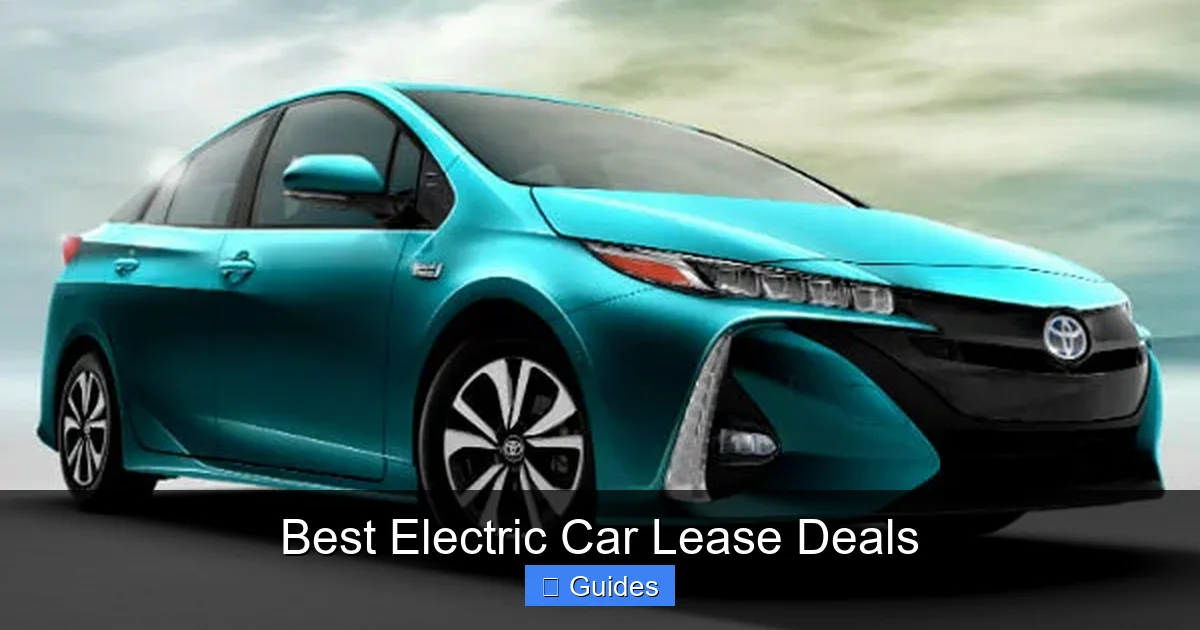
Looking for the best electric car lease deals? You’re in the right place. We break down the top EV leases available now, including low monthly payments, tax credits, and manufacturer incentives. Whether you’re new to electric vehicles or upgrading your current ride, these deals make going green more affordable than ever.
In This Article
- 1 Key Takeaways
- 2 📑 Table of Contents
- 3 Why Lease an Electric Car in 2024?
- 4 How Electric Car Leasing Works
- 5 Top Electric Car Lease Deals Right Now
- 6 How to Get the Best Electric Car Lease Deal
- 7 Pros and Cons of Leasing an Electric Car
- 8 Is Leasing an EV Right for You?
- 9 Final Thoughts: Lock in the Best Electric Car Lease Deals Today
- 10 Frequently Asked Questions
- 10.1 Can I claim the federal tax credit when leasing an electric car?
- 10.2 What happens if I go over my lease mileage limit?
- 10.3 Can I negotiate an electric car lease?
- 10.4 Are electric car leases available in all states?
- 10.5 What happens at the end of an EV lease?
- 10.6 Do I need home charging to lease an electric car?
Key Takeaways
- Lease incentives are at an all-time high: Many automakers are offering cash rebates, reduced money factors, and waived fees to boost EV adoption.
- Federal and state tax credits can lower your effective monthly payment: While you can’t claim the full federal credit directly on a lease, dealers often pass savings through to you.
- Popular models like the Tesla Model 3, Chevrolet Bolt, and Hyundai Ioniq 5 have competitive lease terms: These EVs offer strong value with low monthly payments and high range.
- Lease mileage limits and wear-and-tear policies matter: Understand your driving habits and choose a plan that fits your lifestyle to avoid extra fees.
- Timing your lease can save you hundreds: End-of-quarter and end-of-year promotions often bring the best electric car lease deals.
- Negotiate even on leases: Just like buying, you can often negotiate the capitalized cost and other terms to get a better deal.
- Consider total cost of ownership: Lower monthly payments are great, but factor in insurance, charging, and maintenance for a full picture.
📑 Table of Contents
Why Lease an Electric Car in 2024?
Electric vehicles (EVs) are no longer a futuristic dream—they’re here, and they’re more accessible than ever. With rising gas prices, environmental concerns, and rapid advancements in battery technology, more drivers are making the switch. But buying an EV outright can still be a big financial commitment. That’s where leasing comes in.
Leasing an electric car offers a smart middle ground. You get to drive a brand-new, high-tech vehicle with lower monthly payments than financing a purchase. Plus, you’re often covered under warranty for the entire lease term, meaning fewer repair worries. And with the current wave of incentives, the best electric car lease deals are more attractive than they’ve ever been.
But it’s not just about saving money. Leasing lets you stay up-to-date with the latest EV tech. Battery ranges are improving every year, and new models are launching with faster charging, better interiors, and smarter features. By leasing, you can upgrade to a newer model every few years without the hassle of selling or trading in.
How Electric Car Leasing Works

Visual guide about Best Electric Car Lease Deals
Image source: glory4cars.com
If you’ve leased a gas-powered car before, the process for leasing an EV is very similar. But there are a few key differences—especially when it comes to incentives and total cost of ownership.
When you lease an electric car, you’re essentially paying for the vehicle’s depreciation during the lease term, plus interest (called the “money factor”), taxes, and fees. Most leases last 24 to 36 months, though 12- and 48-month options are also available. At the end of the lease, you return the car to the dealership—no long-term commitment.
One major advantage of leasing an EV is access to federal and state incentives. While the federal tax credit of up to $7,500 doesn’t go directly to you as a lessee, dealerships often apply it to reduce the capitalized cost of the vehicle. This lowers your monthly payment significantly. Some states also offer additional rebates or tax credits that can be applied at the time of lease.
Understanding Lease Terms
Every lease agreement includes several key terms:
- Capitalized Cost: This is the negotiated price of the vehicle. The lower it is, the lower your monthly payment will be.
- Residual Value: The estimated value of the car at the end of the lease. EVs with strong resale value (like Teslas) often have higher residuals, which can lead to lower payments.
- Money Factor: This is the interest rate on your lease. It’s usually a small decimal (like 0.00125), but it translates to an APR. Ask for it in APR form to compare offers.
- Mileage Allowance: Most leases allow 10,000 to 15,000 miles per year. Exceeding this limit results in per-mile charges, often $0.15 to $0.25.
- Disposition Fee: A fee charged when you return the car, typically around $300–$500.
EV-Specific Lease Considerations
Electric cars have unique factors that can affect your lease:
- Charging Infrastructure: Make sure you have access to home charging or reliable public stations. Range anxiety is real, but planning ahead helps.
- Battery Degradation: Over time, EV batteries lose some capacity. Most leases cover this under warranty, but it’s something to be aware of.
- Software Updates: Many EVs receive over-the-air updates that improve performance and add features—something you’ll enjoy throughout your lease.
Top Electric Car Lease Deals Right Now

Visual guide about Best Electric Car Lease Deals
Image source: carparisonleasing.co.uk
As of mid-2024, several automakers are offering standout lease deals on popular EV models. These deals combine low monthly payments, generous incentives, and strong vehicle performance. Here are some of the best electric car lease deals available today.
1. Tesla Model 3 – Starting at $349/month
Tesla continues to dominate the EV market, and the Model 3 remains one of the most leased electric cars. Current offers include:
- Monthly payment: $349 (after $3,500 due at signing)
- Term: 36 months
- Mileage: 10,000 miles/year
- Incentives: $7,500 federal tax credit applied by dealer
The Model 3 offers up to 358 miles of range, autopilot features, and access to Tesla’s Supercharger network. While Tesla doesn’t negotiate prices, the federal credit and low money factor make this a strong deal.
2. Chevrolet Bolt EV – Starting at $199/month
The Bolt EV is one of the most affordable EVs on the market, and its lease deals reflect that. Current offers include:
- Monthly payment: $199 (after $2,999 due at signing)
- Term: 36 months
- Mileage: 10,000 miles/year
- Incentives: $7,500 federal credit + $5,000 GM loyalty/conquest bonus
With 259 miles of range and a compact design, the Bolt is perfect for city driving. GM has been aggressive with incentives to clear inventory, making this one of the best electric car lease deals for budget-conscious drivers.
3. Hyundai Ioniq 5 – Starting at $299/month
The Ioniq 5 stands out with its retro-futuristic design, ultra-fast charging, and spacious interior. Current lease offers:
- Monthly payment: $299 (after $3,995 due at signing)
- Term: 39 months
- Mileage: 12,000 miles/year
- Incentives: $7,500 federal credit + $2,000 Hyundai loyalty bonus
The Ioniq 5 can charge from 10% to 80% in just 18 minutes with a 350-kW charger. It also comes with Hyundai’s excellent warranty, giving you peace of mind during your lease.
4. Nissan Leaf – Starting at $229/month
The Nissan Leaf is one of the original mass-market EVs and still offers solid value. Current deals:
- Monthly payment: $229 (after $2,999 due at signing)
- Term: 36 months
- Mileage: 10,000 miles/year
- Incentives: $7,500 federal credit + $2,000 Nissan loyalty bonus
The Leaf offers up to 212 miles of range (on the Plus model) and comes with Nissan’s ProPILOT Assist for semi-autonomous driving. It’s a reliable, no-frills EV that’s great for commuters.
5. Ford Mustang Mach-E – Starting at $349/month
Ford’s electric SUV combines performance, style, and practicality. Current lease offers:
- Monthly payment: $349 (after $3,995 due at signing)
- Term: 36 months
- Mileage: 10,000 miles/year
- Incentives: $7,500 federal credit + $2,500 Ford loyalty bonus
The Mach-E offers up to 314 miles of range and comes with Ford’s SYNC 4A infotainment system. It’s a great option if you want an EV with SUV versatility and sporty handling.
How to Get the Best Electric Car Lease Deal

Visual guide about Best Electric Car Lease Deals
Image source: carparisonleasing.co.uk
Finding the best electric car lease deals isn’t just about picking the lowest monthly payment. It’s about understanding the full picture and negotiating smartly. Here’s how to get the most value from your lease.
1. Time Your Lease Right
Automakers often offer the best deals at the end of the quarter (March, June, September, December) or at the end of the model year (typically August–October). These are when dealers are trying to meet sales targets or clear out old inventory.
For example, in September 2023, several brands slashed lease prices on 2023 models to make room for 2024 versions. If you’re flexible with timing, you can save hundreds.
2. Negotiate the Capitalized Cost
Even though leasing seems less negotiable than buying, you can still haggle. The capitalized cost (the price of the car) directly affects your monthly payment. Use online pricing tools like Edmunds or Kelley Blue Book to find the invoice price and aim to lease below that.
For instance, if the MSRP of a Hyundai Ioniq 5 is $48,000, but the invoice is $45,000, try to get the capitalized cost down to $44,000 or lower. Every $1,000 reduction can save you about $30 per month on a 36-month lease.
3. Watch Out for Excess Fees
Some leases come with hidden fees—like documentation fees, acquisition fees, or excessive disposition fees. Ask for a full breakdown of all charges before signing.
Also, be cautious of “wear and tear” policies. While minor scratches are expected, some dealers charge for things like tire wear or interior stains. Take photos of the car before and after your lease to protect yourself.
4. Choose the Right Mileage Limit
If you drive more than 12,000 miles a year, a 10,000-mile lease could cost you extra. For example, exceeding by 5,000 miles at $0.20 per mile adds $1,000 to your bill.
But if you drive less, you can save by choosing a lower mileage allowance. Some leases even offer prepaid mileage packages, which can be cheaper than paying per mile later.
5. Consider State and Local Incentives
In addition to the federal tax credit, many states offer rebates or tax credits for EV leases. For example:
- California: Up to $2,000 rebate through the Clean Vehicle Rebate Project (CVRP)
- New York: Up to $2,000 rebate through the Drive Clean Rebate
- Colorado: Up to $5,000 state tax credit
These can be applied at the time of lease, further reducing your monthly payment. Check your state’s Department of Motor Vehicles or energy office for current programs.
Pros and Cons of Leasing an Electric Car
Like any financial decision, leasing an EV has its upsides and downsides. Let’s break them down so you can decide if it’s right for you.
Pros
- Lower Monthly Payments: Leasing typically costs less per month than financing a purchase.
- Access to Latest Technology: EVs improve quickly—leasing lets you upgrade every few years.
- Warranty Coverage: Most leases fall within the manufacturer’s warranty period, so repairs are covered.
- No Resale Hassle: You don’t have to worry about selling the car later.
- Incentive Access: You benefit from federal and state credits without claiming them yourself.
Cons
- No Ownership: You don’t build equity, and you’ll always have a car payment if you keep leasing.
- Mileage Restrictions: Exceeding your limit can be expensive.
- Wear and Tear Fees: You may pay extra for damage beyond “normal” use.
- Early Termination Fees: Ending your lease early can cost thousands.
- Charging Dependency: You need reliable access to charging, which isn’t always available.
Is Leasing an EV Right for You?
Leasing an electric car makes sense for many drivers, but it’s not for everyone. Ask yourself these questions:
- Do I drive less than 15,000 miles per year?
- Do I want to drive a new car every 2–3 years?
- Do I have access to home or workplace charging?
- Am I comfortable with not owning the vehicle?
- Do I want to take advantage of current incentives?
If you answered “yes” to most of these, leasing could be a great fit. But if you drive a lot, prefer ownership, or plan to keep a car for 10+ years, buying might be better.
Final Thoughts: Lock in the Best Electric Car Lease Deals Today
The electric vehicle market is evolving fast, and 2024 is shaping up to be a great year for EV leases. With strong incentives, competitive pricing, and a growing selection of models, there’s never been a better time to go electric.
The best electric car lease deals combine low monthly payments, generous incentives, and a vehicle that fits your lifestyle. Whether you’re drawn to the tech-forward Tesla Model 3, the budget-friendly Chevrolet Bolt, or the stylish Hyundai Ioniq 5, there’s a lease out there for you.
Remember to shop around, negotiate terms, and time your lease for maximum savings. And don’t forget to factor in charging costs, insurance, and maintenance for a complete picture of your expenses.
By choosing to lease an EV, you’re not just saving money—you’re also making a positive impact on the environment. With zero tailpipe emissions and lower overall carbon footprint, electric cars are a smart choice for the planet and your wallet.
So what are you waiting for? Start exploring the best electric car lease deals today and take the first step toward a cleaner, greener future.
Frequently Asked Questions
Can I claim the federal tax credit when leasing an electric car?
No, you cannot claim the federal tax credit directly when leasing. However, the leasing company (usually the manufacturer’s finance arm) claims it and often passes the savings to you by reducing the capitalized cost of the vehicle, which lowers your monthly payment.
What happens if I go over my lease mileage limit?
If you exceed your annual mileage allowance, you’ll be charged a per-mile fee—typically $0.15 to $0.25. For example, going 2,000 miles over on a 10,000-mile lease could cost you $300–$500 at the end of the term.
Can I negotiate an electric car lease?
Yes! While some brands like Tesla have fixed pricing, most automakers allow negotiation on the capitalized cost, money factor, and fees. Use pricing guides and competitor offers to strengthen your position.
Are electric car leases available in all states?
Most EV leases are available nationwide, but incentives and availability may vary by state. Some states have additional rebates or restrictions, so check with local dealers and state programs.
What happens at the end of an EV lease?
At the end of your lease, you return the vehicle to the dealership. You may be charged for excess wear and tear or mileage, and there’s usually a disposition fee. You can also choose to buy the car or lease a new one.
Do I need home charging to lease an electric car?
While not required, home charging is highly recommended for convenience and cost savings. Public charging is available, but it’s often slower and more expensive. If you don’t have home charging, make sure there are reliable public stations near you.

At CarLegit, we believe information should be clear, factual, and genuinely helpful. That’s why every guide, review, and update on our website is created with care, research, and a strong focus on user experience.