
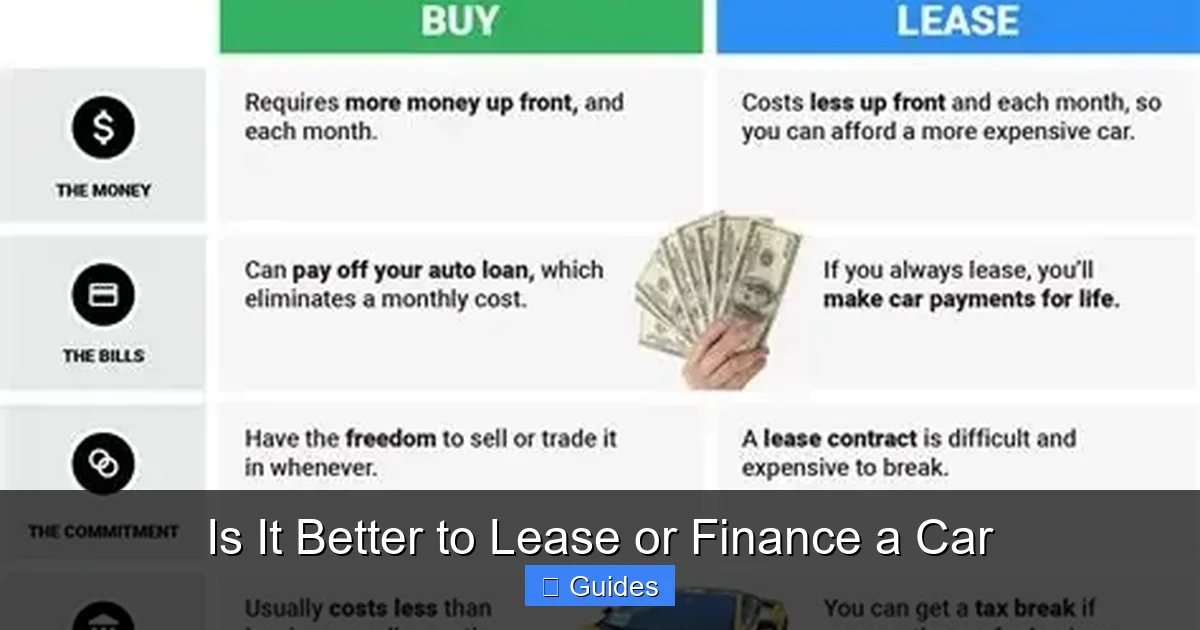
Choosing between leasing and financing a car depends on your financial goals, driving habits, and lifestyle preferences. Leasing offers lower monthly payments and the chance to drive new models more often, while financing builds equity and allows full ownership—ideal if you plan to keep the vehicle long-term.
This is a comprehensive guide about is it better to lease or finance a car.
In This Article
- 1 Key Takeaways
- 2 Is It Better to Lease or Finance a Car?
- 3 What Is Leasing a Car?
- 4 What Is Financing a Car?
- 5 Cost Comparison: Leasing vs. Financing
- 6 Lifestyle and Driving Habits: Which Option Fits You?
- 7 Long-Term Financial Impact
- 8 Tips for Making the Right Choice
- 9 Conclusion
- 10 Frequently Asked Questions
Key Takeaways
- Leasing means lower monthly payments: You only pay for the car’s depreciation during the lease term, not the full value, which typically results in smaller monthly payments compared to financing.
- Financing builds ownership equity: When you finance a car, you’re paying toward full ownership. Once the loan is paid off, the car is yours to keep, sell, or trade in.
- Leases come with mileage and wear restrictions: Most leases limit how many miles you can drive (usually 10,000–15,000 per year) and charge fees for excessive wear and tear.
- Financing offers more freedom and customization: Owned vehicles can be modified, driven without mileage worries, and kept as long as you like—no penalties for high mileage or dents.
- Leasing may require less upfront cost: Many leases require little or no down payment, making them attractive for buyers who want to minimize initial expenses.
- Financing usually costs more over time: While you own the car eventually, total interest paid on a loan can make financing more expensive than leasing in the long run—especially if you upgrade frequently.
- Your driving habits and financial goals matter most: Frequent upgraders and low-mileage drivers may prefer leasing; long-term owners and high-mileage drivers often benefit more from financing.
[FEATURED_IMAGE_PLACEOLDER]
Is It Better to Lease or Finance a Car?
Buying a car is one of the biggest financial decisions most people make—right after purchasing a home. But before you even think about make, model, or color, you’ve got a more fundamental choice to make: should you lease or finance your next vehicle?
It’s a question that trips up even seasoned car shoppers. Both options have their perks and pitfalls, and what works for your neighbor might not work for you. Maybe you love driving the latest tech-packed SUV every three years. Or perhaps you’re the type who keeps a car for a decade, putting on thousands of miles without a second thought. Your lifestyle, budget, and long-term goals all play a role.
The good news? You don’t have to guess. By understanding how leasing and financing work—and how they align with your personal situation—you can make a confident, informed decision. This guide breaks down everything you need to know, from monthly costs and mileage limits to ownership benefits and long-term value. Whether you’re eyeing a sleek electric sedan or a rugged pickup truck, we’ll help you figure out which path makes the most sense.
What Is Leasing a Car?
Leasing a car is essentially renting it for a fixed period—typically two to four years. Instead of buying the vehicle outright, you pay for its depreciation (loss in value) during the lease term, plus fees, taxes, and interest. At the end of the lease, you return the car to the dealership unless you choose to buy it at its residual (predetermined) value.
Think of it like renting an apartment. You get to use it, but you don’t own it. And just like with rent, you’re expected to follow certain rules—like keeping the place in good condition and not making major changes without permission.
How Car Leasing Works
When you lease, the dealership estimates how much the car will be worth at the end of the lease—this is called the residual value. The difference between the car’s current price and its residual value is what you’re paying for. For example, if a $30,000 car has a 60% residual value after three years, it’ll be worth $18,000. You’ll pay for the $12,000 in depreciation, spread over 36 monthly payments.
On top of that, you’ll pay interest (called the money factor in leasing), taxes, and possibly a down payment or acquisition fee. Some leases also include maintenance packages or gap insurance, which can simplify budgeting.
Pros of Leasing
One of the biggest advantages of leasing is lower monthly payments. Because you’re only covering depreciation—not the full cost of the car—your payments are usually 20% to 40% lower than financing the same vehicle.
Leasing also lets you drive a new car more often. Most people upgrade every two to three years, enjoying the latest safety features, infotainment systems, and fuel-efficient engines. And since leases typically cover the manufacturer’s warranty period, you’re less likely to face costly repairs out of pocket.
Another perk? Minimal upfront costs. Many leases require little or no down payment, and some even roll taxes and fees into the monthly payment. This can be a lifesaver if you’re short on cash but still want a reliable, modern vehicle.
Cons of Leasing
But leasing isn’t all smooth driving. One major downside is that you don’t build any equity. Once the lease ends, you walk away with nothing to show for your payments—no car, no trade-in value, no asset.
Leases also come with strict rules. Most limit your annual mileage to 10,000, 12,000, or 15,000 miles. Go over, and you’ll pay anywhere from 10 to 25 cents per extra mile. And if the car has excessive wear—like deep scratches, dents, or stained upholstery—you could face hefty end-of-lease charges.
Customization is another limitation. Want to tint the windows, install a spoiler, or upgrade the sound system? You’ll need approval from the leasing company, and you may have to return the car to its original condition before turning it in.
What Is Financing a Car?
Financing a car means taking out a loan to purchase it. You make monthly payments over a set term—usually 36 to 72 months—until the balance is paid off. Once the loan is complete, the car is fully yours.
Unlike leasing, financing is about ownership. You’re investing in an asset that you can keep, sell, or trade in whenever you choose. It’s similar to buying a house with a mortgage: you pay interest over time, but eventually, you own the property outright.
How Car Financing Works
When you finance, the lender (usually a bank, credit union, or dealership) pays the dealer for the car, and you repay the loan with interest. The total cost includes the principal (the car’s price), interest, taxes, and fees.
Your monthly payment depends on several factors: the car’s price, down payment, loan term, and interest rate. A larger down payment or shorter loan term reduces interest costs, while a longer term lowers monthly payments but increases total interest paid.
For example, a $30,000 car with a $5,000 down payment and a 5% interest rate over 60 months would cost about $472 per month. Over five years, you’d pay roughly $28,320—$3,320 in interest.
Pros of Financing
The biggest benefit of financing is ownership. Once the loan is paid off, the car is yours free and clear. You can drive it as much as you want, modify it, sell it, or keep it for years—no penalties or restrictions.
Financing also offers long-term savings if you keep the car beyond the loan term. After five years of payments, you could enjoy several more years of driving without a car payment. That’s pure savings compared to leasing, where you’re always paying for the next vehicle.
Another advantage? No mileage limits. Whether you drive 5,000 or 50,000 miles a year, it’s your car—you decide. And you can customize it however you like: lift kits, custom paint, performance upgrades—it’s all fair game.
Cons of Financing
But financing isn’t perfect. Monthly payments are typically higher than leasing because you’re paying for the entire car, not just its depreciation. And if you choose a long loan term (like 72 or 84 months), you could end up paying thousands in interest.
There’s also the risk of being “upside-down” on your loan—owing more than the car is worth. This happens when the car depreciates faster than you pay down the loan. If you need to sell or trade in early, you might have to pay the difference out of pocket.
And unlike leasing, you’re responsible for maintenance and repairs once the warranty expires. While some loans include service plans, most don’t, so budgeting for upkeep is essential.
Cost Comparison: Leasing vs. Financing
When it comes to cost, leasing and financing each have their financial sweet spots. Let’s look at a real-world example to see how they stack up.
Say you’re considering a 2024 Honda Accord EX, priced at $32,000. You plan to drive 12,000 miles per year and keep the car for five years.
Leasing Scenario
With a 36-month lease, 12,000-mile annual limit, and $2,000 down, your monthly payment might be around $350. Over three years, you’ll pay $14,600 ($350 x 36 + $2,000). At the end, you return the car. If you want a new one, you start the process again—another down payment, another lease agreement.
Total cost over five years (assuming you lease two cars): ~$29,200.
Financing Scenario
With a $5,000 down payment and a 60-month loan at 5% interest, your monthly payment would be about $500. Over five years, you’ll pay $35,000 ($500 x 60 + $5,000). But here’s the kicker: after five years, the car is yours. Even if it’s worth $15,000, you’ve built $15,000 in equity.
Net cost over five years: $20,000 ($35,000 paid minus $15,000 resale value).
Which Is Cheaper?
In this example, financing costs less over five years—$20,000 vs. $29,200. But that’s not the whole story. Leasing offers lower monthly payments and no long-term commitment, which might be better if your income fluctuates or you prefer driving new cars often.
Financing wins on long-term value, but leasing wins on short-term affordability and flexibility. Your choice depends on how you weigh monthly cash flow versus total cost of ownership.
Lifestyle and Driving Habits: Which Option Fits You?
Your personal habits and preferences play a huge role in whether leasing or financing is better for you. Let’s break it down.
You Should Lease If…
– You drive fewer than 15,000 miles per year.
– You like having the latest technology and safety features.
– You prefer lower monthly payments and minimal upfront costs.
– You don’t want to deal with long-term maintenance and repairs.
– You’re okay with not owning the car and returning it every few years.
For example, Sarah, a marketing manager in Chicago, drives 8,000 miles a year and loves trying new models. She leases a luxury sedan every three years, enjoys the low payments, and never worries about repair bills. For her, leasing is a no-brainer.
You Should Finance If…
– You drive more than 15,000 miles annually.
– You plan to keep the car for five years or longer.
– You want to customize or modify your vehicle.
– You’re focused on building equity and long-term savings.
– You don’t mind higher monthly payments in exchange for ownership.
Take Mike, a delivery driver in Texas. He puts 25,000 miles on his truck each year and plans to keep it for a decade. Financing makes sense—he avoids mileage penalties, builds value, and saves money over time.
What About Electric Vehicles (EVs)?
EVs add another layer to the decision. Many come with federal and state tax credits, which can reduce the purchase price—but these incentives usually apply only to financed or purchased vehicles, not leases (though some lease deals pass the savings to you).
Also, EVs depreciate faster than gas cars in the early years, which can make leasing attractive. But as battery technology improves and charging infrastructure grows, long-term ownership may become more appealing.
Long-Term Financial Impact
Beyond monthly payments, it’s important to consider the long-term financial picture.
Depreciation and Equity
Cars lose value fast—up to 20% in the first year and 60% over five years. Leasing accounts for this by charging you only for depreciation. Financing, however, means you absorb the full depreciation hit—but you also gain equity as the loan balance decreases.
If you keep a financed car past the loan term, that equity turns into savings. No more car payments, just insurance, gas, and maintenance.
Total Cost of Ownership
Leasing may seem cheaper upfront, but over a decade, frequent lessees can end up paying more. Imagine leasing a $350/month car every three years for 10 years: that’s $126,000 in payments with no asset to show for it.
A financed car, even with higher payments, could cost less over the same period—especially if you keep it for 8–10 years. After the loan ends, you’re driving payment-free.
Credit and Financial Flexibility
Both options affect your credit. Missing payments hurts your score, but making on-time payments builds it. Leasing may require a higher credit score for the best rates, while financing offers more flexibility for buyers with average credit.
Also, consider your overall financial goals. If you’re saving for a house or paying off debt, lower monthly payments from leasing might free up cash. But if you’re focused on net worth, financing and building equity could be smarter.
Tips for Making the Right Choice
Still unsure? Here are some practical tips to help you decide.
1. Calculate Your Annual Mileage
Check your odometer from last year. If you’re over 15,000 miles, financing is likely better. If under 12,000, leasing could save you money.
2. Compare Total Costs Over 5–7 Years
Use online calculators to model both scenarios. Include down payments, monthly costs, interest, fees, and estimated resale value.
3. Read the Fine Print
Lease agreements are full of details—mileage limits, wear-and-tear policies, early termination fees. Financing contracts include prepayment penalties and loan terms. Know what you’re signing.
4. Consider Your Future Plans
Are you starting a family? Changing jobs? Moving cities? Life changes can affect your car needs. A lease offers flexibility; financing offers stability.
5. Negotiate Like a Pro
Whether leasing or financing, negotiate the price of the car first. A lower price means lower payments, regardless of the method. Don’t focus only on monthly payments—dealers can stretch terms to hide costs.
6. Test Drive Both Options
Some dealerships let you “test lease” or compare payment scenarios. Use this to see how each feels in real life.
Conclusion
So, is it better to lease or finance a car? The answer isn’t one-size-fits-all. It depends on your budget, driving habits, and long-term goals.
Leasing shines for those who want lower payments, newer models, and minimal hassle. It’s ideal for city dwellers, tech lovers, and low-mileage drivers who don’t mind returning their car every few years.
Financing, on the other hand, is perfect for high-mileage drivers, long-term owners, and anyone who values ownership and equity. It costs more upfront but pays off over time.
The best choice is the one that aligns with your lifestyle and financial priorities. Take the time to crunch the numbers, think about your habits, and don’t rush the decision. Whether you lease or finance, the right car is out there—and now you know how to get it on terms that work for you.
Frequently Asked Questions
Can I buy my leased car at the end of the lease?
Yes, most leases allow you to purchase the car at its residual value. This amount is set at the start of the lease and listed in your contract. You can pay it outright or finance the purchase.
What happens if I go over my lease mileage limit?
You’ll be charged a per-mile fee, typically between 10 and 25 cents. For example, driving 2,000 extra miles at 15 cents each would cost $300. Some leases offer mileage buy-ups upfront to avoid this.
Is it better to lease or finance a used car?
Financing is usually better for used cars. They depreciate slower than new ones, so you build equity faster. Leasing used cars is less common and often has higher interest rates.
Can I terminate a car lease early?
Yes, but it usually comes with penalties. Early termination fees can be steep, often equal to several months of payments. Some leases allow transfers to another person to avoid fees.
Do I need gap insurance when financing?
It’s highly recommended, especially if you have a small down payment or a long loan term. Gap insurance covers the difference between what you owe and the car’s value if it’s totaled or stolen.
Which option builds credit faster?
Both can help build credit if you make on-time payments. However, financing may have a slightly bigger impact because loan accounts are weighted more heavily in credit scoring models than leases.

At CarLegit, we believe information should be clear, factual, and genuinely helpful. That’s why every guide, review, and update on our website is created with care, research, and a strong focus on user experience.