
Leasing a car offers lower monthly payments, access to the latest technology, and minimal maintenance worries. It’s a flexible, cost-effective way to drive a new vehicle every few years without the long-term commitment of ownership.
In This Article
- 1 Key Takeaways
- 2 📑 Table of Contents
- 3 Introduction: Why Leasing a Car Might Be the Smart Move
- 4 Lower Monthly Payments: Stretch Your Budget Further
- 5 Drive the Latest Models with Cutting-Edge Features
- 6 Minimal Maintenance and Repair Worries
- 7 No Resale or Trade-In Hassle
- 8 Tax Benefits for Business Use
- 9 Lower Down Payments and Easier Approval
- 10 Conclusion: Is Leasing Right for You?
- 11 Frequently Asked Questions
Key Takeaways
- Lower Monthly Payments: Lease payments are typically 30–50% lower than loan payments for the same vehicle, freeing up your budget for other expenses.
- Drive Newer Cars More Often: Most leases last 2–4 years, letting you upgrade to a new model with the latest safety and tech features regularly.
- Warranty Coverage: Leased vehicles are usually under manufacturer warranty, so repairs are often covered, reducing out-of-pocket costs.
- No Resale Hassle: At the end of the lease, you simply return the car—no need to sell or trade it in yourself.
- Tax Advantages for Business Use: If you use the car for work, you may deduct a portion of lease payments as a business expense.
- Lower Down Payments: Many leases require little or no down payment, making it easier to get into a new car quickly.
- Predictable Costs: With fixed monthly payments and known mileage limits, leasing offers financial predictability compared to unpredictable depreciation and repair costs of ownership.
📑 Table of Contents
- Introduction: Why Leasing a Car Might Be the Smart Move
- Lower Monthly Payments: Stretch Your Budget Further
- Drive the Latest Models with Cutting-Edge Features
- Minimal Maintenance and Repair Worries
- No Resale or Trade-In Hassle
- Tax Benefits for Business Use
- Lower Down Payments and Easier Approval
- Conclusion: Is Leasing Right for You?
Introduction: Why Leasing a Car Might Be the Smart Move
Thinking about getting a new car? You’ve probably heard the classic debate: buy or lease? While buying a car outright has its fans—especially those who love building equity and driving without mileage limits—leasing is quietly becoming the go-to choice for many drivers. And it’s not hard to see why. The perks of leasing a car go far beyond just lower monthly payments. From cutting-edge tech to peace of mind on maintenance, leasing offers a modern, flexible way to enjoy driving without the long-term baggage of ownership.
In today’s fast-paced world, where technology evolves faster than your phone’s software updates, driving a car that’s more than a few years old can feel like using a flip phone in the age of smartphones. Leasing lets you stay current—literally. Every two to four years, you can trade up to a newer model with better fuel efficiency, advanced safety systems, and the latest infotainment features. Plus, you avoid the stress of selling a used car, dealing with depreciation, or worrying about unexpected repair bills once the warranty expires.
Lower Monthly Payments: Stretch Your Budget Further
Visual guide about Perks of Leasing a Car
Image source: nyc3.digitaloceanspaces.com
One of the biggest draws of leasing is the significantly lower monthly payment compared to financing a purchase. Because you’re only paying for the car’s depreciation during the lease term—plus fees and interest—rather than the full value of the vehicle, your out-of-pocket cost each month is much more manageable.
Let’s break it down with a real-world example. Say you’re looking at a new SUV that costs $40,000. If you finance it with a 60-month loan at 5% interest, your monthly payment could be around $750. But if you lease the same vehicle for 36 months with a typical depreciation rate, your monthly payment might drop to $450—that’s $300 less per month. Over three years, that’s $10,800 saved. That’s a vacation, a home improvement project, or a serious boost to your emergency fund.
How Lease Payments Are Calculated
Lease payments are based on three main factors: the car’s capitalized cost (what you agree to pay), the residual value (how much the car is expected to be worth at the end of the lease), and the money factor (the lease’s interest rate). The difference between the capitalized cost and residual value is your depreciation—the amount you’re essentially “renting” the car for. Add in taxes, fees, and the money factor, and you get your monthly payment.
Because you’re not paying off the entire vehicle, just the portion that loses value while you drive it, the math works in your favor. This makes leasing especially attractive for people who want a premium or luxury vehicle but don’t want to commit to a high loan payment.
Tips to Lower Your Lease Payment Even More
Want to squeeze even more value out of your lease? Here are a few smart strategies:
– Negotiate the capitalized cost: Just like when buying, you can negotiate the price of the car before leasing. A lower starting price means lower depreciation and a smaller monthly payment.
– Put down a larger down payment (cap cost reduction): While many leases advertise “$0 down,” putting money down reduces your monthly payment. Just be cautious—if the car is totaled or stolen, you may not get that money back unless you have gap insurance.
– Choose a longer lease term: Extending your lease from 24 to 36 months can lower monthly payments, though you’ll pay more in total interest.
– Look for lease specials: Automakers often run promotional leases with reduced money factors or waived fees, especially at the end of model years.
Drive the Latest Models with Cutting-Edge Features
Visual guide about Perks of Leasing a Car
Image source: infographicplaza.com
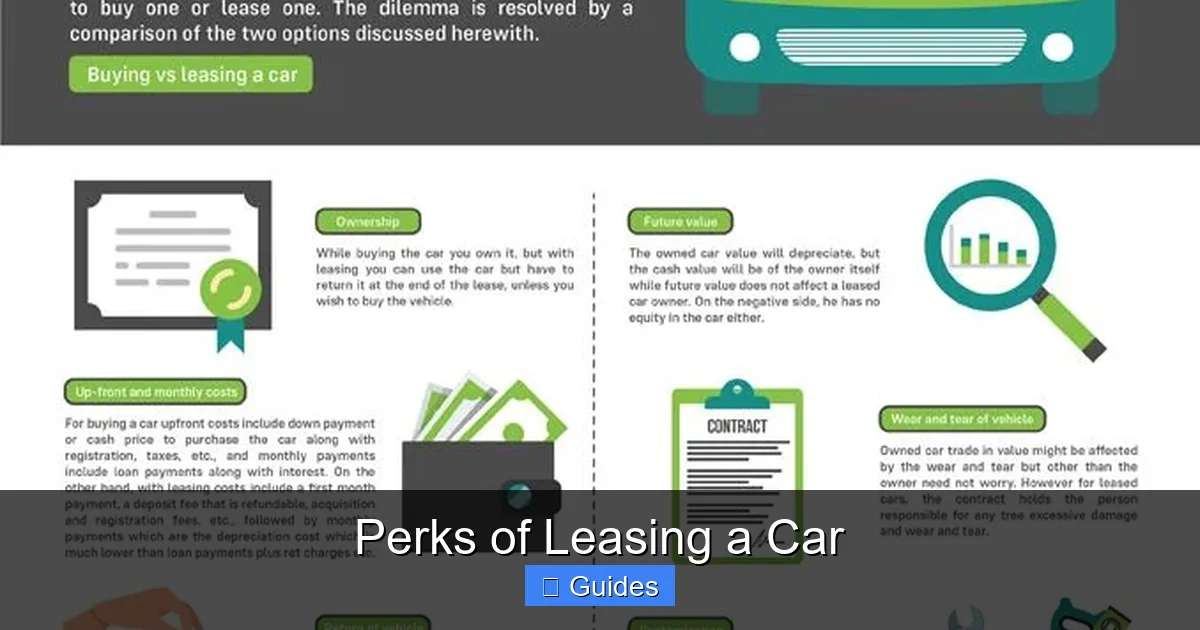
Technology in cars is advancing at lightning speed. What was high-tech five years ago—like basic Bluetooth or a rearview camera—is now standard. Today’s vehicles come packed with features like adaptive cruise control, lane-keeping assist, wireless Apple CarPlay and Android Auto, over-the-air software updates, and even semi-autonomous driving modes.
When you lease, you’re not stuck with outdated tech. Most leases last 24 to 36 months, which means you can upgrade to a new model every few years and always be driving something fresh and innovative. This is especially appealing if you love having the latest gadgets or if safety is a top priority—newer cars often have better crash ratings and more advanced driver-assistance systems.
Stay Safe with Modern Safety Features
Safety isn’t just about airbags and seatbelts anymore. Today’s vehicles include features like automatic emergency braking, blind-spot monitoring, rear cross-traffic alert, and even night vision. These systems can prevent accidents before they happen, giving you and your family extra peace of mind.
For example, a 2024 sedan might include a system that detects pedestrians at night and automatically applies the brakes if you don’t react in time. That kind of tech simply wasn’t available in cars from just a decade ago. By leasing, you ensure your vehicle is equipped with the most up-to-date safety advancements.
Enjoy the Latest in Comfort and Convenience
Beyond safety, newer cars offer incredible comfort and convenience. Think heated and ventilated seats, panoramic sunroofs, premium sound systems, and customizable ambient lighting. Many modern vehicles also offer smartphone integration, voice commands, and even built-in Wi-Fi hotspots.
Imagine driving cross-country with your kids entertained by streaming movies through the car’s infotainment system, or warming up your car remotely on a cold winter morning. These aren’t luxuries—they’re everyday perks that make driving more enjoyable. And with a lease, you get to experience them without waiting years to afford a new car.
Minimal Maintenance and Repair Worries

Visual guide about Perks of Leasing a Car
Image source: car-bon.com.au
One of the hidden perks of leasing a car is the reduced stress around maintenance and repairs. Since most leases are for 2–4 years, your vehicle is typically still under the manufacturer’s warranty for the entire lease term. That means if something breaks—whether it’s the transmission, infotainment system, or air conditioning—you’re usually covered at no extra cost.
Warranty Coverage During the Lease
New car warranties often last 3 years/36,000 miles or more, and many powertrain warranties extend even further. Because lease terms are shorter than these coverage periods, you’re almost always protected. This eliminates the surprise repair bills that can hit used car owners hard.
For example, if your leased car’s engine develops a problem at 20,000 miles, the dealership will fix it under warranty. You don’t pay a dime. Compare that to owning a 5-year-old car out of warranty—where a single repair could cost thousands.
Scheduled Maintenance Made Easy
Many automakers now include complimentary scheduled maintenance for the first few years, especially on luxury brands. This means oil changes, tire rotations, brake inspections, and fluid top-offs are all taken care of at no charge. Even if your lease doesn’t include free maintenance, you’re still driving a newer car with fewer wear-and-tear issues.
Some leasing companies also offer maintenance packages you can add to your lease, bundling routine services into your monthly payment. This makes budgeting even easier and ensures your car stays in top condition.
Avoid the “Used Car Roulette”
When you buy a car, especially a used one, you’re taking on the risk of hidden problems. Even with a pre-purchase inspection, issues can arise after you drive off the lot. With a lease, you’re getting a brand-new vehicle with a full factory warranty—no guessing games, no lemon laws, no sleepless nights wondering if the transmission will fail next month.
No Resale or Trade-In Hassle
Selling a car is a pain. Between listing it online, meeting with potential buyers, negotiating prices, and handling paperwork, it can take weeks—or even months—to complete. And that’s if you’re lucky. If your car has high mileage, wear and tear, or isn’t in high demand, you might have to drop the price just to move it.
Leasing eliminates this headache entirely. When your lease ends, you simply return the car to the dealership. No need to clean it out, fix scratches, or haggle with strangers. Just hand over the keys, settle any excess wear-and-tear charges (if applicable), and walk away.
End-of-Lease Process: Simple and Straightforward
At the end of your lease, the dealership will inspect the car for excessive wear and mileage overages. If everything is within the agreed limits, you’re free to go. You can then lease a new car, buy the one you’ve been driving, or walk away and explore other options.
Some people worry about being “stuck” with a car they don’t want, but leasing actually gives you more flexibility. You’re not tied down. If your needs change—maybe you need a bigger SUV for a growing family or a more fuel-efficient car for a long commute—you can switch easily.
Avoid Depreciation Losses
Cars lose value the moment they’re driven off the lot. In fact, a new car can depreciate 20% in the first year and up to 60% over three years. When you buy, you absorb that loss. When you lease, the leasing company takes on the depreciation risk. You only pay for the portion of the car’s value you use during the lease term.
This means you’re not losing money on a rapidly depreciating asset. Instead, you’re paying for the privilege of driving it—kind of like renting a luxury apartment instead of buying a house in a volatile market.
Tax Benefits for Business Use
If you use your car for work, leasing can offer significant tax advantages. The IRS allows business owners and self-employed individuals to deduct a portion of lease payments as a business expense, which can lower your taxable income.
How Business Lease Deductions Work
The amount you can deduct depends on the percentage of business use. For example, if you drive your leased car 70% for work and 30% for personal trips, you can deduct 70% of the lease payments. This applies to both the monthly payment and any down payment (amortized over the lease term).
Let’s say your monthly lease payment is $500, and you use the car 80% for business. That’s $400 per month—or $4,800 per year—that you can deduct from your business income. Depending on your tax rate, that could save you hundreds or even thousands of dollars.
Bonus: Section 179 Deduction
For business owners, the IRS also offers the Section 179 deduction, which allows you to deduct the full purchase price of qualifying equipment—including vehicles—in the year you start using it. While this applies more to purchased vehicles, some leasing structures (like capital leases) may also qualify. Consult a tax professional to see if your lease setup is eligible.
Keep Accurate Records
To claim lease deductions, you’ll need to track your mileage and usage. Use a mileage log app or a simple spreadsheet to record business trips. The IRS may ask for proof, so stay organized.
Lower Down Payments and Easier Approval
Getting into a new car doesn’t have to drain your savings. Many lease deals require little or no down payment, making it easier to drive off the lot without a huge upfront cost.
$0 Down Lease Offers
It’s common to see lease promotions advertising “$0 due at signing” or “$99 down.” These deals roll the down payment, first month’s payment, and fees into the monthly cost or offer incentives to reduce upfront expenses. While this can increase your monthly payment slightly, it preserves your cash for emergencies or investments.
Easier Credit Approval
Leasing can also be more accessible for people with less-than-perfect credit. Because the leasing company retains ownership of the vehicle, they may be more willing to approve applicants with lower credit scores than a traditional lender would be for a car loan. This doesn’t mean you’ll get the best rate—your credit still affects the money factor—but it does open doors for more people.
Flexible Lease Terms
Leasing companies often offer a range of terms and mileage limits, so you can tailor the lease to your lifestyle. Need a car for just two years? No problem. Drive more than 12,000 miles a year? You can choose a higher mileage allowance (though it will cost more). This flexibility makes leasing adaptable to changing life circumstances.
Conclusion: Is Leasing Right for You?
The perks of leasing a car are clear: lower payments, newer models, minimal maintenance, no resale stress, and potential tax benefits. It’s a smart, flexible option for people who want to drive a reliable, up-to-date vehicle without the long-term commitment of ownership.
But leasing isn’t for everyone. If you drive a lot, love customizing your car, or plan to keep a vehicle for 10+ years, buying might be better. However, for commuters, tech lovers, business professionals, and anyone who values predictability and convenience, leasing offers a compelling alternative.
Before you decide, compare lease offers from multiple dealerships, read the fine print, and consider your driving habits and financial goals. And remember—leasing isn’t just about saving money. It’s about enjoying the ride, staying current, and driving with confidence.
So the next time you’re in the market for a new car, don’t just think buy or lease. Think about what matters most to you. If it’s lower costs, newer tech, and hassle-free driving, leasing might just be the perfect fit.
Frequently Asked Questions
Is leasing a car cheaper than buying?
Leasing often has lower monthly payments than buying, but you don’t build equity. Over the long term, buying may be cheaper if you keep the car for many years. Leasing is cost-effective if you prefer driving new cars every few years.
What happens at the end of a car lease?
At the end of the lease, you return the car to the dealership. You may be charged for excess mileage or wear and tear. You can then lease a new car, buy the current one, or walk away.
Can you negotiate a car lease?
Yes, you can negotiate the capitalized cost, money factor, and other terms just like when buying. A lower negotiated price reduces your monthly payment and overall cost.
Are lease payments tax-deductible?
If you use the car for business, you can deduct a portion of lease payments based on business use percentage. Personal use payments are not tax-deductible.
What happens if I go over my mileage limit?
Most leases charge a per-mile fee (e.g., $0.25/mile) for exceeding the agreed limit. To avoid fees, choose a higher mileage allowance upfront or return the car early.
Can you lease a used car?
Most leases are for new cars, but some dealerships and leasing companies offer certified pre-owned (CPO) vehicles with lease options. These often come with warranties and lower payments.

At CarLegit, we believe information should be clear, factual, and genuinely helpful. That’s why every guide, review, and update on our website is created with care, research, and a strong focus on user experience.