
Trading in a leased car doesn’t have to be confusing. With the right preparation and knowledge, you can turn your lease end into a smart financial move—whether you’re upgrading, switching brands, or buying out your vehicle.
So, you’re nearing the end of your car lease—and now you’re wondering: *Can I even trade in a leased car?* The short answer is yes. But it’s not as simple as just driving up to a dealership and saying, “Here, take this.” Trading in a leased car involves understanding your contract, knowing your car’s worth, and navigating a few financial nuances. The good news? With the right approach, trading in your leased vehicle can actually work in your favor—especially if you time it right and do your homework.
Leasing has become increasingly popular over the past decade because it offers lower monthly payments, warranty coverage for the entire term, and the chance to drive a new car every few years. But when that three- or four-year term wraps up, many lessees feel stuck. Do I return the car and walk away? Buy it outright? Or try to trade it in for something newer? The truth is, trading in a leased car is a legitimate and often smart option—but only if you understand how it works. Unlike trading in a car you own, a leased vehicle still belongs to the leasing company (often a bank or financial institution). That means you can’t just hand over the keys and walk away with a check. Instead, you’ll need to coordinate between the leasing company, the dealership, and sometimes even a third-party buyer.
The key to a smooth trade-in experience lies in preparation. From reviewing your lease agreement to getting your car appraised, every step matters. And while it might seem overwhelming at first, breaking it down into manageable parts makes it much easier. In this guide, we’ll walk you through everything you need to know—from understanding your lease terms to negotiating the best deal on your next vehicle. Whether you’re looking to upgrade to a newer model, switch to a different brand, or simply avoid the hassle of returning a car with excess wear, this guide will help you make an informed decision.
In This Article
- 1 Key Takeaways
- 2 📑 Table of Contents
- 3 Understanding Your Lease Agreement
- 4 Assessing Your Car’s Market Value
- 5 Timing Your Trade-In Right
- 6 Buying Your Leased Car First (Then Trading It In)
- 7 Negotiating the Best Deal
- 8 Working with Your Leasing Company
- 9 Final Steps and Paperwork
- 10 Conclusion
- 11 Frequently Asked Questions
- 11.1 Can I trade in a leased car before the lease ends?
- 11.2 What happens if my leased car is worth less than the residual value?
- 11.3 Do I have to go back to the same dealership to trade in my leased car?
- 11.4 Can I trade in a leased car with excess mileage?
- 11.5 Is it better to buy my leased car or trade it in?
- 11.6 How long does the trade-in process take?
Key Takeaways
- Understand your lease terms: Know your mileage limits, wear-and-tear guidelines, and end-of-lease options before making any decisions.
- Assess your car’s value: Use tools like Kelley Blue Book or Edmunds to compare your car’s current market value against its residual value.
- Negotiate with confidence: If your car is worth more than the residual value, you can use that equity toward a new lease or purchase.
- Time it right: Start shopping for your next vehicle 3–4 months before your lease ends to avoid rushed decisions.
- Consider buying first: Purchasing your leased car may give you more flexibility when trading it in at a dealership.
- Avoid excess fees: Address minor repairs and stay within mileage limits to reduce end-of-lease charges.
- Work with your leasing company: They can provide payoff quotes and help coordinate the trade-in process smoothly.
📑 Table of Contents
Understanding Your Lease Agreement
Before you even think about trading in your leased car, you need to know exactly what you’re dealing with. Your lease agreement is more than just a piece of paper—it’s a binding contract that outlines your rights, responsibilities, and options at the end of the term. Ignoring it could cost you hundreds, or even thousands, in unexpected fees.
Start by pulling out your lease contract (or logging into your leasing company’s online portal). Look for three critical pieces of information: the **residual value**, the **mileage allowance**, and the **wear-and-tear guidelines**.
The residual value is the predetermined amount your car is expected to be worth at the end of the lease. For example, if you leased a $30,000 car with a 60% residual value, the leasing company expects it to be worth $18,000 after three years. This number is crucial because it determines whether your car has equity—or negative equity—at lease end.
Next, check your mileage limit. Most leases allow 10,000 to 15,000 miles per year. If you’ve driven more than that, you’ll be charged a per-mile fee (typically $0.10 to $0.25). For instance, exceeding your limit by 5,000 miles at $0.15 per mile means a $750 penalty. That’s money you could lose if you’re not careful.
Finally, review the wear-and-tear policy. Leasing companies expect some normal use, but excessive damage—like deep scratches, dents, or stained upholstery—can result in repair charges. Some companies offer wear-and-tear protection plans for an extra fee, which can save you money if your car isn’t in perfect condition.
What Happens at Lease End?
At the end of your lease, you typically have three options:
1. **Return the car** and walk away (possibly paying excess mileage or damage fees).
2. **Buy the car** at the residual value.
3. **Trade it in** for a new vehicle.
Trading in falls under option three—but it’s not as straightforward as trading in a car you own. Since the leasing company still holds the title, you can’t just sell or trade the car without their involvement. Instead, the dealership will work with the leasing company to settle the account.
For example, let’s say your car’s residual value is $18,000, but it’s currently worth $20,000 on the open market. That $2,000 difference is equity you can use toward a new lease or purchase. The dealership will pay off the leasing company and apply the equity to your new deal. But if your car is worth less than the residual value—say, $16,000—you’ll have negative equity, meaning you owe $2,000. In that case, you’d need to pay the difference out of pocket or roll it into a new lease (which isn’t always recommended).
Assessing Your Car’s Market Value
Visual guide about How to Trade in a Leased Car
Image source: fourwheeltrends.com
Now that you understand your lease terms, it’s time to find out what your car is actually worth. This step is essential because it tells you whether you have equity to work with—or if you’re better off returning the car and starting fresh.
Start by using reputable online valuation tools like **Kelley Blue Book (KBB)**, **Edmunds**, or **NADA Guides**. These platforms let you input your car’s make, model, year, mileage, condition, and features to get an estimated market value. Be honest about the condition—overestimating can lead to disappointment later.
For example, a 2021 Honda CR-V with 30,000 miles in “good” condition might be valued at $22,000 on KBB. But if your lease residual is $20,000, that means you have $2,000 in equity. That’s a great position to be in.
But what if your car is worth less than the residual value? Let’s say the same CR-V is only worth $18,500. Now you’re $1,500 underwater. In that case, trading in might not be the best move unless you’re willing to pay the difference or roll it into a new lease.
Get a Professional Appraisal
Online tools are helpful, but they’re not always accurate. For a more precise estimate, consider getting a professional appraisal. Many dealerships offer free appraisals, especially if you’re shopping for a new car. Just be aware that their offer might be lower than private market value—dealerships need to make a profit when they resell.
Alternatively, you can use services like **CarMax** or **Vroom**, which provide instant online offers based on your car’s details. These offers are usually valid for a week or two and can give you a realistic idea of what your car is worth.
Pro tip: Get appraisals from at least two sources. If one dealership offers $19,000 and another offers $20,500, you’ve got leverage to negotiate.
Timing Your Trade-In Right

Visual guide about How to Trade in a Leased Car
Image source: cartradeinsider.com
Timing is everything when it comes to trading in a leased car. If you wait until the last minute, you’ll be rushed, stressed, and more likely to accept a bad deal. The ideal time to start the process is **3 to 4 months before your lease ends**.
Why so early? Because it gives you time to:
– Shop around for the best trade-in value.
– Compare offers from multiple dealerships.
– Negotiate your next lease or purchase deal.
– Handle any necessary repairs or cleaning.
Let’s say your lease ends on December 15. By starting in September, you can test-drive new models, get pre-approved for financing, and even lock in a trade-in offer. This way, when your lease is up, you’re ready to roll—literally.
Avoid the End-of-Lease Rush
Many lessees wait until the final month to think about their next move. But dealerships know this, and they often take advantage of the urgency. By starting early, you put yourself in control. You can say no to lowball offers and walk away if the deal isn’t right.
Plus, starting early gives you time to address any issues with your current car. If you’re over your mileage limit, you can reduce driving or pay the excess fee in advance. If there’s minor damage, you can get it repaired before the appraisal.
Buying Your Leased Car First (Then Trading It In)
Visual guide about How to Trade in a Leased Car
Image source: eautolease.com
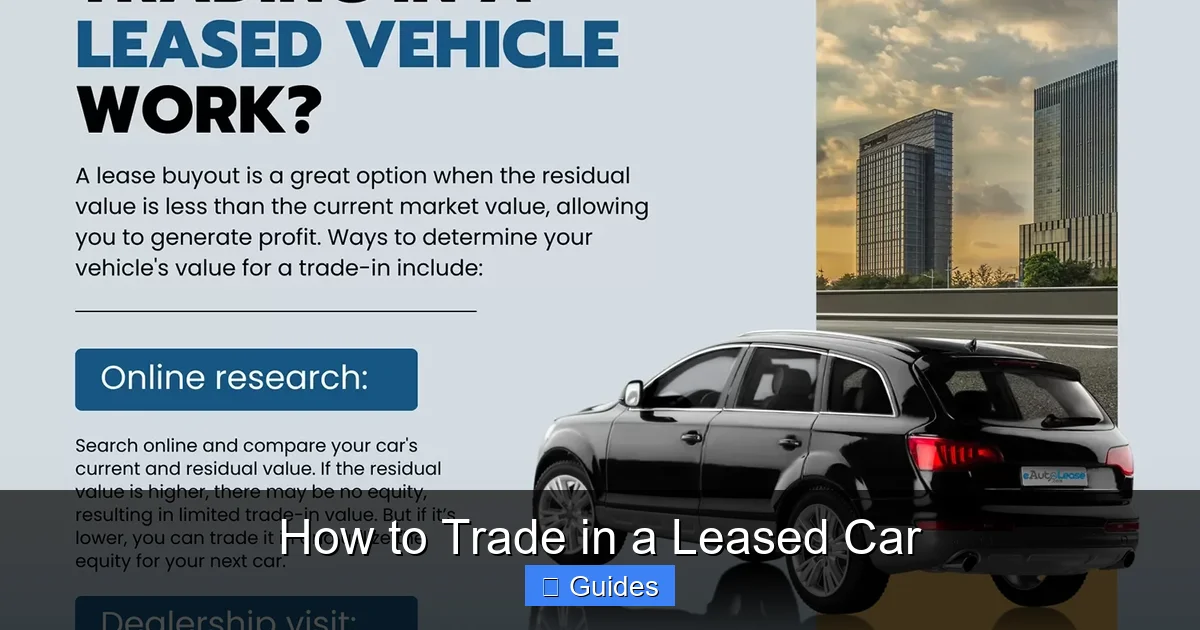
Here’s a strategy that many people overlook: **buy your leased car first, then trade it in**. This might sound counterintuitive, but it can give you more flexibility and potentially better value.
When you buy your leased car, you pay the residual value plus any applicable taxes and fees. Once you own it, you can trade it in just like any other vehicle. The dealership will appraise it, and you’ll get credit toward your new car.
Why would you do this? Because it removes the leasing company from the equation. Instead of coordinating between the dealer and the lessor, you’re dealing directly with the dealership. This can simplify the process and give you more negotiating power.
When Does Buying First Make Sense?
Buying your leased car first is a good idea if:
– Your car’s market value is higher than the residual value (you have equity).
– You want to avoid end-of-lease fees for wear and tear.
– You’re planning to keep the car long-term but are considering a trade-in later.
For example, let’s say your leased Toyota Camry has a residual value of $16,000 but is worth $18,000. If you buy it for $16,000 and then trade it in for $18,000, you’ve effectively made $2,000—minus taxes and fees, of course.
But be cautious: if your car is worth less than the residual value, buying it first could lock you into a loss. Only go this route if you’re confident the trade-in value will cover your purchase cost.
Negotiating the Best Deal
Negotiating a trade-in for a leased car is different from negotiating a purchase. You’re not just haggling over the price of a new car—you’re also dealing with the value of your current vehicle and any equity or negative equity.
The key is to **negotiate the trade-in value and the new car price separately**. Don’t let the dealer bundle everything into one number. This way, you can ensure you’re getting fair value for both transactions.
Start by getting a firm offer for your trade-in. Use your appraisals as leverage. If CarMax offered $20,000 and the dealer only offers $18,500, ask them to match it. Most dealerships will, especially if they want your business.
Next, negotiate the price of the new car. Research the invoice price and any current incentives. Use tools like **TrueCar** or **Edmunds’ True Market Value** to see what others are paying in your area.
Watch Out for Rolled-In Negative Equity
If your leased car is worth less than the residual value, the dealer might offer to “roll” the difference into your new lease or loan. While this sounds convenient, it can cost you more in the long run.
For example, if you owe $2,000 and roll it into a new 36-month lease, you’re essentially financing that $2,000 over three years—plus interest. That could add $60 to $80 per month to your payment.
Instead, consider paying the difference out of pocket. It might hurt now, but it saves you money over time.
Working with Your Leasing Company
Your leasing company plays a crucial role in the trade-in process. Even though you’re dealing with a dealership, the leasing company must approve the transaction and release the title.
Start by contacting your leasing company 60 to 90 days before your lease ends. Ask for a **payoff quote**, which tells you exactly how much it would cost to buy the car. This includes the residual value, taxes, and any fees.
Most leasing companies will also provide a **trade-in authorization form** that the dealership needs to complete the transaction. Make sure the dealer fills this out correctly to avoid delays.
What If the Dealer Lowballs Your Trade-In?
If the dealership offers less than your car is worth, you have options. You can:
– Walk away and sell the car privately (after buying it out).
– Use a third-party service like CarMax or Vroom to get a better offer.
– Negotiate with the dealer using your appraisal as proof.
Remember: the leasing company doesn’t care who buys the car—as long as they get paid. So if a third party offers more, the dealer may be willing to match it to keep your business.
Final Steps and Paperwork
Once you’ve agreed on a deal, it’s time to finalize the paperwork. This includes:
– Signing the trade-in authorization form.
– Completing the new lease or purchase agreement.
– Settling any remaining balance (if you have negative equity).
– Transferring registration and insurance.
Make sure all documents are accurate and that you understand the terms. Ask questions if anything is unclear.
After everything is signed, the dealership will pay off your leasing company and apply any equity to your new deal. You’ll drive off in your new car—and the process is complete.
Conclusion
Trading in a leased car doesn’t have to be complicated. With the right knowledge and preparation, you can turn your lease end into a smart financial move. Start by understanding your lease terms, assess your car’s value, and time your trade-in right. Consider buying your car first if it makes sense, and always negotiate separately for the trade-in and new vehicle. Work closely with your leasing company and don’t be afraid to walk away from a bad deal.
By following these steps, you’ll not only avoid common pitfalls but also maximize the value of your current vehicle. Whether you’re upgrading to a newer model or switching brands, trading in your leased car can be a smooth and rewarding experience.
Frequently Asked Questions
Can I trade in a leased car before the lease ends?
Yes, you can trade in a leased car early, but you’ll need to pay off the remaining lease payments plus any early termination fees. This is only worth it if the equity in your car covers those costs.
What happens if my leased car is worth less than the residual value?
If your car is worth less than the residual value, you have negative equity. You can pay the difference out of pocket, roll it into a new lease (not recommended), or return the car and walk away (if allowed by your lease).
Do I have to go back to the same dealership to trade in my leased car?
No, you can trade in your leased car at any dealership. However, the leasing company must approve the transaction, so coordination is required.
Can I trade in a leased car with excess mileage?
Yes, but you’ll be charged for the excess miles. These fees can be paid at lease end or rolled into a new lease. It’s often cheaper to pay them upfront.
Is it better to buy my leased car or trade it in?
It depends on your car’s value. If it’s worth more than the residual value, buying it first may give you more trade-in flexibility. If it’s worth less, returning or trading it in directly is usually better.
How long does the trade-in process take?
The process typically takes 1 to 2 hours at the dealership, but it’s best to start shopping 3 to 4 months before your lease ends to get the best deal.

At CarLegit, we believe information should be clear, factual, and genuinely helpful. That’s why every guide, review, and update on our website is created with care, research, and a strong focus on user experience.