
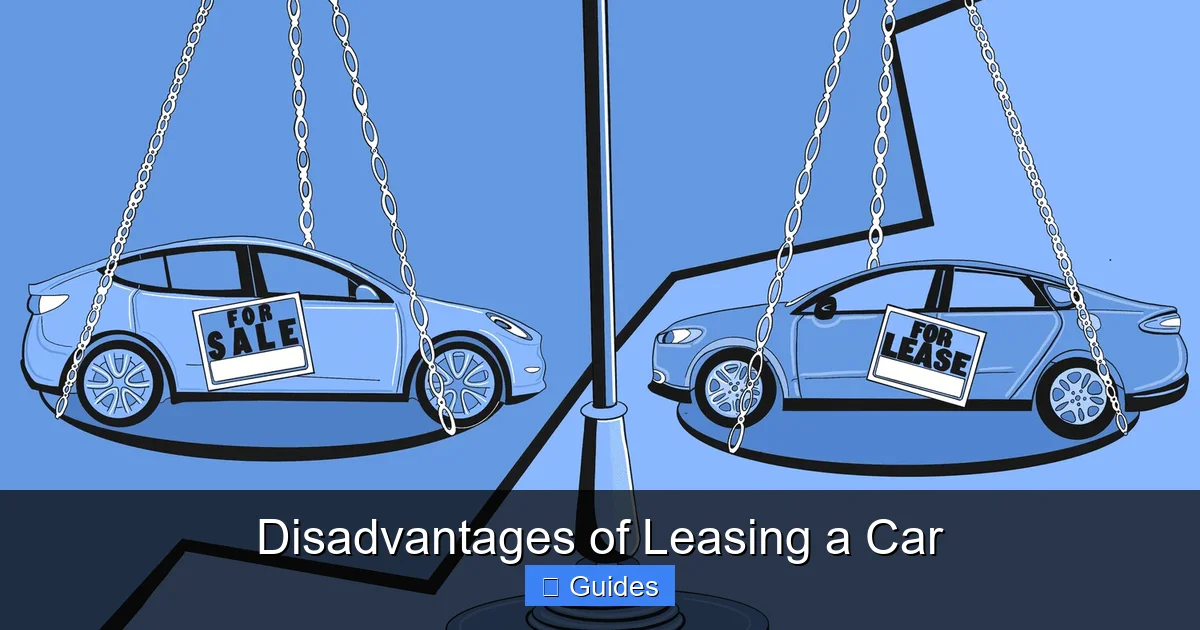
Leasing a car may seem affordable upfront, but it comes with several hidden drawbacks. From strict mileage limits to long-term financial costs, understanding the disadvantages of leasing a car helps you make a smarter decision.
In This Article
- 1 Key Takeaways
- 2 📑 Table of Contents
- 3 Introduction: Is Leasing Really the Smart Choice?
- 4 No Ownership: You’re Paying to Rent, Not Build Equity
- 5 Mileage Restrictions: The Hidden Cost of Driving Too Much
- 6 Wear and Tear Fees: Paying for “Normal” Use
- 7 Early Termination Penalties: Getting Stuck in a Lease
- 8 Customization Limits: You Can’t Make It Yours
- 9 Higher Insurance Costs: More Coverage, More Expense
- 10 Conclusion: Is Leasing Worth the Trade-Offs?
- 11 Frequently Asked Questions
- 11.1 Can I negotiate the terms of a car lease?
- 11.2 What happens if I return a leased car early?
- 11.3 Are lease payments tax-deductible?
- 11.4 Can I buy my leased car at the end of the lease?
- 11.5 What counts as “normal wear and tear” on a leased car?
- 11.6 Is leasing a car better than buying for low-mileage drivers?
Key Takeaways
- No Ownership: You don’t own the car at the end of the lease, meaning you’re essentially renting it for years.
- Mileage Restrictions: Most leases cap annual mileage (usually 10,000–15,000 miles), and exceeding it results in costly fees.
- Long-Term Expense: While monthly payments are lower than buying, you’ll never build equity and may pay more over time.
- Wear and Tear Fees: You’re charged for excessive damage beyond “normal wear and tear,” which can be subjective and expensive.
- Early Termination Penalties: Ending a lease early often triggers steep fees, making it hard to get out of the contract.
- Customization Limits: You can’t modify leased vehicles, limiting personalization and upgrades.
- Insurance Costs: Leased cars typically require higher insurance coverage, increasing monthly expenses.
📑 Table of Contents
- Introduction: Is Leasing Really the Smart Choice?
- No Ownership: You’re Paying to Rent, Not Build Equity
- Mileage Restrictions: The Hidden Cost of Driving Too Much
- Wear and Tear Fees: Paying for “Normal” Use
- Early Termination Penalties: Getting Stuck in a Lease
- Customization Limits: You Can’t Make It Yours
- Higher Insurance Costs: More Coverage, More Expense
- Conclusion: Is Leasing Worth the Trade-Offs?
Introduction: Is Leasing Really the Smart Choice?
Leasing a car has become a popular alternative to buying, especially for drivers who want lower monthly payments and the thrill of driving a new vehicle every few years. It sounds appealing—drive a shiny new sedan or SUV with the latest tech, pay less each month, and simply return it when the lease ends. But beneath the glossy brochures and smooth sales pitches lies a reality that many consumers overlook: leasing isn’t always the best financial move.
While leasing offers short-term benefits, it comes with a host of long-term disadvantages that can catch you off guard. From mileage restrictions to unexpected fees, the fine print of a lease agreement often hides pitfalls that can cost you thousands over time. If you’re considering leasing your next car, it’s crucial to understand not just the perks, but the real drawbacks that could impact your budget, lifestyle, and peace of mind.
No Ownership: You’re Paying to Rent, Not Build Equity
One of the biggest disadvantages of leasing a car is that you never actually own the vehicle. Think of it like renting an apartment—you pay month after month, but when the lease ends, you walk away with nothing to show for it. Unlike buying a car, where your payments go toward building equity and eventually owning a valuable asset, leasing keeps you in a cycle of perpetual payments.
When you buy a car, even with a loan, you’re investing in something that’s yours. Once the loan is paid off, the car is yours to keep, sell, or trade in. But with a lease, you’re only paying for the car’s depreciation during the lease term—typically 24 to 36 months—plus interest, fees, and taxes. At the end of the lease, the car goes back to the dealership, and you start the process all over again with a new lease.
This lack of ownership means you’re not building any long-term value. You’re essentially renting a car for years, and every dollar you spend goes toward temporary use, not long-term gain. For example, if you lease a $35,000 car for three years with monthly payments of $400, you’ll have paid $14,400—but you won’t own a single thing. Compare that to buying the same car with a loan, where after three years, you’d own a vehicle worth $20,000 or more, depending on depreciation.
Example: Leasing vs. Buying Over Time
Let’s say you’re deciding between leasing and buying a mid-size SUV. You lease it for $380 per month over three years. Total cost: $13,680. At the end, you return the car and lease a new one. Over nine years (three leases), you’d pay $41,040 and own nothing.
Now, consider buying the same SUV with a 60-month loan at $550 per month. After five years, you’ve paid $33,000 and own a car worth about $15,000. If you keep driving it for another four years, your total cost drops to just $33,000 for nine years of use—saving you over $8,000 compared to leasing.
This example shows how leasing can cost significantly more over time, especially if you plan to drive for many years. While leasing offers lower monthly payments, the long-term financial impact can be substantial.
Tip: Consider Your Long-Term Plans
If you drive a lot, plan to keep a car for more than five years, or want to eventually own a vehicle, buying is usually the smarter choice. Leasing makes sense only if you prefer driving new cars every few years and don’t mind never owning one.
Mileage Restrictions: The Hidden Cost of Driving Too Much
Another major disadvantage of leasing a car is the strict mileage limits imposed by most lease agreements. Typically, leases allow between 10,000 and 15,000 miles per year. If you exceed this limit, you’ll be charged a per-mile fee—usually between $0.10 and $0.25—which can add up quickly.
For example, if your lease allows 12,000 miles per year and you drive 15,000, you’ve gone over by 3,000 miles. At $0.15 per mile, that’s an extra $450 per year. Over a three-year lease, that’s $1,350 in penalty fees—money you could have used toward buying a car instead.
Many people underestimate how much they drive. A daily commute of 30 miles round-trip adds up to over 7,000 miles a year. Add weekend trips, family visits, or road trips, and you can easily surpass the limit. Even occasional long drives can push you over the edge.
Example: The Commuter’s Dilemma
Sarah leases a compact car with a 12,000-mile annual limit. She drives 40 miles round-trip to work, five days a week—that’s 10,400 miles just from commuting. She also drives 200 miles per month for errands and weekend trips, adding another 2,400 miles. Her total: 12,800 miles—just 800 over the limit. At $0.20 per mile, she’ll owe $160 at the end of the year. Over three years, that’s $480 in extra fees.
Now imagine she takes a 1,000-mile vacation once a year. That pushes her over by 1,800 miles annually, costing her $360 per year—$1,080 over the lease term. These fees can turn a seemingly affordable lease into a financial burden.
Tip: Choose a Higher Mileage Lease (If You Can)
Some dealerships offer leases with higher mileage limits—18,000 or even 20,000 miles per year—for a slightly higher monthly payment. If you know you’ll drive more than average, this can save you money in the long run. For example, paying an extra $20 per month for a 15,000-mile lease might cost $720 over three years, but it could save you $1,000 in overage fees.
However, even with a higher limit, you’re still restricted. There’s no flexibility once you sign the contract. If your driving habits change—say, you get a new job farther away—you’re stuck with the same mileage cap.
Wear and Tear Fees: Paying for “Normal” Use
Leased cars come with strict rules about condition. At the end of the lease, the dealership will inspect the vehicle for damage beyond “normal wear and tear.” What counts as “normal” is often subjective and can lead to unexpected charges.
Common issues that trigger fees include:
– Scratches or dents on the body
– Stains or tears in the upholstery
– Excessive tire wear
– Cracked windshield or mirrors
– Interior damage from pets or children
Even minor imperfections can result in hundreds of dollars in charges. For example, a small dent on the door might cost $200 to repair, and a stained seat could run $150. These fees are added to your final bill when you return the car.
Example: The Family Car Problem
Mike leases a minivan for his growing family. His kids spill juice on the seats, and his dog scratches the door panels. At the end of the lease, the dealership charges him $400 for upholstery cleaning and $300 for paint repair. That’s $700 out of pocket—on top of his monthly payments.
Even if the damage seems minor to you, the dealership may classify it as excessive. Their standards are often stricter than what you’d expect from a used car buyer. And since you don’t own the car, you have no choice but to pay.
Tip: Document the Car’s Condition
To protect yourself, take photos and videos of the car before you drive it off the lot. Note any existing scratches, dents, or stains. Keep a record of all maintenance and repairs. At the end of the lease, do a final walkthrough with a dealership representative and get any charges in writing.
Some lessees also purchase a lease-end protection package, which covers certain wear and tear fees for a flat fee (usually $500–$1,000). While this adds to your cost, it can provide peace of mind and prevent surprise charges.
Early Termination Penalties: Getting Stuck in a Lease
Life changes—jobs, relocations, financial hardships—and sometimes you need to get out of a car lease early. But ending a lease before the term is up is rarely easy or cheap. Most leases include early termination penalties that can cost thousands of dollars.
These penalties typically include:
– Remaining lease payments
– A termination fee (often $300–$500)
– Unpaid taxes and fees
– Potential loss of your security deposit
For example, if you’re six months into a 36-month lease with $400 monthly payments, you might owe $14,400 in remaining payments plus a $400 fee—totaling nearly $15,000 to walk away.
Some leases allow you to transfer the lease to another person, but this requires approval from the leasing company and often comes with transfer fees. Even then, you may still be liable if the new lessee defaults.
Example: Job Loss and Lease Stress
Lisa loses her job and can no longer afford her $450 monthly lease payment. She tries to return the car early but is told she must pay $12,000 in remaining payments plus a $500 fee. She can’t afford it, so she keeps the car and struggles to make payments, damaging her credit when she eventually defaults.
This scenario highlights how inflexible leases can be. Unlike owning a car, which you can sell at any time, a lease locks you into a long-term contract with severe financial consequences for breaking it.
Tip: Consider Lease Assumption or Buyout
If you need to exit a lease, explore options like lease assumption (transferring the lease to someone else) or buying out the car. Some dealerships offer lease buyout programs where you can purchase the vehicle at its residual value. While this requires a large upfront payment, it may be cheaper than paying early termination fees.
Always read the fine print before signing a lease. Look for clauses about early termination, transferability, and penalties. Some leases are more flexible than others, so shop around.
Customization Limits: You Can’t Make It Yours
If you love personalizing your car—adding spoilers, tinting windows, upgrading the sound system—leasing is not for you. Most lease agreements prohibit modifications to the vehicle. Any changes you make must be reversible, and you’ll need to restore the car to its original condition before returning it.
This means no custom paint jobs, no aftermarket wheels, and no performance upgrades. Even something as simple as seat covers or floor mats might need to be removed if they’re not factory-installed.
Example: The Enthusiast’s Frustration
Jake loves modifying cars. He leases a sporty coupe and wants to install a turbocharger and custom exhaust. The dealership says no—any modifications void the lease and could result in penalties. He’s stuck with a stock car he can’t personalize.
Even if he makes reversible changes, he’ll need to spend time and money removing them before returning the car. This defeats the purpose of customization and adds stress to the lease experience.
Tip: Stick to Factory Options
If you lease, choose a car with the features and appearance you want from the start. Opt for factory-installed upgrades like premium audio, leather seats, or sunroofs. These are allowed and don’t require modifications.
Alternatively, consider buying a used car you can modify freely. You’ll have full control over the vehicle and can make it truly yours.
Higher Insurance Costs: More Coverage, More Expense
Leased cars typically require higher insurance coverage than owned vehicles. Most leasing companies mandate comprehensive and collision coverage with low deductibles (often $500 or less). This increases your monthly insurance premium.
For example, a leased car might cost $150 per month to insure, while the same owned car with a higher deductible could cost $100. Over three years, that’s an extra $1,800 in insurance costs.
Additionally, if the car is totaled or stolen, the insurance payout goes to the leasing company, not you. You’ll still owe any difference between the payout and the car’s residual value—a gap that can be thousands of dollars.
Example: The Insurance Gap
Maria’s leased car is totaled in an accident. The insurance company pays $20,000, but the car’s residual value is $25,000. She owes the leasing company $5,000—money she didn’t have and now must pay out of pocket.
This is known as “gap risk,” and it’s a real danger with leasing. While gap insurance can cover this difference, it adds to your monthly cost and isn’t always included in standard policies.
Tip: Shop for Insurance Carefully
Compare insurance quotes from multiple providers and ask about discounts for safe driving, bundling, or low mileage. Some companies offer lower rates for leased vehicles, so don’t assume all policies are the same.
Also, consider whether the extra coverage is worth the cost. If you’re driving a high-end vehicle, comprehensive coverage may be necessary. But for a basic car, you might save money by buying instead of leasing.
Conclusion: Is Leasing Worth the Trade-Offs?
Leasing a car offers lower monthly payments and the chance to drive a new vehicle every few years, but the disadvantages are significant. You don’t build equity, face mileage restrictions, risk wear and tear fees, and pay more in insurance and long-term costs. Early termination is expensive, and customization is off-limits.
For many drivers, especially those who drive a lot, plan to keep a car long-term, or want to personalize their vehicle, buying is the better option. Leasing may work for people who prioritize low payments and enjoy driving new models, but it’s not a one-size-fits-all solution.
Before signing a lease, ask yourself: Do I really need a new car every three years? Can I live with mileage limits and no ownership? Am I prepared for potential fees and higher insurance?
If the answer is no, consider buying instead. You’ll save money in the long run, own a valuable asset, and have the freedom to drive, modify, and keep your car as long as you want.
Ultimately, the decision comes down to your lifestyle, driving habits, and financial goals. Understanding the disadvantages of leasing a car empowers you to make a choice that fits your needs—not just the dealership’s bottom line.
Frequently Asked Questions
Can I negotiate the terms of a car lease?
Yes, you can negotiate certain lease terms like the capitalized cost, money factor, and mileage allowance. However, some terms, such as the residual value, are set by the leasing company and harder to change. Always read the contract carefully before signing.
What happens if I return a leased car early?
Returning a leased car early usually triggers early termination fees, which can include remaining payments and administrative charges. Some leases allow transfers to another person, but this requires approval and may still involve fees.
Are lease payments tax-deductible?
Lease payments may be tax-deductible if the car is used for business purposes. The deduction is typically limited to the business-use percentage of the lease cost. Consult a tax professional for guidance based on your situation.
Can I buy my leased car at the end of the lease?
Yes, most leases include a purchase option at the end of the term. You can buy the car for its residual value, which is set at the beginning of the lease. This can be a good deal if the car’s market value is higher than the residual value.
What counts as “normal wear and tear” on a leased car?
Normal wear and tear includes minor scratches, dings, and upholstery wear from regular use. Damage like large dents, broken windows, or pet stains is usually considered excessive and may result in fees. Standards vary by leasing company.
Is leasing a car better than buying for low-mileage drivers?
Leasing can be a good option for low-mileage drivers who want lower payments and enjoy driving new cars. However, you still won’t build equity, and long-term costs may be higher. Compare total costs over time to decide what’s best for you.

At CarLegit, we believe information should be clear, factual, and genuinely helpful. That’s why every guide, review, and update on our website is created with care, research, and a strong focus on user experience.