
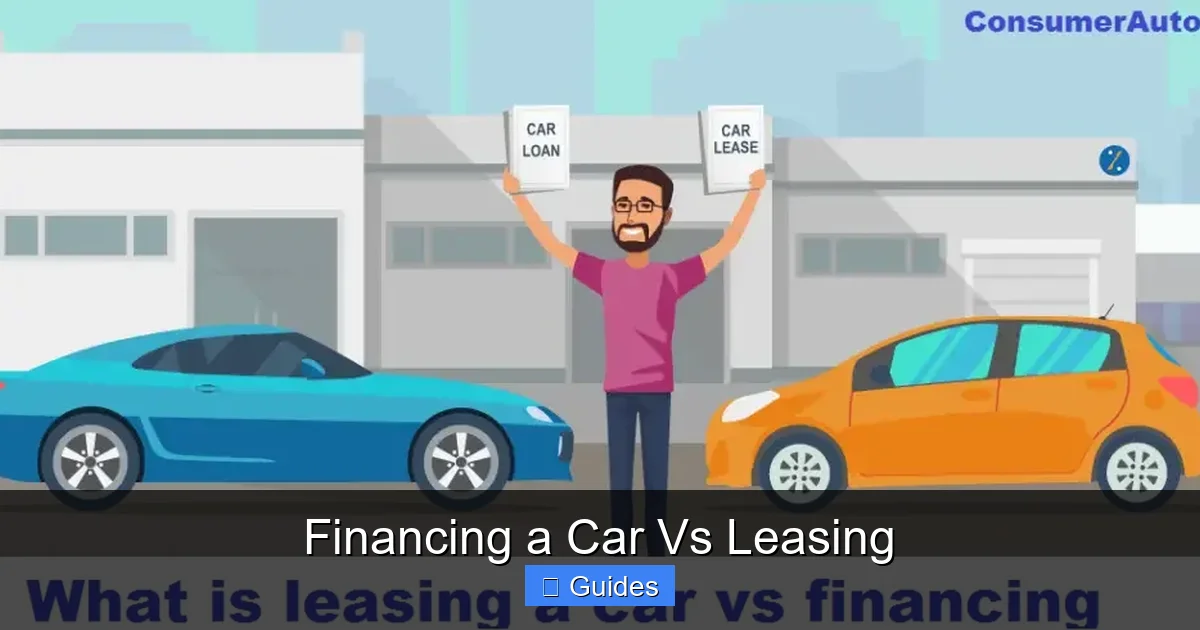
Choosing between financing a car and leasing can feel overwhelming, but it doesn’t have to be. This guide breaks down the pros, cons, and hidden costs of each option so you can make a smart, informed decision that fits your lifestyle and budget.
In This Article
- 1 Key Takeaways
- 2 📑 Table of Contents
- 3 Financing a Car vs Leasing: What’s the Real Difference?
- 4 What Does It Mean to Finance a Car?
- 5 What Does It Mean to Lease a Car?
- 6 Cost Comparison: Financing vs Leasing
- 7 Who Should Finance a Car?
- 8 Who Should Lease a Car?
- 9 Hidden Costs and Fine Print to Watch For
- 10 Tips for Making the Right Choice
- 11 Final Thoughts: Which Is Right for You?
- 12 Frequently Asked Questions
Key Takeaways
- Financing builds equity: When you finance a car, you eventually own it, which means you can sell it or trade it in later.
- Leasing offers lower monthly payments: Lease payments are typically 20–30% lower than loan payments because you’re only paying for the car’s depreciation during the lease term.
- Mileage and wear restrictions apply to leases: Most leases limit you to 10,000–15,000 miles per year and charge fees for excessive wear and tear.
- Financing gives you full ownership freedom: Once you pay off your loan, you can drive as much as you want, modify the car, or sell it without penalties.
- Leasing keeps you in new cars more often: Leases usually last 2–4 years, so you can upgrade to the latest models with updated tech and safety features.
- Insurance costs may be higher with leasing: Leased vehicles often require higher coverage limits, which can increase your monthly insurance premium.
- Your driving habits and long-term goals matter most: If you drive a lot or want to keep a car for 10+ years, financing is usually the better choice.
📑 Table of Contents
- Financing a Car vs Leasing: What’s the Real Difference?
- What Does It Mean to Finance a Car?
- What Does It Mean to Lease a Car?
- Cost Comparison: Financing vs Leasing
- Who Should Finance a Car?
- Who Should Lease a Car?
- Hidden Costs and Fine Print to Watch For
- Tips for Making the Right Choice
- Final Thoughts: Which Is Right for You?
Financing a Car vs Leasing: What’s the Real Difference?
So you’re in the market for a new car. Exciting, right? But before you even step onto the dealership lot, there’s a big decision to make: should you finance the car or lease it? It’s one of the most common questions car buyers face—and for good reason. The choice between financing and leasing can impact your monthly budget, long-term finances, and even how you use your vehicle.
At first glance, both options let you drive a new car without paying the full price upfront. But that’s where the similarities end. Financing means you’re buying the car over time with a loan, while leasing is more like renting it for a set period. One builds ownership; the other offers flexibility. And depending on your lifestyle, one might be a much better fit than the other.
In this guide, we’ll walk you through everything you need to know about financing a car vs leasing. We’ll compare costs, explain the fine print, and help you figure out which path aligns with your goals. Whether you’re a first-time buyer or just exploring your options, this breakdown will make the decision clearer—and less stressful.
What Does It Mean to Finance a Car?
Visual guide about Financing a Car Vs Leasing
Image source: tadvantagesites-com.cdn-convertus.com
When you finance a car, you’re taking out a loan to purchase it. The dealership or a bank lends you the money to buy the vehicle, and you pay it back over time—usually 36 to 72 months—with interest. Once the loan is paid off, the car is 100% yours.
Think of it like buying a house. You don’t pay the full price on day one. Instead, you make monthly mortgage payments until the debt is cleared. With a car loan, it’s the same idea—just on a smaller scale.
How Car Financing Works
Here’s how the process typically goes:
You choose a car and agree on a price (after negotiating, of course). Then, you apply for an auto loan—either through the dealership’s financing department or a bank/credit union. If approved, the lender pays the dealer, and you take possession of the car. From there, you make monthly payments that include both principal (the amount you borrowed) and interest (the cost of borrowing).
Most loans require a down payment—usually 10% to 20% of the car’s price—though some lenders offer 0% down options. The higher your down payment, the lower your monthly payments and total interest paid.
For example, let’s say you buy a $30,000 car with a $6,000 down payment and a 5-year loan at 5% interest. Your monthly payment would be around $450. Over 60 months, you’d pay about $27,000 in total (including interest), and then the car would be yours.
Pros of Financing a Car
There are several advantages to financing:
– You own the car outright after the loan is paid off. No more payments, no more obligations.
– No mileage restrictions. Drive as much as you want—road trips, cross-country moves, daily commutes—it’s all fair game.
– Freedom to customize. Want to tint the windows, upgrade the stereo, or add a spoiler? Go for it. It’s your car.
– Potential to build equity. If you take good care of the car, you can sell it later and recoup some of your investment.
– No penalties for wear and tear. Scratches, dents, and faded paint? As long as the car runs, you’re in the clear.
Cons of Financing a Car
But financing isn’t perfect. Here are some downsides to consider:
– Higher monthly payments. Since you’re paying for the entire value of the car (plus interest), your payments will be higher than a lease.
– Depreciation hits hard. New cars lose value fast—often 20% in the first year and up to 60% over three years. If you sell early, you might owe more than the car is worth (known as being “upside-down” on your loan).
– Long-term commitment. Auto loans can stretch 5–7 years. That’s a long time to be tied to one vehicle.
– Maintenance costs add up. Once the warranty expires, you’re responsible for all repairs and upkeep.
What Does It Mean to Lease a Car?
Leasing a car is like renting it for a fixed period—usually 24 to 36 months. You pay for the vehicle’s depreciation during that time, plus fees and interest, but you never own it. At the end of the lease, you return the car to the dealership (unless you choose to buy it).
Think of it as a long-term rental with rules. You get to drive a new car with the latest features, but you’re essentially paying for its use—not its ownership.
How Car Leasing Works
Here’s how leasing typically unfolds:
You select a car and negotiate the capitalized cost (the price used to calculate your lease payments). Then, the leasing company estimates how much the car will be worth at the end of the lease—this is called the residual value. The difference between the purchase price and the residual value is your depreciation, which makes up the bulk of your monthly payment.
You’ll also pay other fees, including a down payment (called a “cap cost reduction”), acquisition fee, security deposit, and sales tax. Some leases offer “sign-and-drive” deals with no down payment, but that usually means higher monthly payments.
For example, leasing a $30,000 car with a 36-month term and a 50% residual value means you’re paying for $15,000 in depreciation. Add in interest and fees, and your monthly payment might be around $300—significantly less than financing the same car.
Pros of Leasing a Car
Leasing has some clear benefits:
– Lower monthly payments. Since you’re only paying for depreciation (not the full value), your payments are usually 20–30% lower than a loan.
– Drive a new car every few years. Leases typically last 2–4 years, so you can upgrade to the latest model with updated tech, safety features, and styling.
– Lower sales tax. In many states, you only pay sales tax on the monthly lease payments, not the full price of the car.
– Warranty coverage for most of the lease. Most new cars come with a 3-year/36,000-mile warranty, which covers repairs during the lease term.
– No hassle selling later. At the end of the lease, you just return the car—no need to deal with private buyers or trade-ins.
Cons of Leasing a Car
But leasing isn’t for everyone. Here are the drawbacks:
– No ownership. You’re essentially renting the car. At the end of the lease, you walk away with nothing to show for your payments.
– Mileage limits. Most leases cap you at 10,000 to 15,000 miles per year. Go over, and you’ll pay 10 to 25 cents per extra mile.
– Wear and tear fees. The dealership will inspect the car at return. Excessive scratches, dents, or interior damage can result in hefty charges.
– Early termination fees. Want to end the lease early? You’ll likely pay a steep penalty.
– Customization restrictions. Most leases don’t allow modifications. Want to change the wheels or paint job? You’ll have to revert it before returning the car.
Cost Comparison: Financing vs Leasing
Now let’s get into the numbers. How do financing and leasing really stack up when it comes to cost?
Let’s use a real-world example: a 2024 Honda Accord EX, priced at $32,000.
Financing Scenario
– Down payment: $6,400 (20%)
– Loan term: 60 months
– Interest rate: 5%
– Monthly payment: ~$480
– Total paid over 5 years: ~$35,200 (including interest)
– After 5 years: You own the car
Even though the car depreciates, you still have an asset. If you sell it after 5 years for $15,000, your net cost is about $20,200.
Leasing Scenario
– Capitalized cost: $32,000
– Residual value (after 3 years): $18,000 (56%)
– Depreciation: $14,000
– Interest and fees: ~$3,000
– Total lease cost: ~$17,000
– Monthly payment: ~$320
– Down payment: $2,000 (cap cost reduction)
– Total out-of-pocket over 3 years: ~$13,520
At the end of 3 years, you return the car. If you want a new one, you start the process again.
Which Is Cheaper in the Long Run?
It depends on your timeline.
If you plan to keep a car for 6+ years, financing is usually cheaper. You pay more upfront, but once the loan is done, you have a paid-off vehicle with no monthly payments.
If you prefer driving a new car every 2–3 years and don’t mind never owning, leasing can save you money in the short term. But over a 10-year period, leasing the same type of car could cost you significantly more than buying and keeping one.
For example, leasing a $32,000 car every 3 years for 9 years could cost around $40,000. Buying one car and keeping it for 9 years might cost $35,000 total—including depreciation, maintenance, and repairs.
Who Should Finance a Car?
Financing is ideal for certain types of drivers. Here’s who benefits most:
High-Mileage Drivers
If you drive more than 15,000 miles a year—maybe for work, family, or travel—leasing can get expensive fast. Excess mileage fees add up quickly. With financing, you can drive as much as you want without penalties.
Long-Term Owners
If you plan to keep your car for 7–10 years, financing makes sense. You’ll pay off the loan and enjoy years of no payments. Plus, well-maintained cars can last well beyond 100,000 miles.
People Who Like to Customize
Love personalizing your ride? Financing gives you full freedom. Leasing companies often prohibit modifications, so if you want to upgrade the sound system or add performance parts, ownership is the way to go.
Budget-Conscious Buyers Who Can Handle Higher Payments
If you can afford higher monthly payments and want to build equity, financing is a smart financial move. You’re investing in an asset that you’ll eventually own outright.
Who Should Lease a Car?
Leasing works best for a different set of drivers:
Tech and Feature Enthusiasts
If you love having the latest infotainment systems, driver-assist features, and safety tech, leasing lets you upgrade every few years. New models come out annually, and leasing keeps you current.
Low-Mileage Drivers
If you drive under 12,000 miles a year, you’re unlikely to hit mileage limits. This makes leasing a cost-effective option without the risk of overage fees.
People Who Want Lower Monthly Payments
If your budget is tight, leasing can free up cash for other expenses. Lower payments mean more flexibility in your monthly budget.
Business Owners (in Some Cases)
Some business owners lease cars for tax advantages. Lease payments may be deductible as a business expense, depending on how the vehicle is used. (Always consult a tax professional.)
Hidden Costs and Fine Print to Watch For
Both financing and leasing come with fine print. Here are some hidden costs to watch out for:
Financing Pitfalls
– Negative equity. If you trade in a car you still owe money on, the remaining balance gets rolled into your new loan—increasing your debt.
– Extended warranties and add-ons. Dealerships often push expensive extras like paint protection or VIN etching. These can add hundreds to your loan.
– Prepayment penalties. Some loans charge fees if you pay off the loan early. Always check the terms.
Leasing Pitfalls
– Disposition fees. At the end of the lease, you may be charged $300–$500 just to process the return.
– Excess wear and tear. Even minor scratches can trigger charges. Take photos before and after the lease.
– Gap insurance. If the car is totaled, gap insurance covers the difference between the car’s value and what you owe. Some leases include it; others don’t.
Tips for Making the Right Choice
Still unsure? Here are some practical tips to help you decide:
– Assess your driving habits. How many miles do you drive annually? Do you take long trips?
– Consider your long-term plans. Will you want this car in 5 years? Or do you prefer upgrading often?
– Run the numbers. Use online calculators to compare total costs over 3, 5, and 10 years.
– Check your credit score. Better credit means lower interest rates on loans and better lease terms.
– Negotiate the price, not just the payment. Whether financing or leasing, always negotiate the car’s price first. Low payments can hide high interest or fees.
– Read the contract carefully. Don’t sign until you understand all terms, fees, and penalties.
Final Thoughts: Which Is Right for You?
There’s no one-size-fits-all answer to the financing a car vs leasing debate. It all comes down to your lifestyle, budget, and goals.
If you value ownership, drive a lot, and plan to keep your car for years, financing is likely the better choice. You’ll pay more each month, but you’ll build equity and eventually drive payment-free.
If you prefer lower payments, enjoy driving new models, and don’t mind returning the car every few years, leasing could be a great fit. Just be mindful of mileage limits and wear-and-tear rules.
Ultimately, the best decision is the one that aligns with your financial situation and driving needs. Take your time, do the math, and don’t let a salesperson rush you. Whether you finance or lease, you’re making a big purchase—so make it a smart one.
Frequently Asked Questions
Is it better to finance or lease a car?
It depends on your goals. Financing is better if you want to own the car and drive it long-term. Leasing is better if you prefer lower payments and upgrading every few years.
Can I negotiate a lease?
Yes! You can negotiate the capitalized cost, money factor (interest rate), and mileage allowance. Always aim to lower the price before finalizing the lease.
What happens at the end of a car lease?
You return the car to the dealership. They’ll inspect it for excess wear and mileage. If everything’s in order, you walk away—unless you choose to buy the car.
Can I buy my leased car at the end of the lease?
Yes, most leases allow you to purchase the car at its residual value. This can be a good option if you love the vehicle and want to keep it.
Do I need gap insurance when leasing?
It’s highly recommended. Gap insurance covers the difference if your car is totaled and the insurance payout is less than what you owe. Some leases include it; others don’t.
Can I lease a used car?
Yes, some dealerships offer certified pre-owned leases. These often have lower prices and shorter terms, but availability varies by location.

At CarLegit, we believe information should be clear, factual, and genuinely helpful. That’s why every guide, review, and update on our website is created with care, research, and a strong focus on user experience.