
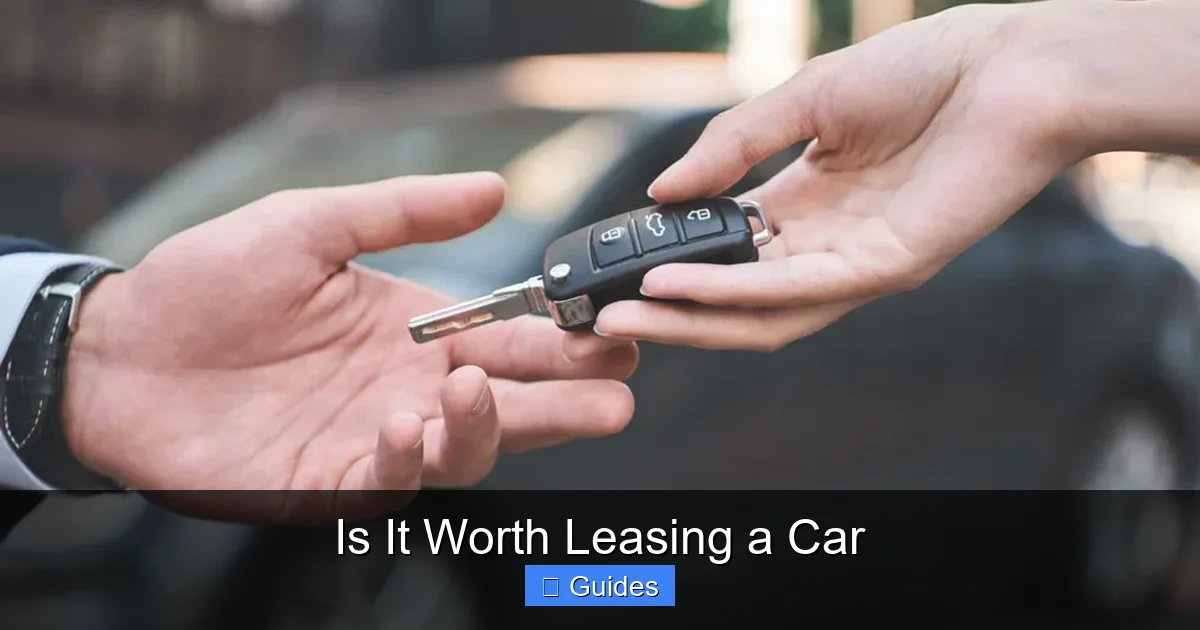
Leasing a car can be a smart financial move—or a costly mistake—depending on your driving habits, budget, and long-term goals. This guide breaks down everything you need to know to decide if leasing is right for you.
In This Article
- 1 Key Takeaways
- 2 📑 Table of Contents
- 3 Is It Worth Leasing a Car? A Complete Guide to Making the Right Choice
- 4 How Car Leasing Works: The Basics Explained
- 5 Pros of Leasing a Car: Why People Choose to Lease
- 6 Cons of Leasing a Car: The Hidden Costs and Limitations
- 7 Leasing vs. Buying: Which Is Better for You?
- 8 Tips for Getting the Best Lease Deal
- 9 When Leasing Makes the Most Sense
- 10 Final Verdict: Is It Worth Leasing a Car?
- 11 Frequently Asked Questions
Key Takeaways
- Lower monthly payments: Leasing typically costs less per month than buying, making it attractive for budget-conscious drivers.
- Drive newer cars more often: Lease terms usually last 2–4 years, so you can upgrade to a new vehicle with the latest tech and safety features.
- Mileage and wear restrictions: Most leases limit annual mileage (e.g., 10,000–15,000 miles) and charge fees for excess wear and tear.
- No ownership at the end: You don’t build equity, and you must return the car unless you choose to buy it at the residual value.
- Potential for lower taxes and fees: In some states, you only pay sales tax on the monthly payment, not the full vehicle price.
- Gap insurance included: Most leases come with gap coverage, protecting you if the car is totaled or stolen.
- Not ideal for high-mileage drivers: Frequent travelers or those with long commutes may find leasing too restrictive and expensive.
📑 Table of Contents
- Is It Worth Leasing a Car? A Complete Guide to Making the Right Choice
- How Car Leasing Works: The Basics Explained
- Pros of Leasing a Car: Why People Choose to Lease
- Cons of Leasing a Car: The Hidden Costs and Limitations
- Leasing vs. Buying: Which Is Better for You?
- Tips for Getting the Best Lease Deal
- When Leasing Makes the Most Sense
- Final Verdict: Is It Worth Leasing a Car?
Is It Worth Leasing a Car? A Complete Guide to Making the Right Choice
So, you’re in the market for a new car. You’ve test-driven a few models, compared features, and now you’re staring at two big options: buy or lease. It’s a decision that can affect your wallet for years to come. And if you’re leaning toward leasing, you’re not alone. Millions of drivers choose to lease each year—especially for luxury vehicles, tech-savvy models, or when they want lower monthly payments.
But is it worth leasing a car? That’s the million-dollar question. The truth is, leasing isn’t inherently good or bad. It’s a tool—one that works brilliantly for some people and poorly for others. Your lifestyle, driving habits, financial goals, and even your personality all play a role in whether leasing makes sense for you.
In this guide, we’ll walk you through everything you need to know about car leasing. We’ll break down how it works, compare it to buying, explore the hidden costs, and help you decide if leasing is the right move for your next vehicle. No jargon, no sales pitch—just honest, practical advice to help you drive away with confidence.
How Car Leasing Works: The Basics Explained
Visual guide about Is It Worth Leasing a Car
Image source: slashgear.com
Let’s start with the fundamentals. Leasing a car is essentially renting it for a set period—usually 24 to 36 months, though 48-month leases are also common. Instead of paying off the entire value of the car like you would when buying, you’re only paying for the vehicle’s depreciation during the lease term, plus interest and fees.
Think of it this way: when you buy a car, you’re responsible for its entire value. But when you lease, you’re only covering the portion of the car’s value that it loses while you’re driving it. For example, if a $40,000 car is expected to be worth $24,000 after three years, you’ll pay for that $16,000 drop in value, plus finance charges and other costs.
Key Components of a Lease Agreement
Every lease agreement includes several important terms:
- Capitalized Cost: This is the negotiated price of the car—similar to the purchase price when buying. The lower this number, the lower your monthly payments.
- Residual Value: The estimated value of the car at the end of the lease. A higher residual means lower depreciation and lower payments.
- Money Factor: This is the lease’s interest rate, expressed as a decimal (e.g., 0.0025). Multiply it by 2,400 to get the approximate APR. A lower money factor means lower financing costs.
- Lease Term: How long you’ll have the car—typically 24, 36, or 48 months.
- Mileage Allowance: The number of miles you’re allowed to drive per year. Common limits are 10,000, 12,000, or 15,000 miles. Exceeding this limit results in per-mile charges (often $0.10 to $0.25).
- Disposition Fee: A charge (usually $300–$500) you pay at the end of the lease to cover the cost of preparing the car for resale.
Example: Leasing vs. Buying a $35,000 Car
Let’s say you’re looking at a $35,000 SUV. Here’s how leasing and buying might compare over three years:
- Leasing: After negotiation, the capitalized cost is $33,000. The residual value after 36 months is $19,800 (55% of MSRP). Your monthly payment (including taxes and fees) is $420. At the end, you return the car and walk away—or lease a new one.
- Buying: You finance the $35,000 car with a $5,000 down payment and a 5-year loan at 5% interest. Your monthly payment is around $580. After three years, you still owe about $18,000, but you own a car worth roughly $20,000—giving you $2,000 in equity.
In this example, leasing saves you $160 per month. But after three years, you have nothing to show for it. Buying costs more upfront but builds equity. Which is better? It depends on your priorities.
Pros of Leasing a Car: Why People Choose to Lease
Visual guide about Is It Worth Leasing a Car
Image source: slashgear.com
Leasing has a lot of appeal—especially for drivers who value flexibility, lower payments, and the latest technology. Let’s look at the biggest advantages.
1. Lower Monthly Payments
This is the #1 reason people lease. Because you’re only paying for depreciation (not the full value of the car), monthly lease payments are almost always lower than loan payments for the same vehicle. For example, leasing a $50,000 luxury sedan might cost $600/month, while buying it could run $900/month or more.
This lower payment frees up cash for other expenses—like saving for a house, paying off debt, or investing. It also makes high-end vehicles more accessible. Want a BMW or Tesla but can’t afford the full price? Leasing might be your ticket in.
2. Drive a New Car Every Few Years
Technology in cars evolves fast. Safety features, infotainment systems, and fuel efficiency improve every year. Leasing lets you upgrade to a new model every 2–4 years, so you’re always driving something modern and reliable.
For tech lovers, this is a huge perk. You’ll never be stuck with outdated navigation, slow charging ports, or missing driver-assist features. Plus, newer cars often have better fuel economy and lower maintenance costs.
3. Lower Repair Costs and Warranty Coverage
Most leases last 24 to 36 months—well within the manufacturer’s warranty period (typically 3 years/36,000 miles or more). That means major repairs are usually covered, and you’re less likely to face expensive out-of-pocket costs.
Compare that to buying a car and keeping it for 8–10 years. After the warranty expires, you’re on the hook for everything—transmission failures, engine issues, electrical problems. Leasing lets you avoid that financial risk.
4. Potential Tax and Fee Savings
In some states, you only pay sales tax on the monthly lease payment, not the full value of the car. This can result in significant savings, especially on expensive vehicles.
For example, in California, if you lease a $60,000 car with a 7% sales tax, you pay tax on each $700 payment—about $49/month. If you bought it, you’d pay $4,200 in tax upfront. That’s a big difference.
Also, many leases include gap insurance, which covers the difference between what you owe and the car’s value if it’s totaled. When you buy, you have to purchase this separately.
5. No Hassle of Selling or Trading In
When your lease ends, you simply return the car to the dealership. No need to list it online, meet with buyers, or haggle over price. It’s quick, easy, and stress-free.
And if you love the car, most leases give you the option to buy it at the end for the residual value. You can even roll that purchase into a new lease or loan.
Cons of Leasing a Car: The Hidden Costs and Limitations
Leasing isn’t perfect. For many drivers, the downsides outweigh the benefits. Let’s look at the potential pitfalls.
1. No Ownership or Equity
This is the biggest downside. When you lease, you’re paying to use the car—not to own it. At the end of the term, you have nothing to show for your payments. No asset, no trade-in value, no resale profit.
Compare that to buying: even if your car depreciates, you still own it. You can sell it, trade it in, or keep driving it for years with no payments. Over time, that equity can add up.
2. Mileage Restrictions and Fees
Most leases come with strict mileage limits—usually 10,000 to 15,000 miles per year. If you go over, you’ll be charged per mile, often $0.10 to $0.25. That can add up fast.
For example, driving 18,000 miles in a year on a 12,000-mile lease means 6,000 extra miles. At $0.15/mile, that’s $900 in fees. Ouch.
If you’re a commuter, road-tripper, or just someone who drives a lot, leasing might not be practical. You could easily exceed the limit and face steep penalties.
3. Wear and Tear Charges
Leased cars must be returned in “good condition.” That means no excessive dents, scratches, stains, or mechanical issues. The dealership will inspect the car at the end and charge you for any damage beyond “normal wear and tear.”
What’s “normal”? It’s subjective. A small scratch might be fine, but a cracked windshield or torn seat could cost hundreds to fix. Even things like tire wear or brake pad replacement might be your responsibility if they’re deemed excessive.
Tip: Take photos of the car when you pick it up and keep records of maintenance. This can help dispute unfair charges later.
4. Early Termination Fees
Want to get out of your lease early? It’s possible—but expensive. Most leases charge an early termination fee, which can be thousands of dollars. You’d also lose any down payment or fees you paid upfront.
Some leases allow you to transfer the lease to another person (called a lease assumption), but not all do. And the new driver must qualify with the leasing company.
5. Higher Long-Term Costs
While monthly payments are lower, leasing can cost more over time—especially if you lease repeatedly. You’re always making payments, never building equity. After 10 years of leasing, you could have paid $40,000 or more with nothing to show for it.
Buying a car and keeping it for 8–10 years often costs less in the long run. Even with higher monthly payments, you eventually own the car outright and drive it payment-free.
6. Customization Restrictions
Leased cars must be returned in original condition. That means no aftermarket parts, performance upgrades, or major modifications. Want to install a new stereo, lift kit, or custom paint? You’ll have to remove it before returning the car—or pay to have it restored.
This can be a dealbreaker for car enthusiasts who love to personalize their ride.
Leasing vs. Buying: Which Is Better for You?
So, how do you decide? It comes down to your personal situation. Let’s compare leasing and buying across key factors.
Driving Habits
- Lease if: You drive under 12,000 miles per year and want a new car every few years.
- Buy if: You drive more than 15,000 miles annually or plan to keep the car long-term.
Budget and Cash Flow
- Lease if: You want lower monthly payments and can afford the upfront costs (down payment, fees, etc.).
- Buy if: You can handle higher payments now to save money long-term and build equity.
Lifestyle and Preferences
- Lease if: You love new technology, hate car maintenance, and don’t mind not owning.
- Buy if: You want full ownership, plan to modify the car, or prefer the freedom of no restrictions.
Financial Goals
- Lease if: You prioritize cash flow and short-term affordability over long-term savings.
- Buy if: You’re focused on building wealth, reducing debt, and minimizing lifetime vehicle costs.
Example Scenarios
Scenario 1: The Urban Professional
Sarah lives in Chicago, drives 8,000 miles a year, and wants a luxury SUV with the latest safety features. She leases a $55,000 vehicle for $650/month. After three years, she returns it and leases a new model. For her, leasing makes sense—low mileage, love of new tech, and no desire to deal with resale.
Scenario 2: The Family Road-Tripper
Mike drives 20,000 miles a year for work and family trips. He buys a reliable minivan for $38,000 and keeps it for 10 years. He pays more upfront but saves thousands in the long run. For him, buying is the smarter choice.
Tips for Getting the Best Lease Deal
If you decide leasing is right for you, don’t just sign the first offer. With a little strategy, you can save hundreds—or even thousands.
1. Negotiate the Capitalized Cost
Just like when buying, the price of the car is negotiable. Research the invoice price (what the dealer paid) and aim to lease at or below that. Use tools like Edmunds, Kelley Blue Book, or TrueCar to find fair market values.
2. Watch the Money Factor
Ask for the money factor and convert it to an APR (multiply by 2,400). Compare it to current auto loan rates. If it’s higher, you might be better off financing.
3. Choose the Right Lease Term
Shorter leases (24–36 months) often have higher monthly payments but lower total cost. Longer leases (48 months) spread payments out but may have higher interest and depreciation.
4. Consider a Higher Down Payment (But Not Too High)
Putting money down (called a “cap cost reduction”) lowers your monthly payment. But avoid putting too much down—if the car is totaled, you may not get that money back. Many experts recommend keeping the down payment under $2,000.
5. Buy Out Excess Mileage Upfront
If you think you’ll drive more than the allowance, ask to buy extra miles at the start. It’s usually cheaper than paying per-mile fees later.
6. Read the Fine Print
Check for hidden fees, early termination clauses, and wear-and-tear policies. Make sure you understand all charges before signing.
When Leasing Makes the Most Sense
Despite the drawbacks, leasing is a great option in certain situations:
- You want a luxury or high-end vehicle but can’t afford the full price.
- You drive less than 12,000 miles per year and stay within limits.
- You prefer driving new cars with the latest safety and tech features.
- You want lower monthly payments to improve cash flow.
- You don’t want to deal with selling or trading in a used car.
- You’re self-employed or a business owner and can deduct lease payments as a business expense (consult a tax professional).
Final Verdict: Is It Worth Leasing a Car?
So, is it worth leasing a car? The answer isn’t black and white. For the right person, leasing is a smart, flexible, and cost-effective way to drive a new vehicle. For others, it’s a financial trap that leads to endless payments and no ownership.
If you drive moderately, love new technology, and prioritize low monthly costs, leasing could be a great fit. But if you drive a lot, want to build equity, or plan to keep a car for many years, buying is likely the better choice.
The key is to understand your needs, read the fine print, and do the math. Don’t let a flashy ad or smooth-talking salesperson rush you into a decision. Take your time, compare options, and choose what aligns with your lifestyle and financial goals.
At the end of the day, the best car decision is the one that keeps you safe, happy, and financially secure. Whether you lease or buy, drive smart.
Frequently Asked Questions
Can I lease a car with bad credit?
Yes, but it may be more difficult and expensive. Leasing companies check your credit, and lower scores often result in higher money factors (interest rates) or require a larger down payment. Some subprime lenders offer leases, but terms may not be favorable.
What happens if I go over my mileage limit?
You’ll be charged a per-mile fee, typically $0.10 to $0.25, when you return the car. For example, exceeding a 12,000-mile annual limit by 3,000 miles could cost $300–$750. To avoid this, consider buying extra miles upfront or choosing a higher mileage allowance.
Can I end my lease early?
Yes, but it usually comes with a steep early termination fee—often thousands of dollars. Some leases allow lease transfers to another qualified driver, which can help reduce costs. Always check your contract for specific terms.
Do I need full coverage insurance when leasing?
Yes. Leasing companies require comprehensive and collision coverage with low deductibles (usually $500 or less). This protects their asset in case of damage or theft. Gap insurance is typically included in the lease.
Can I negotiate a lease deal?
Absolutely. Just like buying, you can negotiate the capitalized cost, money factor, and other terms. Research the car’s value, compare offers, and don’t be afraid to walk away if the deal isn’t right.
Is leasing better for business use?
It can be. Business owners may deduct a portion of lease payments as a business expense, depending on how the car is used. Consult a tax professional to understand deductions and record-keeping requirements.

At CarLegit, we believe information should be clear, factual, and genuinely helpful. That’s why every guide, review, and update on our website is created with care, research, and a strong focus on user experience.