
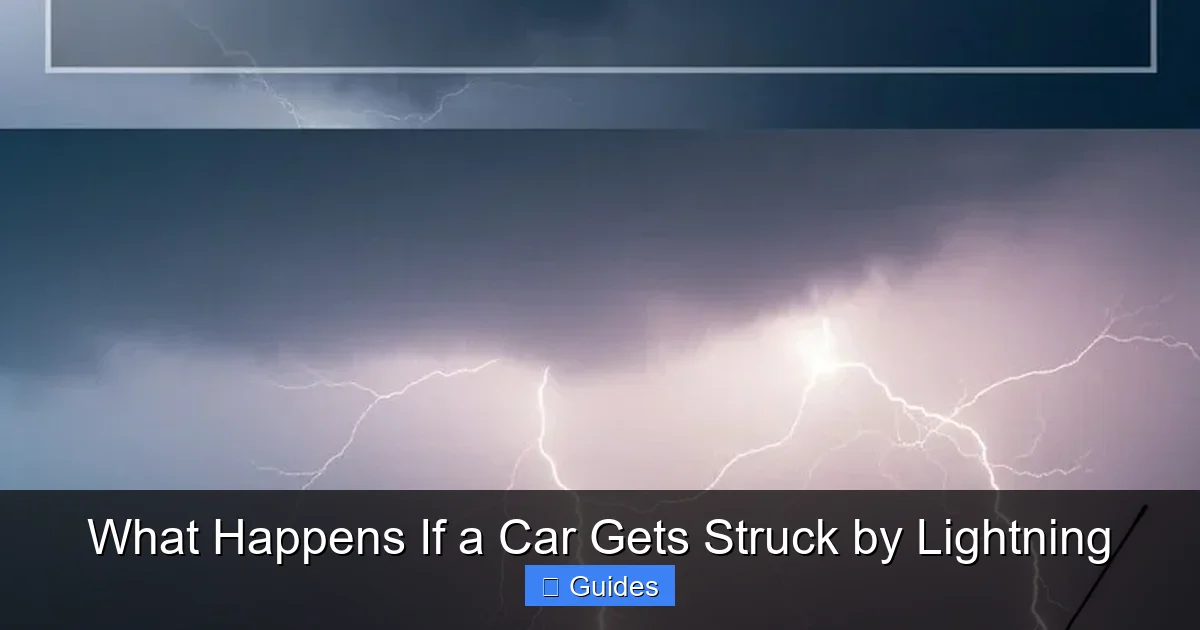
Most cars are surprisingly safe during a lightning strike thanks to their metal frames acting as a Faraday cage. While the electronics may get damaged and tires can blow, passengers are rarely harmed. Understanding how lightning interacts with vehicles can help you stay calm and safe during thunderstorms.
Have you ever been driving when dark clouds rolled in, thunder rumbled, and lightning lit up the sky? It’s a nerve-wracking experience—especially when you’re behind the wheel. You might wonder: *What happens if a car gets struck by lightning?* Is it dangerous? Will the car explode? Will I be electrocuted?
The good news is that while getting hit by lightning is rare, cars are actually one of the safer places to be during a thunderstorm—especially compared to being outside in an open field or under a tree. But that doesn’t mean it’s without risk. Lightning strikes can cause damage to your vehicle, and understanding how they interact with cars can help you stay safe and make smarter decisions when the skies turn stormy.
In this guide, we’ll break down exactly what happens when a car is struck by lightning, how modern vehicles respond, and what you should do if you’re caught in a storm while driving. We’ll also debunk some common myths and give you practical tips to protect yourself and your car. Whether you’re a daily commuter or an occasional road-tripper, this information could one day save you from panic—or worse.
In This Article
- 1 Key Takeaways
- 2 📑 Table of Contents
- 3 How Lightning Interacts with Vehicles
- 4 Safety of Passengers During a Lightning Strike
- 5 Damage to the Vehicle: What to Expect
- 6 Modern Cars vs. Older Models: Does Technology Change the Risk?
- 7 What to Do If Your Car Is Struck by Lightning
- 8 Myths and Misconceptions About Lightning and Cars
- 9 How to Stay Safe While Driving in Thunderstorms
- 10 Conclusion
- 11 Frequently Asked Questions
- 11.1 Can a car protect you from lightning?
- 11.2 Do rubber tires insulate a car from lightning?
- 11.3 Can lightning damage a car’s electronics?
- 11.4 Is it safe to drive after a lightning strike?
- 11.5 Does insurance cover lightning damage to a car?
- 11.6 What should I do if I’m driving during a lightning storm?
Key Takeaways
- Your car can act as a Faraday cage: The metal body of most vehicles helps redirect lightning current around the interior, protecting occupants.
- Passengers are usually safe: Despite the loud noise and bright flash, people inside a car are rarely injured during a lightning strike.
- Electronics may be damaged: Modern cars with advanced electronics are vulnerable to power surges caused by lightning, potentially affecting systems like ignition, infotainment, or sensors.
- Tires don’t protect you: Contrary to popular belief, rubber tires do not insulate the car from lightning—it’s the metal frame that matters.
- Pull over safely if storms approach: If you’re driving in a thunderstorm, find a safe place to stop and avoid open areas, tall objects, or bodies of water.
- Stay inside the vehicle: If caught in a storm, remain in your car with windows closed and avoid touching metal surfaces.
- Insurance may cover lightning damage: Comprehensive auto insurance typically includes coverage for lightning-related damage to your vehicle.
📑 Table of Contents
- How Lightning Interacts with Vehicles
- Safety of Passengers During a Lightning Strike
- Damage to the Vehicle: What to Expect
- Modern Cars vs. Older Models: Does Technology Change the Risk?
- What to Do If Your Car Is Struck by Lightning
- Myths and Misconceptions About Lightning and Cars
- How to Stay Safe While Driving in Thunderstorms
- Conclusion
How Lightning Interacts with Vehicles
When lightning strikes a car, it doesn’t behave the way many people imagine. You might picture sparks flying, the car catching fire, or the driver being thrown from the seat. In reality, the physics of lightning and the design of modern vehicles work together in surprising ways to protect you.
Lightning is a massive electrical discharge—often carrying over 30,000 amps of current and heating the air to temperatures five times hotter than the surface of the sun. When it strikes an object, it seeks the path of least resistance to the ground. Tall, conductive objects like trees, buildings, and yes, cars, are prime targets.
But here’s the key: your car’s metal body acts as a protective shield. This phenomenon is known as a Faraday cage—a concept named after scientist Michael Faraday, who demonstrated that an enclosed metal container can block external electric fields. Most cars, especially those with steel or aluminum bodies, function as partial Faraday cages. When lightning hits the roof or exterior, the electrical current flows along the outer shell and into the ground, bypassing the interior where passengers sit.
This doesn’t mean the car is immune to damage. The intense energy can fry electronics, blow out windows, or cause minor fires. But for the people inside, the risk of serious injury is very low. In fact, according to the National Weather Service, being inside a hard-topped metal vehicle is one of the safest places to be during a lightning storm—second only to being indoors in a sturdy building.
Why the Metal Body Matters
The reason your car offers protection isn’t because of the tires—it’s because of the metal frame. Many people believe that rubber tires insulate the car from the ground, preventing lightning from reaching it. That’s a myth. Lightning can easily jump thousands of feet through air; a few inches of rubber won’t stop it.
Instead, it’s the conductive metal body that redirects the current. When lightning strikes, it travels across the surface of the car and exits through the tires or other contact points with the road. Because the current stays on the outside, the interior remains relatively safe. This is similar to how an airplane can be struck by lightning and still land safely—the metal fuselage protects the passengers inside.
However, not all vehicles offer the same level of protection. Convertibles, motorcycles, and vehicles with fiberglass or plastic bodies don’t provide the same shielding. If you’re in a convertible during a storm, you’re far more exposed and should seek shelter immediately.
What Happens During the Strike
If your car is struck by lightning, you’ll likely experience a few dramatic moments. First, there’s the blinding flash—lightning can be brighter than the sun, even through cloud cover. Then comes the thunder, which may sound like an explosion right next to you. The car might shake or jolt, and you could hear a loud crack or pop.
Inside the vehicle, you might notice flickering lights, a sudden loss of power, or the radio cutting out. Some drivers report a burning smell or see smoke coming from the dashboard. In rare cases, airbags may deploy due to the electrical surge, though this is uncommon.
Despite the intensity, most people walk away unharmed. There are documented cases of drivers continuing to drive their cars immediately after a strike, though it’s always wise to pull over and check for damage.
Safety of Passengers During a Lightning Strike
Visual guide about What Happens If a Car Gets Struck by Lightning
Image source: m.media-amazon.com
One of the most reassuring facts about lightning strikes on cars is that passengers are rarely injured. In the U.S., lightning strikes the ground about 25 million times per year, but fatalities are relatively low—around 20 to 30 annually. Most of these occur when people are outdoors, not inside vehicles.
When a car is struck, the electrical current flows around the outside of the vehicle and into the ground. Because the interior is shielded, the people inside are not part of the electrical path. This is why you’ll often hear stories of drivers and passengers walking away from a lightning strike with nothing more than a racing heart and a story to tell.
That said, there are a few precautions you should take to maximize your safety. First, avoid touching metal parts of the car during a storm—especially the steering wheel, gear shift, or door handles. While the risk is low, direct contact with conductive surfaces could, in theory, expose you to a small amount of current if the strike is nearby.
Second, keep the windows closed. Open windows can allow side flashes—sparks that jump from the car to nearby objects—to enter the cabin. And while it might be tempting to get out and inspect the car after a strike, it’s safer to stay inside until the storm passes.
Real-Life Examples of Safe Outcomes
There are numerous documented cases of cars being struck by lightning with no injuries. In one well-known incident, a driver in Texas was caught in a thunderstorm when lightning hit his SUV. The vehicle’s electronics were fried, the tires blew out, and the windows cracked—but he and his passengers were unharmed. He later said the only thing he felt was a strong vibration and a loud noise.
In another case, a family in Colorado was driving through a mountain pass when their minivan was struck. The airbags deployed, the radio stopped working, and the engine died—but everyone inside was safe. They were able to restart the car after a few minutes and drive to a nearby town for help.
These stories highlight an important point: while the damage can be significant, the human cost is usually minimal. Your car is designed to protect you, even in extreme conditions.
When Passengers Could Be at Risk
While rare, there are situations where passengers could be injured during a lightning strike. If someone is leaning against a metal door or touching a conductive surface that’s in direct contact with the outside, there’s a small chance of receiving a shock. This is more likely in older vehicles with less effective grounding or in cases where the lightning strike is exceptionally powerful.
Additionally, if the strike causes a fire or explosion—such as if it ignites fuel vapors or damages the battery—there could be secondary risks. But these scenarios are extremely uncommon. The vast majority of lightning strikes on vehicles result in property damage, not personal injury.
Damage to the Vehicle: What to Expect
Visual guide about What Happens If a Car Gets Struck by Lightning
Image source: m.media-amazon.com
While passengers are usually safe, the same can’t always be said for the car. Lightning strikes can cause a range of damage, from minor electrical glitches to total system failure. The extent of the damage depends on the strength of the strike, the vehicle’s design, and whether it has modern electronics.
One of the most common issues is damage to the car’s electrical system. Modern vehicles are packed with sensors, computers, and wiring that control everything from the engine to the infotainment system. Lightning can induce powerful electromagnetic pulses (EMPs) that overload these circuits, causing them to fail.
Common Types of Damage
– **Electronics Failure:** The radio, navigation system, dashboard lights, and even the engine control unit (ECU) may stop working. In some cases, the car won’t start at all.
– **Battery Damage:** The 12-volt battery can be fried by a power surge, requiring replacement.
– **Tire Blowouts:** The intense heat from a lightning strike can cause tires to explode or deflate rapidly.
– **Window Cracking:** The rapid expansion of air from the strike can crack or shatter glass, especially if the windows are closed.
– **Paint Burns:** You might see scorch marks or burn spots on the roof or hood where the lightning made contact.
– **Airbag Deployment:** In rare cases, the electrical surge can trigger airbags to deploy, even if there’s no collision.
In severe cases, the car may be totaled. Insurance companies often classify lightning damage as “act of God” and will cover repairs or replacement under comprehensive coverage—so it’s worth checking your policy.
Can the Car Still Be Driven?
After a lightning strike, it’s important to assess the vehicle before attempting to drive. If the engine won’t start, the electronics are dead, or there’s visible damage, it’s best to call a tow truck. Driving a damaged car could be dangerous—especially if critical systems like brakes or steering are affected.
However, in many cases, the car may still be drivable. Some drivers report that their vehicles started right up after a strike, though they noticed issues like a dead battery or malfunctioning dashboard lights. If you do decide to drive, proceed with caution and head to a mechanic or dealership for a full inspection.
Modern Cars vs. Older Models: Does Technology Change the Risk?
Visual guide about What Happens If a Car Gets Struck by Lightning
Image source: m.media-amazon.com
With the rise of electric vehicles (EVs) and advanced driver-assistance systems (ADAS), you might wonder if modern cars are more vulnerable to lightning strikes. The short answer is: possibly.
Older cars with simpler mechanical systems are generally more resilient. They have fewer electronic components, so there’s less to damage. A 1980s sedan might lose its radio but keep running just fine.
Modern vehicles, on the other hand, are essentially computers on wheels. They rely on complex networks of sensors, cameras, and processors to function. A lightning-induced power surge can easily overwhelm these systems, leading to costly repairs.
The Challenge with Electric Vehicles
Electric vehicles (EVs) present a unique challenge. They have high-voltage battery packs and sophisticated charging systems that could be damaged by lightning. While the metal body still provides protection, the risk of electrical damage is higher.
Some EV manufacturers have implemented additional shielding and surge protection to guard against such events. Tesla, for example, uses robust electrical architecture designed to handle power fluctuations. But no system is foolproof.
If an EV is struck by lightning, there’s also a small risk of battery thermal runaway—a dangerous condition where the battery overheats and potentially catches fire. However, this is extremely rare and would likely require a direct, high-energy strike.
Advanced Safety Features and Lightning
Ironically, the very features designed to keep us safe—like automatic emergency braking, lane-keeping assist, and adaptive cruise control—could be compromised by a lightning strike. If the sensors or control modules are damaged, these systems may stop working, reducing the car’s safety in normal driving conditions.
This is why it’s crucial to have your vehicle inspected after a lightning strike, even if it seems to be running fine. A technician can run diagnostics to check for hidden damage that could affect performance or safety.
What to Do If Your Car Is Struck by Lightning
If you’re driving and your car is struck by lightning, stay calm. Panic won’t help, and your first priority is safety.
First, pull over to a safe location as soon as possible. Turn on your hazard lights and assess the situation. Check for visible damage—burn marks, cracked windows, or smoke. If you smell burning or see flames, exit the vehicle immediately and move to a safe distance.
If the car is still running and there’s no immediate danger, you may be able to drive to a nearby service station or shelter. But avoid highways or busy roads if the vehicle is behaving erratically.
Immediate Steps to Take
– **Stay inside the car** until the storm passes, if it’s safe to do so.
– **Avoid touching metal surfaces** like the steering wheel, door handles, or gear shift.
– **Turn off the engine** if you suspect electrical damage.
– **Call for help** using a cell phone—don’t rely on the car’s built-in emergency system if it’s damaged.
– **Do not exit the vehicle** in an open area during an active storm.
Once the storm has passed, have your car inspected by a professional. Even if it seems fine, internal damage to electronics or wiring could cause problems later.
Filing an Insurance Claim
If your car is damaged by lightning, contact your insurance company as soon as possible. Comprehensive coverage typically includes lightning damage, but you’ll need to provide documentation—photos, a police report (if applicable), and a repair estimate.
Be prepared for a possible inspection. Some insurers may send an adjuster to assess the damage before approving a claim. Keep all receipts for towing, repairs, and rental cars, as these may be reimbursable.
Myths and Misconceptions About Lightning and Cars
There are many myths about lightning and vehicles that persist despite scientific evidence to the contrary. Let’s clear up some of the most common ones.
Myth: Rubber Tires Protect You from Lightning
This is perhaps the most widespread myth. People believe that because tires are made of rubber—an insulator—they prevent lightning from reaching the ground. But lightning can easily arc through air gaps and doesn’t need a direct conductive path. The real protection comes from the metal body, not the tires.
Myth: Convertibles Are Safe Because They’re Open
Actually, convertibles are less safe during lightning storms. Without a metal roof, there’s no Faraday cage effect. If you’re in a convertible, seek shelter immediately.
Myth: Lightning Never Strikes the Same Place Twice
False. Lightning can and does strike the same location multiple times—especially tall, conductive objects like radio towers or, yes, cars parked in open areas.
Myth: You’ll Be Electrocuted If You Touch the Steering Wheel
While it’s wise to avoid metal surfaces during a storm, the risk of electrocution is extremely low. The current flows around the outside of the car, not through the interior. Still, it’s best to minimize contact just in case.
How to Stay Safe While Driving in Thunderstorms
The best way to handle a lightning strike is to avoid it altogether. If you know a storm is approaching, plan your route to include safe shelters like gas stations, parking garages, or buildings.
If you’re already on the road, here are some tips:
– **Pull over safely** if the storm intensifies. Avoid stopping under trees, bridges, or power lines.
– **Keep windows closed** to prevent side flashes.
– **Turn on headlights** to increase visibility, even during the day.
– **Avoid flooded roads**—lightning can travel through water, and driving through deep puddles is dangerous for many reasons.
– **Wait it out**—most thunderstorms pass within 30 minutes. Use the time to rest, make calls, or listen to the radio.
Remember, your car is one of the safest places to be during a lightning storm—but only if you’re inside and not touching metal.
Conclusion
So, what happens if a car gets struck by lightning? In most cases, the vehicle suffers damage while the passengers remain safe. Thanks to the Faraday cage effect, your car’s metal body redirects lightning current around the interior, protecting you from harm.
While electronics may be fried, tires blown, or windows cracked, serious injuries are rare. Modern vehicles, especially those with advanced electronics, are more vulnerable to damage—but still offer strong protection for occupants.
The key is to stay calm, stay inside, and avoid touching metal surfaces during a storm. And if your car is struck, have it inspected by a professional and contact your insurance company.
Lightning is powerful, unpredictable, and awe-inspiring. But with the right knowledge, you can drive through a storm with confidence—knowing that your car is designed to keep you safe, even when the skies light up.
Frequently Asked Questions
Can a car protect you from lightning?
Yes, most cars with metal bodies act as Faraday cages, redirecting lightning current around the interior and protecting passengers. This makes them one of the safest places to be during a thunderstorm.
Do rubber tires insulate a car from lightning?
No, rubber tires do not protect against lightning. The real protection comes from the metal frame of the car, which conducts the current around the cabin and into the ground.
Can lightning damage a car’s electronics?
Yes, lightning can cause power surges that damage sensitive electronics like the ECU, infotainment system, and sensors. Modern cars are especially vulnerable due to their reliance on digital systems.
Is it safe to drive after a lightning strike?
It depends on the damage. If the car won’t start, has electrical issues, or shows signs of fire, do not drive it. Have it towed and inspected by a professional.
Does insurance cover lightning damage to a car?
Yes, comprehensive auto insurance typically covers lightning damage. Check your policy and file a claim with photos and repair estimates.
What should I do if I’m driving during a lightning storm?
Pull over in a safe location, stay inside the car with windows closed, avoid touching metal surfaces, and wait for the storm to pass. Seek shelter in a building if possible.

At CarLegit, we believe information should be clear, factual, and genuinely helpful. That’s why every guide, review, and update on our website is created with care, research, and a strong focus on user experience.