

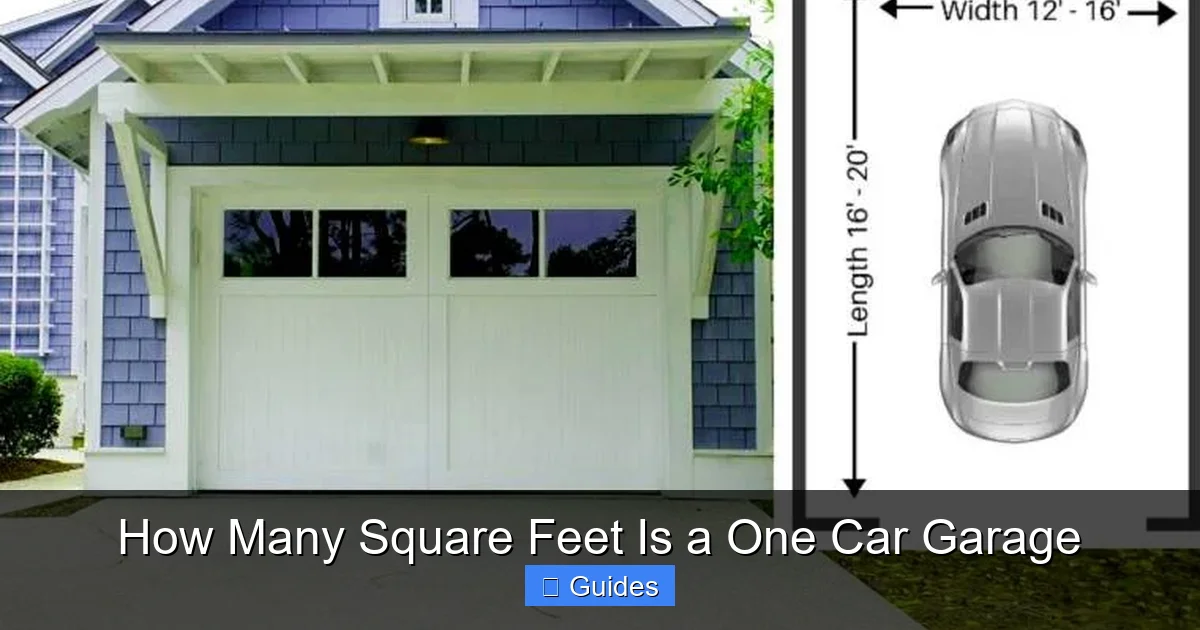
So, how many square feet is a one car garage? Most standard one-car garages range from 120 to 200 square feet, with typical dimensions of 12×12 feet up to 16×12 feet. This size comfortably fits one vehicle while leaving room for storage, tools, or a small workspace. However, actual square footage can vary based on design, regional building codes, and intended use.
In This Article
- 1 Key Takeaways
- 2 📑 Table of Contents
- 3 How Many Square Feet Is a One Car Garage? The Complete Guide
- 4 Standard Dimensions of a One Car Garage
- 5 Minimum Size Requirements by Building Code
- 6 Vehicle Size and Garage Fit: What You Need to Know
- 7 Designing for Function: Storage, Workspaces, and More
- 8 Regional Variations and Climate Considerations
- 9 Future-Proofing Your Garage
- 10 Conclusion: Finding the Right Size for Your Needs
- 11 Frequently Asked Questions
- 11.1 What is the smallest legal size for a one-car garage?
- 11.2 Can a one-car garage fit a truck?
- 11.3 Is a 10×10 garage big enough for one car?
- 11.4 How much does it cost to build a one-car garage?
- 11.5 Can I convert my one-car garage into living space?
- 11.6 What’s the best way to maximize space in a small garage?
Key Takeaways
- Standard Size Range: A one-car garage typically ranges from 120 to 200 square feet, with 144 sq ft (12×12) being a common baseline.
- Minimum Dimensions: Most building codes require a minimum width of 10 feet and depth of 18 feet, totaling 180 sq ft for safe vehicle access and door clearance.
- Vehicle Fit Matters: Compact cars fit easily in smaller garages, while trucks and SUVs may need 14–16 feet in width for comfortable parking.
- Storage & Functionality: Adding shelving, cabinets, or a workbench reduces usable floor space, so plan accordingly.
- Garage Door Size: Standard single garage doors are 8–9 feet wide; larger doors (up to 10 feet) may require wider garages.
- Local Codes Vary: Always check local building regulations, as some areas mandate larger minimums for safety and accessibility.
- Future-Proofing: Consider expanding or designing with flexibility if you plan to add EVs, bikes, or hobby spaces later.
📑 Table of Contents
- How Many Square Feet Is a One Car Garage? The Complete Guide
- Standard Dimensions of a One Car Garage
- Minimum Size Requirements by Building Code
- Vehicle Size and Garage Fit: What You Need to Know
- Designing for Function: Storage, Workspaces, and More
- Regional Variations and Climate Considerations
- Future-Proofing Your Garage
- Conclusion: Finding the Right Size for Your Needs
How Many Square Feet Is a One Car Garage? The Complete Guide
If you’re building a new home, renovating your garage, or just curious about space planning, you’ve probably asked: *How many square feet is a one car garage?* It’s a simple question with a surprisingly nuanced answer. While the average one-car garage falls between 120 and 200 square feet, the exact size depends on several factors—from the type of vehicle you drive to local building codes and how you plan to use the space.
Garages are more than just parking spots. For many homeowners, they double as storage areas, workshops, home gyms, or even man caves. That means understanding the square footage isn’t just about fitting your car—it’s about maximizing functionality without feeling cramped. Whether you’re working with a tight lot or designing a custom build, knowing the standard dimensions and how they translate into real-world use can save you time, money, and frustration down the road.
In this guide, we’ll break down everything you need to know about one-car garage sizes. We’ll cover standard dimensions, minimum requirements, vehicle considerations, design tips, and how to make the most of your space. By the end, you’ll have a clear picture of what “one car garage” really means—and how to tailor it to your lifestyle.
Standard Dimensions of a One Car Garage

Visual guide about How Many Square Feet Is a One Car Garage
Image source: shunauto.com
When people ask, “How many square feet is a one car garage?” they’re usually looking for a quick number. The most common answer is **144 square feet**, based on a standard 12-foot by 12-foot layout. But that’s just the starting point.
Most one-car garages range from **12×12 feet (144 sq ft)** to **16×12 feet (192 sq ft)**. Some larger models go up to 16×14 feet (224 sq ft), especially if they include extra storage or a small workshop area. These dimensions provide enough room to park a standard sedan, open doors, and move around safely.
Let’s look at the most common configurations:
– **12×12 feet (144 sq ft):** Ideal for compact cars like a Honda Civic or Toyota Corolla. This size is common in older homes and smaller lots.
– **14×12 feet (168 sq ft):** A popular upgrade that offers more wiggle room for midsize sedans and small SUVs.
– **16×12 feet (192 sq ft):** Great for larger vehicles like trucks or SUVs, with space left over for storage bins or a tool bench.
Why Depth Matters More Than Width
While width gets a lot of attention, depth is actually more critical for functionality. A garage that’s too shallow won’t allow you to open your car doors fully or store items behind the vehicle. Most experts recommend a minimum depth of **18 to 20 feet** to accommodate parking, door swing, and storage.
For example, a 12×18-foot garage (216 sq ft) gives you more usable space than a 12×12-foot one, even though the width is the same. The extra six feet in depth means you can park your car, open the doors, and still have room for a shelf or bike rack at the back.
Garage Door Width and Its Impact
The garage door is one of the biggest factors in determining usable space. Standard single-car garage doors are **8 feet wide**, but many modern homes use **9-foot doors** for easier access. Some homeowners even opt for 10-foot doors, especially if they drive a wider vehicle or want a more open feel.
A wider door means you need a wider garage. For instance, a 9-foot door typically requires a garage that’s at least 14 feet wide to allow for framing, insulation, and safe clearance. This pushes the total square footage up to around 168–200 sq ft.
Minimum Size Requirements by Building Code

Visual guide about How Many Square Feet Is a One Car Garage
Image source: garagesideas.com
You can’t just build a garage any size you want—local building codes set minimum standards to ensure safety, accessibility, and functionality. These codes vary by city, county, and state, but most follow guidelines from the International Residential Code (IRC).
IRC Standards for One-Car Garages
According to the IRC, a one-car garage must be at least:
– **10 feet wide**
– **18 feet deep**
– **7 feet high (minimum ceiling height)**
That gives a minimum square footage of **180 square feet** (10×18). However, many municipalities require larger dimensions. For example, some cities mandate a 12-foot width to allow for door clearance and safe entry/exit.
Why Minimums Exist
These requirements aren’t arbitrary. A 10-foot-wide garage might technically fit a car, but it leaves almost no room to open doors or walk beside the vehicle. That’s dangerous and impractical. The 18-foot depth ensures there’s space behind the car for storage or movement, and the 7-foot ceiling accommodates most vehicles and allows for overhead storage.
Always check with your local building department before finalizing plans. Some areas have additional rules for ventilation, lighting, electrical outlets, or even fire separation from the house.
Vehicle Size and Garage Fit: What You Need to Know
Visual guide about How Many Square Feet Is a One Car Garage
Image source: garagesideas.com
Not all cars are created equal—and neither are garages. The size of your vehicle plays a huge role in determining how much space you actually need.
Compact Cars vs. Trucks and SUVs
A Honda Fit or Mini Cooper can fit comfortably in a 12×12-foot garage with room to spare. But if you drive a Ford F-150, Chevy Tahoe, or Tesla Model X, you’ll need more space.
Here’s a quick breakdown:
– **Compact cars (e.g., Toyota Yaris):** 14–15 feet long, 6 feet wide → fits in 12×12 ft garage
– **Midsize sedans (e.g., Honda Accord):** 16–17 feet long, 6.5 feet wide → needs 14×18 ft garage
– **Full-size SUVs/trucks (e.g., Ford F-150):** 18–20 feet long, 7+ feet wide → requires 16×20 ft garage
If you park a truck, even a 16×12-foot garage might feel tight. You’ll want at least 16×18 feet to open doors and access storage.
Measuring Your Vehicle
Before building or buying, measure your car’s length, width, and height—including mirrors and roof racks. Add at least 2 feet to the length and 1 foot to the width for comfortable clearance. For example, a 17-foot-long car needs a garage that’s at least 19 feet deep.
Also consider how you enter and exit. If you back in, you’ll need more depth. If you pull straight in, you might get away with less—but it’s safer to plan for backing in.
Designing for Function: Storage, Workspaces, and More
A garage isn’t just for cars. For many families, it’s the hub of household activity—storing tools, sports gear, holiday decorations, and even serving as a home gym or workshop. That means you need to plan for more than just parking.
Storage Solutions That Save Space
Even in a 12×12-foot garage, smart storage can make a big difference. Here are some space-saving ideas:
– **Overhead racks:** Store seasonal items like Christmas decorations or camping gear up high.
– **Wall-mounted shelves:** Use vertical space for bins, paint cans, or gardening tools.
– **Pegboards:** Perfect for hanging tools, bikes, or sports equipment.
– **Cabinets:** Lockable cabinets keep hazardous materials (like gasoline or pesticides) secure.
But remember: every shelf or cabinet takes up floor space. If you add a 2-foot-deep workbench along one wall, you’ve effectively reduced your garage’s usable width from 12 feet to 10 feet.
Workshop or Hobby Space
Want to turn your garage into a DIY paradise? You’ll need at least 6–8 feet of clear floor space for a workbench, tool storage, and movement. That means a 12×12 garage might only fit a small bench in the corner, while a 16×14 garage can accommodate a full workshop.
Consider lighting, electrical outlets, and ventilation. A good workshop needs bright LED lights, multiple outlets, and possibly a ventilation fan if you’re painting or using chemicals.
Home Gym or Yoga Studio
Garages are popular spots for home gyms. A treadmill, weights, and yoga mat need about 8×8 feet of open space. Add mirrors, storage for weights, and proper flooring (like rubber mats), and you’ll want at least a 14×14-foot garage.
Regional Variations and Climate Considerations
Garage size isn’t just about function—it’s also influenced by where you live.
Climate and Insulation
In colder climates, garages are often insulated and heated, especially if they’re attached to the house. This can reduce usable space slightly due to thicker walls, but it also makes the garage more comfortable year-round.
In warmer areas, garages may be uninsulated and used primarily for parking and storage. However, if you plan to use the space as a workshop or gym, insulation and cooling become important.
Snow and Ice Management
In snowy regions, you’ll want extra depth to store shovels, snow blowers, and salt bags. Some homeowners even build small mudrooms or entryways between the garage and house to reduce snow and dirt inside.
Coastal and Humid Areas
In humid or coastal climates, moisture can damage tools and vehicles. Consider adding a dehumidifier, proper ventilation, and moisture-resistant storage solutions. This might mean sacrificing a bit of floor space for equipment, but it’s worth it for long-term protection.
Future-Proofing Your Garage
Technology and lifestyle trends are changing how we use garages. Planning ahead can save you from costly renovations later.
Electric Vehicle (EV) Charging
If you’re thinking about buying an electric car, you’ll need space for a charging station. Most home EV chargers (Level 2) require a dedicated 240-volt outlet and about 2–3 feet of clearance on one wall. That means you’ll want to reserve space near the electrical panel or a convenient wall.
Some homeowners even install solar panels on the garage roof to power their EVs—another reason to consider a larger, more versatile garage.
Smart Garage Technology
Smart garage doors, lighting, and security systems are becoming standard. These systems often require Wi-Fi access, sensors, and power sources. Make sure your garage has enough outlets and internet coverage to support these upgrades.
Flexible Design for Changing Needs
Your needs will change over time. Today it’s a parking spot; tomorrow it might be a playroom, home office, or Airbnb rental. Designing with flexibility in mind—like removable shelving, modular cabinets, or open floor plans—can make your garage adaptable for years to come.
Conclusion: Finding the Right Size for Your Needs
So, how many square feet is a one car garage? The answer isn’t one-size-fits-all. While 144 square feet (12×12) is a common benchmark, the ideal size depends on your vehicle, storage needs, local codes, and how you plan to use the space.
For most homeowners, a garage between 168 and 192 square feet (14×12 to 16×12) offers the best balance of functionality and efficiency. It fits a wide range of vehicles, allows for storage, and leaves room for future upgrades.
Remember: it’s better to have a little extra space than to feel cramped. Measure your car, think about your lifestyle, and consult local building codes before making a decision. With smart planning, your one-car garage can be more than just a parking spot—it can be a valuable extension of your home.
Frequently Asked Questions
What is the smallest legal size for a one-car garage?
Most building codes require a minimum of 10 feet wide by 18 feet deep, totaling 180 square feet. However, many areas recommend at least 12 feet in width for safety and usability.
Can a one-car garage fit a truck?
Yes, but it depends on the truck size. A full-size pickup like a Ford F-150 needs at least a 16×18-foot garage to park comfortably with room to open doors and access storage.
Is a 10×10 garage big enough for one car?
A 10×10-foot garage (100 sq ft) is technically too small by most building codes and won’t allow safe door clearance. It’s not recommended for regular use.
How much does it cost to build a one-car garage?
Costs vary by location and materials, but a basic one-car garage typically ranges from $15,000 to $30,000. Larger or custom designs with insulation, electricity, and finishes can cost more.
Can I convert my one-car garage into living space?
Yes, but it requires permits, insulation, heating, and compliance with local zoning laws. It’s a popular renovation, especially for home offices or guest suites.
What’s the best way to maximize space in a small garage?
Use vertical storage like wall shelves, pegboards, and overhead racks. Keep the floor clear and invest in modular, multi-functional furniture to make the most of limited square footage.

At CarLegit, we believe information should be clear, factual, and genuinely helpful. That’s why every guide, review, and update on our website is created with care, research, and a strong focus on user experience.