
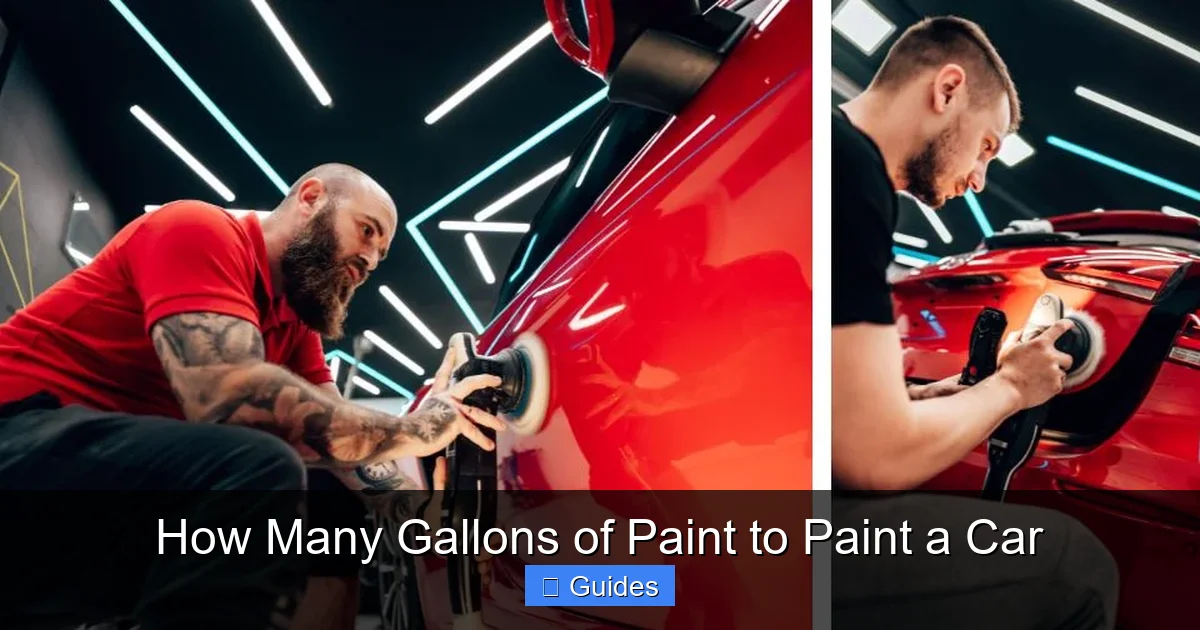
Knowing how many gallons of paint to paint a car is essential for a professional finish and budget planning. The amount depends on the car size, paint type, number of coats, and surface condition. Most full car repaints require 2–4 gallons, but proper prep and technique matter most.
In This Article
- 1 Key Takeaways
- 2 📑 Table of Contents
- 3 How Many Gallons of Paint to Paint a Car: A Complete Guide
- 4 Understanding the Basics of Car Painting
- 5 Factors That Affect Paint Quantity
- 6 Estimating Paint Needs for Different Vehicles
- 7 Tips to Minimize Paint Waste and Maximize Coverage
- 8 Common Mistakes to Avoid
- 9 Conclusion
- 10 Frequently Asked Questions
Key Takeaways
- Typical paint usage: Most cars need 2–4 gallons of paint for a full repaint, including primer, base coat, and clear coat.
- Car size matters: Compact cars use less paint (1.5–2.5 gallons), while SUVs and trucks may need 3–5 gallons.
- Paint type affects coverage: High-solid paints cover better and may reduce the total gallons needed.
- Multiple coats increase usage: Base coats usually require 2–3 layers, and clear coat needs 2–3 layers for durability and shine.
- Surface prep is crucial: Sanding, priming, and repairing dents can increase paint consumption due to absorption and texture.
- Spray technique impacts efficiency: Proper spray gun settings and overlapping strokes help minimize waste and ensure even coverage.
- Always buy extra: Purchase 10–20% more paint than estimated to account for touch-ups, spills, and inconsistencies.
📑 Table of Contents
How Many Gallons of Paint to Paint a Car: A Complete Guide
So, you’re thinking about painting your car. Maybe it’s looking a little faded, or you just want a fresh new look. Whatever the reason, one of the first questions that pops into your mind is: How many gallons of paint do I actually need? It’s not as simple as grabbing a couple of cans and hoping for the best. Painting a car is a detailed process that involves prep work, multiple layers, and the right materials. And yes, the amount of paint you’ll use depends on several factors—some obvious, some not so much.
If you’ve never painted a car before, it’s easy to underestimate how much paint is required. You might think one gallon is enough, but in reality, most full car repaints need anywhere from two to four gallons. That includes primer, base coat, and clear coat. And if you’re working on a larger vehicle like an SUV or truck, you could be looking at even more. But don’t worry—this guide will walk you through everything you need to know to estimate your paint needs accurately, avoid waste, and get that showroom shine.
Understanding the Basics of Car Painting
Visual guide about How Many Gallons of Paint to Paint a Car
Image source: mightypaint.com
Before we dive into gallons and measurements, let’s talk about what actually goes into painting a car. It’s not just slapping on some color and calling it a day. A professional-quality paint job involves several layers, each with a specific purpose. Skipping steps or cutting corners can lead to peeling, bubbling, or a dull finish that doesn’t last.
The typical car paint job consists of three main stages: primer, base coat, and clear coat. The primer seals the metal, fills in small imperfections, and helps the paint adhere properly. The base coat is the colored layer—the one you actually see. And the clear coat protects the color, adds shine, and resists UV damage and scratches. Each of these layers requires its own amount of paint, and they all add up.
Now, when people ask, “How many gallons of paint to paint a car?” they’re usually referring to the base coat. But in reality, you’ll need paint for all three stages. Primer is often sold in gallons, but you might only use a fraction of a gallon depending on the car size. The base coat is where most of the paint goes—typically 1.5 to 3 gallons for a standard sedan. Then the clear coat usually takes another 1 to 2 gallons. So when you add it all up, you’re looking at a total of 2.5 to 5 gallons for the entire job.
Why Layering Matters
You might be tempted to skip the primer or use just one coat of base paint to save time and money. But that’s a recipe for disaster. Primer creates a smooth, sealed surface that helps the color lay evenly. Without it, the paint can absorb unevenly, leading to blotchiness or poor adhesion. And the base coat needs multiple layers to achieve full coverage and depth. One thin coat will look translucent and weak. Two to three coats give you that rich, solid color you’re after.
The clear coat is just as important. It’s not just for shine—it’s a protective barrier. Without enough clear coat, your paint will fade quickly, scratch easily, and lose its luster. Most professionals recommend two to three coats of clear for durability. And since clear coat is usually applied in thinner layers, it can take more volume than you’d expect.
The Role of Paint Type
Not all paints are created equal. The type of paint you choose can significantly affect how much you’ll need. For example, high-solid paints contain more pigment and binders, which means they cover better and require fewer coats. This can reduce the total gallons needed. On the other hand, lower-quality or water-based paints might need more layers to achieve the same coverage, increasing your paint consumption.
Automotive paints come in different formulations, including acrylic enamel, urethane, and water-based systems. Urethane paints are popular for their durability and smooth finish, but they can be more expensive. Water-based paints are eco-friendlier and easier to clean up, but they may require more careful application. No matter which type you choose, always follow the manufacturer’s recommendations for mixing, thinning, and application.
Factors That Affect Paint Quantity
Visual guide about How Many Gallons of Paint to Paint a Car
Image source: cypaint.com
Now that you understand the basics, let’s look at the real-world factors that determine how many gallons of paint you’ll need. It’s not just about the size of the car—though that’s a big part of it. Surface condition, paint type, number of coats, and even your spray technique can all influence the final amount.
Car Size and Body Style
This is the most obvious factor. A compact car like a Honda Civic or Toyota Corolla has less surface area than a full-size SUV like a Ford Expedition or a pickup truck. As a general rule:
– Compact cars: 1.5–2.5 gallons of base paint
– Midsize sedans: 2–3 gallons
– SUVs and crossovers: 2.5–4 gallons
– Trucks and vans: 3–5 gallons
These estimates are for the base coat only. Add another 1–2 gallons for clear coat and about 0.5–1 gallon for primer, and you’ll have a better idea of the total paint needed.
But it’s not just about square footage. The design of the car also matters. Vehicles with complex body lines, spoilers, or extra trim may require more paint due to increased surface area and harder-to-reach spots. A convertible with a fabric top might need less paint than a hardtop, but you’ll still need to paint the frame and interior panels if you’re doing a full job.
Surface Condition and Prep Work
Here’s where many DIYers go wrong. If your car has rust, dents, or old paint that’s flaking, you’ll need to do extensive prep work before painting. Sanding, filling, and priming all add layers that can absorb more paint. For example, if you’re repairing large dents with body filler, that area will need extra primer and paint to blend smoothly with the rest of the car.
Rust is another big factor. If you’re dealing with surface rust, you’ll need to sand it down, apply a rust converter, and then prime the area. Each of these steps uses additional materials and can increase paint consumption. In severe cases, you might need to replace panels, which adds even more surface area to paint.
Even if your car looks clean, you still need to wash it thoroughly, degrease it, and sand the old paint to create a “tooth” for the new paint to adhere to. This prep work doesn’t use paint directly, but it ensures that the paint you do apply sticks properly and lasts longer. Skipping prep might save paint in the short term, but it will cost you in the long run with peeling or bubbling.
Number of Coats and Desired Finish
How many coats you apply directly affects how much paint you’ll use. Most professionals recommend:
– Primer: 1–2 coats
– Base coat: 2–3 coats
– Clear coat: 2–3 coats
Each coat should be thin and even. Thick coats can run or sag, while too-thin coats won’t provide full coverage. The goal is to build up the color gradually. For example, if you’re painting a red car, the first coat might look pink or translucent. The second coat brings it closer to the final color, and the third coat gives it depth and richness.
Metallic and pearl paints often require more coats than solid colors because the flakes need to align properly to reflect light correctly. If you’re going for a custom color or a tri-coat finish (like some luxury cars), you could be looking at four or more base coats, which significantly increases paint usage.
Paint Application Method
Are you using a spray gun, aerosol cans, or a brush? The method you choose affects efficiency and waste. A professional HVLP (high-volume, low-pressure) spray gun is the most efficient, delivering a fine mist that covers evenly with minimal overspray. But if you’re using cheap spray cans or an old gun, you might end up using more paint due to uneven application and wasted overspray.
Even with a good spray gun, technique matters. Holding the gun too far away or moving too quickly can cause thin spots. Moving too slowly or too close can lead to runs. The ideal distance is about 6–8 inches from the surface, with overlapping strokes of about 50%. This ensures full coverage without wasting paint.
Estimating Paint Needs for Different Vehicles
Visual guide about How Many Gallons of Paint to Paint a Car
Image source: theprairiehomestead.com
Let’s put this into practice with some real-world examples. Here’s how much paint you might need for different types of vehicles, based on average surface area and standard coating practices.
Compact Car (e.g., Honda Civic)
– Surface area: ~300 square feet
– Primer: 0.5–0.75 gallon
– Base coat: 1.5–2 gallons
– Clear coat: 1–1.5 gallons
– Total paint: ~3–4.25 gallons
This assumes a full repaint with proper prep and 2–3 coats of each layer. If you’re only painting certain panels (like the hood or doors), you can scale down accordingly.
Midsize Sedan (e.g., Toyota Camry)
– Surface area: ~350–400 square feet
– Primer: 0.75–1 gallon
– Base coat: 2–2.5 gallons
– Clear coat: 1.5–2 gallons
– Total paint: ~4.25–5.5 gallons
Sedans have more surface area than compacts, especially with larger trunks and longer hoods. The paint needs will increase proportionally.
SUV (e.g., Ford Explorer)
– Surface area: ~500–600 square feet
– Primer: 1–1.5 gallons
– Base coat: 3–4 gallons
– Clear coat: 2–2.5 gallons
– Total paint: ~6–8 gallons
SUVs have large doors, roofs, and bumpers, which all add up. If you’re painting the roof, pillars, or interior trim, you’ll need even more.
Pickup Truck (e.g., Ford F-150)
– Surface area: ~600–700 square feet
– Primer: 1.5–2 gallons
– Base coat: 4–5 gallons
– Clear coat: 2.5–3 gallons
– Total paint: ~8–10 gallons
Trucks have large beds, extended cabs, and wide fenders. If you’re painting the bed or trailer hitch, factor in extra paint.
Tips to Minimize Paint Waste and Maximize Coverage
Now that you know how much paint you might need, let’s talk about how to use it wisely. Paint isn’t cheap—automotive paint can cost $50–$150 per gallon, and clear coat is often more expensive. Wasting even half a gallon can add $50–$100 to your project cost. Here are some tips to get the most out of every drop.
Use the Right Spray Gun Settings
Your spray gun’s air pressure, fluid nozzle size, and fan pattern all affect how efficiently paint is applied. Most automotive paints are designed for a 1.3–1.4 mm nozzle with 25–30 PSI at the gun. If the pressure is too high, you’ll get more overspray. Too low, and the paint won’t atomize properly, leading to thick, uneven coats.
Always test your settings on a piece of cardboard or scrap metal before spraying the car. Adjust until you get a smooth, even pattern with minimal bounce-back.
Maintain Proper Distance and Speed
Hold the spray gun 6–8 inches from the surface and move at a steady pace—about 1–2 feet per second. Overlap each pass by 50% to ensure full coverage. If you move too fast, you’ll get thin spots. Too slow, and you’ll get runs.
Work in sections: door, fender, hood, etc. Don’t try to paint the whole car at once. This helps you maintain consistency and avoid drying lines.
Thin Paint Correctly
Most automotive paints need to be thinned before spraying. Follow the manufacturer’s instructions for the right ratio—usually 10–20% reducer. Over-thinning can cause the paint to run; under-thinning makes it hard to spray smoothly.
Use a mixing cup with graduated markings to get the ratio right. Stir gently to avoid bubbles, which can cause orange peel texture.
Work in a Clean, Controlled Environment
Dust, dirt, and moisture are the enemies of a good paint job. Paint in a clean, dry, well-ventilated area—ideally a spray booth. If you’re working in a garage, cover the floor with plastic and use a fan to control dust.
Avoid painting in high humidity or direct sunlight. Moisture can cause blushing (a cloudy appearance), and heat can make the paint dry too fast, leading to poor adhesion.
Buy Extra Paint
Always purchase 10–20% more paint than your estimate. This gives you room for touch-ups, color matching, and unexpected spills. Leftover paint can be stored in a cool, dry place for future repairs. Just make sure to seal the can tightly and label it with the color code and date.
Common Mistakes to Avoid
Even with the best planning, mistakes happen. Here are some common pitfalls that can lead to wasted paint or a subpar finish.
Skipping Primer
Primer isn’t optional. It seals the metal, fills minor imperfections, and helps the paint stick. Skipping it might save a gallon of paint, but it will cost you in the long run with peeling or corrosion.
Applying Thick Coats
One thick coat is worse than two thin ones. Thick paint is more likely to run, sag, or crack. It also takes longer to dry and can trap solvents, leading to bubbling.
Ignoring Color Matching
If you’re only painting part of the car, you need to blend the new paint with the old. This often requires “feathering” the edges and using the same paint code. Mismatched colors are obvious and ruin the look.
Not Allowing Proper Drying Time
Each coat needs time to flash (dry between coats) and cure (harden fully). Rushing the process can cause the layers to mix or the paint to wrinkle. Follow the manufacturer’s recommended drying times—usually 10–15 minutes between coats and 24–48 hours before wet sanding or polishing.
Conclusion
So, how many gallons of paint to paint a car? The answer isn’t one-size-fits-all. For most standard cars, you’ll need 2–4 gallons of base paint, plus another 1–2 gallons for clear coat and about a gallon for primer. Larger vehicles like SUVs and trucks can require 6–10 gallons total. The key is to assess your car’s size, condition, and the number of coats you plan to apply.
But remember, paint quantity is only part of the equation. Proper prep, the right tools, and good technique are what make the difference between a DIY job that looks amateur and one that turns heads. Take your time, follow the steps, and don’t skimp on quality materials. With the right approach, you can achieve a professional-looking finish that lasts for years.
And when in doubt, buy a little extra paint. It’s better to have leftovers than to run out halfway through a panel. Happy painting!
Frequently Asked Questions
How many gallons of paint do I need for a full car repaint?
Most full car repaints require 2–4 gallons of base paint, plus 1–2 gallons of clear coat and about 1 gallon of primer. Total paint needed typically ranges from 4 to 7 gallons, depending on the vehicle size and number of coats.
Can I paint a car with one gallon of paint?
One gallon is usually not enough for a full car repaint. It might cover a small panel or a motorcycle, but most cars need at least 2–3 gallons of base paint alone, not including primer and clear coat.
Does the color of the paint affect how much I need?
Yes, darker colors and metallic/pearl finishes often require more coats for full coverage, which increases paint usage. Light colors may show through more easily, requiring additional layers.
How much paint is needed for a truck?
A full-size pickup truck typically needs 4–5 gallons of base paint, 2.5–3 gallons of clear coat, and 1.5–2 gallons of primer, totaling 8–10 gallons for a complete repaint.
Can I use spray cans to paint a whole car?
While possible, spray cans are inefficient and expensive for full car painting. They produce more overspray and require many cans—often 20–30 for a sedan—making professional spray equipment a better choice.
How do I store leftover paint?
Store leftover paint in a cool, dry place with the lid sealed tightly. Label the can with the color code, date, and mixing ratio. Properly stored automotive paint can last 1–2 years.

At CarLegit, we believe information should be clear, factual, and genuinely helpful. That’s why every guide, review, and update on our website is created with care, research, and a strong focus on user experience.