
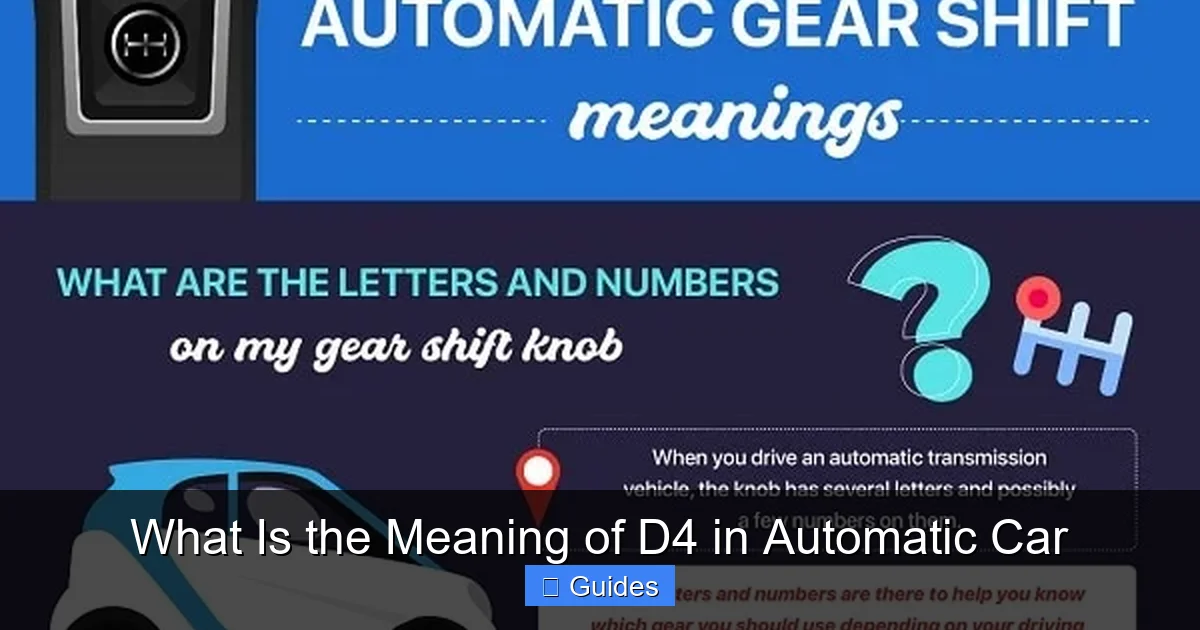
The “D4” in an automatic car stands for “Drive 4,” indicating the transmission can use up to fourth gear. It’s commonly found in older or specific automatic transmissions and offers better control in certain driving conditions like hills or towing.
In This Article
- 1 Key Takeaways
- 2 📑 Table of Contents
- 3 Understanding the Basics: What Is D4 in an Automatic Car?
- 4 When Should You Use D4?
- 5 D4 vs. Other Gear Modes: What’s the Difference?
- 6 Is Using D4 Bad for Your Car?
- 7 How to Use D4: Step-by-Step Guide
- 8 Common Misconceptions About D4
- 9 Conclusion: D4 Is a Useful Tool, Not a Gimmick
- 10 Frequently Asked Questions
Key Takeaways
- What D4 Means: D4 allows the transmission to shift through the first four forward gears, limiting higher gears for better engine control.
- When to Use D4: Ideal for city driving, hilly terrain, or when towing, as it prevents excessive shifting and improves responsiveness.
- Difference from D3 and D: Unlike D3 (which limits to third gear), D4 includes fourth gear for slightly higher speeds without entering overdrive.
- Fuel Efficiency Impact: Using D4 may reduce fuel economy slightly compared to full Drive (D) mode due to higher engine RPMs.
- Common in Older Models: Many older automatic cars and some modern ones with 4-speed transmissions feature D4 as a selectable gear range.
- Not a Safety Risk: D4 is safe to use and designed for specific driving scenarios—misuse is rare and unlikely to damage the vehicle.
- Check Your Owner’s Manual: Always refer to your car’s manual to understand how D4 functions in your specific make and model.
📑 Table of Contents
Understanding the Basics: What Is D4 in an Automatic Car?
If you’ve ever glanced at your gear selector and noticed positions like P, R, N, D, D3, and D4, you might have wondered—what exactly does D4 mean? You’re not alone. Many drivers, especially those new to automatic transmissions, find the array of gear options confusing. While most people simply shift into “D” and drive, understanding what D4 stands for can help you drive more efficiently, safely, and confidently.
So, what is the meaning of D4 in an automatic car? Simply put, D4 stands for “Drive 4.” It’s a gear setting that allows the transmission to use the first four forward gears but prevents it from shifting into higher gears—typically fifth or sixth, if your car has them. This means the car will operate within a lower gear range, giving you more engine power and control, especially at lower speeds or under load.
This feature is most commonly found in older automatic vehicles with 4-speed transmissions, but you’ll also see it in some modern cars with 5- or 6-speed automatics as a manual override option. It’s not a performance mode or a sport setting—it’s more of a practical tool for specific driving conditions.
How Does D4 Work?
When you shift into D4, you’re essentially telling the transmission: “Stay in the lower gears and don’t go beyond fourth.” This limits the top speed slightly but increases engine braking and responsiveness. For example, if you’re driving on a winding mountain road, using D4 can help prevent the transmission from constantly shifting up and down between gears, which can cause wear and reduce control.
In a typical 6-speed automatic car, the full “D” mode allows the transmission to use all six gears. But when you select D4, the car will only use gears 1 through 4. This keeps the engine RPMs higher, which improves torque and acceleration when you need it. It also reduces the frequency of gear changes, making your drive smoother in stop-and-go traffic or on steep inclines.
Think of it like riding a bicycle with multiple gears. If you’re going uphill, you shift to a lower gear to make pedaling easier. D4 does something similar—it keeps the engine in a “lower gear” range so it can deliver more power when needed.
Why Do Cars Have D4?
You might wonder why car manufacturers include D4 if most drivers just use “D.” The answer lies in versatility. Not all driving conditions are the same. Sometimes, full automatic mode isn’t the best choice. D4 gives drivers more control in situations where the transmission might otherwise behave unpredictably.
For instance, in heavy traffic, the transmission might constantly shift between third and fourth gear, causing a jerky ride. By selecting D4, you stabilize the gear changes and reduce that annoying “hunting” behavior. Similarly, when driving downhill, D4 increases engine braking, which helps slow the car without relying too much on the brakes—this is especially useful for preventing brake fade on long descents.
D4 also comes in handy when towing a trailer or carrying a heavy load. The extra weight puts more strain on the engine and transmission. By staying in lower gears, D4 ensures the engine has enough power to handle the load without overheating or struggling.
When Should You Use D4?
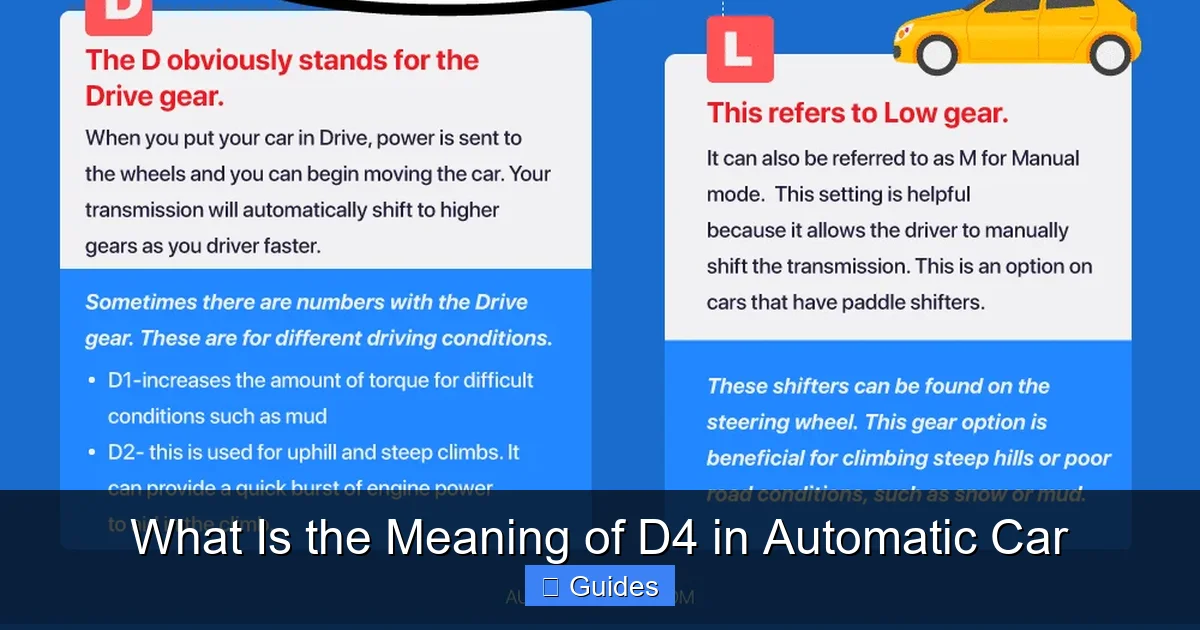
Visual guide about What Is the Meaning of D4 in Automatic Car
Image source: autoguysland.com
Now that you know what D4 means, the next question is: when should you actually use it? While most of the time, you’ll be perfectly fine driving in full “D” mode, there are specific scenarios where D4 shines.
1. Driving in Hilly or Mountainous Areas
If you live in or are traveling through areas with steep hills or mountains, D4 can be a game-changer. On uphill climbs, the transmission might downshift frequently to maintain speed, which can cause jerky movements and wear on the transmission. By selecting D4, you keep the car in a more consistent gear range, reducing unnecessary shifting and providing smoother power delivery.
On downhill slopes, D4 increases engine braking. This means the engine helps slow the car down, reducing the need to ride the brakes. Overusing brakes on long descents can cause them to overheat and lose effectiveness—a condition known as brake fade. Using D4 helps prevent this by letting the engine do some of the work.
For example, imagine driving down a long mountain pass. In full “D” mode, your car might shift into a high gear, making the engine less effective at slowing the vehicle. But in D4, the engine stays in a lower gear, providing more resistance and helping you maintain a safe, controlled speed.
2. Towing or Carrying Heavy Loads
If you’re towing a trailer, boat, or carrying a full load of passengers and cargo, your car’s engine has to work harder. In these situations, the transmission may struggle to find the right gear, leading to constant shifting or loss of power.
Using D4 keeps the engine in a lower gear range, where it can deliver maximum torque. This improves acceleration and reduces strain on the transmission. It also helps prevent overheating, which can be a risk when towing in hot weather or on long trips.
Let’s say you’re pulling a small camper up a hill. In full “D,” the transmission might shift up too soon, causing the engine to lug. But in D4, it stays in a lower gear, maintaining power and preventing stalling or sluggish performance.
3. Stop-and-Go City Driving
City driving often involves frequent stops, starts, and slow speeds. In these conditions, the transmission may shift between third and fourth gear repeatedly, especially if you’re driving just below the threshold for fourth gear. This constant shifting can feel jerky and uncomfortable.
By switching to D4, you limit the transmission to the first four gears, which can reduce this “gear hunting.” It creates a smoother, more predictable driving experience, especially in traffic jams or school zones where speeds are low.
For instance, if you’re driving at 35 mph in a 40 mph zone, the car might keep shifting between third and fourth. In D4, it will stay in third or fourth without trying to go higher, making your ride more consistent.
4. Slippery or Wet Road Conditions
In rainy, snowy, or icy conditions, traction can be reduced. Using D4 can help by keeping the engine in a lower gear, which provides more controlled power delivery to the wheels. This reduces the chance of wheel spin, especially when accelerating from a stop.
Lower gears also offer better engine braking, which can help you slow down gradually without skidding. This is particularly useful on icy hills or wet roads where sudden braking can lead to loss of control.
Imagine starting from a stop on a snowy road. In full “D,” the transmission might shift into a higher gear too quickly, causing the wheels to spin. But in D4, the engine stays in a lower gear, delivering power more smoothly and helping you maintain traction.
D4 vs. Other Gear Modes: What’s the Difference?
Visual guide about What Is the Meaning of D4 in Automatic Car
Image source: symbolismdesk.com
To fully understand D4, it helps to compare it with other common gear positions. Let’s break down how D4 differs from D, D3, and other settings.
D4 vs. D (Full Drive)
The “D” mode is the standard driving position. It allows the transmission to use all available forward gears—whether it’s 4, 5, 6, or even 8 or 9 in newer cars. This mode is optimized for everyday driving and fuel efficiency.
In contrast, D4 limits the transmission to the first four gears. This means the car won’t shift into fifth or sixth gear, even if it’s available. As a result, engine RPMs stay higher, which can reduce fuel economy but improve control and responsiveness.
For example, on the highway, driving in D4 might cause the engine to rev higher than necessary, using more fuel. But in the city or on hills, D4 can provide better performance and smoother shifts.
D4 vs. D3 (Drive 3)
D3 is similar to D4 but even more restrictive. It limits the transmission to the first three forward gears. This is useful for very low-speed driving, such as in parking lots or heavy traffic, where you want maximum engine braking and minimal shifting.
D4, on the other hand, includes fourth gear, allowing for slightly higher speeds—typically up to around 50–60 mph, depending on the vehicle. This makes D4 more versatile than D3 for suburban or light highway driving.
For instance, if you’re driving at 45 mph in a 50 mph zone, D3 might keep you in third gear, causing high RPMs and noise. But D4 allows you to shift into fourth, providing a quieter, more comfortable ride while still offering better control than full “D.”
D4 vs. Manual Mode or Sport Mode
Some modern cars have a manual or sport mode, where you can shift gears using paddle shifters or the gear lever. These modes give you full control over gear selection, similar to a manual transmission.
D4 is not the same as manual mode. It’s an automatic limitation—you’re not shifting gears yourself. The transmission still manages the shifts within the first four gears. It’s more of a “set it and forget it” option for specific conditions.
Sport mode, on the other hand, often delays upshifts and holds gears longer for better acceleration and responsiveness. It’s designed for performance driving, while D4 is more about practicality and control.
Is Using D4 Bad for Your Car?
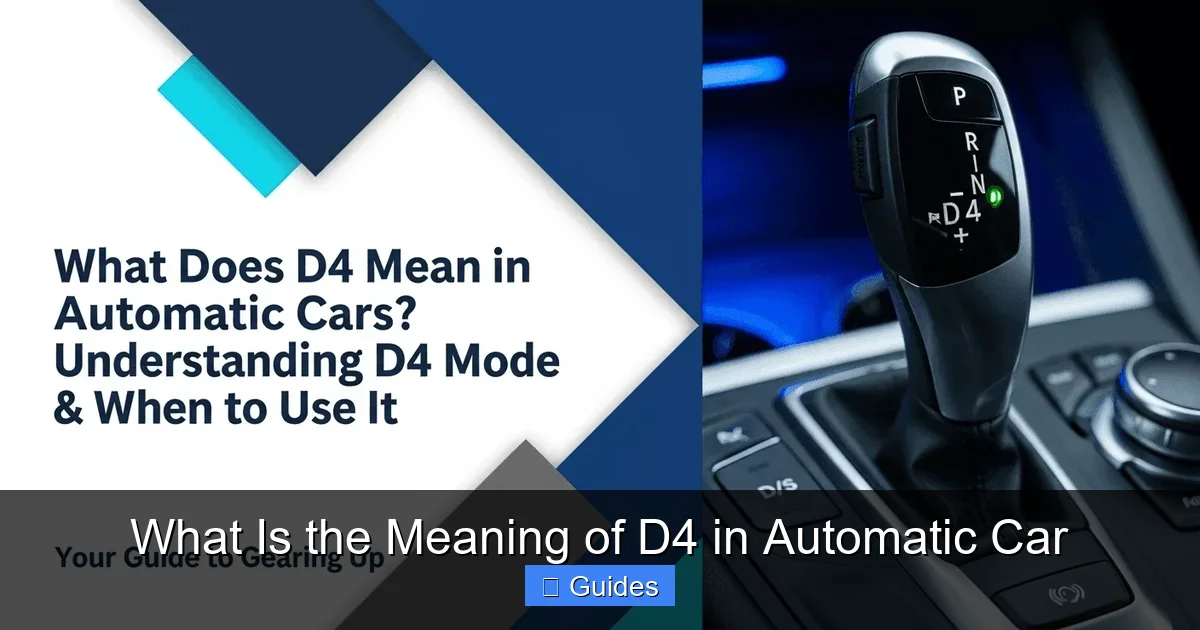
Visual guide about What Is the Meaning of D4 in Automatic Car
Image source: carxplorer.com
A common concern among drivers is whether using D4 can damage the transmission or reduce the lifespan of the vehicle. The short answer is: no, it’s not harmful—when used appropriately.
Transmission Safety and Design
Modern automatic transmissions are designed to handle a wide range of driving conditions. Gear positions like D4, D3, and 2nd gear are included precisely because they’re safe and useful in certain situations. Manufacturers test these modes extensively to ensure they don’t cause damage.
Using D4 occasionally—like when driving on hills or towing—won’t harm your transmission. In fact, it can even help by reducing unnecessary shifting and preventing overheating.
However, using D4 all the time, especially on the highway, can lead to higher engine RPMs, increased fuel consumption, and more engine noise. It’s not designed for long-distance, high-speed driving. So while it’s safe, it’s not always the most efficient choice.
Potential Downsides of Overusing D4
One downside of using D4 too often is reduced fuel economy. Because the engine stays in lower gears, it runs at higher RPMs, burning more fuel. On long highway trips, this can significantly increase your fuel costs.
Additionally, higher RPMs mean more engine wear over time. While modern engines are built to handle this, consistently driving in D4 when it’s not needed can contribute to faster wear on components like spark plugs, pistons, and the catalytic converter.
Another issue is noise and vibration. Lower gears produce more engine noise, which can be annoying on long drives. If you’re cruising at 70 mph in D4, your engine might sound like it’s working much harder than it needs to.
So, the key is balance. Use D4 when it makes sense—like in hills, traffic, or when towing—but switch back to “D” for normal highway driving.
How to Use D4: Step-by-Step Guide
Using D4 is simple, but it’s important to do it correctly to avoid confusion or accidental damage.
Step 1: Come to a Complete Stop (If Necessary)
While you can often shift into D4 while driving, it’s safest to do so when the car is moving slowly or at a stop. This prevents jerky shifts and reduces stress on the transmission.
Step 2: Move the Gear Selector
With your foot on the brake, move the gear lever from “D” to “D4.” In most cars, you’ll feel a slight click or resistance as you move past “D” into the lower gear range.
Some vehicles require you to press a button on the gear lever to access D4, while others allow direct movement. Check your owner’s manual if you’re unsure.
Step 3: Drive Normally
Once in D4, drive as you normally would. The transmission will now only use the first four gears. You’ll notice smoother shifts in traffic, better engine braking on hills, and more responsive acceleration when needed.
Step 4: Switch Back When Done
When you no longer need D4—such as when you reach flat highway driving—simply shift back to “D.” The transmission will resume normal operation, using all available gears for optimal efficiency.
Pro Tip: Use the Tachometer
If your car has a tachometer (RPM gauge), you can use it to monitor engine speed. In D4, you’ll notice higher RPMs at lower speeds compared to full “D.” This is normal and indicates the engine is working in a lower gear range.
Common Misconceptions About D4
Despite its usefulness, D4 is often misunderstood. Let’s clear up some common myths.
Myth 1: D4 Is Only for Old Cars
While D4 is more common in older vehicles with 4-speed transmissions, many modern cars still include it—especially SUVs, trucks, and performance models. It’s not outdated; it’s a practical feature for specific driving needs.
Myth 2: D4 Is the Same as “Low Gear”
D4 is not the same as “L” or “1st” gear. Those settings lock the transmission in the lowest gear for maximum engine braking, often used in extreme conditions like steep descents. D4 allows up to fourth gear, offering a balance between control and speed.
Myth 3: You Should Always Use D4 in Traffic
While D4 can help in stop-and-go traffic, it’s not always necessary. If traffic is moving steadily above 40 mph, full “D” mode may be more efficient. Use D4 when you notice excessive shifting or sluggish performance.
Myth 4: D4 Improves Fuel Economy
Actually, the opposite is usually true. D4 keeps the engine in lower gears, increasing RPMs and fuel consumption. It’s better for control, not efficiency.
Conclusion: D4 Is a Useful Tool, Not a Gimmick
Understanding what D4 means in an automatic car opens up new ways to drive smarter and safer. It’s not just a confusing label on your gear selector—it’s a functional feature designed to improve control, reduce wear, and enhance performance in specific conditions.
Whether you’re navigating mountain roads, towing a trailer, or dealing with heavy traffic, D4 gives you the power to adapt your driving to the situation. It’s not about replacing full “D” mode, but about knowing when to use each option for the best results.
So the next time you see D4 on your gear shift, don’t ignore it. Give it a try in the right conditions. You might be surprised how much smoother and more confident your drive becomes.
And remember: always consult your owner’s manual. Every car is different, and the best way to understand how D4 works in your vehicle is to read the manufacturer’s guidance.
With this knowledge, you’re not just driving—you’re driving with purpose.
Frequently Asked Questions
What does D4 stand for in an automatic car?
D4 stands for “Drive 4,” meaning the transmission can use the first four forward gears but won’t shift into higher gears like fifth or sixth. It’s designed to provide better control and engine braking in specific driving conditions.
Is it safe to drive in D4 all the time?
While D4 is safe to use, driving in it constantly—especially on highways—can reduce fuel efficiency and increase engine wear. It’s best used only when needed, such as in hills, traffic, or when towing.
Can I shift into D4 while driving?
Yes, in most vehicles you can shift into D4 while driving at low to moderate speeds. However, it’s safest to do so when the car is moving slowly to avoid jerky shifts.
What’s the difference between D4 and D3?
D4 allows the transmission to use up to fourth gear, while D3 limits it to the first three gears. D4 is better for slightly higher speeds, while D3 is ideal for very low-speed driving or maximum engine braking.
Does using D4 save fuel?
No, D4 typically reduces fuel economy because the engine runs at higher RPMs. It’s better for control and performance, not efficiency.
Do all automatic cars have D4?
No, not all automatic cars have D4. It’s more common in older models and vehicles with 4-speed transmissions, though some modern cars include it as a selectable gear range.

At CarLegit, we believe information should be clear, factual, and genuinely helpful. That’s why every guide, review, and update on our website is created with care, research, and a strong focus on user experience.