
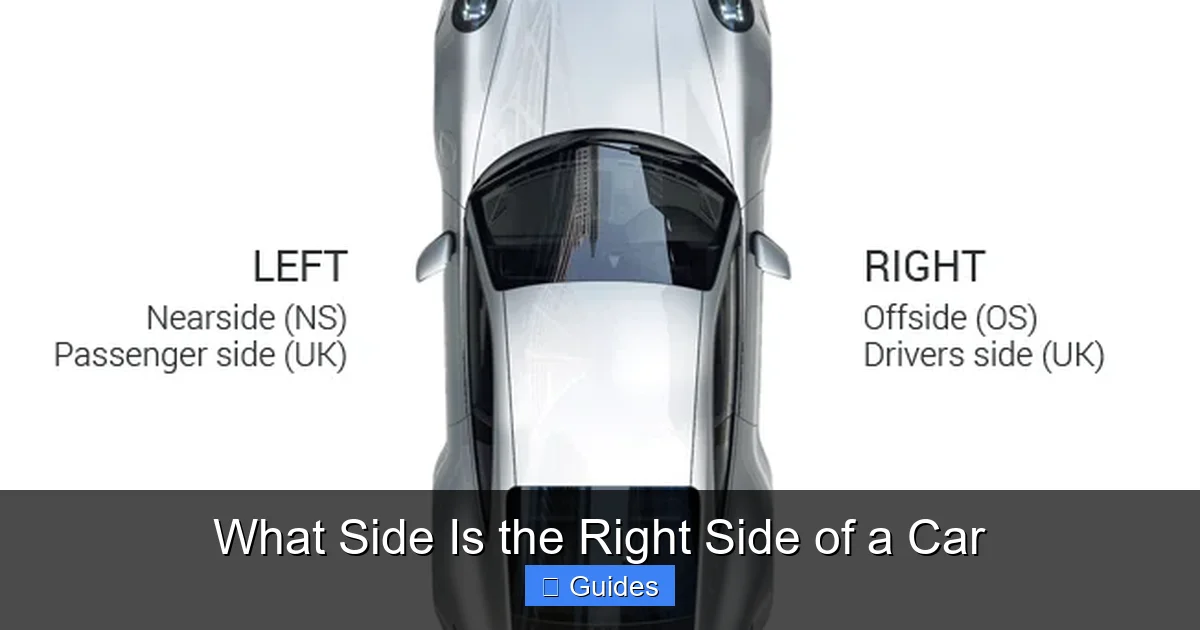
Understanding what side is the right side of a car isn’t just about directions—it’s about safety, design, and global driving standards. This guide breaks down the logic behind vehicle orientation, explains regional differences, and offers practical tips for drivers and passengers alike.
This is a comprehensive guide about What Side Is The Right Side Of A Car.
In This Article
- 1 Key Takeaways
- 2 What Side Is the Right Side of a Car?
- 3 Understanding Left-Hand Drive vs. Right-Hand Drive
- 4 Global Driving Standards and Their Impact
- 5 Practical Implications for Drivers and Passengers
- 6 Vehicle Design Features and the Right Side
- 7 Tips for International Drivers
- 8 Conclusion
- 9 Frequently Asked Questions
- 9.1 Is the right side of a car always the passenger side?
- 9.2 Why do some countries drive on the left and others on the right?
- 9.3 How can I avoid confusion when renting a car abroad?
- 9.4 Are car designs different for LHD and RHD markets?
- 9.5 What should I do if I accidentally signal the wrong way in a foreign car?
- 9.6 Can I drive an RHD car in an LHD country?
Key Takeaways
- The “right side” of a car refers to the passenger side in left-hand drive (LHD) vehicles, which are used in most of the world. This is the side closest to the center of the road when driving on the right.
- In right-hand drive (RHD) countries like the UK and Japan, the driver sits on the right, making the “right side” the driver’s side. This affects everything from door placement to mirror positioning.
- Knowing the right side helps with safe entry, exit, and passenger loading, especially in traffic or parking situations. It reduces confusion and prevents accidents.
- Vehicle design, including fuel doors, windshield wipers, and turn signals, often favors the right side for LHD markets. Manufacturers tailor features based on regional driving norms.
- International drivers must adapt quickly to different configurations to avoid errors like wrong-side merging or incorrect signaling. Awareness prevents dangerous mistakes.
- The right side plays a key role in blind spot management and visibility during lane changes. Proper mirror adjustment on this side is crucial for safety.
- Understanding car orientation improves communication in ride-sharing, car rentals, and emergency situations. Clear directions save time and reduce stress.
[FEATURED_IMAGE_PLACEHOLDER]
What Side Is the Right Side of a Car?
When you think about a car, you probably picture the driver’s seat on the left and the passenger seat on the right. But have you ever stopped to ask: What side is the right side of a car, really? It might seem like a simple question, but the answer depends on where you live, how your car is built, and even the rules of the road in your country.
At first glance, “the right side” sounds straightforward—just look to your right when sitting in the driver’s seat, right? Well, not exactly. The concept of “right side” changes dramatically depending on whether you’re in a left-hand drive (LHD) or right-hand drive (RHD) vehicle. And since nearly 60% of the world drives on the right side of the road, most cars are designed with the driver on the left—making the right side the passenger side. But in countries like the United Kingdom, Australia, India, and Japan, drivers sit on the right, flipping the entire layout.
This isn’t just a quirky detail—it affects how we enter and exit vehicles, how we load passengers, how we park, and even how we signal turns. Whether you’re a new driver, an international traveler renting a car abroad, or just curious about automotive design, understanding what side is the right side of a car is more important than you might think.
In this guide, we’ll explore the logic behind car orientation, break down global driving standards, and explain why the “right side” isn’t always where you expect it to be. We’ll also share practical tips for staying safe and confident no matter which side of the car you’re on.
Understanding Left-Hand Drive vs. Right-Hand Drive
To truly grasp what side is the right side of a car, you first need to understand the difference between left-hand drive (LHD) and right-hand drive (RHD) vehicles. These terms refer to the position of the steering wheel and driver’s seat inside the car.
What Is Left-Hand Drive (LHD)?
Left-hand drive means the driver sits on the left side of the car. This is the standard in countries where people drive on the right side of the road—like the United States, Canada, most of Europe, China, and Brazil. In LHD vehicles, the right side of the car is the passenger side. This setup allows the driver to have a better view of oncoming traffic when passing or turning, especially on two-lane roads.
For example, imagine you’re driving on a rural highway in France. You want to pass a slow-moving truck. With the driver on the left, you can see clearly into the opposite lane before merging. That improved visibility is a major safety advantage, which is why LHD is so widely adopted.
What Is Right-Hand Drive (RHD)?
Right-hand drive means the driver sits on the right side of the car. This is common in countries where people drive on the left side of the road, such as the United Kingdom, Australia, Japan, India, and South Africa. In RHD vehicles, the right side of the car is the driver’s side—so the “right side” becomes the primary control area.
This configuration gives drivers better visibility when overtaking on left-driving roads. For instance, in the UK, when a driver wants to pass a cyclist or another vehicle, they can see more of the road ahead because they’re positioned closer to the center line.
Why Do These Differences Exist?
The split between LHD and RHD dates back centuries. In the early days of horse-drawn carriages, drivers sat on the left so they could use their right hand to wield a whip. This made it easier to control the horses. When roads were narrow and traffic was light, this setup worked fine.
But as vehicles evolved and traffic increased, countries began standardizing road rules. Nations like the U.S. and Germany adopted right-side driving and LHD vehicles for better traffic flow and safety. Meanwhile, former British colonies like Australia and India kept left-side driving and RHD vehicles due to historical ties.
Today, about 35% of the world’s population drives on the left, and the rest drive on the right. This means that while most cars are LHD, a significant number are RHD—especially in Asia, Africa, and Oceania.
How This Affects the “Right Side” of the Car
Now, back to the original question: What side is the right side of a car? The answer depends entirely on the vehicle type:
– In an LHD car (most common globally), the right side is the passenger side.
– In an RHD car, the right side is the driver’s side.
This distinction matters more than you might think. It influences everything from where the fuel cap is located to how the windshield wipers are designed. It also affects how passengers enter and exit the vehicle, especially in busy urban areas.
For example, in the U.S., passengers typically exit on the right side—toward the curb—when parked curbside. This keeps them away from traffic and reduces the risk of accidents. But in the UK, passengers exit on the left side (the curb side), because the driver is on the right.
Understanding this difference is crucial for safety, especially when traveling or renting cars in foreign countries.
Global Driving Standards and Their Impact
The way cars are designed—and which side is considered “right”—is deeply tied to national driving standards. These standards aren’t random; they’re the result of historical, cultural, and practical decisions that have shaped transportation systems worldwide.
Countries That Drive on the Right
The majority of the world—about 65% of countries—drives on the right side of the road. This includes the United States, Canada, Mexico, most of Europe, China, and Brazil. In these nations, vehicles are almost exclusively left-hand drive (LHD), meaning the driver sits on the left and the right side of the car is the passenger side.
This standard promotes consistency in traffic flow. When everyone drives on the same side, merging, turning, and passing become more predictable. It also simplifies vehicle manufacturing—automakers can produce one main design for the largest markets.
For example, Ford, Toyota, and Volkswagen design most of their vehicles as LHD for global sales. Even in countries where RHD is used, many imported vehicles are converted or specially built to meet local needs.
Countries That Drive on the Left
About 35% of the world drives on the left. This includes the United Kingdom, Ireland, Australia, New Zealand, India, Japan, South Africa, and several Caribbean nations. In these countries, vehicles are right-hand drive (RHD), so the driver sits on the right side of the car.
This means that in RHD countries, the “right side” of the car is the driver’s side—not the passenger side. This flips many assumptions we make about car layout.
For instance, in Japan, the driver’s seat is on the right, and passengers enter from the left. This affects how people load groceries, buckle children into car seats, and even how taxi doors open.
The Historical Roots of These Standards
Why do some countries drive on the left and others on the right? The answer goes back centuries.
In medieval Europe, most people were right-handed. When traveling on horseback, it was easier to mount from the left side of the horse. As a result, travelers tended to stay to the left of the road to avoid collisions. This practice carried over into early carriage travel.
However, as roads improved and traffic increased, some countries switched to right-side driving for better control and visibility. Napoleon, for example, enforced right-side driving in the territories he conquered, which is why much of Europe drives on the right today.
Britain, however, kept left-side driving—and passed this tradition to its colonies. That’s why countries like Australia, India, and South Africa still drive on the left.
The Role of Geography and Infrastructure
Geography also plays a role. Island nations like the UK and Japan have compact road networks where left-side driving became standardized early on. Changing it now would require massive infrastructure overhauls—reconfiguring traffic lights, road signs, and even vehicle designs.
In contrast, large continental nations like the U.S. and China adopted right-side driving early in their development, making it easier to maintain consistency across vast distances.
Impact on Vehicle Design and Safety
These global differences directly affect how cars are built. Manufacturers must consider:
– Steering wheel placement
– Pedal layout
– Mirror positioning
– Door hinge direction
– Fuel cap and charging port location
For example, in LHD cars, the fuel door is often on the right side—convenient for drivers filling up at gas stations where the pump is on the right. In RHD cars, it’s usually on the left.
Similarly, windshield wipers are often designed to sweep more effectively on the driver’s side. In LHD cars, the wiper on the right (passenger side) may be shorter, while in RHD cars, the left wiper is smaller.
These design choices aren’t arbitrary—they’re based on visibility, safety, and user convenience.
Practical Implications for Drivers and Passengers
Knowing what side is the right side of a car isn’t just academic—it has real-world consequences for safety, convenience, and communication.
Safe Entry and Exit
One of the most important reasons to understand car orientation is safe entry and exit. In LHD countries, passengers typically exit on the right side—toward the curb—when parked on a city street. This keeps them away from moving traffic and reduces the risk of being hit by passing vehicles.
In RHD countries, passengers exit on the left side, which is also the curb side. This might feel counterintuitive to visitors from LHD countries, but it’s designed for the same safety reason: keeping people away from traffic.
For example, imagine you’re visiting London and renting a car. If you’re used to the U.S., you might instinctively open the right door to exit—but that would put you directly into the path of oncoming traffic. Knowing that the right side is the driver’s side in the UK helps you avoid this dangerous mistake.
Loading Passengers and Cargo
The right side of the car also affects how you load passengers and cargo. In families with young children, the right side (passenger side in LHD cars) is often where car seats are installed. This allows parents to secure children from the curb side, away from traffic.
Similarly, when loading groceries or luggage, people tend to use the right-side door for convenience. In parking lots, this side is usually closer to shopping carts or sidewalks.
But in RHD countries, the left side becomes the primary loading zone. This can confuse travelers who aren’t used to the layout.
Parking and Curbside Etiquette
Parking rules often depend on which side is considered “right.” In many cities, parking regulations specify which side of the street is legal for stopping or loading. Understanding car orientation helps you follow these rules.
For instance, in New York City, you’re allowed to double-park on the right side (passenger side) for short periods to drop off passengers—but not on the left. In Tokyo, the rules are reversed due to RHD vehicles.
Communication in Ride-Sharing and Taxis
When using ride-sharing apps like Uber or Lyft, clear communication about which side to approach is essential. Saying “I’m on the right side of the car” can be confusing if the driver isn’t sure which side you mean.
To avoid confusion, it’s better to say “passenger side” or “driver’s side” instead of “right” or “left.” This removes ambiguity, especially in international settings.
For example, if you’re in Australia and call a taxi, saying “I’m at the driver’s side” is clearer than “I’m on the right,” because the driver knows you’re referring to the right side of the vehicle.
Emergency Situations
In emergencies, knowing which side is which can save time and lives. If you need to direct emergency responders to a specific door or window, using terms like “passenger side” or “driver’s side” is more reliable than “right” or “left.”
For instance, if a child is trapped in a car after an accident, telling paramedics “the passenger is on the right side” helps them act quickly—especially if they’re from a different country or driving an unfamiliar vehicle.
Vehicle Design Features and the Right Side
Car manufacturers design vehicles with specific sides in mind—especially the right side. These design choices are based on safety, usability, and regional driving habits.
Fuel Doors and Charging Ports
One of the most noticeable features tied to the right side is the fuel door. In LHD countries, the fuel cap is almost always on the right side of the car. This makes it easier to pull up to a gas pump, where the nozzle is typically on the right.
For electric vehicles, charging ports are often placed on the right side for the same reason. Tesla, for example, places the charge port on the right rear fender of most models sold in the U.S.
In RHD countries, these features are usually on the left side. This consistency helps drivers know where to look without confusion.
Windshield Wipers and Washer Jets
Windshield wipers are another example of side-specific design. In LHD cars, the driver’s side wiper is usually larger and sweeps a wider area, providing better visibility in rain or snow. The passenger-side wiper is often smaller.
This design prioritizes the driver’s view, which is critical for safety. In RHD cars, the larger wiper is on the right side—the driver’s side.
Washer jets are also positioned to spray more effectively on the driver’s side. This ensures clear visibility when cleaning the windshield.
Mirror Placement and Blind Spot Management
Side mirrors are carefully positioned to minimize blind spots. In LHD cars, the right-side mirror (passenger side) is often convex and angled differently to help the driver see vehicles in adjacent lanes.
This is especially important when changing lanes or merging. The right-side mirror helps detect cars that might be hidden in the driver’s blind spot.
In RHD cars, the left-side mirror serves this purpose. Understanding which mirror to check—and which side is “right”—is key to safe driving.
Door Handles and Hinges
Door handles and hinges are also designed with side orientation in mind. In most cars, the rear doors open toward the rear of the vehicle, but the front doors may have different hinge styles.
In LHD cars, the right front door (passenger side) often has a more accessible handle for passengers. In RHD cars, the left front door is designed for easier access.
These small details improve usability and safety, especially for children and elderly passengers.
Tips for International Drivers
If you’re traveling abroad or renting a car in a foreign country, understanding what side is the right side of a car is essential. Here are some practical tips to help you adapt quickly and stay safe.
Rent from Reputable Companies
Choose rental agencies that offer vehicles familiar to you, if possible. Many international rental companies offer both LHD and RHD options, especially in countries with mixed driving standards.
For example, in Japan, you can often rent LHD cars if you’re from a right-driving country. This can make the transition easier.
Take Time to Adjust
Before driving, spend a few minutes inside the car. Adjust the seat, mirrors, and steering wheel. Note where the turn signals, wipers, and headlights are located—they may be on the opposite side from what you’re used to.
In RHD cars, the turn signal stalk is usually on the right side of the steering wheel, while in LHD cars, it’s on the left. This can cause accidental high-beam activation if you’re not careful.
Practice in a Safe Area
Start your driving experience in a quiet parking lot or empty road. Practice turning, signaling, and checking mirrors. Get a feel for the car’s size and handling before entering traffic.
This is especially important in countries with narrow roads or heavy traffic, like the UK or India.
Use Clear Communication
When giving or receiving directions, avoid using “left” and “right” alone. Instead, say “driver’s side” or “passenger side” to avoid confusion.
For example, instead of saying “the gas cap is on the right,” say “the fuel door is on the passenger side.” This works regardless of the vehicle type.
Stay Alert and Patient
Driving in a new country can be stressful. Stay calm, follow local traffic laws, and don’t hesitate to pull over if you’re unsure. Remember, it’s better to drive slowly and safely than to rush and make a mistake.
Conclusion
So, what side is the right side of a car? The answer isn’t as simple as it seems. It depends on whether you’re in a left-hand drive or right-hand drive vehicle, which in turn depends on the driving standards of your country. In most of the world, the right side is the passenger side—but in places like the UK, Japan, and Australia, the right side is the driver’s side.
Understanding this distinction is more than just a fun fact. It affects how we drive, park, load passengers, and stay safe on the road. It influences vehicle design, from fuel doors to windshield wipers, and plays a key role in emergency situations and international travel.
Whether you’re a daily commuter, a frequent traveler, or just curious about how cars work, knowing what side is the right side of a car helps you navigate the world with confidence. So next time you get behind the wheel—or help someone else into a car—remember: the “right side” might not always be where you think.
Frequently Asked Questions
Is the right side of a car always the passenger side?
No, the right side of a car is the passenger side only in left-hand drive (LHD) vehicles, which are used in countries that drive on the right. In right-hand drive (RHD) countries, the right side is the driver’s side.
Why do some countries drive on the left and others on the right?
This dates back to historical traditions, such as horseback riding and colonial influence. Countries like the UK kept left-side driving, while others, influenced by Napoleon or early American standards, adopted right-side driving.
How can I avoid confusion when renting a car abroad?
Use terms like “driver’s side” or “passenger side” instead of “left” or “right.” Take time to adjust mirrors and controls, and practice in a safe area before driving in traffic.
Are car designs different for LHD and RHD markets?
Yes, manufacturers adjust steering wheel placement, mirror angles, wiper sizes, and even fuel door locations based on whether the vehicle is LHD or RHD to optimize safety and usability.
What should I do if I accidentally signal the wrong way in a foreign car?
Stay calm and correct the signal as soon as possible. If you’re in an RHD car, remember that the turn signal stalk is usually on the right side of the steering wheel, not the left.
Can I drive an RHD car in an LHD country?
Yes, but it may feel unfamiliar and could affect visibility and signaling. Some countries allow it, but it’s important to adjust carefully and follow local traffic laws.

At CarLegit, we believe information should be clear, factual, and genuinely helpful. That’s why every guide, review, and update on our website is created with care, research, and a strong focus on user experience.