
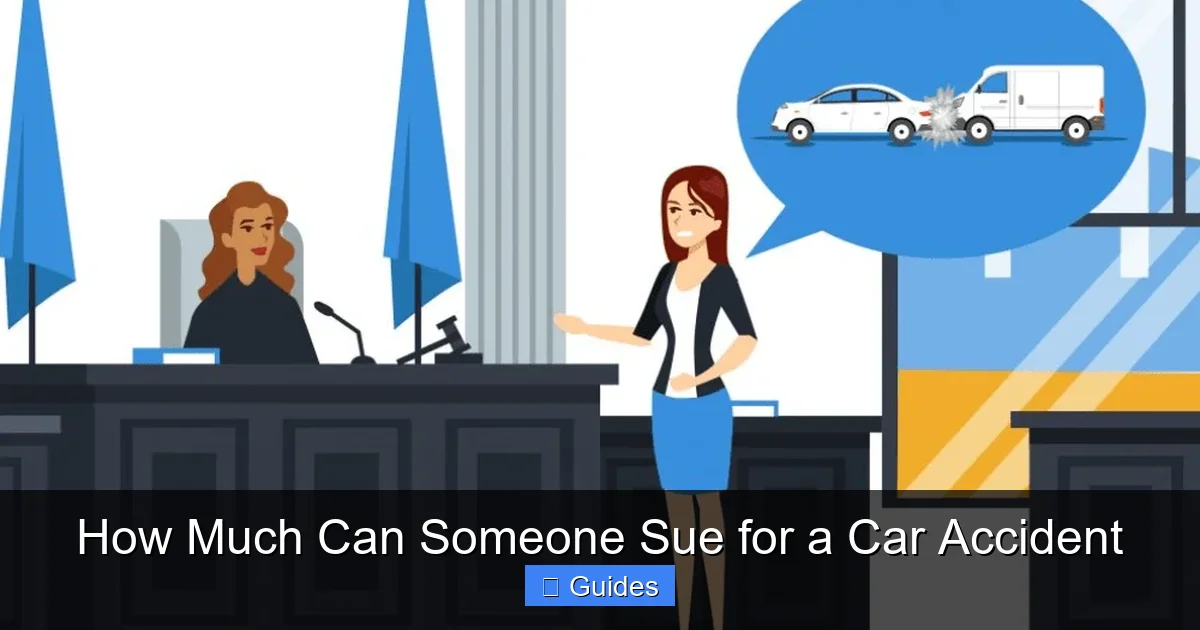
If you’ve been in a car accident, you may be able to sue for damages—but the amount varies widely. Compensation depends on injury severity, lost wages, property damage, and state laws, with some cases reaching millions while others settle for far less.
Getting into a car accident is stressful—even more so when you’re injured, your car is totaled, or you’re facing mounting medical bills. You might be wondering: How much can someone sue for a car accident? The short answer? It depends. There’s no one-size-fits-all number. Some people walk away with a few thousand dollars, while others receive settlements in the millions. But understanding the factors that influence compensation can help you set realistic expectations and take the right steps to protect your rights.
Whether you’re the injured party or someone facing a lawsuit, knowing how car accident claims work is essential. This guide breaks down everything you need to know—from the types of damages you can claim to how state laws and insurance policies affect your payout. We’ll also look at real-world examples, common misconceptions, and practical tips to help you navigate the legal process with confidence. By the end, you’ll have a clear picture of what to expect and how to pursue fair compensation.
In This Article
- 1 Key Takeaways
- 2 📑 Table of Contents
- 3 Understanding Car Accident Lawsuits
- 4 Types of Damages You Can Sue For
- 5 Factors That Influence How Much You Can Sue For
- 6 Real Examples: How Much People Actually Receive
- 7 How to Maximize Your Car Accident Settlement
- 8 Common Misconceptions About Car Accident Lawsuits
- 9 Conclusion
- 10 Frequently Asked Questions
- 10.1 Can I sue for a car accident if I wasn’t injured?
- 10.2 How long do I have to sue after a car accident?
- 10.3 Will my insurance go up if I sue someone?
- 10.4 Can I sue if the at-fault driver has no insurance?
- 10.5 Do I have to go to court to get compensation?
- 10.6 What if the insurance company denies my claim?
Key Takeaways
- Compensation varies by case: There’s no fixed amount—each accident is unique and payouts depend on injuries, fault, and insurance coverage.
- Economic damages are quantifiable: These include medical bills, lost income, and vehicle repair costs, and are easier to calculate than non-economic damages.
- Non-economic damages cover pain and suffering: These subjective claims for emotional distress, trauma, and reduced quality of life can significantly increase a settlement.
- Punitive damages are rare: Awarded only in cases of extreme negligence or intentional harm, these punish the at-fault party and deter future misconduct.
- State laws impact your claim: No-fault states limit lawsuits unless injuries meet a threshold, while fault-based states allow broader legal action.
- Insurance limits cap recovery: Most claims are paid by insurance, so the at-fault driver’s policy limits may restrict how much you can recover.
- Hire a skilled attorney: A car accident lawyer can help maximize your compensation by building a strong case and negotiating effectively.
📑 Table of Contents
Understanding Car Accident Lawsuits
A car accident lawsuit is a legal action taken by someone who has been injured or suffered losses due to a collision caused by another driver’s negligence. The goal is to recover financial compensation for damages. But not every accident leads to a lawsuit—many are resolved through insurance claims without going to court. However, when injuries are severe, liability is disputed, or insurance offers are too low, a lawsuit may be necessary.
When Can You Sue After a Car Accident?
You can generally sue if another driver was at fault and their actions caused your injuries or property damage. This includes situations where the other driver was speeding, ran a red light, was under the influence, or failed to yield. Even if you were partially at fault, you may still have a claim depending on your state’s laws. In comparative negligence states, your compensation is reduced by your percentage of fault—so if you’re 20% responsible, you can still recover 80% of the damages.
No-Fault vs. Fault-Based States
One of the biggest factors affecting your ability to sue is where the accident happened. The U.S. has two main systems: no-fault and fault-based (also called tort) states.
In no-fault states like Florida, New York, and Michigan, drivers must first file a claim with their own insurance company for medical expenses and lost wages, regardless of who caused the crash. You can only sue the other driver if your injuries meet a certain threshold—such as permanent disability, significant disfigurement, or medical expenses exceeding a set amount. This system is designed to reduce lawsuits and speed up compensation, but it limits your right to sue unless the injury is serious.
In fault-based states like California, Texas, and Illinois, the at-fault driver is legally responsible for the damages. You can file a claim directly with their insurance company or sue them in court. These states allow more flexibility in pursuing compensation, especially for pain and suffering, which isn’t covered under no-fault personal injury protection (PIP) policies.
Statute of Limitations
Every state has a statute of limitations—a deadline for filing a lawsuit. This varies from one to six years, depending on the state. For example, California gives you two years from the date of the accident, while Kentucky allows up to five years. Missing this deadline usually means losing your right to sue forever. That’s why it’s crucial to act quickly and consult a lawyer as soon as possible after an accident.
Types of Damages You Can Sue For
When you sue for a car accident, you’re seeking compensation for various types of losses. These are generally divided into three categories: economic damages, non-economic damages, and punitive damages. Understanding each helps you assess the full value of your claim.
Visual guide about How Much Can Someone Sue for a Car Accident
Image source: paznerlaw.com
Economic Damages: The Tangible Costs
Economic damages are the out-of-pocket expenses directly related to the accident. They’re easy to calculate because they come with receipts, bills, or pay stubs. These include:
- Medical expenses: Emergency room visits, surgeries, hospital stays, physical therapy, medications, and future treatments.
- Lost wages: Income lost while recovering, including sick days, vacation time, or reduced work hours.
- Property damage: Repair or replacement costs for your vehicle and personal belongings (like a phone or laptop damaged in the crash).
- Other out-of-pocket costs: Transportation to medical appointments, home modifications for disabilities, or childcare during recovery.
For example, if you broke your leg in an accident and needed surgery, physical therapy, and missed six weeks of work, your economic damages might include $25,000 in medical bills, $8,000 in lost income, and $5,000 for car repairs—totaling $38,000.
Non-Economic Damages: The Invisible Injuries
Non-economic damages compensate for intangible losses that don’t have a receipt but still impact your life. These are harder to quantify but can make up a large portion of your settlement. They include:
- Pain and suffering: Physical pain from injuries and the emotional toll of recovery.
- Emotional distress: Anxiety, depression, PTSD, or fear of driving after the accident.
- Loss of enjoyment of life: Inability to participate in hobbies, sports, or family activities due to injuries.
- Loss of consortium: Damages awarded to a spouse for the loss of companionship, intimacy, or support.
Let’s say you suffered a traumatic brain injury that left you with chronic headaches and memory problems. Even if your medical bills are moderate, the ongoing pain, frustration, and inability to enjoy life could justify a significant non-economic award. Some states use a “multiplier method,” where non-economic damages are calculated by multiplying economic damages by a number (usually 1.5 to 5), depending on severity. Others use a “per diem” approach, assigning a daily value to your pain (e.g., $200 per day of recovery).
Punitive Damages: Punishing Bad Behavior
Punitive damages are rare and not meant to compensate you—they’re designed to punish the at-fault driver for especially reckless or malicious behavior and deter others from doing the same. These are typically awarded in cases involving drunk driving, street racing, or intentional harm.
For instance, if a driver was heavily intoxicated, texting, and driving 90 mph in a school zone when they hit you, a court might award punitive damages on top of your compensatory damages. However, most states cap punitive damages or require clear evidence of gross negligence. In some cases, insurance won’t cover punitive damages, meaning the at-fault party must pay out of pocket—which is why they’re uncommon.
Factors That Influence How Much You Can Sue For
Now that you know the types of damages, let’s look at the real-world factors that determine how much you might actually receive. It’s not just about how badly you were hurt—it’s about the full picture of your case.

Visual guide about How Much Can Someone Sue for a Car Accident
Image source: atlantacaraccidentlawyer.com
Severity of Injuries
This is the biggest factor. Minor injuries like whiplash or bruises usually result in smaller settlements—often under $10,000. But serious injuries like spinal damage, amputations, or permanent disabilities can lead to settlements in the hundreds of thousands or even millions. The longer your recovery, the higher your medical costs and lost income, which increases your claim’s value.
Degree of Fault
In states that follow comparative negligence, your compensation is reduced by your share of blame. For example, if you were texting while driving and the other driver ran a stop sign, a court might find you 30% at fault. If your total damages are $100,000, you’d only receive $70,000. In a few states with “contributory negligence,” being even 1% at fault can bar you from recovering anything—so knowing your state’s rules is critical.
Insurance Policy Limits
Most car accident claims are paid by insurance, not the at-fault driver’s personal assets. That means the maximum you can recover is often capped by their policy limits. If the other driver has a $50,000 liability policy and your damages total $150,000, you may only get $50,000 from their insurer—unless you have underinsured motorist coverage on your own policy.
For example, if you have $100,000 in underinsured coverage, you could claim the remaining $50,000 from your own insurer after exhausting the other driver’s policy. This is why it’s wise to carry higher coverage limits and umbrella policies.
Quality of Evidence
Strong evidence increases your chances of a higher payout. This includes police reports, photos of the scene, witness statements, medical records, and expert testimony. A clear timeline of events, documented injuries, and proof of lost income all help build a compelling case. Conversely, missing evidence or conflicting stories can weaken your claim.
Your Attorney’s Experience
A skilled car accident lawyer can make a huge difference. They know how to value your claim, negotiate with insurers, and present your case effectively. Insurance companies often lowball unrepresented claimants, but attorneys can push back and demand fair compensation. In fact, studies show that people with lawyers typically receive 3.5 times more in settlements than those who go it alone.
Real Examples: How Much People Actually Receive
To give you a better sense of what’s possible, here are a few real-world examples of car accident settlements and verdicts. Keep in mind, every case is different—but these illustrate the range of outcomes.

Visual guide about How Much Can Someone Sue for a Car Accident
Image source: raipher.com
Minor Injury Case: $15,000 Settlement
A driver rear-ended at a stoplight suffered whiplash and missed two weeks of work. Medical bills totaled $8,000, and lost wages were $2,000. The at-fault driver had a $25,000 liability policy. After negotiations, the injured party received a $15,000 settlement—covering medical costs, lost income, and a small amount for pain and suffering. No lawsuit was filed; the case was resolved through insurance.
Moderate Injury Case: $125,000 Verdict
A motorcyclist was hit by a driver who failed to yield at an intersection. The rider suffered a broken arm, fractured ribs, and a concussion. Medical expenses reached $45,000, and they missed four months of work ($20,000 in lost wages). The jury awarded $125,000, including $60,000 for pain and suffering. The at-fault driver’s insurance paid the full amount.
Severe Injury Case: $2.3 Million Settlement
A family of four was struck by a drunk driver. The father suffered a traumatic brain injury and spinal damage, leaving him permanently disabled. Medical costs exceeded $500,000, and future care was estimated at $1.2 million. The at-fault driver had minimal insurance, but the family’s underinsured motorist policy and a lawsuit against the bar that served the driver led to a $2.3 million settlement.
Fatal Accident Case: $5.1 Million Verdict
A pedestrian was killed by a speeding driver who was texting. The victim’s family sued for wrongful death, claiming loss of income, companionship, and emotional suffering. The jury awarded $5.1 million, including $3 million in punitive damages due to the driver’s extreme negligence. The driver’s insurance covered part of the award, and the rest was paid from personal assets.
These examples show that while most cases settle for under $100,000, serious injuries or egregious behavior can lead to life-changing compensation.
How to Maximize Your Car Accident Settlement
If you’ve been in an accident, you want to get every dollar you deserve. Here’s how to strengthen your claim and increase your chances of a fair payout.
Seek Medical Attention Immediately
Even if you feel fine, see a doctor right away. Some injuries, like concussions or internal bleeding, don’t show symptoms right away. Medical records are crucial evidence—delaying treatment can make insurers question the severity of your injuries.
Document Everything
Take photos of the accident scene, vehicle damage, injuries, and road conditions. Get contact info from witnesses. Keep a journal of your pain, recovery, and how the injury affects your daily life. Save all receipts for medical bills, repairs, and travel expenses.
Don’t Accept the First Offer
Insurance companies often make low initial offers to save money. Don’t sign anything or accept a check until you’ve reviewed it with a lawyer. Once you accept, you usually can’t ask for more—even if your injuries worsen.
Hire a Car Accident Attorney
A lawyer levels the playing field. They’ll investigate the accident, gather evidence, calculate your damages, and negotiate on your behalf. Most work on a contingency fee basis—meaning they only get paid if you win, typically 33% of the settlement. This makes legal help accessible, even if you can’t afford upfront costs.
Be Patient
Settlements take time—especially if injuries are complex or liability is disputed. Rushing to settle can mean accepting less than you deserve. Let your lawyer handle the process while you focus on recovery.
Common Misconceptions About Car Accident Lawsuits
There’s a lot of misinformation out there. Let’s clear up some common myths.
“I Can Sue for Any Amount I Want”
False. Courts and insurers base compensation on evidence, not demands. You can’t just ask for $1 million because you think you deserve it. Your claim must be supported by medical records, financial losses, and legal standards.
“If I Was Partially at Fault, I Can’t Sue”
Not necessarily. In most states, you can still recover damages even if you were partly to blame—just reduced by your percentage of fault. Only a few states bar recovery entirely if you’re even slightly at fault.
“Insurance Will Automatically Pay What I Ask For”
No. Insurers are businesses that aim to minimize payouts. They’ll investigate your claim, look for reasons to deny or reduce it, and often offer far less than your actual damages. That’s why negotiation—or litigation—is often needed.
“I Don’t Need a Lawyer for a Simple Case”
Even “simple” cases can become complicated. Adjusters may dispute liability, downplay injuries, or pressure you to settle quickly. A lawyer ensures your rights are protected and your claim is valued correctly.
Conclusion
So, how much can someone sue for a car accident? The answer isn’t simple—but it’s not out of reach, either. Compensation depends on a mix of factors: the severity of your injuries, the strength of your evidence, state laws, and the at-fault party’s insurance coverage. While most settlements range from a few thousand to a few hundred thousand dollars, serious cases can result in awards of millions.
The key is to act quickly, document everything, and seek professional legal help. Don’t let insurance companies take advantage of you. Remember, you’re not just fighting for a check—you’re fighting for your recovery, your future, and your peace of mind. With the right approach, you can pursue the compensation you deserve and move forward after a traumatic event.
Frequently Asked Questions
Can I sue for a car accident if I wasn’t injured?
Yes, you can still sue for property damage, such as vehicle repairs or replacement, even if you weren’t physically injured. However, compensation will be limited to economic losses like repair costs and rental car expenses.
How long do I have to sue after a car accident?
The time limit, called the statute of limitations, varies by state—from one to six years. For example, it’s two years in California and three in New York. Always check your state’s laws and consult a lawyer promptly.
Will my insurance go up if I sue someone?
Generally, no—your rates shouldn’t increase if you’re the one suing as an injured party. However, if you’re found partially at fault, your insurer may adjust your premiums based on the claim.
Can I sue if the at-fault driver has no insurance?
Yes. You can file a claim under your own uninsured motorist coverage if you have it. If not, you may sue the driver personally, though collecting from someone with no assets can be difficult.
Do I have to go to court to get compensation?
Not necessarily. Most car accident claims are settled out of court through negotiations with insurance companies. Going to trial is usually a last resort if a fair settlement can’t be reached.
What if the insurance company denies my claim?
If your claim is denied, you can appeal the decision or file a lawsuit. A lawyer can help you challenge the denial by providing additional evidence or arguing that the insurer acted in bad faith.

At CarLegit, we believe information should be clear, factual, and genuinely helpful. That’s why every guide, review, and update on our website is created with care, research, and a strong focus on user experience.