
The number of catalytic converters in a Nissan Altima varies by model year, engine size, and drivetrain configuration. Most modern Altimas have two catalytic converters—one close to the engine (pre-cat) and one further downstream—while some high-performance or all-wheel-drive models may include three. Understanding your Altima’s setup helps with maintenance, repairs, and emissions compliance.
If you’re a Nissan Altima owner—or thinking about becoming one—you’ve probably heard the term “catalytic converter” thrown around, especially when talking about car maintenance, emissions, or that dreaded check engine light. But how many catalytic converters are actually in a Nissan Altima? The answer isn’t as simple as “one” or “two”—it depends on several factors, including your model year, engine type, and even whether your car is front-wheel drive (FWD) or all-wheel drive (AWD).
Catalytic converters are essential components of your vehicle’s exhaust system. They work quietly under your car, converting harmful pollutants like carbon monoxide, nitrogen oxides, and unburned hydrocarbons into less harmful substances like carbon dioxide and water vapor. Thanks to these devices, modern cars like the Nissan Altima meet strict environmental regulations and help reduce air pollution. But because they’re exposed to extreme heat, road debris, and chemical buildup, they can wear out over time—leading to performance issues, reduced fuel efficiency, and failed emissions tests.
So, how many do you actually have? Let’s break it down in detail, so you can understand your Altima’s emissions system, know what to look for during maintenance, and avoid costly surprises down the road.
In This Article
- 1 Key Takeaways
- 2 📑 Table of Contents
- 3 Understanding Catalytic Converters: Why They Matter in Your Altima
- 4 How Many Catalytic Converters Are in a Nissan Altima by Model Year
- 5 Engine Types and Their Impact on Catalytic Converter Count
- 6 All-Wheel Drive (AWD) and Dual Exhaust Systems
- 7 Signs of a Failing Catalytic Converter in Your Altima
- 8 Replacement Costs and Maintenance Tips
- 9 Conclusion
- 10 Frequently Asked Questions
- 10.1 How many catalytic converters does a 2020 Nissan Altima have?
- 10.2 Can a Nissan Altima run with a bad catalytic converter?
- 10.3 Is it illegal to drive a Nissan Altima without a catalytic converter?
- 10.4 How long do catalytic converters last in a Nissan Altima?
- 10.5 Can I replace a catalytic converter myself?
- 10.6 Why do some Altimas have three catalytic converters?
Key Takeaways
- Most Nissan Altimas have two catalytic converters: a primary (pre-catalyst) and a secondary (main) converter, strategically placed to reduce emissions efficiently.
- Engine type matters: V6 and turbocharged engines, like those in the Altima SR or NISMO trims, often require additional catalytic converters for optimal emission control.
- Model year impacts configuration: Older models (pre-2007) may have only one converter, while newer models (2013–present) typically feature dual converters due to stricter emissions standards.
- All-wheel-drive (AWD) models may have three: The extra converter helps manage exhaust flow from dual exhaust systems common in AWD setups.
- Location is key for diagnosis: Knowing where your catalytic converters are located—under the hood, near the exhaust manifold, or under the car—helps identify issues faster.
- Replacing catalytic converters is costly: OEM parts can cost $1,000–$3,000+ per unit, so understanding your vehicle’s setup helps budget for repairs.
- Emissions testing compliance: A failing or missing catalytic converter will cause your Altima to fail state emissions tests, making awareness essential for legal driving.
📑 Table of Contents
- Understanding Catalytic Converters: Why They Matter in Your Altima
- How Many Catalytic Converters Are in a Nissan Altima by Model Year
- Engine Types and Their Impact on Catalytic Converter Count
- All-Wheel Drive (AWD) and Dual Exhaust Systems
- Signs of a Failing Catalytic Converter in Your Altima
- Replacement Costs and Maintenance Tips
- Conclusion
Understanding Catalytic Converters: Why They Matter in Your Altima
Before diving into the specifics of how many catalytic converters are in a Nissan Altima, it’s important to understand what these devices do and why they’re so critical to your vehicle’s operation.
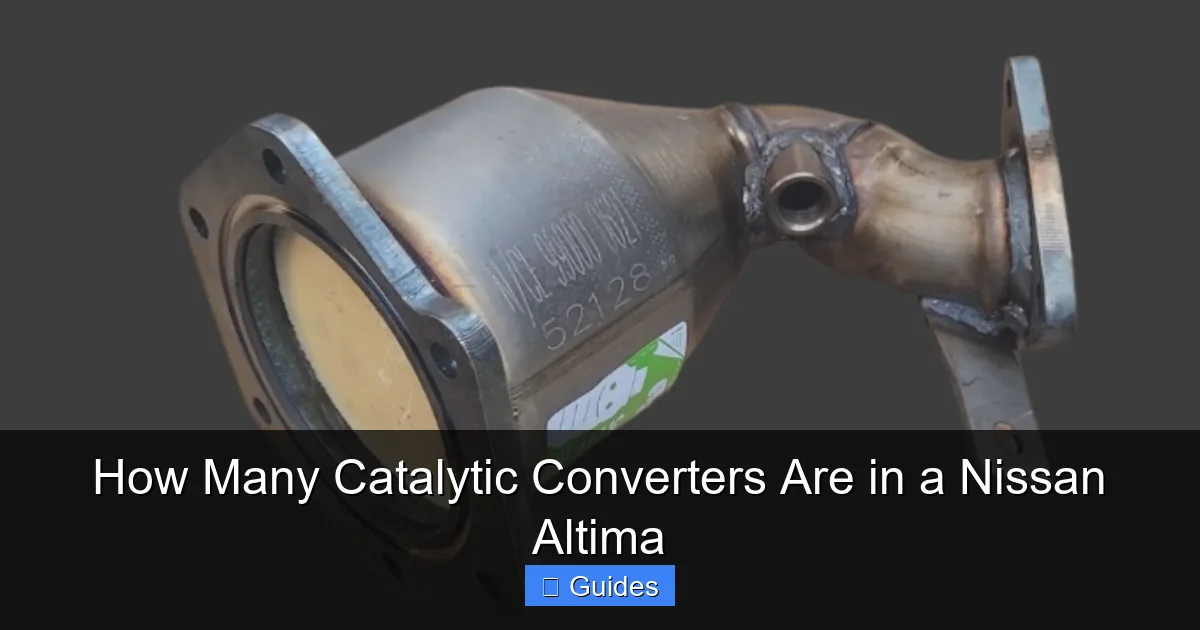
A catalytic converter is essentially a metal canister filled with a ceramic honeycomb structure coated with precious metals like platinum, palladium, and rhodium. As exhaust gases pass through this structure, chemical reactions occur that convert toxic emissions into safer compounds. This process happens continuously while your engine is running, making the catalytic converter one of the hardest-working parts of your car’s emissions system.
In the United States, the Environmental Protection Agency (EPA) mandates that all vehicles meet strict emissions standards. The Nissan Altima, as a popular midsize sedan, must comply with these regulations across all 50 states. That means every Altima sold must be equipped with one or more catalytic converters to reduce harmful exhaust emissions.
But here’s the catch: not all catalytic converters are created equal, and not all Altimas have the same number. The design and placement of these converters depend on the engine’s size, the vehicle’s drivetrain, and the year it was manufactured. For example, a 2005 Altima with a 2.5L 4-cylinder engine might have a single converter, while a 2020 Altima with a 2.0L turbocharged engine and AWD could have three.
Understanding your Altima’s specific configuration helps you make informed decisions about maintenance, repairs, and even resale value. A missing or malfunctioning catalytic converter can trigger the check engine light, reduce fuel economy, and cause your car to fail emissions inspections. In some states, driving without a functioning catalytic converter is illegal and can result in fines.
How Catalytic Converters Work
To appreciate why your Altima needs one or more catalytic converters, let’s take a quick look at how they function.
When your engine burns fuel, it produces exhaust gases that contain pollutants. These gases flow through the exhaust manifold and into the catalytic converter. Inside the converter, the honeycomb structure—coated with precious metals—acts as a catalyst, speeding up chemical reactions that transform harmful substances.
There are two main types of reactions that occur:
– Oxidation: Carbon monoxide (CO) and unburned hydrocarbons (HC) are converted into carbon dioxide (CO₂) and water (H₂O).
– Reduction: Nitrogen oxides (NOx) are broken down into nitrogen (N₂) and oxygen (O₂).
Modern catalytic converters are designed to handle both types of reactions simultaneously, making them highly efficient at reducing emissions. However, they only work properly when the engine is running at the correct air-fuel ratio and the converter reaches its optimal operating temperature (usually around 600–1,000°F).
If your Altima’s engine is running rich (too much fuel) or lean (too little fuel), it can damage the catalytic converter over time. Similarly, oil or coolant leaks into the combustion chamber can coat the catalyst and reduce its effectiveness.
Why the Number of Converters Varies
So why do some Altimas have one catalytic converter while others have two or even three? The answer lies in engine design, emissions regulations, and vehicle configuration.
In the early 2000s, many vehicles—including older Altimas—were equipped with a single catalytic converter located under the car, typically near the muffler. This setup was sufficient to meet emissions standards at the time. However, as regulations became stricter, automakers began adding a second converter closer to the engine, known as a “pre-catalyst” or “close-coupled” converter.
This pre-catalyst heats up faster than the main converter because it’s located near the exhaust manifold. Since catalytic converters are most effective when hot, placing one close to the engine allows it to start reducing emissions almost immediately after startup—critical for passing cold-start emissions tests.
Additionally, vehicles with larger or more powerful engines—like the V6 or turbocharged variants—produce more exhaust gases and pollutants. To handle the increased load, these engines often require multiple converters or larger, more efficient units.
All-wheel-drive models add another layer of complexity. AWD systems often use dual exhaust setups to manage airflow from both the front and rear axles. This can necessitate a third catalytic converter to ensure all exhaust streams are properly treated.
How Many Catalytic Converters Are in a Nissan Altima by Model Year
Visual guide about How Many Catalytic Converters Are in a Nissan Altima
Image source: vehiclechef.com
Now that we understand the basics, let’s look at how the number of catalytic converters in a Nissan Altima has evolved over the years. The answer depends heavily on the model year, as emissions standards and engine technology have changed significantly since the Altima’s debut in 1992.
1993–2006: The Early Years (One Converter)
In the first generation (1993–1997) and second generation (1998–2001) of the Nissan Altima, most models were equipped with a single catalytic converter. These early Altimas typically featured a 2.4L inline-4 engine, which produced moderate emissions that could be managed by one converter located under the vehicle, usually near the rear axle.
Even in the third generation (2002–2006), which introduced a more powerful 3.5L V6 option, many FWD models still used a single converter. However, some high-output V6 trims—especially those sold in California or other states with strict emissions laws—began incorporating a second converter to meet tighter standards.
For example, a 2005 Nissan Altima 3.5 SE with the V6 engine might have two catalytic converters: one near the exhaust manifold and one under the car. But the 2.5L 4-cylinder version likely had just one.
2007–2012: The Shift to Dual Converters
With the introduction of the fourth-generation Altima in 2007, Nissan made significant changes to the exhaust system to comply with updated EPA regulations. Most models from this era—especially those with the 2.5L 4-cylinder or 3.5L V6 engines—were equipped with two catalytic converters.
The first converter, known as the pre-catalyst, was mounted directly to the exhaust manifold or close to it. This allowed it to heat up quickly and begin reducing emissions within seconds of starting the engine. The second converter, the main or downstream catalyst, was located further back in the exhaust system, usually before the muffler.
This dual-converter setup became standard across most trims and drivetrains. Even front-wheel-drive models benefited from the improved emissions control, which helped the Altima pass emissions tests in all 50 states.
2013–2018: Refinements and Turbocharged Options
The fifth-generation Nissan Altima (2013–2018) continued the trend of dual catalytic converters. However, this generation introduced new engine options, including the 2.5L 4-cylinder with direct injection and the 3.5L V6 with variable valve timing.
These engines produced more power and torque, but also more emissions. To keep up, Nissan refined the catalytic converter design, using more efficient catalysts and better thermal management. The dual-converter system remained standard, with the pre-cat near the engine and the main cat under the vehicle.
One notable exception was the Altima SR trim with the 3.5L V6. Some of these performance-oriented models featured a more aggressive exhaust system that included a third catalytic converter to handle increased exhaust flow and meet emissions standards in states like California.
2019–Present: The Turbo Era and AWD Models
The current generation of the Nissan Altima (2019–present) represents the most advanced emissions control system in the model’s history. With the introduction of the 2.0L VC-Turbo (variable compression turbo) engine and the availability of all-wheel drive, the number of catalytic converters has increased in certain configurations.
Most 2019–2024 Altimas with the 2.5L 4-cylinder engine still use two catalytic converters: one close to the engine and one downstream. However, the 2.0L turbocharged engine—available in the SR and Platinum trims—often requires a third converter due to higher exhaust temperatures and emissions output.
Additionally, all-wheel-drive models (available since 2019) typically feature a dual exhaust system to manage airflow from both axles. This setup often includes a third catalytic converter to treat exhaust from both sides of the vehicle.
For example, a 2022 Nissan Altima SR AWD with the 2.0L turbo engine likely has three catalytic converters: one pre-cat per exhaust bank (two total) and one main converter further back. This ensures that all exhaust gases are properly treated, even under high load or during cold starts.
Engine Types and Their Impact on Catalytic Converter Count

Visual guide about How Many Catalytic Converters Are in a Nissan Altima
Image source: moparmax.com
The engine under your Altima’s hood plays a major role in determining how many catalytic converters your vehicle has. Let’s break down the most common engine options and their typical converter configurations.
2.5L 4-Cylinder Engine (QR25DE)
The 2.5L inline-4 engine has been the workhorse of the Nissan Altima lineup for decades. Found in base and mid-level trims from 2002 to the present, this engine is known for its reliability and fuel efficiency.
Most 2.5L Altimas—especially those from 2007 onward—are equipped with two catalytic converters. The first is mounted close to the exhaust manifold (pre-cat), and the second is located under the car, usually near the rear axle (main cat). This setup provides excellent emissions control while keeping costs manageable.
Even in older models (2002–2006), the 2.5L engine typically used a single converter, but dual-converter systems became standard as emissions standards tightened.
3.5L V6 Engine (VQ35DE/VQ35DD)
The 3.5L V6 engine, available in SE, SL, and SR trims from 2002 to 2018, produces significantly more power and emissions than the 4-cylinder. To handle the increased exhaust output, most V6 Altimas are equipped with two or even three catalytic converters.
In earlier models (2002–2006), some V6 Altimas had a single converter, but dual-converter systems became standard by 2007. The pre-cat is mounted near each exhaust manifold (one per bank), and a main converter is located downstream.
In high-performance trims or vehicles sold in California, a third converter may be added to meet stricter emissions standards. This is especially true for models with dual exhaust systems.
2.0L VC-Turbo Engine (KR20DDET)
Introduced in 2019, the 2.0L variable compression turbo engine is one of the most advanced powerplants in the Altima lineup. It delivers V6-like power with 4-cylinder efficiency, but it also produces higher exhaust temperatures and emissions due to turbocharging.
To manage this, most 2.0L turbo Altimas—especially those with AWD—are equipped with three catalytic converters. The turbocharged exhaust manifold often includes an integrated pre-catalyst, and a second converter is placed downstream. In AWD models, a third converter may be added to handle exhaust from the rear differential or dual exhaust system.
This triple-converter setup ensures that the engine meets emissions standards even under high load or during cold starts, when turbocharged engines are most polluting.
All-Wheel Drive (AWD) and Dual Exhaust Systems

Visual guide about How Many Catalytic Converters Are in a Nissan Altima
Image source: excelexhaust.com
One of the biggest factors that can increase the number of catalytic converters in a Nissan Altima is the presence of all-wheel drive (AWD). Introduced in 2019, AWD Altimas use a more complex exhaust system to manage airflow from both the front and rear axles.
Why AWD Models May Have Three Converters
In AWD Altimas, the exhaust system is often split into two separate paths—one for the front wheels and one for the rear. This dual exhaust setup requires additional components to ensure that all exhaust gases are properly treated.
As a result, many AWD models include three catalytic converters:
– One pre-catalyst near the engine (or one per exhaust bank in V6 or turbo engines)
– One main converter under the car
– A third converter dedicated to the rear exhaust stream or AWD-specific exhaust routing
This third converter is often smaller and located closer to the rear axle. Its job is to treat any remaining pollutants that weren’t fully processed by the upstream converters.
While not all AWD Altimas have three converters, it’s common in higher trims and turbocharged models. If you’re unsure, checking your vehicle’s emissions label (usually found under the hood or on the driver’s door jamb) can provide clues about your exhaust system configuration.
Identifying AWD vs. FWD Exhaust Systems
If you’re trying to determine how many catalytic converters your Altima has, one way to start is by checking whether your vehicle is AWD or FWD.
FWD Altimas typically have a single exhaust pipe exiting the rear bumper, while AWD models often have dual exhaust tips—one on each side. This visual cue can indicate a more complex exhaust system, which may include additional converters.
You can also look under the car. AWD models often have more exhaust components, including additional mufflers, resonators, and catalytic converters. If you see three distinct catalytic converter-shaped canisters along the exhaust path, you likely have a triple-converter setup.
Signs of a Failing Catalytic Converter in Your Altima
Regardless of how many catalytic converters your Altima has, it’s important to recognize the signs of a failing unit. A malfunctioning converter can lead to reduced performance, poor fuel economy, and failed emissions tests.
Common Symptoms
– Check Engine Light: A failing catalytic converter often triggers the check engine light. Common trouble codes include P0420 (Catalyst System Efficiency Below Threshold) and P0430 (Bank 2 Catalyst Efficiency).
– Reduced Engine Performance: A clogged converter restricts exhaust flow, causing the engine to lose power, especially during acceleration.
– Rotten Egg Smell: A sulfur-like odor from the exhaust can indicate a failing converter that’s no longer processing hydrogen sulfide properly.
– Increased Emissions: Your car may fail an emissions test due to high levels of CO, HC, or NOx.
– Loud Rattling Noise: If the internal honeycomb structure breaks apart, you may hear a rattling sound from under the car.
Diagnosing the Problem
If you suspect a catalytic converter issue, it’s best to have your Altima inspected by a qualified mechanic. They can use a scan tool to read trouble codes and perform a visual inspection of the exhaust system.
In some cases, the problem may not be the converter itself but an underlying issue like a misfiring spark plug or oxygen sensor failure. These problems can damage the catalytic converter over time, so it’s important to address them promptly.
Replacement Costs and Maintenance Tips
Replacing a catalytic converter is one of the most expensive repairs you can face as an Altima owner. Costs vary widely depending on the number of converters, the engine type, and whether you choose OEM or aftermarket parts.
Cost Breakdown
– Single Converter (Older Models): $800–$1,500 for parts and labor
– Dual Converters (Most Modern Altimas): $1,500–$3,000+
– Triple Converters (Turbo or AWD Models): $2,500–$5,000+
OEM (original equipment manufacturer) parts are more expensive but offer better durability and emissions compliance. Aftermarket converters are cheaper but may not last as long or meet strict emissions standards in certain states.
Maintenance Tips
– Use Quality Fuel: Low-quality or contaminated fuel can damage the catalytic converter over time.
– Fix Engine Problems Promptly: Misfires, rich fuel mixtures, and oil leaks can all harm the converter.
– Avoid Short Trips: Frequent cold starts prevent the converter from reaching optimal temperature, leading to buildup.
– Get Regular Emissions Checks: Stay ahead of problems by having your Altima inspected annually.
Conclusion
So, how many catalytic converters are in a Nissan Altima? The answer depends on your model year, engine type, and drivetrain. Most modern Altimas have two catalytic converters—one near the engine and one under the car—while turbocharged or AWD models may have three. Understanding your vehicle’s setup helps you maintain it properly, avoid costly repairs, and stay compliant with emissions regulations.
Whether you’re diagnosing a check engine light or preparing for an emissions test, knowing how your Altima’s catalytic converters work—and how many you have—puts you in control. With proper care, these essential components can last for 100,000 miles or more, keeping your Altima running clean and efficient for years to come.
Frequently Asked Questions
How many catalytic converters does a 2020 Nissan Altima have?
A 2020 Nissan Altima typically has two catalytic converters—one close to the engine (pre-cat) and one further downstream. However, models with the 2.0L turbocharged engine or all-wheel drive may have three converters to meet emissions standards.
Can a Nissan Altima run with a bad catalytic converter?
Technically, yes, but it’s not recommended. A failing catalytic converter can cause reduced performance, poor fuel economy, and increased emissions. It may also trigger the check engine light and cause your car to fail emissions tests.
Is it illegal to drive a Nissan Altima without a catalytic converter?
Yes, in most states it is illegal to operate a vehicle without a functioning catalytic converter. Doing so can result in fines, failed inspections, and environmental penalties.
How long do catalytic converters last in a Nissan Altima?
Most catalytic converters in a Nissan Altima last between 100,000 and 150,000 miles. However, driving conditions, fuel quality, and engine health can affect their lifespan.
Can I replace a catalytic converter myself?
While possible, replacing a catalytic converter is complex and requires specialized tools and knowledge. It’s best left to professionals, especially since improper installation can lead to emissions issues or damage.
Why do some Altimas have three catalytic converters?
Turbocharged engines and all-wheel-drive models often produce more exhaust gases and require additional converters to meet strict emissions standards. The third converter helps treat exhaust from dual exhaust systems or high-output engines.

At CarLegit, we believe information should be clear, factual, and genuinely helpful. That’s why every guide, review, and update on our website is created with care, research, and a strong focus on user experience.