
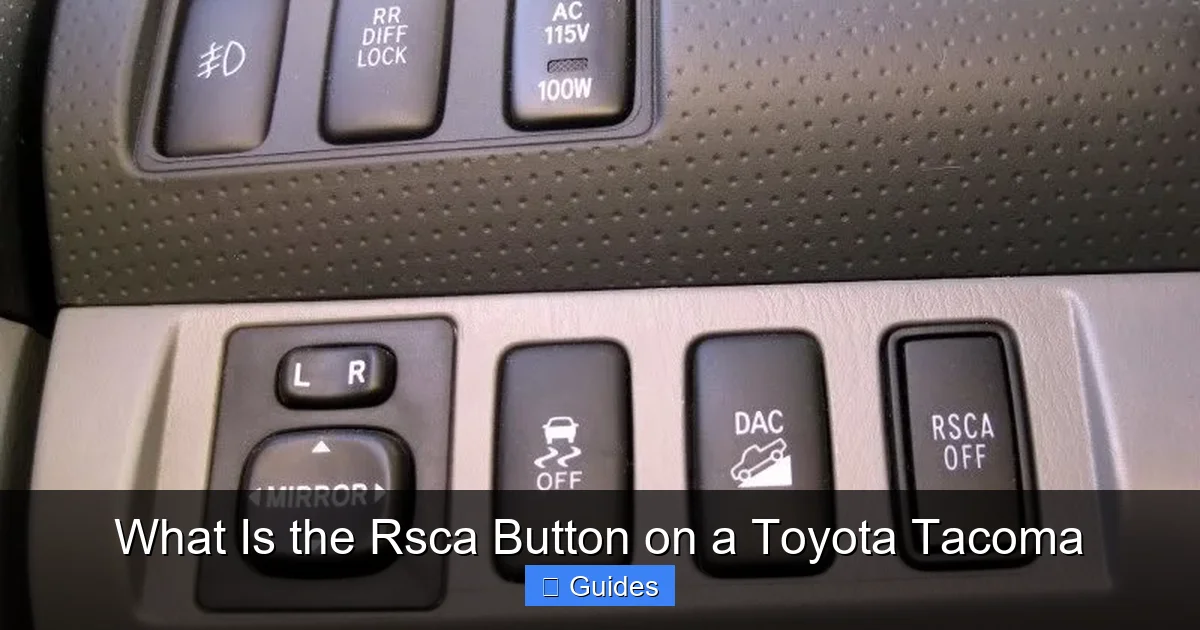
The RSCA button on a Toyota Tacoma stands for Roll Stability Control and Active Traction Control. It helps improve vehicle stability and traction during off-road driving or slippery conditions. Understanding when and how to use it can make a big difference in your driving experience.
If you’ve ever driven a Toyota Tacoma, especially off the beaten path, you might have noticed a small button labeled “RSCA” near the gear shifter or on the dashboard. At first glance, it might seem mysterious—what does it do? Should you press it? When? And why does your Tacoma even have it? These are all great questions, and the answers can make a real difference in how confidently and safely you drive your truck, particularly when the pavement ends and the adventure begins.
The RSCA button is more than just a fancy acronym—it’s a critical part of your Tacoma’s advanced safety and traction system. Whether you’re navigating rocky trails, muddy backroads, or snowy mountain passes, understanding what RSCA does and how to use it properly can help you maintain control, avoid accidents, and get the most out of your vehicle’s capabilities. This guide will walk you through everything you need to know about the RSCA button: what it stands for, how it works, when to use it, and why it matters for both daily driving and serious off-roading.
In This Article
Key Takeaways
- What RSCA means: RSCA stands for Roll Stability Control and Active Traction Control, a safety system designed to help maintain vehicle control.
- When to use it: Activate RSCA when driving off-road, on loose terrain, or in slippery conditions like mud, snow, or gravel.
- How it works: The system monitors wheel speed, steering angle, and vehicle tilt to detect loss of traction or rollover risk and applies brakes or reduces engine power accordingly.
- Off-road benefits: RSCA enhances stability on uneven terrain, helping prevent skidding, sliding, or tipping during steep climbs or sharp turns.
- When to turn it off: Disable RSCA only in deep mud, sand, or when you need full wheel spin for momentum—re-enable it afterward for safety.
- Not a replacement for caution: RSCA is a helpful aid, but safe driving practices and proper terrain assessment are still essential.
- Common misconceptions: RSCA is not the same as 4WD—it’s a stability system that works alongside your truck’s drivetrain to improve control.
📑 Table of Contents
What Does RSCA Stand For?
The RSCA button on your Toyota Tacoma stands for **Roll Stability Control and Active Traction Control**. Let’s break that down so it’s easy to understand.
Roll Stability Control (RSC) is a safety feature designed to help prevent your vehicle from rolling over, especially during sharp turns or sudden maneuvers. It works by monitoring the vehicle’s roll angle—essentially how much it’s tilting side to side. If the system detects that the truck is leaning too far and might be at risk of tipping, it can automatically apply the brakes to individual wheels and reduce engine power to help bring the vehicle back to a stable position.
Active Traction Control (ATC), on the other hand, focuses on maintaining grip. When you’re driving on slippery or uneven surfaces—like mud, snow, gravel, or wet grass—your wheels can lose traction and start spinning. ATC detects when one or more wheels are slipping and applies brake pressure to those wheels while sending more power to the ones with better grip. This helps your Tacoma keep moving forward without getting stuck.
Together, RSC and ATC form the RSCA system, a smart combination that enhances both stability and traction. It’s especially useful when you’re driving off-road, where conditions can change quickly and unpredictably.
How Is RSCA Different from 4WD?
One common point of confusion is how RSCA differs from your Tacoma’s 4WD (four-wheel drive) system. While both are designed to improve traction and control, they serve different purposes and work in different ways.
4WD is a mechanical system that sends power to all four wheels simultaneously, giving you more pulling power and better grip on rough terrain. You typically engage 4WD using a separate switch or dial, often labeled “4H” (four-high) or “4L” (four-low), depending on your driving needs.
RSCA, by contrast, is an electronic safety system. It doesn’t change how power is delivered to the wheels—it monitors how the wheels are behaving and intervenes when necessary. Think of 4WD as giving your truck more muscle, while RSCA is like having a co-pilot who watches the road and helps you stay balanced.
In short:
– 4WD = more power to all wheels
– RSCA = smarter control of that power and stability
They work best when used together. For example, if you’re climbing a steep, rocky trail in 4L, having RSCA active can help prevent your truck from sliding sideways or tipping over during a sharp turn.
How Does the RSCA System Work?
Visual guide about What Is the Rsca Button on a Toyota Tacoma
Image source: twstatic.net
Now that you know what RSCA stands for, let’s dive into how it actually works under the hood—or rather, under the electronics.
The RSCA system uses a network of sensors located throughout your Tacoma to constantly monitor the vehicle’s behavior. These sensors track things like:
– Wheel speed (to detect slipping)
– Steering angle (to see which way you’re turning)
– Lateral acceleration (how much the truck is leaning side to side)
– Yaw rate (how fast the vehicle is rotating around its vertical axis)
All this data is fed into the truck’s onboard computer, which analyzes it in real time. If the system detects a potential problem—like a wheel spinning out of control or the truck leaning too far to one side—it takes action automatically.
Roll Stability Control in Action
Imagine you’re driving on a narrow mountain trail and take a sharp turn too quickly. Your Tacoma starts to lean to the outside of the turn. The RSC sensors detect this increased roll angle and send a signal to the computer. The system then applies the brakes to the outer wheels, slowing them down just enough to reduce the roll and help keep the truck level. At the same time, it may reduce engine power to prevent over-acceleration, which could worsen the situation.
This intervention happens in milliseconds—so fast that you might not even notice it. But it can make the difference between a smooth turn and a dangerous rollover.
Active Traction Control in Action
Now picture this: you’re driving through a muddy field, and your front left wheel starts spinning because it’s lost contact with the ground. The ATC portion of RSCA detects this slip and instantly applies the brake to that wheel. This redirects power to the other wheels that still have traction, helping your Tacoma keep moving forward.
This is especially helpful when one wheel is on a slippery patch while the others are on solid ground. Without ATC, the spinning wheel would just waste power, and your truck might get stuck. With ATC, the system helps maintain momentum and control.
When the System Intervenes
The RSCA system is designed to be proactive. It doesn’t wait for a full-blown accident to happen—it steps in early to prevent problems. Here are some common scenarios where RSCA might activate:
– Taking a sharp turn too fast on a gravel road
– Driving over a steep, uneven hill
– Crossing a stream with slippery rocks
– Accelerating on ice or snow
– Navigating a rocky trail with loose stones
In each case, the system helps keep your Tacoma stable and moving in the direction you want.
When Should You Use the RSCA Button?
Visual guide about What Is the Rsca Button on a Toyota Tacoma
Image source: tacomaexplorer.com
Now comes the practical part: when should you actually press the RSCA button? The short answer is: **most of the time, you should leave it ON**. But there are specific situations where turning it off can be helpful.
By default, the RSCA system is active whenever you start your Tacoma. You’ll usually see a light on the dashboard indicating that it’s working. Pressing the RSCA button toggles the system on or off—when it’s off, the light will stay illuminated or flash, depending on your model year.
Keep RSCA On: Everyday and Off-Road Driving
For the vast majority of driving conditions—whether you’re commuting to work, driving on highways, or exploring dirt roads—you should keep RSCA turned on. It provides an extra layer of safety by helping prevent rollovers and maintaining traction.
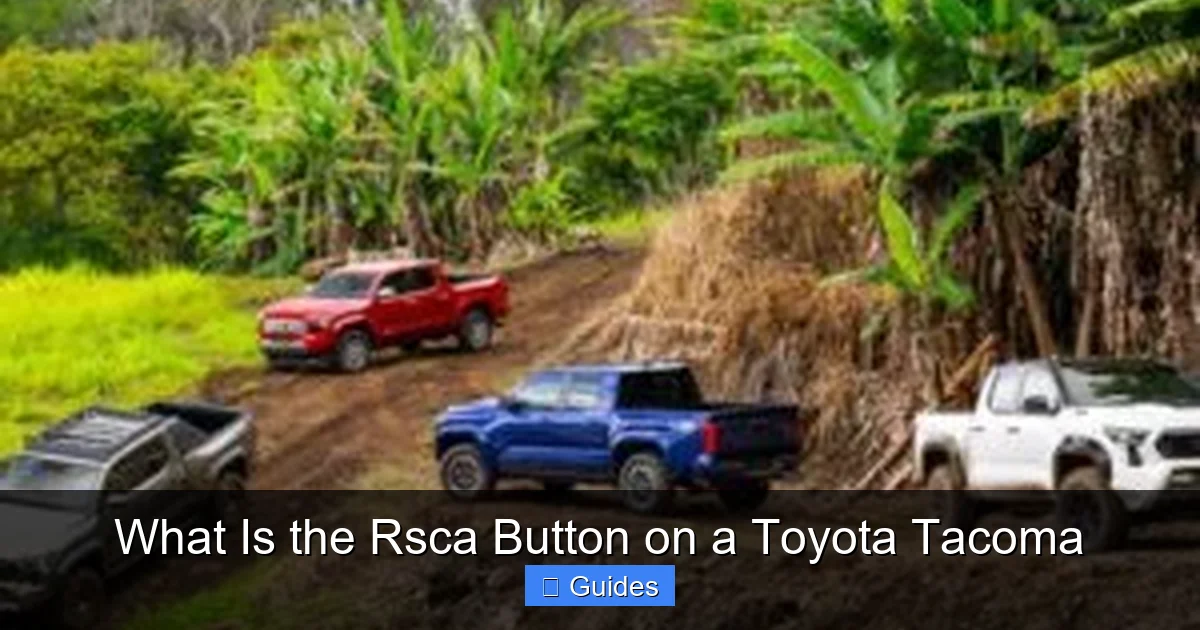
Off-road enthusiasts especially benefit from having RSCA active. When you’re navigating uneven terrain, the system helps keep your truck stable during climbs, descents, and side-hilling. It’s like having a digital spotter watching your back.
When to Turn RSCA Off
There are a few specific situations where turning off RSCA can actually improve performance:
1. **Deep Mud or Sand:** When you’re stuck in deep mud or soft sand, you often need your wheels to spin freely to build momentum and “walk” your way out. If RSCA is on, it may detect the spinning wheels as a loss of traction and apply brakes or reduce power, which can make it harder to get unstuck. Turning it off allows the wheels to spin more freely.
2. **Rock Crawling with One Wheel in the Air:** If you’re doing extreme rock crawling and one wheel lifts off the ground, RSCA might interpret this as a roll risk and apply brakes. Turning it off gives you more control over wheel placement and momentum.
3. **Winching or Recovery Operations:** During recovery, you may need precise control over wheel spin. Turning off RSCA can prevent the system from interfering.
Important Reminder: Re-Enable RSCA Afterward
Whenever you turn off RSCA, it’s crucial to turn it back on once you’re back on stable ground or finished with the challenging terrain. Driving with RSCA disabled on normal roads increases your risk of losing control, especially in wet or slippery conditions.
A good rule of thumb: if you’re not sure whether to turn it off, leave it on. The system is there to help, not hinder.
Common Misconceptions About the RSCA Button
Visual guide about What Is the Rsca Button on a Toyota Tacoma
Image source: slashgear.com
Despite its importance, the RSCA button is often misunderstood. Let’s clear up some of the most common myths.
Myth 1: “RSCA Is Just Another Name for 4WD”
As we discussed earlier, RSCA and 4WD are completely different systems. 4WD is about power distribution, while RSCA is about stability and traction control. You can have 4WD without RSCA, and vice versa—but on a modern Tacoma, they work together to give you the best of both worlds.
Myth 2: “Turning Off RSCA Makes My Truck More Powerful”
Some drivers believe that disabling RSCA gives their truck more horsepower or torque. This isn’t true. RSCA doesn’t increase or decrease engine power—it only manages how that power is used and how the vehicle behaves. Turning it off doesn’t make your Tacoma faster or stronger; it just removes a safety net.
Myth 3: “I Only Need RSCA If I’m Off-Roading”
While RSCA is especially useful off-road, it’s also valuable in everyday driving. Sudden swerves, wet roads, or unexpected obstacles can happen anywhere. RSCA helps keep you safe whether you’re on a highway or a backcountry trail.
Myth 4: “If RSCA Is On, I Don’t Need to Drive Carefully”
This is a dangerous mindset. RSCA is a safety aid, not a substitute for good driving habits. It can’t prevent all accidents, especially if you’re driving too fast for conditions or ignoring basic off-road techniques. Always drive responsibly and assess terrain before proceeding.
Tips for Using RSCA Effectively
To get the most out of your RSCA system, follow these practical tips:
1. **Leave It On Unless You Have a Specific Reason to Turn It Off:** As mentioned, RSCA is designed to help in most situations. Only disable it when you’re in deep mud, sand, or doing technical rock crawling.
2. **Know Your Terrain:** Before heading off-road, assess the conditions. If you’re expecting deep ruts or soft ground, consider turning off RSCA temporarily. But remember to turn it back on when you’re back on solid ground.
3. **Use It with Other Systems:** RSCA works best when combined with other Tacoma features like Crawl Control, Multi-Terrain Select, and 4WD. Use them together for maximum control.
4. **Check the Dashboard Light:** If the RSCA light is flashing or stays on, it could indicate a problem with the system. Have your truck inspected by a qualified technician.
5. **Practice in a Safe Area:** If you’re new to off-roading, practice using RSCA (and turning it off) in a controlled environment like a dirt lot or mild trail. This helps you understand how the system responds.
6. **Educate Your Passengers:** Let anyone who drives your Tacoma know what the RSCA button does and when it should be used. This ensures everyone stays safe.
Real-World Examples of RSCA in Action
Let’s look at a few real-world scenarios where the RSCA button made a difference.
Example 1: Mountain Trail Descent
Sarah was driving her Tacoma down a steep, winding mountain trail after a rainstorm. The ground was slick with mud and loose rocks. As she rounded a sharp switchback, her rear wheels started to slide outward. The RSCA system detected the loss of traction and applied the brakes to the outer wheels, helping her maintain control and avoid sliding off the edge. She didn’t even realize the system had intervened—until she checked the dashboard and saw the RSCA light flicker briefly.
Example 2: Getting Stuck in Mud
Mike was exploring a remote forest road when his Tacoma got stuck in a deep mud pit. The wheels were spinning, but the truck wasn’t moving. He remembered reading about the RSCA button and turned it off. With the system disabled, the wheels were able to spin freely, and he was able to rock the truck back and forth to gain momentum and escape. Once he was back on solid ground, he turned RSCA back on for the rest of the trip.
Example 3: Highway Emergency
During a road trip, David’s Tacoma hit a patch of black ice on the highway. He instinctively swerved to avoid a deer, and the truck started to skid. The RSCA system detected the loss of traction and applied individual brakes to stabilize the vehicle, helping him regain control without spinning out. He later credited the system with preventing a potentially serious accident.
Conclusion
The RSCA button on your Toyota Tacoma is a powerful but often overlooked feature that plays a vital role in keeping you safe and in control. By combining Roll Stability Control and Active Traction Control, it helps prevent rollovers, maintain traction, and improve handling in a wide range of driving conditions.
Whether you’re a daily commuter or a weekend warrior, understanding how and when to use RSCA can make your driving experience smoother, safer, and more enjoyable. Remember: keep it on for most situations, turn it off only when necessary (like in deep mud or sand), and always re-enable it when you’re back on stable ground.
Your Tacoma is built for adventure—and the RSCA system is there to help you tackle it with confidence. So the next time you see that little button, don’t ignore it. Embrace it. Use it wisely. And drive with peace of mind, knowing your truck has your back.
Frequently Asked Questions
The RSCA button controls the Roll Stability Control and Active Traction Control system. It helps prevent rollovers and maintains traction by monitoring wheel speed, steering, and vehicle tilt, then applying brakes or reducing power when needed.
You should keep the RSCA button on for most driving conditions, including off-roading. Only turn it off in deep mud, sand, or during technical rock crawling when you need full wheel spin. Always re-enable it afterward.
Can I drive safely with RSCA turned off?
You can drive with RSCA off in specific off-road situations, but it’s not recommended for regular driving. Disabling it removes a key safety feature that helps prevent skidding and rollovers.
Is RSCA the same as 4WD?
No, RSCA is not the same as 4WD. 4WD sends power to all four wheels, while RSCA is an electronic system that monitors and adjusts stability and traction. They work together but serve different purposes.
Why is the RSCA light on my dashboard flashing?
A flashing RSCA light usually means the system is actively working to stabilize the vehicle. If it stays on solid, there may be a malfunction—have your Tacoma inspected by a technician.
Does RSCA work in snow and ice?
Yes, RSCA works well in snow and ice by detecting wheel slip and applying brakes to maintain traction. Keep it on during winter driving for added safety and control.

At CarLegit, we believe information should be clear, factual, and genuinely helpful. That’s why every guide, review, and update on our website is created with care, research, and a strong focus on user experience.