
The number of catalytic converters in a Toyota 4Runner varies by model year, engine size, and drivetrain configuration. Most modern 4Runners come with two to four catalytic converters, including both primary and secondary units. Understanding this helps with maintenance, repairs, and emissions compliance.
If you’re a Toyota 4Runner owner—or thinking about becoming one—you’ve probably heard the term “catalytic converter” thrown around, especially when talking about emissions, performance, or that dreaded check engine light. But how many catalytic converters does a 4Runner actually have? The answer isn’t as simple as “one” or “two.” It depends on several factors, including the year your 4Runner was made, what engine it has, and even where you live.
The Toyota 4Runner has been a staple in the SUV world since the 1980s, evolving from a compact off-roader to a rugged, full-size SUV that balances trail capability with daily drivability. Over the decades, emissions standards have gotten stricter, and vehicle manufacturers have had to adapt. One of the key ways they’ve done that is by adding more catalytic converters—devices that reduce harmful exhaust emissions by converting pollutants like carbon monoxide, nitrogen oxides, and hydrocarbons into less harmful substances like carbon dioxide and water vapor.
So, how many catalytic converters are in a Toyota 4Runner? The short answer: most modern 4Runners (2003 and newer) have two to four catalytic converters. But let’s dig deeper. The number can vary based on engine type (V6 vs. V8), model year, drivetrain (2WD vs. 4WD), and whether the vehicle meets federal or California Air Resources Board (CARB) emissions standards. Understanding this helps you make informed decisions about maintenance, repairs, and even theft prevention.
In this guide, we’ll break down everything you need to know about catalytic converters in the Toyota 4Runner—from how many you have, where they’re located, why they matter, and what to do if one fails. Whether you’re troubleshooting a check engine light, preparing for an emissions test, or just curious about your vehicle’s exhaust system, this article has you covered.
In This Article
- 1 Key Takeaways
- 2 📑 Table of Contents
- 3 Understanding Catalytic Converters: What They Are and Why They Matter
- 4 How Many Catalytic Converters Are in a Toyota 4Runner? A Year-by-Year Breakdown
- 5 Why Does the Number of Catalytic Converters Vary?
- 6 Where Are the Catalytic Converters Located on a 4Runner?
- 7 Catalytic Converter Theft: A Growing Problem for 4Runner Owners
- 8 Signs of a Failing Catalytic Converter
- 9 Conclusion: Know Your 4Runner’s Catalytic Converter Setup
- 10 Frequently Asked Questions
- 10.1 How many catalytic converters does a 2020 Toyota 4Runner have?
- 10.2 Can I drive my 4Runner with a bad catalytic converter?
- 10.3 Are catalytic converters covered under warranty?
- 10.4 How much does it cost to replace a catalytic converter on a 4Runner?
- 10.5 Why are 4Runners targeted for catalytic converter theft?
- 10.6 Can I install a catalytic converter shield myself?
Key Takeaways
- Most 4Runners have 2–4 catalytic converters: The exact number depends on the engine (V6 or V8), model year, and whether it’s a 2WD or 4WD system.
- Dual exhaust systems require dual cats: Vehicles with dual exhaust setups typically have one catalytic converter per side, doubling the count.
- Older models (pre-2003) often have fewer cats: Early 4Runners with inline-4 or single-exhaust V6 engines may only have one or two converters.
- Federal vs. California emissions standards matter: California and other CARB-compliant states often require additional catalytic converters for stricter emissions control.
- Catalytic converter theft is a growing concern: 4Runners are prime targets due to their high ground clearance and valuable catalytic converters—especially those with multiple units.
- Replacing a catalytic converter can be expensive: Costs range from $1,000 to $3,000+ per unit, making prevention and maintenance crucial.
- Regular inspections help avoid surprises: Include catalytic converter checks during routine maintenance to catch issues early and avoid failed emissions tests.
📑 Table of Contents
- Understanding Catalytic Converters: What They Are and Why They Matter
- How Many Catalytic Converters Are in a Toyota 4Runner? A Year-by-Year Breakdown
- Why Does the Number of Catalytic Converters Vary?
- Where Are the Catalytic Converters Located on a 4Runner?
- Catalytic Converter Theft: A Growing Problem for 4Runner Owners
- Signs of a Failing Catalytic Converter
- Conclusion: Know Your 4Runner’s Catalytic Converter Setup
Understanding Catalytic Converters: What They Are and Why They Matter
Before we get into the specifics of how many catalytic converters are in a 4Runner, it helps to understand what these components actually do. A catalytic converter is an emissions control device located in the exhaust system. It uses precious metals like platinum, palladium, and rhodium as catalysts to trigger chemical reactions that convert toxic gases into less harmful ones.
For example, carbon monoxide (a deadly gas) is converted into carbon dioxide, hydrocarbons (unburned fuel) become water and CO2, and nitrogen oxides (contributors to smog) are broken down into nitrogen and oxygen. This process happens as exhaust gases pass through a honeycomb-like structure inside the converter, coated with the catalytic metals.
Catalytic converters became standard on all U.S. vehicles in the mid-1970s, following the Clean Air Act. Over time, emissions standards have tightened, especially in states like California, which enforce stricter rules through the CARB program. As a result, modern vehicles—including the 4Runner—often have multiple catalytic converters to meet these requirements.
How Catalytic Converters Work
The catalytic converter operates through two main types of reactions: oxidation and reduction. The reduction catalyst (usually rhodium) reduces nitrogen oxides into nitrogen and oxygen. The oxidation catalyst (platinum and palladium) oxidizes carbon monoxide and hydrocarbons into carbon dioxide and water.
These reactions require high temperatures—typically between 600°F and 1,600°F—to work efficiently. That’s why catalytic converters are usually located close to the engine, where exhaust gases are hottest. However, some vehicles also have “underfloor” converters farther back in the exhaust system to provide additional cleaning as gases cool.
Why Multiple Catalytic Converters?
So why would a vehicle need more than one catalytic converter? There are several reasons:
– **Dual exhaust systems:** Vehicles with two exhaust pipes (common in V6 and V8 engines) often have one converter per side.
– **Pre- and post-cat sensors:** Some systems use a “pre-cat” converter near the engine and a “post-cat” or “main” converter further downstream to monitor efficiency.
– **Emissions compliance:** Stricter standards may require additional converters or more efficient designs.
– **Engine configuration:** V8 engines, with their higher output and more complex exhaust routing, often need more converters than inline-4 or single-exhaust V6 engines.
In the case of the 4Runner, the number of catalytic converters increases with engine size and model year, reflecting both technological advancements and regulatory demands.
How Many Catalytic Converters Are in a Toyota 4Runner? A Year-by-Year Breakdown
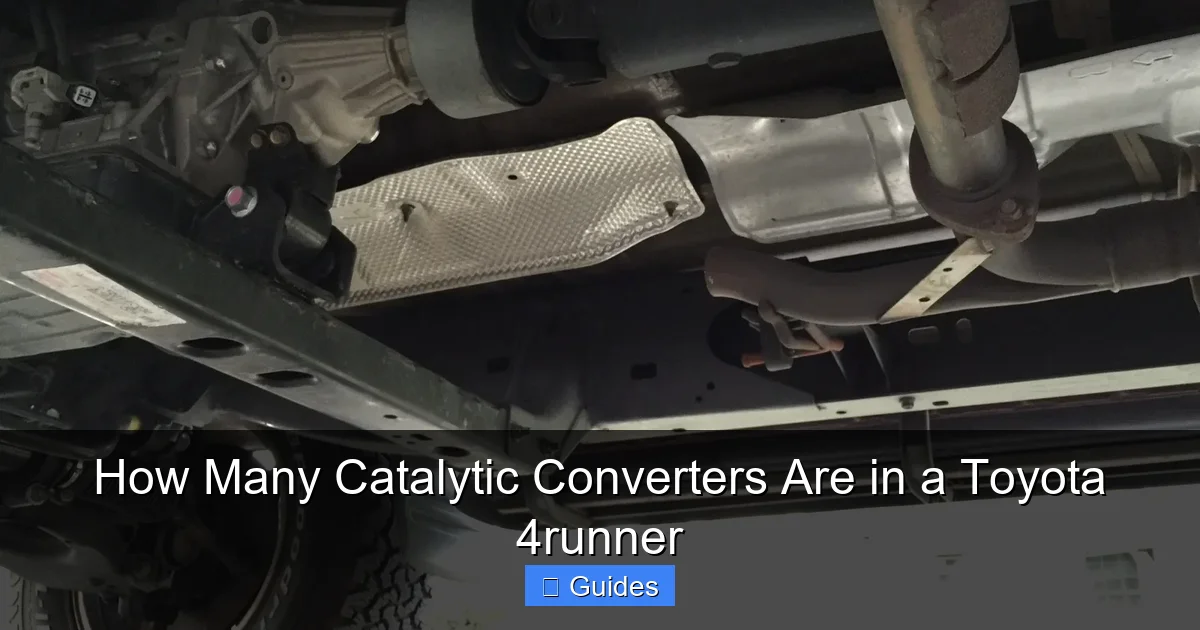
Visual guide about How Many Catalytic Converters Are in a Toyota 4runner
Image source: i0.wp.com
Now let’s get to the heart of the question: how many catalytic converters does your Toyota 4Runner have? The answer depends heavily on the model year and engine. Below is a detailed breakdown by generation and engine type.
First Generation (1984–1989)
The earliest 4Runners were essentially lifted Toyota pickup trucks with a fiberglass top. They came with either a 2.4L inline-4 or a 3.0L V6 engine. These models had relatively simple exhaust systems.
– **2.4L I4:** Typically one catalytic converter.
– **3.0L V6:** Usually one or two converters, depending on whether it had a single or dual exhaust setup.
These early models were not subject to the same emissions standards as modern vehicles, so catalytic converter counts were low.
Second Generation (1990–1995)
This generation introduced more refined engines and improved emissions controls. The 3.0L V6 became standard, and some models offered a 2.4L turbo diesel in certain markets.
– **3.0L V6 (gas):** Most had one catalytic converter, though some 4WD models with dual exhausts may have had two.
– **2.4L Turbo Diesel (non-US):** Often had one converter, but emissions systems varied by region.
Emissions standards were tightening, but catalytic converter counts remained modest.
Third Generation (1996–2002)
The third-gen 4Runner marked a shift toward more modern emissions systems. The 3.4L V6 became the standard engine, and dual exhaust systems became more common, especially in 4WD models.
– **3.4L V6 (single exhaust):** One catalytic converter.
– **3.4L V6 (dual exhaust):** Two catalytic converters—one for each exhaust bank.
This was also the era when OBD-II (On-Board Diagnostics II) became mandatory, allowing the vehicle to monitor catalytic converter efficiency. If a converter wasn’t working properly, the check engine light would come on.
Fourth Generation (2003–2009)
This is where things get interesting. The fourth-generation 4Runner introduced a 4.0L V6 engine and, later, a 4.7L V8 option (in the Limited trim). These larger engines, combined with stricter emissions standards, led to an increase in catalytic converter count.
– **4.0L V6 (2WD):** Typically two catalytic converters—one for each exhaust manifold (pre-cat), plus sometimes a main converter further back.
– **4.0L V6 (4WD):** Often three or four converters due to dual exhaust and additional emissions controls.
– **4.7L V8 (Limited):** Four catalytic converters—two pre-cats (one per bank) and two main converters.
California and other CARB-compliant models often had additional converters or more robust designs to meet stricter standards.
Fifth Generation (2010–Present)
The current generation 4Runner continues with the 4.0L V6 engine (no V8 option since 2009). However, emissions systems have become even more sophisticated.
– **4.0L V6 (all trims):** Most models have two to four catalytic converters.
– **2WD models:** Often two converters (one per bank).
– **4WD models:** Typically three or four, with pre-cats near the engine and main converters under the vehicle.
– **TRD Pro and Limited trims:** May have additional emissions components, including secondary air injection systems, which can affect converter placement and count.
It’s also worth noting that some 2010–2013 models had a recall related to catalytic converter efficiency due to premature wear. Toyota extended the warranty on converters for these years, so if you own one, check your VIN for eligibility.
Why Does the Number of Catalytic Converters Vary?
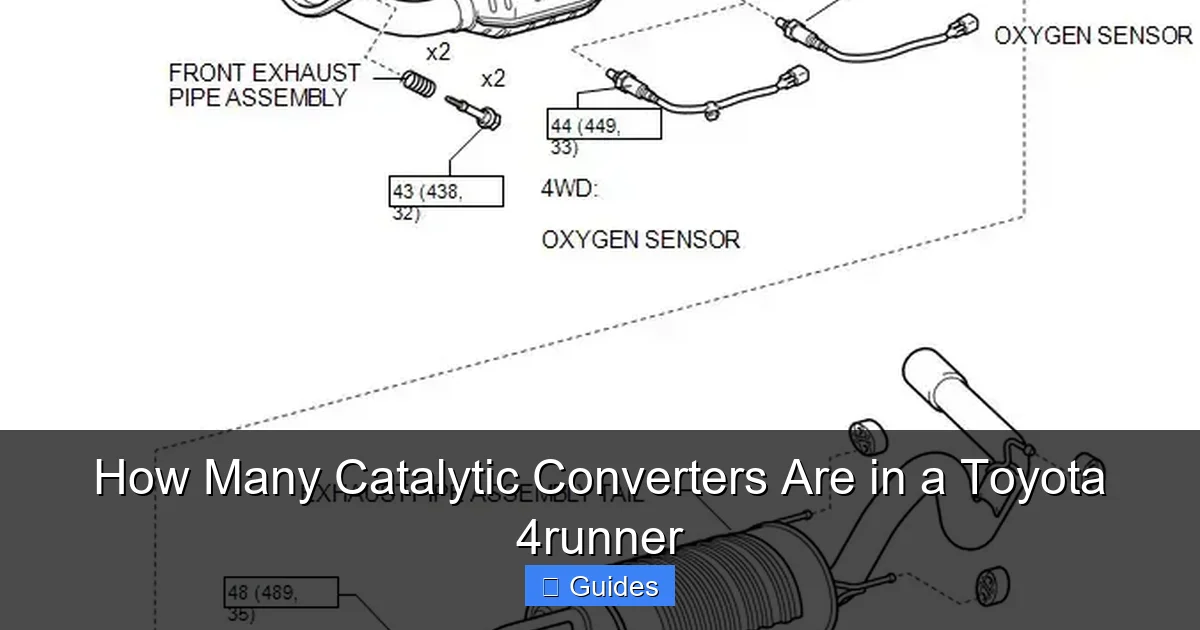
Visual guide about How Many Catalytic Converters Are in a Toyota 4runner
Image source: diycarexpert.com
You might be wondering: why can’t Toyota just use the same setup across all models? The answer lies in engineering, emissions regulations, and vehicle design.
Engine Configuration and Exhaust Layout
The 4Runner’s V6 engine is a “V” configuration, meaning it has two banks of cylinders (left and right). Each bank has its own exhaust manifold, which can feed into a separate catalytic converter. This is why dual-exhaust systems often have two converters—one for each side.
In contrast, an inline-4 engine has all cylinders in a line, so it typically uses a single exhaust manifold and one converter. However, even some inline engines now use dual converters for better emissions control.
Emissions Standards: Federal vs. CARB
The U.S. has two main sets of emissions standards: federal (EPA) and California (CARB). States that follow CARB rules (like New York, Massachusetts, and Washington) require vehicles to meet stricter standards. As a result, 4Runners sold in these states often have more catalytic converters or more efficient designs.
For example, a 2015 4Runner sold in Texas might have two converters, while the same model sold in California could have three or four. This is why it’s important to know your vehicle’s emissions certification when diagnosing or replacing parts.
Drivetrain and Exhaust Routing
4WD 4Runners often have more complex exhaust systems due to the transfer case and driveshaft tunnel. This can require longer exhaust pipes and additional converters placed strategically to maintain performance and meet emissions targets.
Additionally, some 4WD models use a “Y-pipe” or “H-pipe” to merge exhaust flows, which can affect where converters are installed. In some cases, a single converter handles merged exhaust, while in others, each side keeps its own converter.
Where Are the Catalytic Converters Located on a 4Runner?
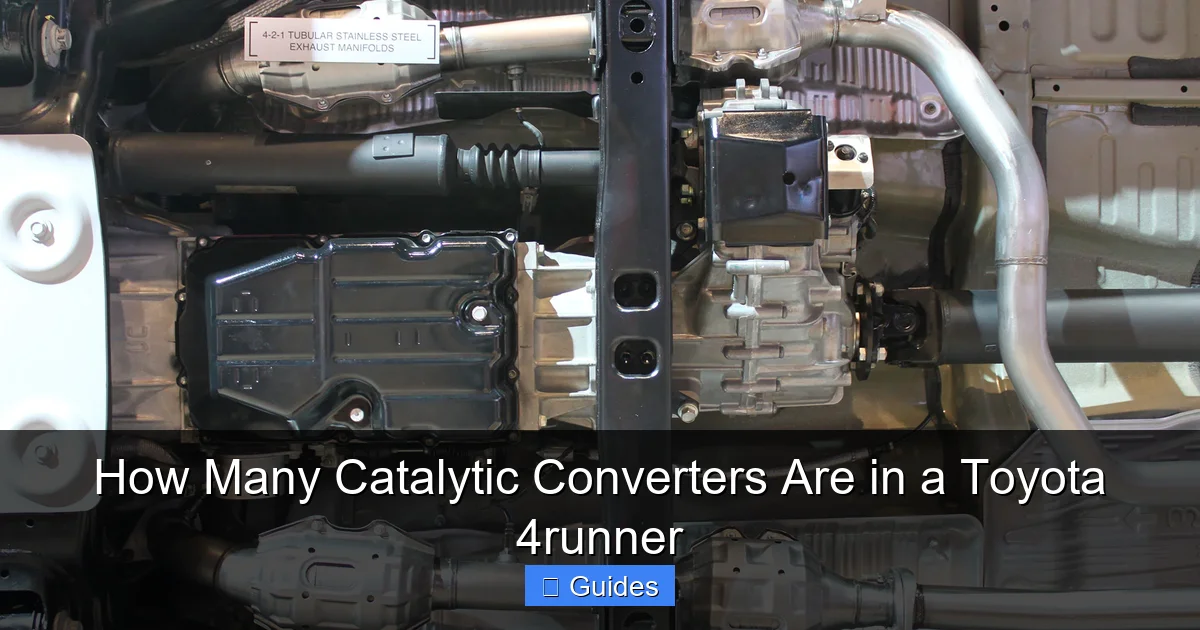
Visual guide about How Many Catalytic Converters Are in a Toyota 4runner
Image source: motortrend.com
Knowing how many catalytic converters your 4Runner has is one thing—knowing where they are is another. Location matters for maintenance, repairs, and theft prevention.
Pre-Cat (Manifold-Mounted) Converters
These are the converters mounted directly to the exhaust manifolds, close to the engine. They’re often called “pre-cats” because they treat exhaust gases before they reach the main converter. Pre-cats heat up quickly and are highly efficient, but they’re also more exposed and vulnerable to damage.
On a 4Runner with a V6, you’ll typically find one pre-cat on each side of the engine, just behind the cylinder heads. These are the most valuable converters due to their high precious metal content, making them prime targets for theft.
Main (Underfloor) Converters
These are located further back in the exhaust system, usually under the vehicle near the transmission or fuel tank. They’re larger and handle the bulk of emissions cleanup after the pre-cats.
Main converters are often housed in a protective shield and are less accessible than pre-cats, which can deter theft—but not always. Some thieves use saws or wrenches to remove them quickly, especially on high-clearance vehicles like the 4Runner.
Secondary or “Post-Cat” Converters
Some 4Runners have additional converters downstream, often monitored by oxygen sensors. These are sometimes called “post-cat” converters and are used to ensure emissions stay within legal limits even as the primary converters age.
While less common, these can appear in later-model 4Runners, especially those with advanced emissions systems.
Catalytic Converter Theft: A Growing Problem for 4Runner Owners
If you own a 4Runner, you’ve probably heard horror stories about catalytic converter theft. Unfortunately, these SUVs are prime targets—and not just because they’re popular.
Why Are 4Runners Targeted?
Several factors make the 4Runner attractive to thieves:
– **High ground clearance:** Makes it easy to slide under and remove converters with basic tools.
– **Multiple converters:** More units mean more profit per vehicle.
– **Valuable metals:** Platinum, palladium, and rhodium are worth hundreds of dollars per ounce.
– **Quiet exhaust systems:** Some 4Runners have quiet exhausts, so theft may go unnoticed until the next drive.
According to the National Insurance Crime Bureau (NICB), catalytic converter thefts have increased dramatically in recent years, with over 64,000 reported in 2022 alone. SUVs and trucks are disproportionately affected.
How to Protect Your 4Runner
While you can’t eliminate the risk entirely, you can reduce it:
– **Install a catalytic converter shield:** These metal cages make it harder to access the converters.
– **Etch your VIN on the converter:** Makes it traceable and less attractive to thieves.
– **Park in well-lit, secure areas:** Avoid dark alleys or isolated parking lots.
– **Use a steering wheel lock or alarm:** Adds another layer of deterrence.
– **Consider insurance coverage:** Some policies cover catalytic converter theft—check with your provider.
Toyota also offers a catalytic converter anti-theft program in some regions, which includes etching and registration. Contact your local dealer to see if it’s available.
Signs of a Failing Catalytic Converter
Even with protection, catalytic converters can fail due to age, damage, or contamination. Here’s how to spot the signs.
Common Symptoms
– **Check engine light:** Often triggered by oxygen sensor readings indicating poor converter efficiency.
– **Reduced fuel economy:** A clogged converter restricts exhaust flow, making the engine work harder.
– **Poor acceleration:** Sluggish performance, especially under load.
– **Rattling noise:** A broken honeycomb inside the converter can rattle when shaken.
– **Sulfur smell:** A rotten egg odor from the exhaust can indicate a failing converter.
– **Failed emissions test:** High levels of hydrocarbons or carbon monoxide.
Diagnosing the Problem
If you notice any of these symptoms, have your vehicle inspected by a trusted mechanic. They can use a scan tool to check for trouble codes (like P0420 or P0430, which indicate catalyst efficiency below threshold) and perform a visual inspection.
Don’t ignore the problem—driving with a failed converter can damage other components, including the oxygen sensors and engine.
Repair and Replacement Options
Replacing a catalytic converter isn’t cheap. OEM (original equipment manufacturer) parts can cost $1,500–$3,000 or more, especially for 4Runners with multiple units. Aftermarket converters are cheaper ($500–$1,200) but may not last as long or meet emissions standards.
In some cases, cleaning or repairing the converter is possible, but this is rare. Most failures require full replacement.
Conclusion: Know Your 4Runner’s Catalytic Converter Setup
So, how many catalytic converters are in a Toyota 4Runner? The answer depends on your model year, engine, and emissions package—but most modern 4Runners have two to four. Understanding this helps you maintain your vehicle, prepare for repairs, and protect against theft.
Whether you’re a weekend warrior hitting the trails or a daily driver navigating city streets, your 4Runner’s catalytic converters play a vital role in keeping it running clean and legal. Regular maintenance, awareness of theft risks, and prompt attention to warning signs can save you time, money, and headaches down the road.
Remember: your 4Runner isn’t just a tough SUV—it’s a complex machine with systems designed to balance performance, efficiency, and environmental responsibility. Knowing how many catalytic converters it has is just one piece of the puzzle, but an important one.
Frequently Asked Questions
How many catalytic converters does a 2020 Toyota 4Runner have?
A 2020 Toyota 4Runner with the 4.0L V6 engine typically has two to four catalytic converters, depending on whether it’s 2WD or 4WD. 4WD models often have additional converters due to dual exhaust and stricter emissions controls.
Can I drive my 4Runner with a bad catalytic converter?
You can drive short distances, but it’s not recommended. A failed converter can reduce performance, damage the engine, and cause you to fail emissions tests. Have it inspected and repaired as soon as possible.
Are catalytic converters covered under warranty?
Yes, catalytic converters are covered under the federal emissions warranty for 8 years or 80,000 miles, whichever comes first. Some Toyota models also have extended coverage due to recalls.
How much does it cost to replace a catalytic converter on a 4Runner?
Replacement costs range from $1,000 to $3,000+ per converter, depending on whether you use OEM or aftermarket parts. Vehicles with multiple converters will have higher total costs.
Why are 4Runners targeted for catalytic converter theft?
4Runners are targeted because of their high ground clearance, multiple converters, and valuable precious metals. Thieves can easily slide underneath and remove them with basic tools.
Can I install a catalytic converter shield myself?
Yes, many shields are designed for DIY installation and can be bolted or welded on. However, professional installation ensures a secure fit and doesn’t void your warranty.

At CarLegit, we believe information should be clear, factual, and genuinely helpful. That’s why every guide, review, and update on our website is created with care, research, and a strong focus on user experience.