
The number of catalytic converters in a Toyota Tacoma varies by model year, engine size, and configuration—typically ranging from one to three units. Understanding your Tacoma’s setup helps with maintenance, repairs, and staying compliant with emissions laws.
If you’re a Toyota Tacoma owner—or thinking about becoming one—you’ve probably heard the term “catalytic converter” thrown around, especially when it comes to emissions, maintenance, or that dreaded check engine light. But how many catalytic converters does a Toyota Tacoma actually have? The answer isn’t as simple as “one” or “two.” It depends on several factors, including the year your Tacoma was made, the engine under the hood, and even where you live.
Let’s be honest: most of us don’t spend our weekends crawling under our trucks to count exhaust components. But knowing how many catalytic converters your Tacoma has can save you time, money, and headaches down the road. Whether you’re troubleshooting a performance issue, preparing for an emissions test, or just curious about your vehicle’s design, this guide will break it all down in plain English. We’ll cover everything from basic function to real-world examples, so you can understand your Tacoma’s emissions system like a pro.
The Toyota Tacoma has been a favorite among off-roaders, commuters, and weekend warriors since the 1990s. Known for its reliability, rugged build, and strong resale value, the Tacoma has evolved significantly over the years—especially under the hood. With changes in engine technology, emissions regulations, and consumer demand for more power, Toyota has adjusted the exhaust and emissions systems accordingly. That means the number of catalytic converters has changed too.
So, let’s dive in and answer the big question: How many catalytic converters does a Toyota Tacoma have? The short answer is: it depends. But by the end of this article, you’ll know exactly what to look for in your specific model.
In This Article
- 1 Key Takeaways
- 2 📑 Table of Contents
- 3 What Is a Catalytic Converter and Why Does It Matter?
- 4 How Many Catalytic Converters Does a Toyota Tacoma Have? (By Model Year and Engine)
- 5 Why Do Some Tacomas Have More Than One Catalytic Converter?
- 6 How to Identify the Catalytic Converters on Your Toyota Tacoma
- 7 Common Issues and Maintenance Tips
- 8 Replacement Costs and What to Expect
- 9 Legal and Environmental Considerations
- 10 Conclusion
- 11 Frequently Asked Questions
- 11.1 How many catalytic converters does a 2020 Toyota Tacoma have?
- 11.2 Can a Toyota Tacoma run without a catalytic converter?
- 11.3 Why are catalytic converters stolen from Toyota Tacomas?
- 11.4 How long do catalytic converters last on a Toyota Tacoma?
- 11.5 Can I replace just one catalytic converter on my V6 Tacoma?
- 11.6 Are aftermarket catalytic converters legal for Toyota Tacomas?
Key Takeaways
- Most Toyota Tacomas have 1–3 catalytic converters depending on the engine and model year, with V6 and turbocharged models often using more than one.
- Dual exhaust systems usually mean dual catalytic converters, commonly found in TRD Off-Road and TRD Pro trims with V6 engines.
- Pre-2005 models often had a single catalytic converter, while newer models (especially post-2012) may include additional under-hood or pre-cats for stricter emissions control.
- California and CARB-compliant models may have extra converters to meet stricter environmental standards compared to federal-only versions.
- Replacing a catalytic converter can cost $1,000–$3,000+, so knowing your Tacoma’s configuration helps budget for repairs and avoid scams.
- Regular maintenance and using quality fuel can extend the life of your catalytic converters and prevent premature failure.
- Tampering with or removing catalytic converters is illegal in most U.S. states and can result in fines, failed inspections, and increased emissions.
📑 Table of Contents
- What Is a Catalytic Converter and Why Does It Matter?
- How Many Catalytic Converters Does a Toyota Tacoma Have? (By Model Year and Engine)
- Why Do Some Tacomas Have More Than One Catalytic Converter?
- How to Identify the Catalytic Converters on Your Toyota Tacoma
- Common Issues and Maintenance Tips
- Replacement Costs and What to Expect
- Legal and Environmental Considerations
- Conclusion
What Is a Catalytic Converter and Why Does It Matter?
Before we get into the nitty-gritty of how many catalytic converters your Tacoma has, let’s start with the basics. What exactly is a catalytic converter, and why should you care?
A catalytic converter is a key part of your vehicle’s exhaust system. Its job is to reduce harmful emissions by converting toxic gases—like carbon monoxide, nitrogen oxides, and unburned hydrocarbons—into less harmful substances such as carbon dioxide, nitrogen, and water vapor. It does this using precious metals like platinum, palladium, and rhodium as catalysts inside a honeycomb-like structure.
Think of it like a filter for your truck’s exhaust. Without it, your Tacoma would spew out pollutants that contribute to smog, acid rain, and health problems. That’s why catalytic converters are required by law in most countries, including the United States.
But here’s the thing: catalytic converters don’t last forever. Over time, they can get clogged, damaged, or stolen (yes, stolen—more on that later). When they fail, you might notice reduced fuel efficiency, a rotten egg smell, or that annoying check engine light. In some cases, your truck might even fail an emissions test.
So, knowing how many catalytic converters your Tacoma has helps you understand:
– What to expect during maintenance or repairs
– How much a replacement might cost
– Whether your truck is running efficiently
– If you’re at risk for theft (spoiler: newer Tacomas with multiple converters are prime targets)
How Many Catalytic Converters Does a Toyota Tacoma Have? (By Model Year and Engine)
Now for the main event: how many catalytic converters does a Toyota Tacoma actually have? The answer varies widely depending on the year, engine, and trim level. Let’s break it down by generation and configuration.
Tacoma Generations and Catalytic Converter Count
Toyota has produced the Tacoma in three main generations since its U.S. debut in 1995:
– **First Generation (1995–2004):** These early models were simpler in design. Most came with a 2.4L or 2.7L four-cylinder engine, and some had a 3.4L V6. The four-cylinder models typically had **one catalytic converter**, usually located under the truck near the engine. The V6 models often had **two catalytic converters**—one for each bank of the V6 engine—especially in dual-exhaust setups.
– **Second Generation (2005–2015):** This generation introduced the 4.0L V6 engine, which became the most popular option. With stricter emissions standards, Toyota added more catalytic converters. Most V6 models from this era have **two catalytic converters**—one for each exhaust manifold (called “pre-cats”)—and sometimes a third “main” or “underbody” converter further down the exhaust system. Four-cylinder models (2.7L) usually still have just **one catalytic converter**.
– **Third Generation (2016–Present):** The current generation brought even tighter emissions controls, especially with the introduction of direct injection and turbocharged engines in some markets. The 3.5L V6 engine dominates this generation, and most models come with **two or three catalytic converters**. Some high-output or TRD Pro models may have additional pre-cats or close-coupled converters mounted directly to the exhaust manifolds for faster light-off during cold starts.
Engine Type Matters
The engine under your Tacoma’s hood is the biggest factor in determining how many catalytic converters it has.
– **2.7L Four-Cylinder (161 hp):** Found in base models, this engine typically uses **one catalytic converter**, located under the vehicle near the transmission. It’s a simple, cost-effective setup that meets federal emissions standards.
– **3.5L V6 (278 hp):** This is the most common engine in modern Tacomas. Because it’s a V6 with two cylinder banks, it usually has **two catalytic converters**—one for each side. These are often mounted close to the engine (called “manifold converters” or “pre-cats”) and may be followed by a third converter further back in the exhaust system.
– **Turbocharged or Hybrid Variants (Future Models):** While Toyota hasn’t released a turbocharged Tacoma in the U.S. yet, some global markets have seen turbo-diesel versions. These often use **three or more catalytic converters**, including diesel oxidation catalysts (DOCs) and selective catalytic reduction (SCR) systems. Keep an eye out—Toyota may introduce hybrid or turbocharged Tacomas in the future, which could increase converter counts.
Drivetrain and Trim Level Influence
Believe it or not, your Tacoma’s trim level and drivetrain can also affect the number of catalytic converters.
– **TRD Off-Road and TRD Pro Trims:** These performance-oriented models often come with dual exhaust systems, which means **two catalytic converters**—one for each tailpipe. This setup improves exhaust flow and gives the truck a deeper sound.
– **4WD vs. 2WD:** While drivetrain doesn’t directly change the number of converters, 4WD models often have more complex exhaust routing, which can make converter access trickier during repairs.
– **California vs. Federal Emissions:** If your Tacoma was sold in California or a state that follows California Air Resources Board (CARB) standards, it may have **additional catalytic converters** or more stringent emissions equipment. These “CARB-compliant” models often have extra pre-cats or secondary converters to meet stricter rules.
Why Do Some Tacomas Have More Than One Catalytic Converter?
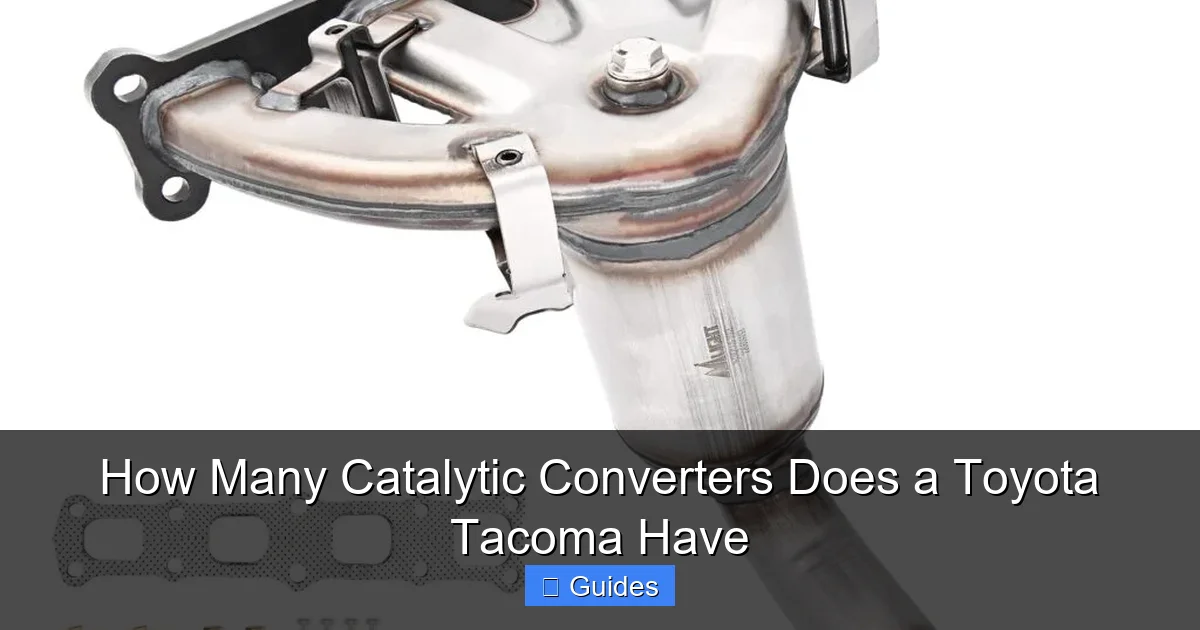
Visual guide about How Many Catalytic Converters Does a Toyota Tacoma Have
Image source: jeepexplorer.com
You might be wondering: why would Toyota put more than one catalytic converter on a truck? Isn’t one enough to clean the exhaust?
The short answer is: no, not anymore. Modern emissions standards are incredibly strict, and a single converter often can’t do the job alone—especially on larger engines like the V6.
Emissions Regulations Are Tighter Than Ever
In the past, a single catalytic converter could handle most of the emissions cleanup. But as environmental laws have evolved—especially with the Clean Air Act and CARB regulations—automakers have had to get creative.
Today’s engines produce more power and run more efficiently, but they also generate complex exhaust gases that require multiple stages of treatment. That’s where multiple catalytic converters come in.
For example:
– **Pre-cats (manifold converters):** These are mounted close to the engine and start working almost immediately after startup. They handle the initial conversion of harmful gases while the engine is still cold.
– **Main or underbody cats:** These are located further down the exhaust system and handle the final cleanup. They work at higher temperatures and are more efficient once the system is warmed up.
Using multiple converters allows Toyota to meet emissions standards without sacrificing performance or fuel economy.
Engine Design Plays a Role
V6 engines have two separate cylinder banks—left and right—each with its own exhaust manifold. To treat the gases from both sides efficiently, Toyota uses a catalytic converter on each manifold. This ensures that emissions are reduced evenly and effectively.
In contrast, four-cylinder engines have a single exhaust manifold, so one converter is usually sufficient.
Performance and Sound Considerations
Dual catalytic converters are also common in performance trims like the TRD Pro. Not only do they help with emissions, but they also support dual exhaust systems, which improve exhaust flow and give the truck a more aggressive sound.
Plus, having two converters can reduce backpressure, which helps the engine breathe better and deliver more power—especially at higher RPMs.
How to Identify the Catalytic Converters on Your Toyota Tacoma
Now that you know your Tacoma might have one, two, or even three catalytic converters, how do you find them?
Here’s a simple guide to help you locate them:
Step 1: Check Under the Hood
Pop the hood and look near the exhaust manifolds (the pipes that come out of the engine). On V6 models, you’ll often see a small, box-like component bolted directly to each manifold. These are the **pre-catalytic converters** (or “pre-cats”). They’re usually made of stainless steel and have heat shields.
Tip: If you see two of these near the engine, your Tacoma likely has at least two catalytic converters.
Step 2: Crawl Under the Truck
With the truck safely lifted (use jack stands—never rely on a jack alone), look along the exhaust system.
– You’ll typically see a larger, cylindrical component under the passenger side, near the transmission. This is the **main catalytic converter**.
– On dual-exhaust models, you’ll see a similar component on the driver’s side as well.
These underbody converters are often the ones that fail first due to heat, road debris, or corrosion.
Step 3: Use an OBD2 Scanner
If you’re still unsure, plug in an OBD2 scanner and check for trouble codes related to the catalytic converter (like P0420 or P0430). These codes often indicate which bank (left or right) is having issues, helping you identify how many converters are in use.
For example:
– P0420 = Catalyst system efficiency below threshold (Bank 1)
– P0430 = Catalyst system efficiency below threshold (Bank 2)
If you get both codes, it’s a strong sign your Tacoma has two catalytic converters.
Step 4: Check Your Owner’s Manual or VIN
Your Toyota owner’s manual may list emissions equipment, including catalytic converters. Alternatively, you can decode your VIN (Vehicle Identification Number) using Toyota’s official tools or third-party services to find your exact engine and emissions configuration.
Common Issues and Maintenance Tips
Catalytic converters are built to last, but they’re not indestructible. Here are some common problems and how to keep yours in good shape.
Signs Your Catalytic Converter Is Failing
– **Check Engine Light:** The most common sign. Codes like P0420 or P0430 point directly to converter issues.
– **Reduced Fuel Economy:** A clogged converter restricts exhaust flow, making the engine work harder.
– **Rotten Egg Smell:** Sulfur buildup in a failing converter produces a strong odor.
– **Loss of Power:** Especially when accelerating or climbing hills.
– **Excessive Heat Under the Truck:** A glowing red converter is a sign of severe clogging.
How to Extend the Life of Your Catalytic Converters
– **Use Quality Fuel:** Cheap or contaminated gas can damage the catalyst. Stick to top-tier gasoline.
– **Fix Engine Problems Promptly:** Misfires, rich fuel mixtures, and oil leaks can dump unburned fuel into the exhaust, overheating the converter.
– **Avoid Short Trips:** Catalytic converters need to reach high temperatures (around 800°F) to work properly. Frequent short drives prevent them from heating up, leading to buildup.
– **Don’t Ignore the Check Engine Light:** Early diagnosis can prevent costly damage.
Theft Prevention
Sadly, catalytic converters are a prime target for thieves because of the precious metals inside. Tacomas—especially lifted ones with high ground clearance—are easy targets.
To protect yours:
– Park in well-lit, secure areas
– Install a catalytic converter shield or anti-theft device
– Engrave your VIN on the converter (deters thieves and helps recovery)
Replacement Costs and What to Expect
If your catalytic converter does fail, replacement can be expensive—but it’s not always necessary to buy a brand-new OEM part.
Cost Breakdown
– **OEM (Toyota Genuine) Converter:** $1,500–$3,000+ per unit, including labor.
– **Aftermarket Converter:** $500–$1,500, depending on quality and emissions certification.
– **Universal or High-Flow Converter:** $300–$800, but may not pass emissions in strict states.
Note: In California and other CARB states, only CARB-compliant converters are legal for replacement.
Can You Repair Instead of Replace?
In most cases, no. Catalytic converters can’t be “cleaned” or repaired once they’re clogged or damaged. However, if the issue is a minor blockage or a faulty oxygen sensor, fixing the root cause might restore function—temporarily.
But for long-term reliability, replacement is usually the best option.
DIY vs. Professional Installation
Replacing a catalytic converter is a complex job that requires cutting, welding, and emissions knowledge. Unless you’re an experienced mechanic, it’s best left to professionals.
Improper installation can lead to leaks, reduced performance, or failed inspections.
Legal and Environmental Considerations
Tampering with your catalytic converter isn’t just a bad idea—it’s illegal.
Federal and State Laws
Under the Clean Air Act, it’s illegal to remove or disable a catalytic converter on a vehicle used on public roads. Violators can face fines up to $25,000 per violation.
Some states, like California, have even stricter rules. You can’t install a non-CARB-compliant converter, even if it fits.
Emissions Testing
Most states require emissions testing as part of vehicle inspections. If your catalytic converter is missing or malfunctioning, your Tacoma will fail.
Even if your state doesn’t require testing, driving without a functioning converter increases pollution and can harm public health.
Environmental Impact
Catalytic converters play a crucial role in reducing air pollution. By converting harmful gases into safer ones, they help protect the environment and improve air quality—especially in urban areas.
Keeping your Tacoma’s converters in good working order isn’t just about compliance—it’s about responsibility.
Conclusion
So, how many catalytic converters does a Toyota Tacoma have? The answer depends on your model year, engine, and trim, but most Tacomas have between one and three.
– Older four-cylinder models typically have one.
– V6 models, especially from 2005 onward, often have two or three.
– Performance trims and CARB-compliant versions may have additional converters.
Understanding your Tacoma’s setup helps you maintain it properly, avoid costly repairs, and stay compliant with emissions laws. Whether you’re diagnosing a check engine light, preparing for an inspection, or just curious about your truck’s design, knowing about catalytic converters is a smart move.
Remember: these small but mighty components do a big job. Treat them well, and they’ll keep your Tacoma running clean and strong for years to come.
Frequently Asked Questions
How many catalytic converters does a 2020 Toyota Tacoma have?
A 2020 Toyota Tacoma with the 3.5L V6 engine typically has two catalytic converters—one for each cylinder bank—mounted near the exhaust manifolds. Some models may also have a third underbody converter for additional emissions control.
Can a Toyota Tacoma run without a catalytic converter?
Technically, yes, but it’s illegal in most states and will cause the check engine light to stay on. It also increases harmful emissions and can lead to failed inspections or fines.
Why are catalytic converters stolen from Toyota Tacomas?
Tacomas are popular targets because they sit high off the ground, making converters easy to access. Plus, the precious metals inside (like platinum and rhodium) can be sold for scrap value.
How long do catalytic converters last on a Toyota Tacoma?
Most last 100,000 to 150,000 miles, but lifespan depends on driving habits, fuel quality, and engine condition. Short trips and engine problems can shorten their life.
Can I replace just one catalytic converter on my V6 Tacoma?
Yes, if only one is faulty. However, it’s often recommended to replace both at the same time to ensure balanced performance and avoid future issues.
Are aftermarket catalytic converters legal for Toyota Tacomas?
Only if they’re EPA-compliant for federal states or CARB-certified for California and other strict states. Using non-compliant parts can result in fines or failed inspections.

At CarLegit, we believe information should be clear, factual, and genuinely helpful. That’s why every guide, review, and update on our website is created with care, research, and a strong focus on user experience.