
Popping the hood on a Toyota Tacoma is simple once you know where to look and what steps to follow. This guide walks you through the process for every model year, from older trucks to the latest 2024 Tacoma, including tips for troubleshooting common issues like a stuck latch or hidden release lever.
So, you’ve got a Toyota Tacoma—maybe it’s your trusty work truck, your weekend off-roader, or your daily driver. You’re ready to check the oil, top off the coolant, or just take a peek under the hood. But when you go to pop the hood, you’re suddenly second-guessing yourself. Where’s the release lever? Why won’t it budge? Don’t worry—you’re not alone.
Popping the hood on a Toyota Tacoma is one of those tasks that seems straightforward… until it isn’t. Whether you’re a first-time Tacoma owner or you’ve had your truck for years but never needed to open the hood before, this guide will walk you through the entire process—step by step, model by model. We’ll cover everything from locating the release lever to troubleshooting a stubborn latch, so you can confidently access your engine bay without frustration or fear of breaking something.
And here’s the good news: once you know how it works, popping the hood becomes second nature. No special tools, no complicated steps—just a few simple actions that take less than 30 seconds. Whether you drive a 2005 Tacoma or a brand-new 2024 model, the core process remains consistent, though there are some subtle differences worth noting. By the end of this guide, you’ll not only know how to pop the hood, but you’ll also understand how to maintain it and fix common issues that might arise.
In This Article
- 1 Key Takeaways
- 2 📑 Table of Contents
- 3 Understanding the Hood Release System in a Toyota Tacoma
- 4 Step-by-Step Guide: How to Pop the Hood on a Toyota Tacoma
- 5 Model-Specific Instructions for Different Tacoma Years
- 6 Troubleshooting Common Hood Release Issues
- 7 Maintenance Tips to Keep Your Hood Release Working Smoothly
- 8 Safety Tips When Working Under the Hood
- 9 Conclusion
- 10 Frequently Asked Questions
- 10.1 Where is the hood release lever on a Toyota Tacoma?
- 10.2 Why won’t my Tacoma’s hood pop open after pulling the lever?
- 10.3 Do I need to use a prop rod on a 2024 Toyota Tacoma?
- 10.4 Can I open the hood from outside the truck?
- 10.5 What should I do if the secondary latch is stuck?
- 10.6 How often should I lubricate the hood latch?
Key Takeaways
- Locate the interior hood release lever: It’s typically on the lower left side of the dashboard, near the driver’s footwell, and marked with a hood icon.
- Pull the lever firmly: You’ll hear a click when the primary latch releases, but the hood won’t fully open yet.
- Find the secondary safety latch: After lifting the hood slightly, reach under the front edge to feel for a small lever or button that must be pushed or slid to fully release the hood.
- Use the hood prop rod: Once open, secure the hood with the metal prop rod to prevent it from falling while you work.
- Check for model-specific differences: Older Tacomas (pre-2016) may have slightly different latch mechanisms than newer models (2016–2024).
- Troubleshoot common issues: If the hood won’t pop, check for a broken cable, frozen latch, or misaligned mechanism—especially in cold weather.
- Maintain your hood release system: Regular lubrication and inspection can prevent future problems and ensure smooth operation.
📑 Table of Contents
- Understanding the Hood Release System in a Toyota Tacoma
- Step-by-Step Guide: How to Pop the Hood on a Toyota Tacoma
- Model-Specific Instructions for Different Tacoma Years
- Troubleshooting Common Hood Release Issues
- Maintenance Tips to Keep Your Hood Release Working Smoothly
- Safety Tips When Working Under the Hood
- Conclusion
Understanding the Hood Release System in a Toyota Tacoma
Before we dive into the step-by-step instructions, it helps to understand how the hood release system actually works. The Toyota Tacoma uses a two-stage hood latch mechanism designed for safety and reliability. This means you’ll need to perform two distinct actions: first, release the primary latch from inside the cab, and second, release the secondary safety latch from under the hood.
The primary release is a cable-operated lever located inside the driver’s compartment. When you pull it, it activates a cable that pulls the main latch open. However, for safety reasons—especially in the event of a frontal collision—the hood doesn’t fully open with just that pull. That’s where the secondary latch comes in. Once the primary latch is released, you must physically reach under the front edge of the hood to disengage the safety catch. This prevents the hood from flying open unexpectedly while driving.
This dual-latch system is standard across all Toyota vehicles, not just the Tacoma, and it’s a smart safety feature. But it can confuse new owners who expect the hood to pop open completely after pulling the interior lever. Knowing this two-step process upfront will save you time and frustration.
How the Hood Latch Mechanism Works
The hood latch on a Toyota Tacoma consists of two main components: the primary latch and the secondary safety latch. The primary latch is controlled by a steel cable connected to the interior release lever. When you pull the lever, the cable pulls a hook-shaped mechanism that releases the hood’s front edge. However, the hood only lifts slightly—usually about an inch or two—before hitting the secondary latch.
The secondary latch is a spring-loaded lever or button located in the center of the hood’s leading edge. It’s designed to catch the hood if the primary latch fails or is accidentally released. To fully open the hood, you must push, slide, or pull this secondary latch while lifting the hood at the same time. Once both latches are disengaged, the hood can be raised freely.
This design is especially important for trucks like the Tacoma, which are often driven on rough terrain or at high speeds. A hood that flies open unexpectedly could block your vision or cause serious damage. The secondary latch adds an extra layer of protection, ensuring the hood stays secure unless intentionally opened.
Components Involved in the Hood Release
Let’s break down the key parts involved in popping the hood:
– Interior Release Lever: Found on the lower left side of the dashboard, near the driver’s door. It’s usually marked with a small icon of a raised hood.
– Hood Release Cable: A steel cable that runs from the interior lever to the primary latch under the hood. Over time, this cable can stretch, fray, or break.
– Primary Latch: Located at the front center of the hood. It holds the hood closed until the release lever is pulled.
– Secondary Safety Latch: A small lever or button under the front edge of the hood. Must be manually disengaged after the primary latch releases.
– Hood Prop Rod: A metal rod that supports the hood when it’s open. Some newer models may use a gas strut instead.
Understanding these components will help you diagnose issues if the hood won’t open. For example, if the interior lever pulls but nothing happens, the cable might be broken. If the hood lifts slightly but won’t go further, the secondary latch might be stuck.
Step-by-Step Guide: How to Pop the Hood on a Toyota Tacoma
Visual guide about How to Pop the Hood on a Toyota Tacoma
Image source: extremedimensions.com
Now that you understand how the system works, let’s walk through the actual process of popping the hood. These steps apply to all Toyota Tacoma models from 2005 to 2024, with minor variations noted where applicable.
Step 1: Locate the Interior Hood Release Lever
The first step is finding the hood release lever inside the cab. In most Toyota Tacomas, this lever is located on the lower left side of the dashboard, just above the driver’s footwell. It’s typically within easy reach—about where your left knee would be when seated.
Look for a small lever with a pictogram of a raised hood. It’s usually black or gray and blends in with the surrounding trim. On some older models (2005–2015), it might be slightly higher up, closer to the steering column. On newer models (2016–2024), it’s often positioned lower and more centrally.
If you’re having trouble finding it, try running your hand along the lower edge of the dashboard near the door. You should feel a small, spring-loaded lever. Don’t confuse it with the parking brake or other controls—it’s distinctly marked and usually has a slight upward curve.
Step 2: Pull the Hood Release Lever
Once you’ve located the lever, pull it firmly toward you. You should hear a distinct “click” as the primary latch releases. This sound confirms that the cable has pulled the latch open.
Important: Pull the lever all the way—don’t just give it a light tug. The mechanism requires a firm pull to fully disengage the latch. If you only pull it halfway, the latch may not release completely, and the hood won’t lift.
After pulling the lever, you’ll notice the hood lifts slightly—usually about 1 to 2 inches—at the front. This is normal. The hood is now free from the primary latch but still held by the secondary safety latch.
Step 3: Exit the Vehicle and Approach the Hood
Now that the primary latch is released, you’ll need to go outside to disengage the secondary latch. Walk to the front of the truck and stand directly in front of the hood.
Look for the front edge of the hood—the part that faces the grille. You should see a small gap between the hood and the radiator support. This is where the secondary latch is located.
Step 4: Locate and Release the Secondary Safety Latch
This is the trickiest part for many people. The secondary latch is hidden under the front edge of the hood, right in the center. You won’t be able to see it clearly—you’ll need to feel for it.
Reach under the hood with your hand, fingers pointing toward the grille. Move your hand toward the center until you feel a small lever, button, or sliding mechanism. On most Tacomas, it’s a small, spring-loaded lever that you need to push to the side (usually to the left) while lifting the hood at the same time.
Here’s a pro tip: Use your dominant hand to push the latch and your other hand to lift the hood. This gives you better control and reduces the chance of fumbling.
Once you push the secondary latch and lift the hood simultaneously, the hood should rise freely. If it doesn’t move, double-check that you’re pushing the correct mechanism. Some owners mistake the windshield washer fluid cap or other components for the latch—make sure you’re feeling under the very front edge.
Step 5: Secure the Hood with the Prop Rod
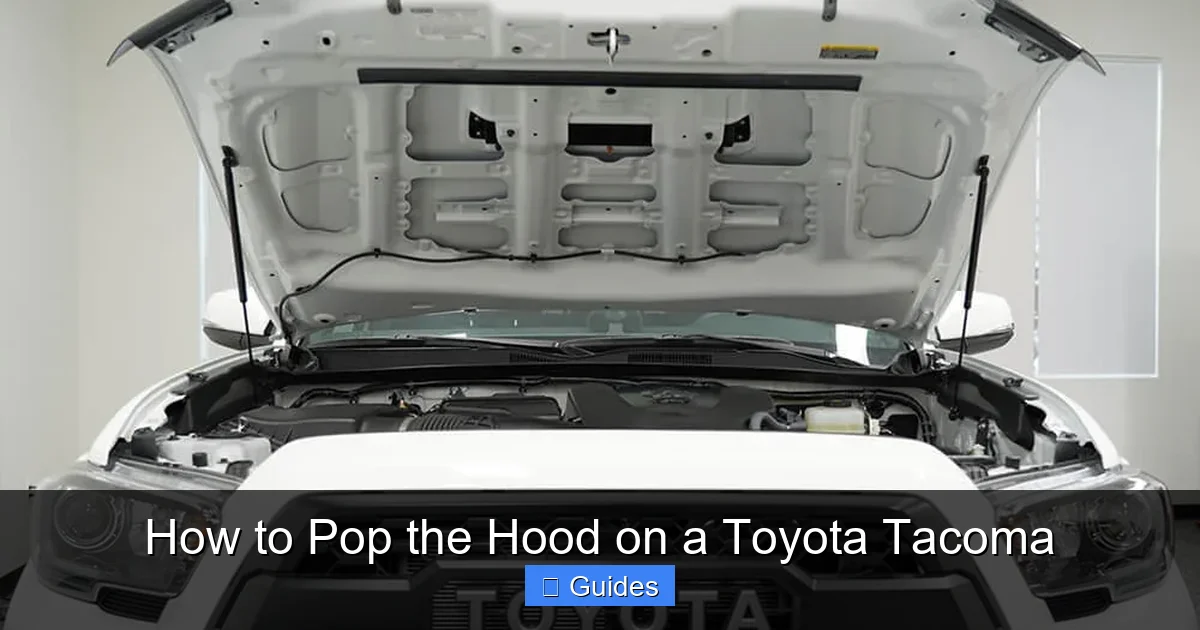
With the hood fully open, you’ll need to support it so it doesn’t fall while you work. Most Toyota Tacomas use a metal prop rod to hold the hood in place.
Look for a metal rod attached to the underside of the hood near the hinges. It’s usually stored in a clip when not in use. Pull the rod out and insert the end into the designated slot on the radiator support or hood brace.
Make sure the rod is fully seated and the hood is stable before letting go. A falling hood can cause injury or damage, so always double-check that it’s secure.
Note: Some newer Tacoma models (especially 2020 and later) may use gas struts instead of a prop rod. These automatically hold the hood open and don’t require manual support. If your truck has gas struts, you won’t need to use a prop rod—just lift the hood and it will stay in place.
Model-Specific Instructions for Different Tacoma Years
Visual guide about How to Pop the Hood on a Toyota Tacoma
Image source: extremedimensions.com
While the basic process is the same across all Tacoma models, there are some differences worth noting depending on the year of your truck.
2005–2015 Toyota Tacoma (Second Generation)
The second-generation Tacoma (2005–2015) uses a traditional hood release system with a cable-operated primary latch and a manual secondary latch. The interior release lever is located on the lower left side of the dashboard, slightly higher than in newer models.
The secondary latch is a small, spring-loaded lever under the front center of the hood. You’ll need to push it to the left while lifting the hood. These models almost always use a prop rod, so be sure to secure it properly.
One common issue with older Tacomas is cable wear. If the lever pulls but the hood doesn’t release, the cable may be stretched or broken. This is more likely after 100,000 miles or more.
2016–2023 Toyota Tacoma (Third Generation)
The third-generation Tacoma (2016–2023) features a slightly redesigned interior, but the hood release mechanism remains largely the same. The interior lever is now positioned lower and more centrally, making it easier to reach.
The secondary latch is still located under the front edge of the hood, but some owners report it being a bit stiffer than in older models. A firm push to the left usually does the trick.
These models may come with either a prop rod or gas struts, depending on the trim level and options. Higher trims (like the TRD Pro) often include gas struts for easier hood operation.
2024 Toyota Tacoma (Fourth Generation)
The all-new 2024 Toyota Tacoma introduces some updates, including a redesigned interior and improved hood release system. The interior lever is now more ergonomically placed and has a smoother action.
The secondary latch is still present, but Toyota has made it slightly easier to locate and operate. The 2024 model also comes standard with gas struts on most trims, eliminating the need for a prop rod.
One new feature is an optional hood release button inside the cab on higher trims. This electronic release simplifies the process—just press the button, and the hood pops open fully. However, the secondary latch is still present for safety.
Troubleshooting Common Hood Release Issues
Visual guide about How to Pop the Hood on a Toyota Tacoma
Image source: tacomabeast.com
Even with proper knowledge, you might run into problems when trying to pop the hood. Here are some common issues and how to fix them.
The Hood Won’t Pop After Pulling the Lever
If you pull the interior lever and nothing happens—no click, no movement—the problem is likely with the release cable. Over time, the cable can stretch, fray, or break, especially in older trucks.
To check, have someone else pull the lever while you watch under the hood. If the primary latch doesn’t move, the cable is likely disconnected or broken. Replacing the cable requires removing the interior trim and routing a new cable—a job best left to a mechanic unless you’re experienced with automotive repairs.
The Hood Lifts Slightly But Won’t Open Fully
This is almost always due to the secondary latch not being disengaged. Make sure you’re reaching under the very front edge of the hood and pushing the correct mechanism. If it still won’t budge, the latch may be frozen or corroded.
Try spraying a small amount of WD-40 or silicone lubricant into the latch area. Let it sit for a few minutes, then try again. Avoid using excessive force, as this can damage the latch.
The Hood Won’t Stay Open
If the hood keeps falling when you try to prop it up, the prop rod may be loose or the gas struts (if equipped) may be worn out. Inspect the prop rod for damage and ensure it’s fully inserted into the support slot.
For gas struts, look for signs of leakage or weak holding power. Worn struts should be replaced in pairs to ensure even support.
Frozen or Stuck Latch in Cold Weather
In cold climates, the hood latch can freeze shut, especially if moisture has gotten into the mechanism. If you suspect this, try warming the area with a hair dryer or portable heater. Never use an open flame.
Applying a silicone-based lubricant can help prevent future freezing. Avoid petroleum-based products, as they can attract dirt and cause more problems.
Maintenance Tips to Keep Your Hood Release Working Smoothly
Prevention is better than repair. With a little regular maintenance, you can avoid most hood release issues.
Lubricate the Latch Mechanism
Every 6 to 12 months, apply a small amount of silicone spray or white lithium grease to the primary and secondary latches. This keeps the moving parts smooth and prevents rust or corrosion.
Avoid using oil-based lubricants, as they can attract dirt and gum up over time.
Inspect the Release Cable
Periodically check the interior lever for smooth operation. If it feels loose or sticky, the cable may need adjustment or replacement.
Also, inspect the cable routing under the hood for signs of wear or rubbing against sharp edges.
Test the Hood Regularly
Even if you don’t need to open the hood often, test the release mechanism every few months. This helps you catch problems early and ensures everything is working when you need it.
Keep the Area Clean
Dirt, leaves, and debris can accumulate around the latch and prevent proper operation. Use a soft brush or compressed air to keep the area clean.
Safety Tips When Working Under the Hood
Once the hood is open, safety should be your top priority.
– Always use the prop rod or ensure gas struts are functioning before leaning into the engine bay.
– Never work under a hood that’s only supported by your hand or a makeshift prop.
– Keep loose clothing, jewelry, and long hair away from moving parts if the engine is running.
– Use a flashlight if working in low light, and avoid placing tools where they can fall into the engine.
Conclusion
Popping the hood on a Toyota Tacoma is a simple task once you know the two-step process: pull the interior lever, then release the secondary latch under the hood. While it may seem confusing at first, especially for new owners, it becomes second nature with practice.
Whether you drive a rugged 2005 Tacoma or the sleek 2024 model, the core principles remain the same. Understanding the hood release system, knowing how to troubleshoot common issues, and performing regular maintenance will keep your truck running smoothly and safely.
So the next time you need to check your oil, add coolant, or just admire your engine, you’ll do it with confidence—no guessing, no frustration. Just pop the hood, get to work, and enjoy the reliability that makes the Toyota Tacoma one of the most trusted trucks on the road.
Frequently Asked Questions
Where is the hood release lever on a Toyota Tacoma?
The hood release lever is located on the lower left side of the dashboard, near the driver’s footwell. It’s usually marked with a small icon of a raised hood and is within easy reach when seated.
Why won’t my Tacoma’s hood pop open after pulling the lever?
If the hood doesn’t move after pulling the lever, the release cable may be broken, stretched, or disconnected. Check for cable damage or have a mechanic inspect the latch mechanism.
Do I need to use a prop rod on a 2024 Toyota Tacoma?
Most 2024 Tacomas come with gas struts that automatically hold the hood open, so a prop rod isn’t needed. However, some base trims may still use a prop rod—check your owner’s manual.
Can I open the hood from outside the truck?
No, the Toyota Tacoma requires you to pull the interior release lever first. There is no external key or button to open the hood from outside.
What should I do if the secondary latch is stuck?
Try spraying a small amount of silicone lubricant into the latch area and wait a few minutes. Gently push the latch while lifting the hood. Avoid using excessive force to prevent damage.
How often should I lubricate the hood latch?
It’s recommended to lubricate the hood latch every 6 to 12 months with a silicone-based spray to prevent rust and ensure smooth operation.

At CarLegit, we believe information should be clear, factual, and genuinely helpful. That’s why every guide, review, and update on our website is created with care, research, and a strong focus on user experience.