
Knowing how much oil a 2010 Toyota Corolla takes is essential for proper engine care. This guide covers oil capacity, types, change intervals, and expert tips to maintain optimal performance and longevity.
In This Article
- 1 Key Takeaways
- 2 📑 Table of Contents
- 3 How Much Oil Does a 2010 Toyota Corolla Take?
- 4 Understanding Engine Oil and Its Role in Your Corolla
- 5 Recommended Oil Types for the 2010 Toyota Corolla
- 6 How to Check and Change the Oil in Your 2010 Corolla
- 7 Oil Change Intervals: How Often Should You Change the Oil?
- 8 Common Mistakes to Avoid When Changing Oil
- 9 Professional Oil Change vs. DIY: Which Is Better?
- 10 Conclusion: Keep Your Corolla Running Smoothly
- 11 Frequently Asked Questions
- 11.1 How much oil does a 2010 Toyota Corolla take with a new filter?
- 11.2 Can I use 10W-30 oil in my 2010 Corolla?
- 11.3 How often should I check the oil in my Corolla?
- 11.4 Can I go 10,000 miles between oil changes?
- 11.5 What happens if I overfill the oil in my Corolla?
- 11.6 Is it okay to mix synthetic and conventional oil?
Key Takeaways
- Oil Capacity: The 2010 Toyota Corolla holds 4.4 quarts (4.2 liters) of engine oil with a new filter.
- Recommended Oil Type: Use 0W-20 or 5W-20 synthetic or conventional oil, depending on climate and driving conditions.
- Oil Change Interval: Change oil every 5,000 to 7,500 miles under normal driving, or every 3,000 miles in severe conditions.
- Check Oil Regularly: Inspect oil level monthly using the dipstick to prevent low oil and engine damage.
- Use Genuine Filters: Always replace the oil filter with a Toyota-approved or high-quality aftermarket filter.
- Warm Up Before Checking: For accurate readings, check oil after the engine has been off for 5–10 minutes post-drive.
- Professional vs. DIY: While DIY changes save money, professional service ensures proper disposal and inspection.
📑 Table of Contents
- How Much Oil Does a 2010 Toyota Corolla Take?
- Understanding Engine Oil and Its Role in Your Corolla
- Recommended Oil Types for the 2010 Toyota Corolla
- How to Check and Change the Oil in Your 2010 Corolla
- Oil Change Intervals: How Often Should You Change the Oil?
- Common Mistakes to Avoid When Changing Oil
- Professional Oil Change vs. DIY: Which Is Better?
- Conclusion: Keep Your Corolla Running Smoothly
How Much Oil Does a 2010 Toyota Corolla Take?
If you own a 2010 Toyota Corolla, you’re driving one of the most reliable and fuel-efficient compact cars ever made. Known for its longevity, low maintenance costs, and smooth ride, the Corolla has earned a loyal following over the years. But like any vehicle, it needs regular care—especially when it comes to engine oil. One of the most common questions Corolla owners ask is: “How much oil does a 2010 Toyota Corolla take?”
The short answer is 4.4 quarts (or 4.2 liters) of engine oil when changing the oil and replacing the filter. But there’s more to the story than just a number. The type of oil, driving conditions, and maintenance habits all play a role in keeping your Corolla’s engine healthy. In this comprehensive guide, we’ll walk you through everything you need to know about oil capacity, oil types, change intervals, and best practices for maintaining your 2010 Toyota Corolla.
Whether you’re a first-time car owner or a seasoned DIY mechanic, this guide will help you understand your vehicle’s oil needs and keep it running smoothly for years to come. We’ll cover the technical specs, explain why oil matters, and offer practical tips to make oil changes easier and more effective.
Understanding Engine Oil and Its Role in Your Corolla
Visual guide about How Much Oil Does a 2010 Toyota Corolla Take
Image source: trucksauthority.com
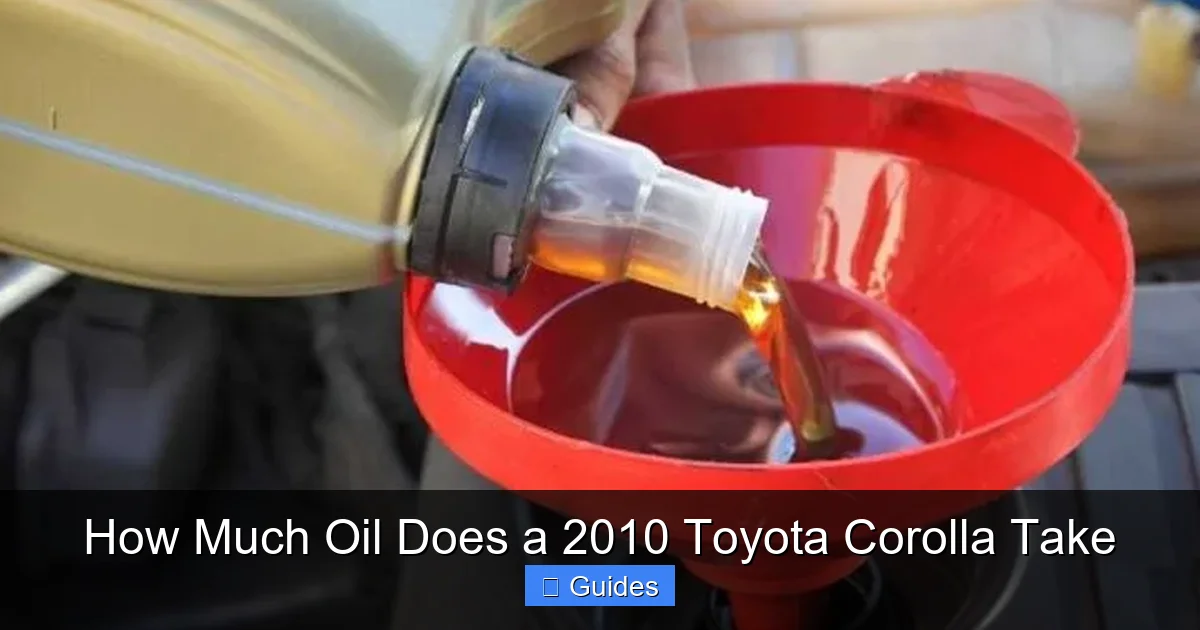
Before diving into oil capacity, it’s important to understand what engine oil does and why it’s so critical to your car’s performance. Engine oil is the lifeblood of your vehicle’s engine. It lubricates moving parts, reduces friction, prevents overheating, and helps keep the engine clean by trapping dirt and debris.
In the 2010 Toyota Corolla, the 1.8-liter 4-cylinder engine relies on a steady supply of clean, high-quality oil to operate efficiently. Without proper lubrication, metal components can grind against each other, leading to increased wear, overheating, and eventually engine failure. That’s why maintaining the correct oil level and using the right type of oil is essential.
Oil also helps seal the gaps between piston rings and cylinder walls, improving compression and fuel efficiency. Over time, oil breaks down due to heat and contamination, losing its effectiveness. This is why regular oil changes are necessary—not just to replace old oil, but to remove sludge and contaminants that can build up inside the engine.
Why Oil Capacity Matters
Knowing how much oil your Corolla takes isn’t just about filling it up correctly. Too little oil can lead to inadequate lubrication, increased engine wear, and overheating. Too much oil can cause foaming, which reduces lubrication and may damage engine seals or even lead to oil leaks.
The 2010 Corolla’s oil capacity of 4.4 quarts is designed to provide optimal lubrication while allowing room for oil expansion and proper circulation. This capacity includes the oil filter, which holds about 0.3 to 0.4 quarts of oil. If you forget to account for the filter during an oil change, you might end up with too little oil in the engine.
For example, if you drain the old oil and add only 4 quarts without replacing the filter, your engine could be running low. That’s why it’s crucial to always replace the oil filter and add the full 4.4 quarts when performing an oil change.
Signs You Need an Oil Change
Even if you follow the recommended schedule, it’s smart to watch for signs that your oil needs changing. These include:
– Dark, dirty oil (instead of amber or light brown)
– Engine noise or knocking sounds
– Oil smell inside the cabin
– Check engine or oil pressure warning light
– Reduced fuel efficiency
If you notice any of these signs, check your oil level and condition immediately. Ignoring them can lead to costly repairs down the road.
Recommended Oil Types for the 2010 Toyota Corolla

Visual guide about How Much Oil Does a 2010 Toyota Corolla Take
Image source: oilcapacityguide.com
Not all engine oils are created equal. The 2010 Toyota Corolla is designed to run on specific oil viscosities and formulations to ensure peak performance and engine protection. Using the wrong type of oil can reduce fuel economy, increase emissions, and even void your warranty (if still applicable).
0W-20 vs. 5W-20: What’s the Difference?
Toyota recommends using 0W-20 or 5W-20 motor oil in the 2010 Corolla. Both are multi-grade oils, meaning they perform well in a range of temperatures. The “W” stands for winter, and the number before it indicates how well the oil flows in cold weather. The number after the “W” shows viscosity at operating temperature.
– **0W-20**: Thinner in cold weather, ideal for colder climates. It flows quickly at startup, reducing engine wear during cold starts.
– **5W-20**: Slightly thicker in cold weather, suitable for moderate to warm climates. It still offers excellent cold-weather performance but may be preferred in areas with mild winters.
In most cases, 0W-20 is the preferred choice because it improves fuel efficiency and provides better cold-weather protection. However, 5W-20 is also acceptable and may be used if 0W-20 is not available.
Synthetic vs. Conventional Oil
You’ll also need to decide between synthetic and conventional oil. Here’s a quick breakdown:
– **Conventional Oil**: Made from refined crude oil. It’s less expensive but breaks down faster under high heat and stress. Best for older engines or light-duty driving.
– **Synthetic Oil**: Engineered for superior performance. It resists breakdown, flows better in cold weather, and provides better protection under extreme conditions. Ideal for modern engines like the Corolla’s.
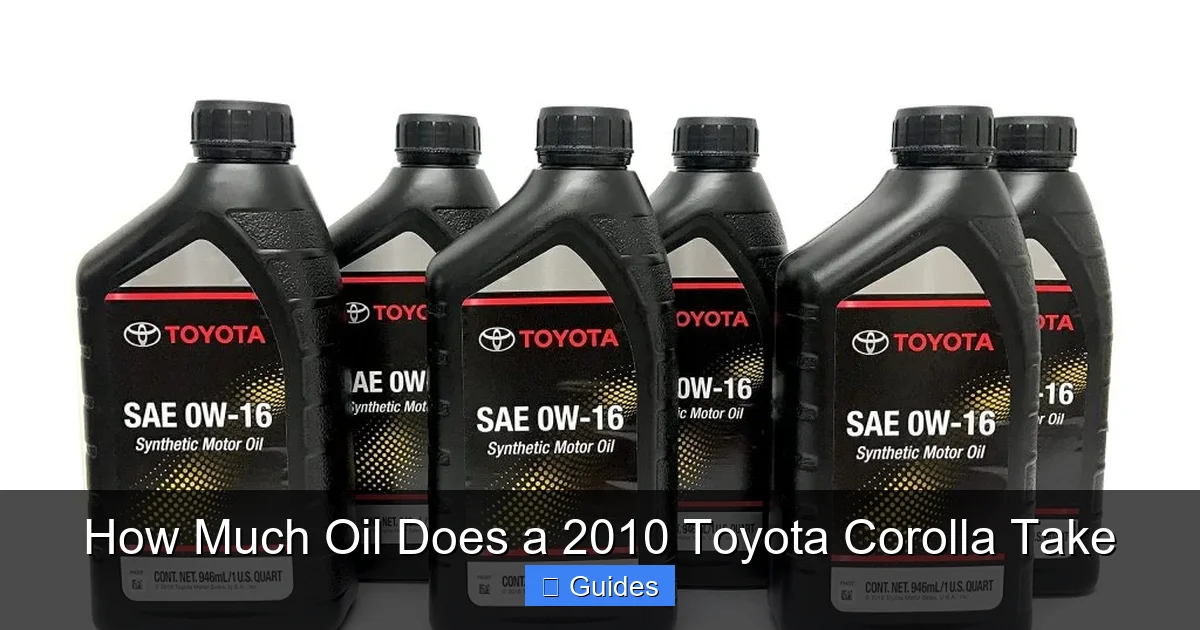
Toyota recommends synthetic oil for the 2010 Corolla, especially if you drive in harsh conditions or want to extend oil change intervals. Full synthetic 0W-20 oil is the top choice for most drivers.
High-Mileage Oil: Is It Necessary?
If your Corolla has over 75,000 miles, you might consider high-mileage oil. These oils contain additives that condition seals, reduce oil consumption, and prevent leaks. They’re especially helpful for older engines that may have minor wear.
However, if your engine is in good condition and doesn’t burn or leak oil, regular synthetic oil is sufficient. High-mileage oil isn’t a cure-all, but it can help extend the life of a high-mileage engine.
How to Check and Change the Oil in Your 2010 Corolla
Visual guide about How Much Oil Does a 2010 Toyota Corolla Take
Image source: oilcapacityguide.com
Changing your own oil can save you money and give you peace of mind knowing the job was done right. Here’s a step-by-step guide to checking and changing the oil in your 2010 Toyota Corolla.
Tools and Supplies You’ll Need
Before starting, gather these items:
– 4.4 quarts of 0W-20 or 5W-20 motor oil
– New oil filter (Toyota part # 90915-YZZF1 or equivalent)
– Oil filter wrench
– Socket wrench and 14mm socket (for drain plug)
– Oil drain pan
– Funnel
– Gloves and safety glasses
– Jack and jack stands or ramps (optional, for easier access)
– Clean rag or paper towels
Step-by-Step Oil Change Process
1. **Warm Up the Engine**: Run the engine for 2–3 minutes to warm the oil. Warm oil flows more easily, helping drain contaminants.
2. **Lift the Vehicle (if needed)**: Use a jack and jack stands or drive onto ramps to access the oil pan. Never work under a car supported only by a jack.
3. **Locate the Drain Plug**: Under the engine, find the oil pan and the 14mm drain plug.
4. **Drain the Old Oil**: Place the drain pan underneath. Loosen the drain plug with a socket wrench and remove it by hand. Let the oil drain completely—this may take 5–10 minutes.
5. **Replace the Drain Plug**: Once drained, clean the plug and reinstall it. Tighten it to 30 ft-lbs (foot-pounds) of torque. Don’t overtighten.
6. **Remove the Old Oil Filter**: Use an oil filter wrench to loosen the old filter. Be prepared for some oil spillage. Wipe the mounting surface clean.
7. **Install the New Oil Filter**: Lightly coat the rubber gasket on the new filter with fresh oil. Screw it on by hand until snug, then give it an extra ¾ turn.
8. **Add New Oil**: Locate the oil filler cap on top of the engine. Insert a funnel and pour in 4.4 quarts of oil. Replace the cap.
9. **Check the Oil Level**: Start the engine and let it run for 30 seconds. Turn it off and wait 5 minutes. Pull out the dipstick, wipe it clean, reinsert it, and check the level. It should be between the “L” (low) and “F” (full) marks.
10. **Dispose of Old Oil Properly**: Pour used oil into a sealed container and take it to a recycling center or auto parts store.
Tips for a Successful Oil Change
– Always use a new oil filter—don’t reuse the old one.
– Don’t overfill. Adding more than 4.4 quarts can cause engine damage.
– Check for leaks after starting the engine.
– Reset the oil change reminder light (if equipped) using the trip odometer button.
Oil Change Intervals: How Often Should You Change the Oil?
One of the most debated topics among car owners is how often to change the oil. The answer depends on your driving habits, climate, and the type of oil you use.
Toyota’s Official Recommendation
Toyota recommends changing the oil in the 2010 Corolla every 5,000 to 7,500 miles under normal driving conditions. If you use synthetic oil and drive mostly on highways, you can safely go up to 7,500 miles. For conventional oil or mixed driving, stick to 5,000 miles.
Severe Driving Conditions
If you frequently drive in “severe” conditions, you should change the oil every 3,000 miles. Severe conditions include:
– Short trips (less than 10 miles) in cold weather
– Stop-and-go traffic or city driving
– Towing or carrying heavy loads
– Driving in dusty or sandy environments
– Extreme temperatures (below 32°F or above 90°F)
Most drivers fall into the severe category without realizing it. If you’re unsure, err on the side of caution and change the oil more frequently.
Using an Oil Life Monitor
The 2010 Corolla is equipped with an oil life monitoring system that calculates when an oil change is needed based on driving patterns. This system considers factors like engine temperature, driving speed, and trip length.
While the monitor is helpful, it’s not foolproof. Always check your oil level and condition manually, especially if you drive in harsh conditions. Don’t rely solely on the monitor.
Common Mistakes to Avoid When Changing Oil
Even experienced DIYers can make mistakes during an oil change. Here are some common pitfalls and how to avoid them.
Overfilling the Engine
Adding too much oil is a serious mistake. Excess oil can foam, reducing lubrication and increasing pressure on seals and gaskets. This can lead to oil leaks, blown gaskets, or even engine damage.
Always measure the oil carefully and check the dipstick after adding. The correct level is between the “L” and “F” marks.
Using the Wrong Oil Filter
Not all oil filters are compatible with the 2010 Corolla. Using a cheap or incorrect filter can lead to poor filtration, reduced oil flow, or even filter collapse under pressure.
Stick to Toyota OEM filters or high-quality aftermarket brands like Fram, Mobil 1, or Bosch. Avoid no-name filters.
Not Tightening the Drain Plug Properly
A loose drain plug can cause oil leaks. An overtightened plug can strip the threads in the oil pan, requiring costly repairs.
Use a torque wrench to tighten the drain plug to 30 ft-lbs. If you don’t have one, tighten it snugly by hand, then give it a quarter turn with a wrench.
Skipping the Oil Filter Change
Some people try to save money by reusing the old oil filter. This is a bad idea. The filter traps contaminants and loses efficiency over time. Always replace it with every oil change.
Professional Oil Change vs. DIY: Which Is Better?
You have two options when it’s time for an oil change: do it yourself or take it to a professional. Both have pros and cons.
DIY Oil Change: Pros and Cons
**Pros:**
– Saves money (typically $20–$40 per change)
– Full control over oil and filter quality
– Convenient if you have the tools and space
**Cons:**
– Requires time, tools, and physical effort
– Risk of spills, overfilling, or improper disposal
– Not ideal for those with mobility issues
Professional Oil Change: Pros and Cons
**Pros:**
– Fast and convenient
– Includes inspection of belts, hoses, and fluids
– Proper disposal of used oil and filter
– Often includes a multi-point inspection
**Cons:**
– More expensive ($40–$70)
– Risk of upselling unnecessary services
– Quality varies by shop
For most people, a mix of both works best. Do it yourself if you’re comfortable and have the tools. Otherwise, choose a trusted mechanic or dealership.
Conclusion: Keep Your Corolla Running Smoothly
Knowing how much oil a 2010 Toyota Corolla takes—4.4 quarts with a new filter—is just the beginning of proper engine maintenance. Using the right oil type, changing it at the right intervals, and avoiding common mistakes will keep your Corolla running efficiently for hundreds of thousands of miles.
Regular oil changes are one of the simplest and most effective ways to extend the life of your engine. Whether you do it yourself or go to a professional, make oil maintenance a priority. Your Corolla will thank you with reliable performance, better fuel economy, and fewer repairs.
Remember: clean oil is cheap insurance for your engine. Don’t wait for warning lights or strange noises—stay proactive. Check your oil monthly, follow the recommended change schedule, and always use high-quality oil and filters.
With proper care, your 2010 Toyota Corolla can easily surpass 200,000 miles—and beyond. So grab that wrench, check that dipstick, and keep your Corolla in top shape for years to come.
Frequently Asked Questions
How much oil does a 2010 Toyota Corolla take with a new filter?
The 2010 Toyota Corolla requires 4.4 quarts (4.2 liters) of engine oil when changing the oil and replacing the filter. This ensures proper lubrication and accounts for the oil held in the new filter.
Can I use 10W-30 oil in my 2010 Corolla?
No, Toyota does not recommend 10W-30 oil for the 2010 Corolla. Use only 0W-20 or 5W-20 oil as specified in the owner’s manual. Using the wrong viscosity can reduce fuel efficiency and engine protection.
How often should I check the oil in my Corolla?
Check the oil level at least once a month, or before long trips. Use the dipstick to ensure the level is between the “L” and “F” marks. Regular checks help prevent low oil and engine damage.
Can I go 10,000 miles between oil changes?
It’s not recommended. Even with synthetic oil, Toyota advises changing oil every 5,000 to 7,500 miles. Going longer increases the risk of sludge buildup and engine wear, especially in severe driving conditions.
What happens if I overfill the oil in my Corolla?
Overfilling can cause oil foaming, reduced lubrication, and increased pressure on engine seals. This may lead to leaks, blown gaskets, or engine damage. Always check the dipstick after adding oil.
Is it okay to mix synthetic and conventional oil?
Yes, you can mix synthetic and conventional oil in a pinch, but it’s not ideal. For best performance, use the same type of oil consistently. Switching back and forth can reduce the benefits of synthetic oil.

At CarLegit, we believe information should be clear, factual, and genuinely helpful. That’s why every guide, review, and update on our website is created with care, research, and a strong focus on user experience.