
A car can indeed be declared a total loss due to mechanical failure, especially if repair costs exceed its actual cash value or pose safety risks. Insurance companies use specific criteria—like cost-to-value ratios and state regulations—to make this determination. Understanding these rules helps you navigate claims and avoid surprises.
Imagine this: You’re driving down the highway, humming along to your favorite playlist, when suddenly—your engine starts making a loud knocking noise. Smoke pours from under the hood. You pull over, heart racing, and call for help. After a tow and a mechanic’s diagnosis, you learn the engine has seized due to a failed oil pump. The repair quote? $8,000. But your car is only worth $6,500. What happens next might surprise you: your insurance company could declare your car “totaled”—not because of an accident, but because of mechanical failure.
This scenario isn’t as rare as you might think. While most people associate “total loss” with crashes or floods, mechanical breakdowns can also lead to a car being written off. Insurance companies don’t just look at how a car was damaged—they assess whether it’s financially or safely feasible to repair it. If the cost of fixing the problem exceeds a certain percentage of the car’s value, or if the damage poses a serious safety risk, the vehicle may be declared a total loss. Understanding how and why this happens can save you stress, money, and confusion when dealing with your insurer.
In This Article
- 1 Key Takeaways
- 2 📑 Table of Contents
- 3 What Does “Totaled” Actually Mean?
- 4 Can Mechanical Failure Really Total a Car?
- 5 How Insurers Evaluate Mechanical Total Loss Claims
- 6 Safety Concerns and Total Loss Decisions
- 7 What You Can Do If Your Car Is Totaled Due to Mechanical Failure
- 8 Preventing Mechanical Failure and Protecting Your Investment
- 9 Frequently Asked Questions
- 9.1 Can a car be totaled if it’s still drivable?
- 9.2 Does comprehensive insurance cover mechanical failure?
- 9.3 What happens to my car after it’s declared a total loss?
- 9.4 Can I keep my car if it’s totaled due to mechanical failure?
- 9.5 How is my car’s value determined after mechanical failure?
- 9.6 What if I disagree with the insurer’s total loss decision?
Key Takeaways
- Mechanical failure can total a car: If repairs cost more than the vehicle’s value or it’s unsafe to drive, insurers may declare it totaled.
- State laws influence the decision: Each state sets thresholds (e.g., 70–100% of ACV) that determine when a car is legally considered a total loss.
- Actual Cash Value (ACV) matters most: Insurers compare repair estimates to your car’s pre-failure market value—not the original price.
- Safety concerns play a role: Even if repairs are affordable, severe mechanical issues (like brake or steering failure) may lead to a total loss declaration for safety reasons.
- Comprehensive vs. collision coverage matters: Mechanical failures are typically covered under comprehensive insurance only if caused by an external event (e.g., flood damage), not normal wear and tear.
- You have rights as a policyholder: You can dispute a total loss decision, request a second inspection, or negotiate the settlement offer.
- Prevention saves money: Regular maintenance reduces the risk of catastrophic mechanical failure and helps preserve your car’s value.
📑 Table of Contents
What Does “Totaled” Actually Mean?
Before diving into mechanical failure, it’s important to clarify what “totaled” really means in the insurance world. A totaled car—also called a “total loss”—is one that the insurance company decides isn’t worth repairing. This doesn’t always mean the car is destroyed beyond recognition. In fact, many totaled vehicles are still drivable, but the cost to fix them makes repair economically unreasonable.
How Insurers Define Total Loss
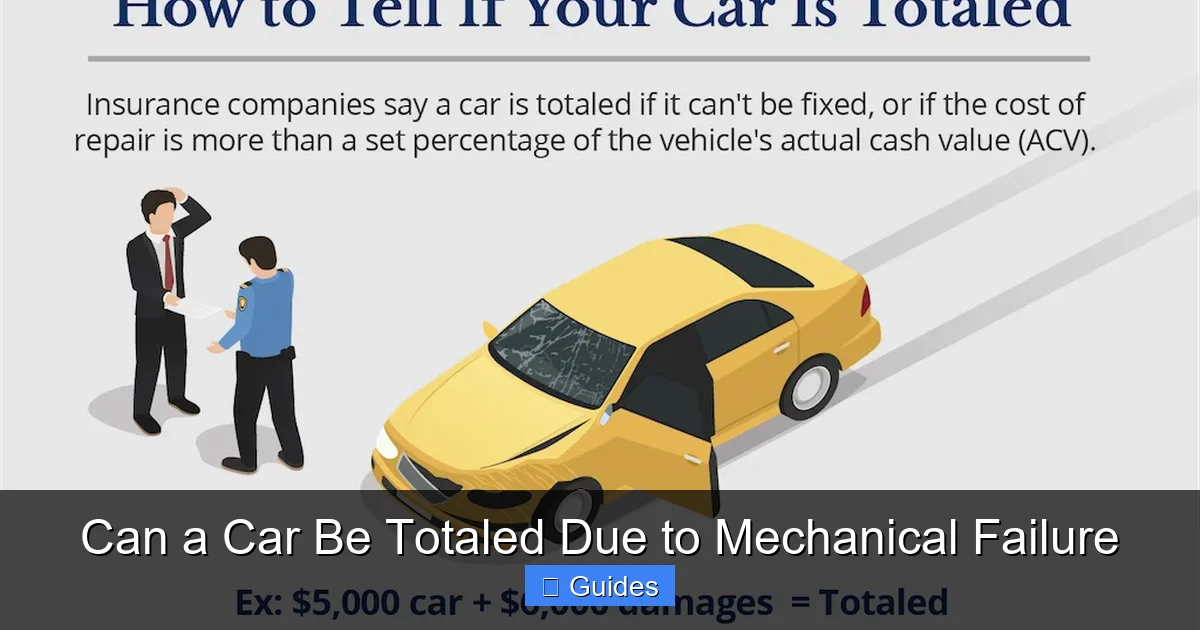
Insurance companies use a simple formula: they compare the estimated repair cost to the car’s Actual Cash Value (ACV). ACV is the market value of your car just before the incident—factoring in age, mileage, condition, and local market trends. If the repair cost exceeds a set percentage of the ACV (usually between 70% and 100%, depending on your state), the car is declared a total loss.
For example, if your car is worth $10,000 and the repair estimate is $8,500, and your state’s threshold is 80%, the insurer will likely total it. Even if the car could technically be fixed, it’s not cost-effective for the insurance company to pay for repairs when they could just pay you the ACV and take ownership of the vehicle.
State-Specific Total Loss Thresholds
Each state sets its own rules for when a vehicle is considered a total loss. These are known as Total Loss Thresholds (TLT) or Total Loss Formulas (TLF). Some states use a fixed percentage (e.g., 75% of ACV), while others use a formula that adds repair costs and salvage value.
For instance:
- California: Uses a 75% threshold. If repairs exceed 75% of ACV, the car is totaled.
- Texas: Uses a Total Loss Formula: if repair cost + salvage value > ACV, the car is totaled.
- New York: Uses an 80% threshold.
Knowing your state’s rules helps you understand whether your car might be totaled—even if the damage isn’t from a collision.
Can Mechanical Failure Really Total a Car?
Yes—mechanical failure can absolutely lead to a total loss declaration. While it’s less common than crash-related totals, it happens more often than most drivers realize. The key factor is whether the failure causes damage that’s expensive to repair or unsafe to ignore.

Visual guide about Can a Car Be Totaled Due to Mechanical Failure
Image source: calljacob.com
Types of Mechanical Failures That Can Total a Car
Not all mechanical issues are created equal. Minor problems like a faulty alternator or worn brake pads are usually cheap to fix and won’t total a car. But major failures—especially those that cause secondary damage—can push repair costs through the roof.
Here are some common mechanical failures that could result in a total loss:
- Engine seizure or catastrophic engine failure: If the engine locks up due to lack of oil, overheating, or internal damage, replacing or rebuilding it can cost $5,000–$10,000—often more than the car is worth.
- Transmission failure: Rebuilding or replacing a transmission can run $3,000–$8,000, especially in modern vehicles with complex automatic systems.
- Frame or structural damage from mechanical stress: In rare cases, a severe mechanical failure (like a broken axle or suspension collapse) can bend the frame, making the car unsafe and expensive to repair.
- Electrical system meltdowns: Modern cars rely heavily on electronics. A short circuit or faulty control module can damage multiple systems, leading to high repair bills.
- Cooling system failure leading to engine damage: A blown head gasket or cracked engine block from overheating can destroy the engine and require a full replacement.
Let’s look at a real-world example: Sarah owns a 2015 Honda Accord with 120,000 miles. One day, her timing belt snaps while driving, causing the valves to collide with the pistons. The mechanic quotes $7,200 for a full engine rebuild. Kelley Blue Book values her car at $6,800 in good condition. Even though the car looks fine externally, the repair cost exceeds its value. Her insurer declares it a total loss due to mechanical failure.
When Is Mechanical Failure Covered?
Here’s a critical point: standard auto insurance policies do not cover mechanical failure due to normal wear and tear. If your engine fails because it’s old or poorly maintained, your insurer likely won’t pay—even if it totals the car.
However, mechanical failure may be covered under certain circumstances:
- Comprehensive coverage: If the failure is caused by a covered peril—like flood damage that ruins the engine, or a fallen tree that damages the transmission—your comprehensive policy may kick in.
- Collision coverage: If a crash causes mechanical damage (e.g., hitting a pothole that bends the axle and damages the transmission), collision coverage applies.
- Extended warranties or mechanical breakdown insurance: Some drivers purchase add-on coverage that pays for major mechanical repairs. These policies can cover engine, transmission, and electrical failures—even without an accident.
- Manufacturer defects or recalls: If the failure is due to a known defect (e.g., a faulty fuel pump recalled by the manufacturer), you may be eligible for a free repair or compensation.
So, while mechanical failure can total your car, coverage depends heavily on the cause and your policy type.
How Insurers Evaluate Mechanical Total Loss Claims
When you file a claim for mechanical failure, the insurer follows a detailed process to decide whether to total the car. Understanding this process helps you know what to expect—and how to advocate for yourself.
Visual guide about Can a Car Be Totaled Due to Mechanical Failure
Image source: mcintyrelaw.com
The Inspection and Estimate Process
After you report the issue, the insurance company will send an adjuster or request a repair estimate from a certified shop. The mechanic will diagnose the problem and provide a detailed quote, including parts, labor, and any additional damage discovered during inspection.
For example, if your engine fails, the mechanic might find that oil sludge has also damaged the transmission or contaminated the cooling system. These “hidden” damages can significantly increase the repair cost—pushing it over the total loss threshold.
Comparing Repair Cost to Actual Cash Value
Once the estimate is in, the insurer calculates your car’s ACV using tools like Kelley Blue Book, NADA Guides, or proprietary software. They’ll adjust for mileage, condition, and local market prices.
Then, they apply the state’s total loss formula. Let’s say your car is worth $9,000, and the repair estimate is $7,500. In a state with an 80% threshold, the cutoff is $7,200 ($9,000 × 0.80). Since $7,500 > $7,200, the car is totaled.
Salvage Value and Who Gets the Car
If the car is declared a total loss, the insurer typically takes ownership and sells it for salvage. The salvage value (what the wrecked car is worth to a recycler or parts dealer) is deducted from your settlement.
For instance, if your ACV is $9,000 and the salvage value is $1,500, you’ll receive a check for $7,500. In some states, you can buy back the car from the insurer (called “retaining salvage”), but it will be branded as a salvage title—which affects resale value and insurability.
Safety Concerns and Total Loss Decisions
Beyond cost, safety is a major factor in total loss decisions. Even if repairs are affordable, insurers may total a car if the mechanical failure creates an unsafe driving condition.
Visual guide about Can a Car Be Totaled Due to Mechanical Failure
Image source: robinsonstith.com
When Safety Trumps Cost
Imagine your car’s steering rack fails due to a manufacturing defect. The repair cost is $2,000, and your car is worth $15,000—well below the total loss threshold. But because sudden steering failure could cause a serious accident, the insurer may still declare it totaled to avoid liability.
Similarly, if a brake line ruptures and causes a fire that damages the undercarriage, the car might be deemed unsafe to repair—even if the fire didn’t destroy the interior.
Branded Titles and Rebuilt Vehicles
Cars that are totaled and then repaired receive a “salvage title.” If you repair it and pass a state inspection, it can be rebranded as “rebuilt” or “reconstructed.” However, these titles scare off many buyers and can reduce resale value by 20–40%.
Insurers are cautious about paying to repair cars with major mechanical failures because of the risk of future claims or lawsuits if the repair isn’t done correctly.
What You Can Do If Your Car Is Totaled Due to Mechanical Failure
Receiving a total loss notice can be frustrating—especially if you believe the car could be safely repaired. But you have options.
Dispute the Decision
You can challenge the insurer’s assessment by:
- Requesting a second inspection from an independent mechanic.
- Providing evidence of your car’s pre-failure condition (photos, maintenance records).
- Comparing ACV estimates from multiple sources (KBB, Edmunds, local dealerships).
Negotiate the Settlement
If the car is totaled, you can still negotiate the payout. Bring comparable listings of similar cars in your area to justify a higher ACV. Some insurers may also offer a “betterment” adjustment if the failure was due to lack of maintenance—but you can argue against this if you have service records.
Consider Retaining the Vehicle
In many states, you can choose to keep the car and receive a reduced settlement (ACV minus salvage value). This makes sense if you have the skills and resources to repair it yourself—but be aware of the salvage title implications.
Preventing Mechanical Failure and Protecting Your Investment
The best way to avoid a mechanical total loss is to prevent the failure in the first place. Regular maintenance is your first line of defense.
Follow the Manufacturer’s Maintenance Schedule
Your owner’s manual outlines when to change oil, replace belts, flush fluids, and inspect critical systems. Sticking to this schedule can prevent catastrophic failures.
Listen to Your Car
Unusual noises, warning lights, or performance issues (like rough idling or slipping gears) are red flags. Address them early—before they lead to expensive damage.
Invest in Extended Coverage
If you drive an older car or a model known for mechanical issues, consider mechanical breakdown insurance or an extended warranty. These can cover major repairs that standard policies won’t.
Keep Detailed Records
Maintain a log of all repairs, oil changes, and inspections. These records can help you dispute a total loss decision or prove your car was well-maintained.
Dealing with a totaled car due to mechanical failure is never fun—but it’s not the end of the road. By understanding how insurers make these decisions, knowing your rights, and taking proactive steps to maintain your vehicle, you can navigate the process with confidence. Whether your car is repaired, sold for parts, or replaced, being informed helps you make the best choice for your wallet and your safety.
Frequently Asked Questions
Can a car be totaled if it’s still drivable?
Yes, a car can be declared totaled even if it’s still drivable. Insurers base the decision on repair cost versus the car’s value, not whether it can be driven. If repairs exceed the threshold, it’s considered a total loss.
Does comprehensive insurance cover mechanical failure?
Only if the failure is caused by a covered event like flooding, fire, or falling objects. Normal wear and tear or lack of maintenance is not covered under comprehensive or collision policies.
What happens to my car after it’s declared a total loss?
The insurance company usually takes ownership and sells it for salvage. You receive a settlement check for the car’s ACV minus the salvage value, unless you choose to retain the vehicle.
Can I keep my car if it’s totaled due to mechanical failure?
Yes, in most states you can “retain salvage” and keep the car. You’ll receive a reduced payout, and the title will be branded as salvage or rebuilt.
How is my car’s value determined after mechanical failure?
Insurers use tools like Kelley Blue Book or NADA Guides to assess the car’s pre-failure market value, adjusted for mileage, condition, and local demand.
What if I disagree with the insurer’s total loss decision?
You can request a second inspection, provide your own repair estimate, or negotiate the ACV. If needed, file a complaint with your state’s insurance department.

At CarLegit, we believe information should be clear, factual, and genuinely helpful. That’s why every guide, review, and update on our website is created with care, research, and a strong focus on user experience.