
The number of catalytic converters in an Acura MDX depends on the model year, engine size, and drivetrain configuration. Most MDX models from 2001 to 2023 come equipped with either two or four catalytic converters, with V6 and V8 engines typically requiring more units to meet strict emissions standards. Understanding this helps with maintenance, repairs, and compliance.
If you’re an Acura MDX owner—or thinking about becoming one—you’ve probably wondered about the inner workings of your vehicle, especially when it comes to emissions and performance. One component that often raises questions is the catalytic converter. It’s a vital part of your car’s exhaust system, responsible for reducing harmful emissions before they leave the tailpipe. But here’s the thing: not all catalytic converters are created equal, and the number you’ll find under your MDX can vary significantly depending on the year, engine, and trim level.
So, how many catalytic converters are in an Acura MDX? The short answer is: it depends. Most models come with either two or four catalytic converters, but the exact number hinges on several factors. For example, a 2007 MDX with a 3.7L V6 engine might have two converters, while a 2014 MDX with the same engine but a different exhaust layout could have four. Even drivetrain choices—like front-wheel drive (FWD) versus all-wheel drive (AWD)—can influence the configuration. Understanding this helps you make smarter decisions about maintenance, repairs, and even resale value.
In this guide, we’ll break down everything you need to know about catalytic converters in the Acura MDX. We’ll explore how many you can expect based on your specific model, why the number varies, and what it means for your vehicle’s performance and compliance with emissions standards. Whether you’re troubleshooting a check engine light or planning a repair, this information will help you stay informed and in control.
In This Article
- 1 Key Takeaways
- 2 📑 Table of Contents
- 3 What Is a Catalytic Converter and Why Does It Matter?
- 4 How Many Catalytic Converters Are in an Acura MDX by Model Year?
- 5 Why Do Some MDX Models Have More Catalytic Converters Than Others?
- 6 Signs Your Acura MDX’s Catalytic Converter May Be Failing
- 7 How to Maintain Your Acura MDX’s Catalytic Converters
- 8 Replacing a Catalytic Converter in an Acura MDX
- 9 Conclusion
- 10 Frequently Asked Questions
- 10.1 How many catalytic converters does a 2015 Acura MDX have?
- 10.2 Can I drive my MDX with a bad catalytic converter?
- 10.3 Are aftermarket catalytic converters legal for my MDX?
- 10.4 How long do catalytic converters last in an Acura MDX?
- 10.5 Will a new catalytic converter improve my MDX’s performance?
- 10.6 Can I clean a catalytic converter instead of replacing it?
Key Takeaways
- Most Acura MDX models have 2 to 4 catalytic converters: The exact number varies by engine type and model year, with V6 and V8 engines often using multiple units.
- Dual exhaust systems require dual catalytic converters: AWD and performance-oriented trims typically feature dual exhausts, each with its own catalytic converter.
- Pre- and post-catalytic oxygen sensors help monitor efficiency: These sensors ensure the catalytic converters are working properly and help the engine run cleanly.
- Federal and state emissions laws influence converter count: Stricter regulations, especially in California and other CARB-compliant states, often require additional converters.
- Replacing a catalytic converter can be expensive: OEM parts and labor can cost $1,500–$3,000+, making maintenance awareness crucial.
- Aftermarket converters may not meet OEM standards: While cheaper, they can fail emissions tests or reduce engine performance if not properly certified.
- Regular maintenance extends converter life: Fixing engine misfires, oil leaks, and using quality fuel helps prevent premature failure.
📑 Table of Contents
- What Is a Catalytic Converter and Why Does It Matter?
- How Many Catalytic Converters Are in an Acura MDX by Model Year?
- Why Do Some MDX Models Have More Catalytic Converters Than Others?
- Signs Your Acura MDX’s Catalytic Converter May Be Failing
- How to Maintain Your Acura MDX’s Catalytic Converters
- Replacing a Catalytic Converter in an Acura MDX
- Conclusion
What Is a Catalytic Converter and Why Does It Matter?
Before diving into the specifics of the Acura MDX, it’s important to understand what a catalytic converter actually does. In simple terms, it’s an emissions control device that converts toxic gases from your engine’s exhaust into less harmful substances before they’re released into the atmosphere. It does this through a chemical reaction that takes place inside a honeycomb-like structure coated with precious metals like platinum, palladium, and rhodium.
These metals act as catalysts—hence the name—speeding up reactions that turn carbon monoxide into carbon dioxide, hydrocarbons into water and carbon dioxide, and nitrogen oxides into nitrogen and oxygen. Without catalytic converters, vehicles would emit far more pollution, contributing to smog, acid rain, and respiratory issues.
In the U.S., catalytic converters have been required on all gasoline-powered vehicles since 1975, thanks to the Clean Air Act. Over time, emissions standards have become stricter, especially in states like California, which enforce even tougher rules through the California Air Resources Board (CARB). This has led automakers like Acura to design increasingly sophisticated exhaust systems with multiple catalytic converters to meet these demands.
For MDX owners, this means your SUV is equipped with a system designed to minimize environmental impact while maintaining performance. But it also means that if something goes wrong—like a clogged or failing converter—it can trigger warning lights, reduce fuel efficiency, and even cause your vehicle to fail an emissions test.
How Many Catalytic Converters Are in an Acura MDX by Model Year?
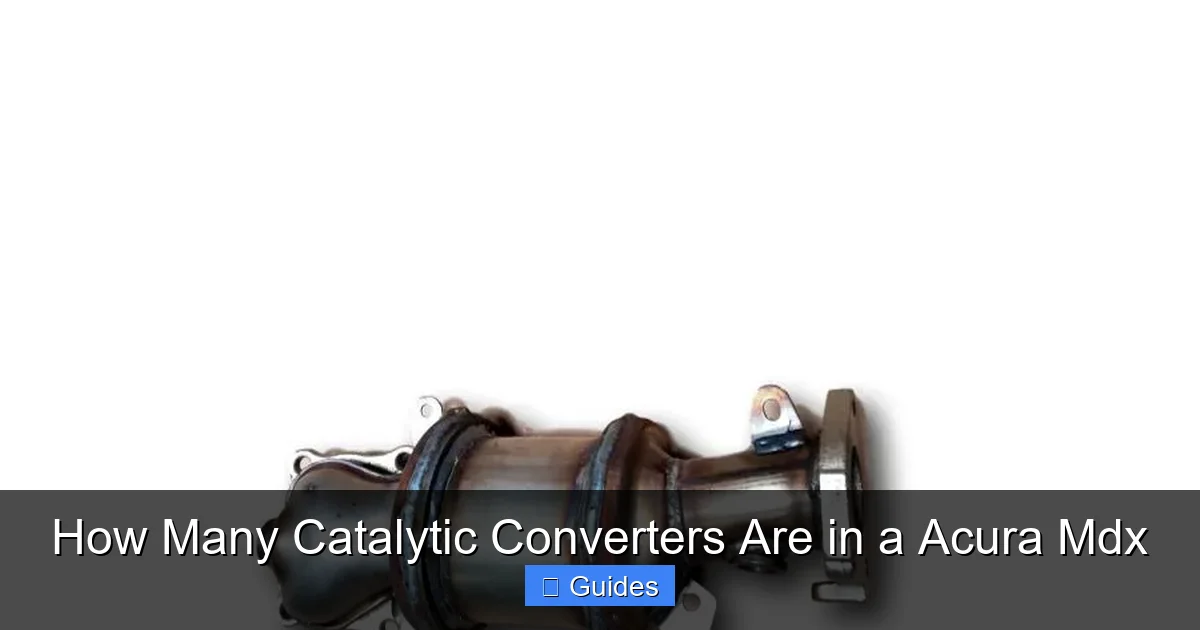
Visual guide about How Many Catalytic Converters Are in a Acura Mdx
Image source: mufflerexpress.com
Now, let’s get into the nitty-gritty: how many catalytic converters does your specific Acura MDX have? The answer varies by generation, engine, and drivetrain. Below is a breakdown by major model years and configurations.
First Generation (2001–2006)
The original Acura MDX, introduced in 2001, was built on the Honda Odyssey platform and came standard with a 3.5L V6 engine. Most models from this era featured a single exhaust system with **two catalytic converters**. One was typically located close to the engine (the “pre-cat” or “manifold” converter), and the second was further down the exhaust line (the “main” or “underbody” converter). This dual setup helped meet early 2000s emissions standards while keeping costs manageable.
However, some high-performance or AWD trims may have had slight variations, especially in regions with stricter emissions laws. Still, two converters were the norm for this generation.
Second Generation (2007–2013)
With the 2007 redesign, Acura upgraded the MDX with a more powerful 3.7L V6 engine and introduced a more refined exhaust system. Most models in this generation also came with **two catalytic converters**, but the design became more sophisticated. The pre-cat was often integrated into the exhaust manifold, while the main converter was positioned under the vehicle.
That said, certain trims—especially those with AWD and dual exhaust systems—began to feature **four catalytic converters**. This was particularly true for models sold in California and other CARB-compliant states. In these configurations, each exhaust pipe had its own pre-cat and main converter, doubling the total count.
For example, a 2010 MDX SH-AWD (Super Handling All-Wheel Drive) with dual exhausts likely has four converters: two near the engine and two under the chassis. This setup allows for better emissions control and improved exhaust flow, which can enhance performance slightly.
Third Generation (2014–2020)
The third-generation MDX brought a complete redesign, including a new platform, updated styling, and improved fuel efficiency. Acura continued using the 3.5L V6 engine, but with direct injection and cylinder deactivation for better mileage.
In this generation, most MDX models—especially those with AWD and dual exhausts—typically have **four catalytic converters**. The dual exhaust system means each side of the engine has its own catalytic setup: a pre-cat near the cylinder head and a main converter downstream. This design helps the vehicle meet stricter EPA and CARB standards introduced in the 2010s.
Front-wheel-drive (FWD) models, which are less common, may still use only two converters, but they’re increasingly rare as AWD has become the standard for the MDX lineup.
Fourth Generation (2022–Present)
The latest MDX, introduced in 2022, features a bold new design, a more powerful 3.5L V6, and advanced driver-assistance systems. It also continues the trend of using **four catalytic converters** in most configurations, especially in AWD models.
Acura has emphasized sustainability and emissions compliance in this generation, and the dual catalytic converter setup per exhaust bank reflects that commitment. Even the base model typically includes four converters, ensuring the vehicle passes emissions tests in all 50 states.
Why Do Some MDX Models Have More Catalytic Converters Than Others?

Visual guide about How Many Catalytic Converters Are in a Acura Mdx
Image source: picclickimg.com
You might be wondering: why the variation? Why do some MDX models have two converters while others have four? The answer lies in a combination of engineering, emissions regulations, and drivetrain design.
Engine Configuration and Exhaust Layout
The most straightforward reason is the exhaust system layout. Vehicles with a single exhaust pipe—common in older or base models—usually have one catalytic converter near the engine and one further back, totaling two.
But when a vehicle has a dual exhaust system—like most modern MDX AWD models—each exhaust pipe needs its own catalytic converter. This means two pre-cats (one per bank of cylinders) and two main converters, bringing the total to four.
Dual exhausts aren’t just for show. They improve exhaust flow, reduce backpressure, and can enhance engine performance and sound. But they also require more emissions control, hence the additional converters.
Emissions Standards and Regulatory Requirements
Emissions laws play a huge role in determining how many catalytic converters a vehicle needs. The U.S. Environmental Protection Agency (EPA) sets federal standards, but states like California, New York, and Massachusetts follow even stricter CARB rules.
Vehicles sold in CARB-compliant states often require more robust emissions systems, including additional catalytic converters. This is why an MDX sold in California might have four converters, while the same model sold in Texas might only have two—though in practice, most manufacturers standardize their designs to simplify production.
Acura, being a premium brand, tends to build its vehicles to meet the strictest standards across all markets. That’s why even non-CARB states often get MDX models with four converters.
Performance and Efficiency Considerations
More catalytic converters can improve emissions control, but they also add weight and complexity. However, modern converters are designed to be efficient and durable, with minimal impact on performance.
In fact, a well-designed dual-converter system can actually help the engine run cleaner and more efficiently by reducing backpressure and allowing exhaust gases to exit more smoothly. This is especially important in turbocharged or high-output engines, though the MDX uses a naturally aspirated V6.
Signs Your Acura MDX’s Catalytic Converter May Be Failing

Visual guide about How Many Catalytic Converters Are in a Acura Mdx
Image source: picclickimg.com
Even with proper maintenance, catalytic converters can fail over time. Knowing the warning signs can help you address issues before they lead to costly repairs or emissions test failures.
Check Engine Light and OBD-II Codes
The most common indicator of a catalytic converter problem is the check engine light. Modern vehicles, including the MDX, use oxygen sensors before and after the catalytic converter to monitor its efficiency.
If the downstream sensor detects that the converter isn’t reducing emissions effectively, the engine control unit (ECU) will trigger a diagnostic trouble code (DTC). Common codes include:
– P0420: Catalyst System Efficiency Below Threshold (Bank 1)
– P0430: Catalyst System Efficiency Below Threshold (Bank 2)
These codes suggest that one or both catalytic converters are not working properly. While they don’t always mean the converter is completely failed, they do warrant investigation.
Reduced Fuel Efficiency
A clogged or failing catalytic converter can restrict exhaust flow, causing the engine to work harder. This often results in decreased fuel economy. If you notice your MDX is getting fewer miles per gallon than usual—especially if combined with a check engine light—it could be a sign of converter issues.
Loss of Power or Poor Acceleration
Severe blockages in the catalytic converter can create backpressure in the exhaust system, reducing engine power. You might notice sluggish acceleration, especially when climbing hills or merging onto highways.
In extreme cases, the engine may even stall or fail to start. This is rare but possible if the converter is completely melted or blocked.
Rattling Noise from Under the Vehicle
Catalytic converters contain a ceramic honeycomb structure. Over time, this structure can break apart due to heat or physical damage, causing a rattling sound when you drive over bumps or accelerate.
If you hear a metallic rattle from underneath your MDX, it’s a strong indicator that the internal substrate has shattered. This usually means the converter needs replacement.
Excessive Heat Under the Vehicle
A failing catalytic converter may overheat due to unburned fuel entering the exhaust system. You might notice a strong smell of sulfur (like rotten eggs) or see smoke coming from the exhaust.
Additionally, the underside of the vehicle near the converter may become unusually hot to the touch. This is a safety concern and should be addressed immediately.
How to Maintain Your Acura MDX’s Catalytic Converters
Prevention is always better than cure, especially when it comes to expensive components like catalytic converters. Here are some practical tips to keep yours in good condition.
Use High-Quality Fuel
Low-quality or contaminated fuel can lead to incomplete combustion, sending unburned hydrocarbons into the exhaust system. Over time, this can clog or damage the catalytic converter.
Stick to top-tier gasoline from reputable stations. Look for fuels that meet Top Tier standards, which contain additional detergents to keep your engine and emissions system clean.
Fix Engine Misfires Promptly
A misfiring engine sends raw fuel into the exhaust, which can overheat and melt the catalytic converter. If your MDX experiences rough idling, hesitation, or a flashing check engine light, have it diagnosed immediately.
Common causes of misfires include faulty spark plugs, ignition coils, or fuel injectors. Replacing these components early can save your catalytic converter from damage.
Avoid Short Trips When Possible
Catalytic converters need to reach a certain temperature (around 600–1,000°F) to work effectively. Short trips don’t allow the converter to heat up fully, leading to moisture buildup and reduced efficiency.
If you frequently drive only a few miles at a time, try to take longer drives occasionally to “burn off” the system. This helps prevent clogging and extends the converter’s life.
Don’t Ignore Oil or Coolant Leaks
Oil or coolant leaking into the combustion chamber can contaminate the catalytic converter. For example, a blown head gasket or worn piston rings can allow fluids to enter the exhaust.
These contaminants coat the catalyst’s surface, reducing its ability to process emissions. Regular maintenance and timely repairs are essential.
Follow the Manufacturer’s Maintenance Schedule
Acura provides a detailed maintenance schedule in your owner’s manual. Stick to it, especially for items like spark plug replacement, air filter changes, and emissions system checks.
Regular inspections can catch small issues before they become big problems. Many dealerships and independent shops offer emissions system diagnostics as part of routine service.
Replacing a Catalytic Converter in an Acura MDX
If your catalytic converter does fail, replacement is often necessary—but it’s not cheap. Here’s what you need to know.
Cost of Replacement
OEM (Original Equipment Manufacturer) catalytic converters for the MDX can cost between $1,200 and $2,500 per unit, depending on the model year and engine. Labor adds another $300–$600, bringing the total to $1,500–$3,000 or more.
Aftermarket converters are cheaper—often $300–$800—but may not meet OEM performance or durability standards. Some states also require CARB-certified converters for emissions compliance.
DIY vs. Professional Installation
Replacing a catalytic converter is a complex job that involves lifting the vehicle, removing exhaust components, and welding or bolting in the new unit. It’s not recommended for most DIYers unless you have advanced mechanical skills and the right tools.
Professional installation ensures proper fitment, alignment, and compliance with emissions laws. It also typically includes a warranty on parts and labor.
Legal and Environmental Considerations
Tampering with or removing a catalytic converter is illegal under federal law and can result in fines. Some states also have anti-tampering laws that apply even if the vehicle is older.
Additionally, recycling old converters is important—they contain valuable precious metals. Many repair shops and recycling centers will accept used converters and may even pay you for them.
Conclusion
So, how many catalytic converters are in an Acura MDX? The answer is typically two or four, depending on the model year, engine, and drivetrain. Most modern MDX models—especially those with AWD and dual exhausts—come equipped with four catalytic converters to meet strict emissions standards and ensure optimal performance.
Understanding this helps you make informed decisions about maintenance, repairs, and compliance. Whether you’re diagnosing a check engine light or planning a long-term ownership strategy, knowing how your MDX’s emissions system works puts you in control.
While catalytic converters are durable, they’re not indestructible. Regular maintenance, quality fuel, and prompt repairs can extend their life and keep your MDX running clean and efficient. And if replacement becomes necessary, choosing the right part and installer is key to getting the best value and performance.
Ultimately, the catalytic converter is more than just a piece of emissions equipment—it’s a critical component that reflects Acura’s commitment to environmental responsibility and engineering excellence. By taking care of it, you’re not only protecting your vehicle but also doing your part for cleaner air.
Frequently Asked Questions
How many catalytic converters does a 2015 Acura MDX have?
A 2015 Acura MDX typically has four catalytic converters. This is because it features a dual exhaust system with AWD, requiring a pre-cat and main converter for each exhaust bank.
Can I drive my MDX with a bad catalytic converter?
You can drive short distances, but it’s not recommended. A failing converter can reduce performance, decrease fuel economy, and eventually cause the engine to stall or fail emissions tests.
Are aftermarket catalytic converters legal for my MDX?
It depends on your state. In California and other CARB states, only CARB-certified aftermarket converters are legal. In other states, EPA-compliant units may be acceptable, but check local laws first.
How long do catalytic converters last in an Acura MDX?
Most catalytic converters last 100,000 to 150,000 miles with proper maintenance. However, engine problems, poor fuel quality, or oil leaks can shorten their lifespan.
Will a new catalytic converter improve my MDX’s performance?
Not significantly, but it can restore lost power and fuel efficiency if the old converter was clogged. A properly functioning converter ensures optimal exhaust flow and engine operation.
Can I clean a catalytic converter instead of replacing it?
Cleaning products may help with minor clogs, but they rarely fix serious damage. If the converter is melted, cracked, or internally damaged, replacement is the only reliable solution.

At CarLegit, we believe information should be clear, factual, and genuinely helpful. That’s why every guide, review, and update on our website is created with care, research, and a strong focus on user experience.