
The number of catalytic converters in a Dodge Charger varies by model year, engine size, and drivetrain configuration. Most modern Chargers have two to four catalytic converters, with V8 models like the R/T and SRT often featuring more due to dual exhaust systems and emissions requirements.
In This Article
- 1 Key Takeaways
- 2 📑 Table of Contents
- 3 How Many Catalytic Converters Are in a Dodge Charger?
- 4 Understanding Catalytic Converters: What They Do and Why They Matter
- 5 Catalytic Converters by Dodge Charger Engine Type
- 6 Model Year Variations: How the Number Has Changed Over Time
- 7 Where Are the Catalytic Converters Located on a Dodge Charger?
- 8 Signs of a Failing Catalytic Converter
- 9 Replacing a Catalytic Converter: Costs and Options
- 10 Conclusion: Know Your Charger’s Emissions System
- 11 Frequently Asked Questions
- 11.1 How many catalytic converters does a 2020 Dodge Charger V6 have?
- 11.2 Do all Dodge Chargers have the same number of catalytic converters?
- 11.3 Can I replace my catalytic converter myself?
- 11.4 Why are catalytic converters stolen from Dodge Chargers?
- 11.5 How long do catalytic converters last on a Dodge Charger?
- 11.6 Is it illegal to drive with a bad catalytic converter?
Key Takeaways
- Most Dodge Chargers have 2–4 catalytic converters: The exact number depends on engine type, model year, and whether the vehicle has a single or dual exhaust system.
- V6 models typically use two catalytic converters: Found on both the driver and passenger sides of the exhaust manifold, especially in models from 2011 onward.
- V8-powered Chargers often have four catalytic converters: High-performance engines like the 5.7L HEMI or 6.4L SRT variants use dual exhausts, each with two catalytic converters for optimal emissions control.
- Location matters for maintenance and theft prevention: Catalytic converters are usually located under the vehicle, near the engine and mid-pipe, making them vulnerable to theft and damage.
- Federal and state emissions standards influence design: Stricter regulations since the 1990s have led to more complex exhaust systems with multiple catalytic converters.
- Replacing a catalytic converter can be costly: OEM parts range from $1,000 to $3,000+, making aftermarket or used options popular—though legality varies by state.
- Signs of failure include reduced performance and check engine lights: A failing catalytic converter may cause poor fuel economy, rattling noises, or failed emissions tests.
📑 Table of Contents
- How Many Catalytic Converters Are in a Dodge Charger?
- Understanding Catalytic Converters: What They Do and Why They Matter
- Catalytic Converters by Dodge Charger Engine Type
- Model Year Variations: How the Number Has Changed Over Time
- Where Are the Catalytic Converters Located on a Dodge Charger?
- Signs of a Failing Catalytic Converter
- Replacing a Catalytic Converter: Costs and Options
- Conclusion: Know Your Charger’s Emissions System
How Many Catalytic Converters Are in a Dodge Charger?
If you’re a proud Dodge Charger owner—or considering buying one—you might be wondering: How many catalytic converters does my Charger actually have? It’s not just a technical curiosity. Knowing the number and location of your catalytic converters can help you understand your car’s emissions system, plan for maintenance, and even protect against theft.
The short answer? Most Dodge Chargers come equipped with two to four catalytic converters, depending on the engine, model year, and exhaust configuration. But the full story is a bit more nuanced. From the fuel-efficient V6 models to the thunderous V8 HEMI beasts, the Charger’s exhaust system has evolved over the years to meet increasingly strict environmental standards. And that evolution has directly impacted how many catalytic converters are tucked underneath your ride.
In this guide, we’ll break down everything you need to know about catalytic converters in the Dodge Charger. We’ll explore how engine type affects the number of converters, where they’re located, why they matter, and what to do if one fails. Whether you drive a 2012 Charger SXT or a 2023 Charger SRT Hellcat, this article will give you the clarity you need.
Understanding Catalytic Converters: What They Do and Why They Matter
Visual guide about How Many Catalytic Converters Are in a Dodge Charger
Image source: m.media-amazon.com
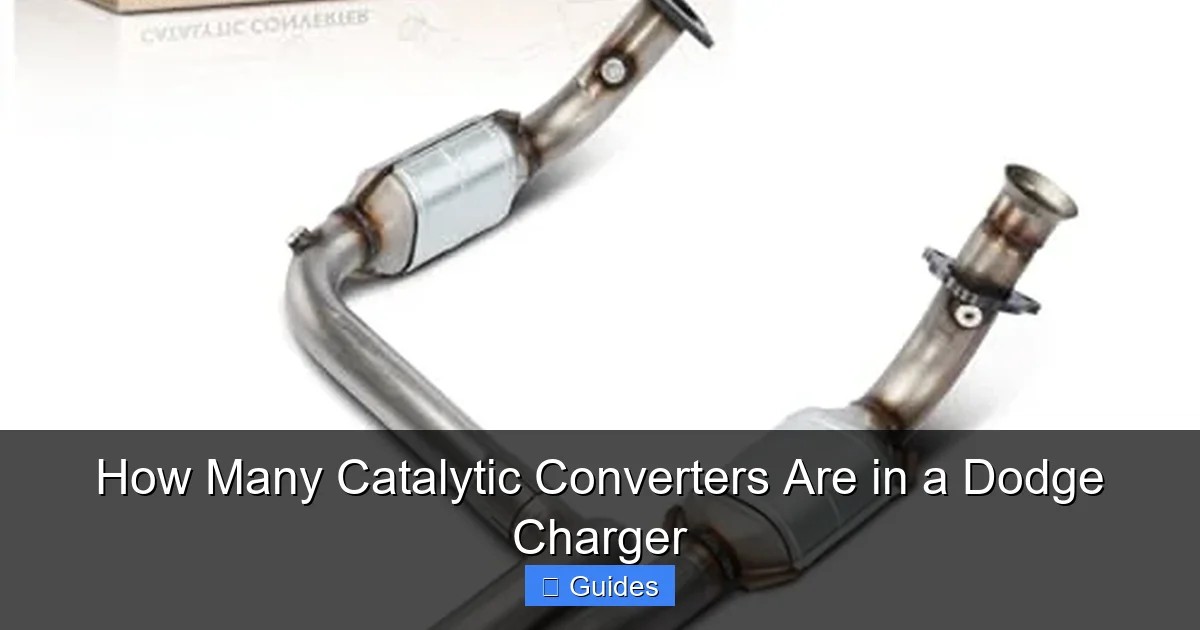
Before diving into the specifics of the Dodge Charger, let’s take a moment to understand what a catalytic converter actually does. Think of it as your car’s personal air filter—but for exhaust gases. When your engine burns fuel, it produces harmful emissions like carbon monoxide, nitrogen oxides, and unburned hydrocarbons. The catalytic converter’s job is to convert these toxic gases into less harmful substances like carbon dioxide, nitrogen, and water vapor before they exit the tailpipe.
This process happens through a chemical reaction facilitated by precious metals—typically platinum, palladium, and rhodium—coated onto a ceramic honeycomb structure inside the converter. These metals act as catalysts, speeding up the conversion without being consumed in the reaction.
Why Are Multiple Catalytic Converters Used?
So why would a car need more than one catalytic converter? The answer lies in engine design and emissions regulations. Modern vehicles, especially performance-oriented ones like the Dodge Charger, often use dual exhaust systems to improve airflow and power output. Each exhaust bank (left and right side of the engine) gets its own catalytic converter to handle the emissions from that side.
Additionally, some vehicles use a pre-catalyst (also called a “warm-up” catalyst) located close to the engine to quickly reduce emissions during cold starts, followed by a main catalytic converter further down the exhaust system. This two-stage approach helps vehicles meet strict emissions standards, especially during the first few minutes of driving when the engine is cold and emissions are highest.
Federal and State Emissions Standards
The number of catalytic converters in your Charger is also influenced by government regulations. Since the Clean Air Act of 1970 and subsequent amendments, automakers have been required to drastically reduce vehicle emissions. The Environmental Protection Agency (EPA) sets national standards, but states like California have even stricter rules under the California Air Resources Board (CARB).
As a result, vehicles sold in CARB-compliant states often have more robust emissions systems—including additional or higher-efficiency catalytic converters. This means a Charger sold in California might have a slightly different setup than one sold in Texas, even if they’re the same model year and trim.
Catalytic Converters by Dodge Charger Engine Type
Visual guide about How Many Catalytic Converters Are in a Dodge Charger
Image source: realtruck.com
Now let’s get into the nitty-gritty: how many catalytic converters your specific Dodge Charger has depends largely on what’s under the hood. Dodge has offered several engine options over the years, and each comes with its own exhaust configuration.
V6 Engines (3.6L Pentastar)
The 3.6L V6 Pentastar engine has been the base engine for the Charger since 2011. It’s a reliable, fuel-efficient option found in trims like the SXT and GT. Most V6 Chargers use a dual exhaust system, meaning there are two exhaust manifolds—one on each side of the engine—each feeding into its own catalytic converter.
So, in a typical V6 Charger, you’ll find two catalytic converters: one on the driver’s side and one on the passenger side, mounted close to the engine. These are often referred to as “manifold catalysts” or “close-coupled catalysts” because they’re positioned right behind the exhaust manifolds to heat up quickly and start reducing emissions as soon as the engine fires up.
Some later model V6 Chargers (especially those built after 2015) may also include a secondary catalytic converter further downstream in the exhaust system, bringing the total to three. However, this is less common and usually depends on the specific model year and emissions certification.
V8 Engines (5.7L HEMI, 6.4L SRT, and 6.2L Supercharged)
If you’re driving a Charger R/T, Scat Pack, or SRT model, chances are you’ve got a V8 under the hood—and that means more power, more exhaust, and more catalytic converters.
The 5.7L HEMI V8, found in the R/T and some Scat Pack models, uses a dual exhaust system with two catalytic converters per side, for a total of four catalytic converters. Here’s how it works: each exhaust manifold has a primary catalytic converter mounted directly behind it (the close-coupled catalyst), and then a secondary catalytic converter further down the mid-pipe. This dual-stage setup ensures maximum emissions reduction, especially under high-load conditions.
The 6.4L SRT V8 and the supercharged 6.2L Hellcat engine follow a similar pattern. These high-output engines produce significantly more exhaust gases, so they require even more robust emissions control. As a result, most SRT and Hellcat Chargers also feature four catalytic converters—two per exhaust bank.
It’s worth noting that some high-performance models may use high-flow catalytic converters to reduce backpressure and maintain power output. These are often made with less restrictive honeycomb structures and higher concentrations of precious metals, allowing for better exhaust flow while still meeting emissions standards.
Special Cases: Police Package and AWD Models
There are a few exceptions to the standard setup. For example, the Dodge Charger Pursuit (the police version) often has a slightly different exhaust configuration due to its unique cooling and performance requirements. Some Pursuit models may use additional heat shielding or modified exhaust routing, but the number of catalytic converters typically remains the same as the civilian version with the same engine.
All-wheel-drive (AWD) Chargers, like the GT AWD, use the same 3.6L V6 engine as their rear-wheel-drive counterparts, so they also have two catalytic converters. The AWD system doesn’t affect the exhaust layout, so the converter count stays consistent.
Model Year Variations: How the Number Has Changed Over Time
Visual guide about How Many Catalytic Converters Are in a Dodge Charger
Image source: cautomods.com
The number of catalytic converters in the Dodge Charger hasn’t stayed static over the years. As emissions standards have tightened and engine technology has advanced, the exhaust system has evolved.
Pre-2011 Models: Simpler Systems
Older Chargers, particularly those from the LX platform era (2006–2010), often had simpler exhaust systems. The 2.7L V6 and 3.5L V6 engines typically used a single catalytic converter mounted in the mid-pipe, especially in base models. However, higher-trim models with dual exhausts sometimes had two converters.
The 5.7L HEMI V8 in pre-2011 Chargers usually had two catalytic converters—one per side—mounted close to the manifolds. These were often larger and less efficient than modern units, but they got the job done for the time.
2011 and Newer: The Shift to Dual Exhaust and More Converters
With the introduction of the refreshed Charger in 2011, Dodge standardized dual exhausts across most trims, even on V6 models. This shift was driven by both performance and emissions goals. Dual exhausts improve exhaust scavenging, which can boost horsepower and torque, while also allowing for more precise emissions control.
As a result, post-2011 Chargers with V6 engines typically have two catalytic converters, while V8 models have four. This trend has continued through the 2023 model year, with only minor tweaks for emissions compliance.
Future Trends: Electrification and the End of the Catalytic Converter?
Looking ahead, the automotive industry is moving toward electrification. Dodge has already announced plans to phase out gasoline-powered Chargers by 2024, with electric successors on the horizon. Once the Charger goes fully electric, catalytic converters will become a thing of the past—at least for this iconic nameplate.
But for now, if you’re driving a gas-powered Charger, you’ve still got one or more catalytic converters working hard to keep your emissions in check.
Where Are the Catalytic Converters Located on a Dodge Charger?
Knowing how many catalytic converters your Charger has is one thing—knowing where they’re located is another. This is important for maintenance, repairs, and theft prevention.
Under the Vehicle: A Quick Visual Guide
Most catalytic converters on the Dodge Charger are located underneath the car, in the exhaust system. Here’s a general breakdown:
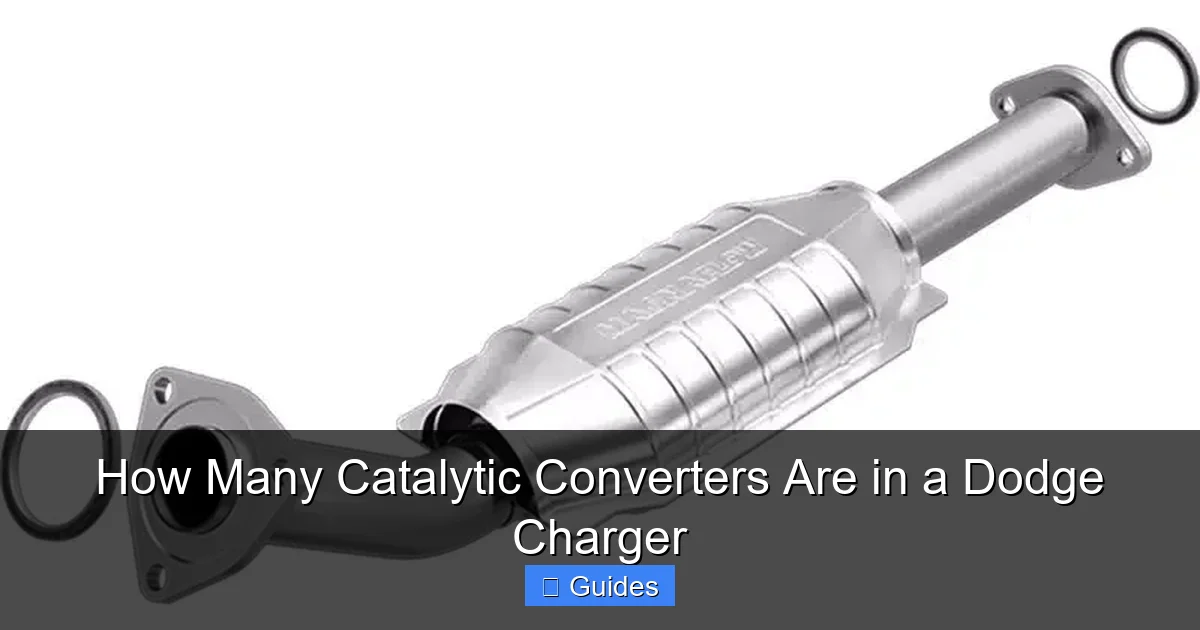
– V6 Models: Two converters, one on each side, mounted just behind the exhaust manifolds. You’ll see them as small, cylindrical or oval-shaped boxes near the front of the undercarriage, close to the engine.
– V8 Models: Four converters total. Two are mounted close to the manifolds (one per side), and two are further back in the mid-pipe, often just before the mufflers.
If you’re looking under your Charger, you’ll typically see the exhaust system running from the engine back toward the rear bumper. The catalytic converters are the metallic boxes with heat shields, usually painted silver or black.
Why Location Matters
The placement of catalytic converters makes them vulnerable to two main issues: damage and theft.
Because they’re mounted underneath the vehicle, they can be hit by road debris, speed bumps, or potholes. A damaged catalytic converter may rattle, reduce performance, or trigger a check engine light.
More concerning is the rise in catalytic converter theft. Thieves target these parts because they contain valuable precious metals. The Dodge Charger, especially V8 models with four converters, is a prime target. The converters are relatively easy to access with a saw or wrench, and a full set can fetch hundreds of dollars on the black market.
Tips to Protect Your Catalytic Converters
– Park in well-lit, secure areas: Avoid leaving your Charger in dimly lit alleys or unmonitored parking lots.
– Install a catalytic converter shield: Aftermarket shields can make it harder for thieves to cut the converters out.
– Engrave your VIN on the converters: This makes them harder to sell and easier to identify if stolen.
– Use a car alarm with tilt sensors: These can detect when someone is jacking up your vehicle.
Signs of a Failing Catalytic Converter
Even with proper care, catalytic converters can fail over time. Here are the most common symptoms to watch for:
Check Engine Light
The most obvious sign is the check engine light. Modern Chargers have oxygen sensors before and after each catalytic converter. If the downstream sensor detects that the converter isn’t reducing emissions effectively, the computer will trigger a trouble code—usually P0420 or P0430, indicating “catalyst system efficiency below threshold.”
Reduced Performance and Fuel Economy
A clogged or failing catalytic converter can restrict exhaust flow, leading to reduced engine power, sluggish acceleration, and poor fuel economy. You might notice your Charger feels “choked” or struggles to reach highway speeds.
Rattling Noise
If you hear a rattling sound from under the car, especially when idling or accelerating, the internal honeycomb structure inside the converter may have broken apart. This is a clear sign the converter needs replacement.
Excessive Heat or Smell
A failing converter may overheat, causing a strong sulfur or rotten egg smell from the exhaust. You might also notice smoke or see the converter glowing red-hot under the car—this is dangerous and should be addressed immediately.
Failed Emissions Test
If your state requires emissions testing, a faulty catalytic converter will almost certainly cause you to fail. High levels of hydrocarbons or carbon monoxide in the exhaust indicate the converter isn’t doing its job.
Replacing a Catalytic Converter: Costs and Options
If your Charger’s catalytic converter fails, replacement is necessary—not just for performance, but for legal compliance. Here’s what you need to know.
OEM vs. Aftermarket
– OEM (Original Equipment Manufacturer): These are direct replacements made by Dodge or Mopar. They’re the most reliable and emissions-legal option, but also the most expensive—typically $1,500 to $3,000+ per converter.
– Aftermarket: Third-party converters are cheaper ($300–$800 each) and widely available. However, not all are legal in every state. California, for example, requires CARB-compliant converters, which are more expensive but necessary for registration.
Used or Reconditioned Converters
Some shops offer used or reconditioned catalytic converters. These can be a cost-effective option, but come with risks. A used converter may have limited life left, and reconditioned units vary in quality. Always buy from a reputable source and check for warranties.
Labor Costs
Replacing a catalytic converter isn’t a DIY job for most people. It requires lifting the vehicle, cutting or unbolting the old unit, and welding or clamping in the new one. Labor costs can range from $200 to $600, depending on the shop and complexity.
Can You Drive with a Bad Catalytic Converter?
Technically, yes—but it’s not recommended. Driving with a failed converter can damage other parts of the exhaust system, reduce fuel efficiency, and cause your car to fail emissions tests. In some states, it’s also illegal.
Conclusion: Know Your Charger’s Emissions System
So, how many catalytic converters are in a Dodge Charger? The answer depends on your engine and model year, but most Chargers have two to four. V6 models typically have two, while V8-powered R/T, Scat Pack, and SRT models usually have four due to their dual exhaust systems and higher emissions output.
Understanding your Charger’s catalytic converter setup isn’t just about technical knowledge—it’s about maintaining performance, staying legal, and protecting your investment. Whether you’re diagnosing a check engine light, planning a repair, or trying to prevent theft, knowing where your converters are and how they work can save you time, money, and headaches.
As the automotive world shifts toward electrification, the days of the catalytic converter may be numbered. But for now, if you’re driving a gas-powered Dodge Charger, those little metal boxes under your car are working hard to keep the air clean and your ride running smoothly.
Frequently Asked Questions
How many catalytic converters does a 2020 Dodge Charger V6 have?
A 2020 Dodge Charger with the 3.6L V6 engine typically has two catalytic converters—one on each side of the engine, mounted behind the exhaust manifolds. Some models may have a third converter further downstream, but two is the most common configuration.
Do all Dodge Chargers have the same number of catalytic converters?
No. The number varies by engine type and model year. V6 models usually have two, while V8 models like the R/T and SRT often have four due to dual exhaust systems and stricter emissions requirements.
Can I replace my catalytic converter myself?
It’s not recommended unless you have welding and exhaust system experience. The job requires lifting the vehicle, cutting or unbolting the old unit, and properly installing the new one. Mistakes can lead to leaks or legal issues.
Why are catalytic converters stolen from Dodge Chargers?
Catalytic converters contain valuable precious metals like platinum, palladium, and rhodium. V8 Chargers with four converters are especially attractive to thieves because they offer a higher payout.
How long do catalytic converters last on a Dodge Charger?
Most catalytic converters last 100,000 to 150,000 miles. However, damage, poor fuel quality, or engine issues can shorten their lifespan. Regular maintenance helps prolong their life.
Is it illegal to drive with a bad catalytic converter?
In many states, yes—especially if your vehicle fails emissions tests. Even if it’s not illegal, a failed converter can reduce performance, damage the engine, and increase emissions.

At CarLegit, we believe information should be clear, factual, and genuinely helpful. That’s why every guide, review, and update on our website is created with care, research, and a strong focus on user experience.