
The GMC Sierra 1500 offers a towing capacity ranging from 6,500 to 11,500 pounds, depending on engine, drivetrain, and optional packages. With proper configuration—like the Max Trailering Package and 3.0L Duramax diesel—you can unlock its highest towing potential for trailers, boats, and campers.
In This Article
- 1 Key Takeaways
- 2 📑 Table of Contents
- 3 What Is the Towing Capacity of GMC Sierra 1500?
- 4 Understanding Towing Capacity: What It Means and Why It Matters
- 5 Engine Options and Their Impact on Towing Capacity
- 6 Key Towing Packages and Options
- 7 Cab and Bed Configurations: How They Affect Towing
- 8 Safety Tips for Maximizing Towing Performance
- 9 Conclusion
- 10 Frequently Asked Questions
Key Takeaways
- Towing capacity varies by model year and configuration: The GMC Sierra 1500’s towing ability ranges from 6,500 to 11,500 pounds, with newer models (2020–2024) generally offering higher capacities.
- Engine choice is critical: The 3.0L Duramax turbo-diesel I6 delivers the highest towing capacity, while the 2.7L turbocharged four-cylinder offers a strong balance of power and efficiency.
- Max Trailering Package boosts performance: This optional package includes cooling upgrades, hitch guidance, and enhanced suspension to safely handle heavier loads.
- Rear-wheel drive vs. four-wheel drive matters: RWD configurations typically allow for higher towing than 4WD due to reduced weight and better weight distribution.
- Payload and tongue weight affect safety: Always consider your truck’s payload capacity and ensure proper trailer tongue weight (10–15% of total trailer weight) for stable towing.
- Technology enhances towing confidence: Features like the ProGrade Trailering System, HD Rear Vision Camera, and Trailer Side Blind Zone Alert make towing easier and safer.
- Regular maintenance is essential: Keep your transmission, brakes, and cooling system in top shape to maintain optimal towing performance over time.
📑 Table of Contents
- What Is the Towing Capacity of GMC Sierra 1500?
- Understanding Towing Capacity: What It Means and Why It Matters
- Engine Options and Their Impact on Towing Capacity
- Key Towing Packages and Options
- Cab and Bed Configurations: How They Affect Towing
- Safety Tips for Maximizing Towing Performance
- Conclusion
What Is the Towing Capacity of GMC Sierra 1500?
If you’re in the market for a full-size pickup truck that blends luxury, capability, and everyday usability, the GMC Sierra 1500 is a top contender. Known for its refined interior, advanced technology, and strong performance, the Sierra 1500 isn’t just about looking good—it’s built to work hard. One of the most important factors for truck buyers is towing capacity. Whether you’re hauling a camper across the country, pulling a boat to the lake, or transporting equipment for a job, knowing how much your truck can safely tow is crucial.
So, what is the towing capacity of GMC Sierra 1500? The answer isn’t one-size-fits-all. It depends on several factors: the engine under the hood, the drivetrain, cab and bed configuration, and whether you’ve equipped your truck with towing-enhancing packages. Across recent model years (2020–2024), the Sierra 1500 can tow anywhere from 6,500 pounds up to an impressive 11,500 pounds when properly configured. That’s a wide range, and understanding what influences it will help you choose the right setup for your needs.
In this guide, we’ll break down everything you need to know about the GMC Sierra 1500’s towing capacity. We’ll explore how different engines affect towing, which packages boost performance, and how to safely maximize your truck’s capabilities. Whether you’re a weekend warrior or a full-time hauler, this article will give you the knowledge to tow with confidence.
Understanding Towing Capacity: What It Means and Why It Matters
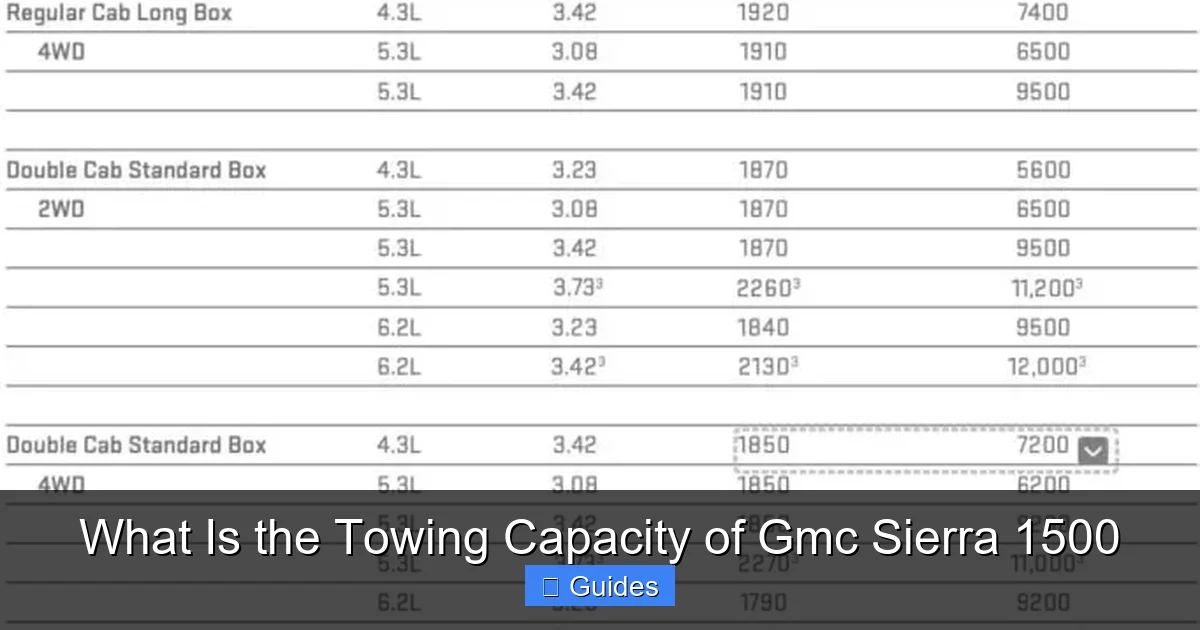
Visual guide about What Is the Towing Capacity of Gmc Sierra 1500
Image source: tailoredtrucks.com
Before diving into the specifics of the GMC Sierra 1500, it’s important to understand what “towing capacity” actually means. Simply put, towing capacity is the maximum weight your vehicle can safely pull behind it, including the trailer, cargo, passengers, and fluids. This number is determined by the manufacturer through rigorous testing and engineering analysis, taking into account the truck’s frame strength, engine power, transmission, cooling system, brakes, and suspension.
Why does this matter? Exceeding your truck’s towing capacity can lead to serious safety risks—loss of control, brake failure, transmission overheating, or even structural damage to the vehicle. It can also void your warranty and increase the likelihood of accidents. That’s why it’s essential to know your truck’s limits and never push beyond them.
The GMC Sierra 1500 is designed with towing in mind. From its high-strength steel frame to its available advanced trailering tech, GMC engineers have built this truck to handle real-world demands. But again, the actual towing capacity varies. For example, a base model with a 2.7L engine and rear-wheel drive might tow around 6,500 pounds, while a fully loaded Denali with the 3.0L Duramax diesel and Max Trailering Package can reach up to 11,500 pounds. That’s nearly double the capacity—all within the same truck lineup.
How GMC Determines Towing Ratings
GMC uses a standardized testing process to determine towing capacity, following guidelines set by the Society of Automotive Engineers (SAE). This ensures consistency and reliability across different models and configurations. The testing includes real-world scenarios like uphill towing, high-speed highway driving, and stop-and-go traffic to simulate actual use.
Key factors in the testing include:
- Engine output and torque: Higher torque at lower RPMs helps with pulling heavy loads from a stop.
- Transmission cooling: Heavy towing generates heat; a robust cooling system prevents overheating.
- Brake system performance: Larger trailers require more stopping power, so brake size and cooling matter.
- Frame and suspension strength: The truck must maintain stability and control under load.
- Aerodynamics and weight distribution: Trailers can create drag and sway, so design plays a role.
All of these elements are considered when GMC assigns a towing capacity to each Sierra 1500 configuration. This means the number you see on the window sticker or in the brochure isn’t just a guess—it’s a tested, verified limit.
Real-World Towing Scenarios
Let’s put this into perspective with some practical examples. If you’re towing a small utility trailer with landscaping supplies, a 6,500-pound capacity is more than enough. But if you’re pulling a 30-foot travel trailer with a family of four, a boat, and gear, you’ll likely need something closer to 10,000 pounds or more.
Here’s a quick breakdown of common towing needs:
- Small trailers (e.g., utility, motorcycle): 1,000–3,000 lbs – easily handled by any Sierra 1500.
- Medium trailers (e.g., small camper, fishing boat): 4,000–7,000 lbs – requires mid-range towing capacity.
- Large trailers (e.g., travel trailer, pontoon boat, horse trailer): 8,000–11,500 lbs – needs the highest towing configuration.
Knowing your typical towing needs will help you choose the right engine and options. Don’t overbuy, but also don’t underestimate your future needs—upgrading later can be costly.
Engine Options and Their Impact on Towing Capacity

Visual guide about What Is the Towing Capacity of Gmc Sierra 1500
Image source: tailoredtrucks.com
The engine is the heart of any truck, and in the case of the GMC Sierra 1500, it plays a major role in determining towing capacity. GMC offers several engine choices across the Sierra 1500 lineup, each with different power outputs, fuel types, and towing capabilities. Let’s take a closer look at the available engines and how they affect your truck’s ability to tow.
2.7L Turbocharged Four-Cylinder Engine
The 2.7L turbocharged I4 is the base engine for many Sierra 1500 models, especially in the SLE and SLT trims. It produces around 310 horsepower and 430 lb-ft of torque—impressive numbers for a four-cylinder. Thanks to its turbocharging, it delivers strong low-end torque, which is ideal for towing.
This engine typically allows for a towing capacity of up to 7,000–7,500 pounds when properly equipped. That’s more than enough for small to medium trailers, including pop-up campers, small boats, and utility trailers. It’s also one of the most fuel-efficient options in the lineup, making it a great choice for daily drivers who occasionally tow.
One thing to note: while the 2.7L is capable, it doesn’t have the same cooling capacity or long-term durability under heavy loads as larger engines. If you plan to tow frequently or over long distances, especially in hot climates or mountainous terrain, you might want to consider a more robust option.
5.3L V8 Engine
The 5.3L EcoTec3 V8 is a popular upgrade, offering a balance of power, reliability, and efficiency. It generates about 355 horsepower and 383 lb-ft of torque. This engine is available across most trims and is often paired with the Max Trailering Package.
With the 5.3L V8, the Sierra 1500 can tow between 9,000 and 11,000 pounds, depending on configuration. This makes it suitable for larger travel trailers, mid-sized boats, and even small fifth-wheel campers. The V8’s larger displacement and natural aspiration provide consistent power delivery, which is helpful when climbing hills or towing in windy conditions.
This engine is a solid all-around choice for buyers who want strong towing without stepping up to diesel. It’s also compatible with GMC’s advanced trailering features, including trailer brake controllers and integrated sway control.
3.0L Duramax Turbo-Diesel I6 Engine
For maximum towing capacity, the 3.0L Duramax turbo-diesel inline-six is the top performer in the Sierra 1500 lineup. It delivers 305 horsepower and a whopping 495 lb-ft of torque—more than any other engine in the range. Diesel engines are known for their high torque at low RPMs, which is perfect for pulling heavy loads from a standstill.
When equipped with the Max Trailering Package and rear-wheel drive, the 3.0L Duramax can tow up to 11,500 pounds—the highest rating for the Sierra 1500. This makes it ideal for large travel trailers, horse trailers, and heavy equipment. It also offers excellent fuel economy for a full-size truck, often achieving over 25 mpg on the highway.
The diesel engine does come with a higher upfront cost and requires diesel fuel, which can be more expensive and less available in some areas. It also needs regular maintenance, including diesel particulate filter (DPF) regeneration. But for serious towers, the performance and efficiency gains are worth it.
6.2L V8 Engine (Limited Availability)
The 6.2L EcoTec3 V8 is the most powerful gasoline engine offered in the Sierra 1500, producing 420 horsepower and 460 lb-ft of torque. While it’s not as torquey as the diesel, it delivers thrilling acceleration and a deep, satisfying exhaust note.
This engine is typically found in high-end trims like the AT4 and Denali. With the right setup, it can tow up to 11,000 pounds—just slightly less than the diesel. It’s a great choice if you want maximum horsepower and a traditional gasoline experience, but it comes at the cost of lower fuel economy and higher emissions.
Key Towing Packages and Options

Visual guide about What Is the Towing Capacity of Gmc Sierra 1500
Image source: tailoredtrucks.com
Engine choice is important, but it’s not the only factor that determines towing capacity. GMC offers several optional packages and features designed to enhance towing performance, safety, and convenience. These can make a significant difference in how much your Sierra 1500 can safely pull.
Max Trailering Package
The Max Trailering Package is the most important upgrade for anyone planning to tow near the upper limits of the Sierra 1500’s capacity. This package is available on most trims and includes a suite of enhancements:
- Enhanced cooling system: Upgraded radiator, transmission cooler, and engine oil cooler to prevent overheating.
- Heavy-duty suspension: Reinforced rear springs and shocks for better load management.
- Trailer brake controller: Integrated into the dashboard for precise brake control.
- Hitch guidance system: Uses the rear camera to help align the hitch with the trailer.
- Increased GVWR (Gross Vehicle Weight Rating): Allows the truck to carry more weight overall.
With the Max Trailering Package, even the 5.3L V8 can reach up to 11,000 pounds of towing capacity. It’s almost essential for anyone planning to tow large trailers regularly.
ProGrade Trailering System
This isn’t a package per se, but a collection of smart towing technologies that make the process easier and safer. Key features include:
- HD Rear Vision Camera with Trailering Views: Offers multiple camera angles, including a “hitch view” to help with alignment.
- Trailer Side Blind Zone Alert: Warns you when a vehicle is in your blind spot—especially useful with long trailers.
- Trailer Tire Pressure Monitoring: Alerts you if a trailer tire is underinflated.
- Integrated Trailer Brake Controller: Lets you adjust brake force from inside the cab.
- Trailer Theft Alert: Notifies you if your trailer is moved without authorization.
These features don’t increase towing capacity, but they significantly improve safety and reduce stress when towing.
Four-Wheel Drive vs. Rear-Wheel Drive
Drivetrain choice also affects towing. Rear-wheel drive (RWD) configurations typically allow for higher towing capacity than four-wheel drive (4WD) because they are lighter and have better weight distribution. The extra components in 4WD (transfer case, front differential, etc.) add weight and can reduce payload and towing ability.
For example, a RWD Sierra 1500 with the 3.0L diesel might tow 11,500 pounds, while the same truck in 4WD might be limited to 11,000 pounds. If maximum towing is your priority, RWD is usually the better choice—unless you need 4WD for off-road or winter driving.
Cab and Bed Configurations: How They Affect Towing
The physical layout of your Sierra 1500—specifically the cab style and bed length—also plays a role in towing capacity. GMC offers three main cab configurations:
- Regular Cab: Two doors, seating for two or three. Offers the longest bed (8 feet) but limited passenger space.
- Double Cab: Four doors with smaller rear seats. Bed length is typically 6.5 feet.
- Crew Cab: Four full-size doors with spacious rear seating. Bed length is 5.5 or 6.5 feet.
In general, Regular Cab models have the highest towing capacity because they are lighter and have a longer wheelbase, which improves stability. Crew Cab models, while more comfortable for passengers, are heavier and may have slightly lower towing ratings.
Bed length affects how you load and secure your trailer. A longer bed provides more space for gear and can improve weight distribution, but it also adds weight. Most buyers opt for the Crew Cab for its versatility, even if it means a small reduction in towing capacity.
Safety Tips for Maximizing Towing Performance
Knowing your truck’s towing capacity is only half the battle. To tow safely and effectively, you need to follow best practices and maintain your vehicle properly.
Check Your Payload Capacity
Towing capacity isn’t the only number to watch. Your truck also has a payload capacity—the total weight it can carry, including passengers, cargo, and the tongue weight of the trailer. Exceeding payload can damage your suspension and affect handling.
Always calculate:
- Passenger and driver weight
- Cargo in the cab and bed
- Tongue weight (10–15% of trailer weight)
If the total exceeds your payload rating, you may need to reduce load or upgrade your truck.
Use the Right Hitch and Weight Distribution
For trailers over 5,000 pounds, a weight-distributing hitch is recommended. It helps balance the load between the truck and trailer, reducing sway and improving control. Make sure your hitch is rated for the trailer’s weight.
Inspect and Maintain Your Truck
- Check tire pressure and condition regularly.
- Change transmission fluid and coolant as recommended.
- Inspect brakes and replace worn pads.
- Ensure trailer lights and brakes are working.
Practice Safe Driving Habits
- Allow extra stopping distance.
- Avoid sudden lane changes or sharp turns.
- Use lower gears when descending hills.
- Check mirrors frequently and use blind-spot alerts.
Conclusion
The GMC Sierra 1500 is a versatile and capable full-size pickup that can handle a wide range of towing tasks. Its towing capacity ranges from 6,500 to 11,500 pounds, depending on engine, drivetrain, and optional packages. The 3.0L Duramax diesel with the Max Trailering Package delivers the highest performance, making it ideal for heavy-duty towing.
But capacity is only part of the equation. To tow safely and confidently, you need the right configuration, proper equipment, and good driving habits. Whether you’re pulling a small trailer or a full-sized camper, the Sierra 1500 has the power, technology, and refinement to get the job done.
When shopping for a Sierra 1500, consider your typical towing needs, future plans, and driving conditions. Don’t just focus on the highest number—focus on the right setup for your lifestyle. With the right knowledge and preparation, your GMC Sierra 1500 can be a reliable partner for years of adventures and hard work.
Frequently Asked Questions
What is the highest towing capacity for a GMC Sierra 1500?
The highest towing capacity for a GMC Sierra 1500 is 11,500 pounds. This is achieved with the 3.0L Duramax turbo-diesel engine, rear-wheel drive, and the Max Trailering Package.
Can a GMC Sierra 1500 tow a travel trailer?
Yes, the GMC Sierra 1500 can tow most travel trailers, especially when equipped with the 5.3L V8 or 3.0L diesel engine. Always check your specific trailer’s weight and ensure it’s within your truck’s capacity.
Does four-wheel drive reduce towing capacity?
Yes, four-wheel drive typically reduces towing capacity by a few hundred pounds compared to rear-wheel drive due to added weight and mechanical components.
What is the Max Trailering Package?
The Max Trailering Package includes enhanced cooling, heavy-duty suspension, trailer brake controller, and hitch guidance to safely increase towing capacity and improve performance.
How do I calculate my truck’s payload when towing?
Add the weight of passengers, cargo, and trailer tongue weight (10–15% of trailer weight). This total must not exceed your truck’s payload capacity, found on the door jamb sticker.
Is the 2.7L engine good for towing?
Yes, the 2.7L turbocharged four-cylinder is capable of towing up to 7,500 pounds. It’s efficient and strong for light to moderate towing, but may struggle with very heavy loads over long distances.

At CarLegit, we believe information should be clear, factual, and genuinely helpful. That’s why every guide, review, and update on our website is created with care, research, and a strong focus on user experience.