
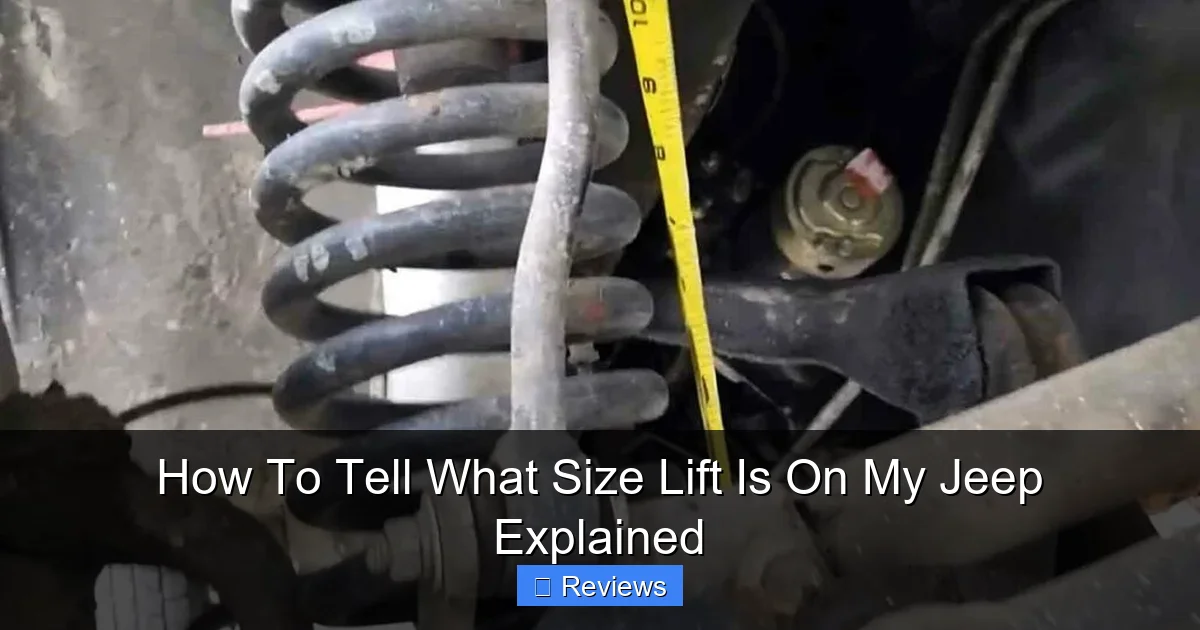
Featured image for how to tell what size lift is on my jeep
Image source: jeepmaven.com
Accurately determining your Jeep’s lift size requires precise measurement, not just a visual assessment. You’ll need to measure key points like the distance from the wheel hub center to the fender flare, comparing these figures against stock specifications for your specific model. Also, inspect for aftermarket lift components such as taller springs or blocks, which provide clear evidence of a modification.
Welcome to the world of Jeeps, where customization is not just a hobby, but a way of life! If you’ve recently acquired a used Jeep, inherited one, or are simply curious about the modifications on your current rig, one of the most common questions that arises is: “How do I tell what size lift is on my Jeep?” This isn’t just about satisfying curiosity; knowing your Jeep’s lift size is critical for everything from safe operation and future upgrades to understanding its capabilities and ensuring proper maintenance. A lift kit dramatically alters a vehicle’s geometry and performance, and without knowing the specifics, you could be making blind decisions that impact safety and ride quality.
The journey to uncover your Jeep’s lift size can seem daunting, especially with the myriad of aftermarket components available. Is it a modest 1-inch spacer lift, a robust 4-inch long-arm suspension system, or perhaps a combination of both? Identifying the specific type and magnitude of the lift can save you headaches, money, and potential mechanical issues down the road. Whether you’re planning to install larger tires, upgrade your suspension components, or simply need to replace worn parts, having accurate information about your Jeep’s current setup is the foundational first step.
This comprehensive guide will walk you through various methods, from simple visual inspections to detailed measurements and component identification, providing you with the knowledge and tools to accurately determine the lift size on your Jeep. We’ll delve into the nuances of different lift types, offer practical tips, and even provide valuable reference data to help you compare your findings. By the end of this explanation, you’ll be well-equipped to confidently answer the question of your Jeep’s true stature.
In This Article
- 1 Key Takeaways
- 2 Why Knowing Your Jeep’s Lift Size Matters (and What Kind of Lift It Is)
- 3 Method 1: The Visual Inspection – A Quick First Assessment
- 4 Method 2: The Definitive Measurement – Comparing to Stock Specifications
- 5 Method 3: Searching for Clues – Aftermarket Components and Documentation
- 6 Method 4: Consulting the Community and Experts – Forums and Mechanics
- 7 Common Stock Jeep Measurements By Model (Reference Data Table)
- 8 Conclusion
- 9 Frequently Asked Questions
- 9.1 How can I determine the size lift on my Jeep?
- 9.2 What’s the best method to measure the actual size lift on my Jeep?
- 9.3 Can I identify the size lift on my Jeep just by looking at the suspension components?
- 9.4 Where can I find the factory stock height specifications for my Jeep model to compare my measurements?
- 9.5 Are there common lift sizes for Jeeps, and how do they generally affect the vehicle?
- 9.6 Do I need any special tools to measure the size lift on my Jeep?
Key Takeaways
- Measure Hub-to-Fender: Compare your Jeep’s hub-to-fender measurement to stock specifications.
- Inspect Coil Springs: Look for aftermarket coil springs; they are often longer than stock.
- Identify Spacers/Blocks: Check above coil springs or between leaf springs for lift spacers or blocks.
- Examine Control Arms: Aftermarket control arms, especially adjustable ones, signal a lift kit.
- Check Shock Absorbers: Longer, aftermarket shock absorbers are essential components of a lift.
- Review Lift Component Brands: Look for common lift kit brand names stamped on springs, shocks, or arms.
- Consult Stock Specifications: Always compare your Jeep’s current measurements against factory stock heights.
Why Knowing Your Jeep’s Lift Size Matters (and What Kind of Lift It Is)
Before diving into the “how-to,” it’s crucial to understand why identifying your Jeep’s lift size is so important. This isn’t just a trivial detail; it impacts nearly every aspect of your vehicle’s performance, safety, and future modification potential. Furthermore, understanding the fundamental differences between types of lifts will inform your investigation.
Safety and Performance Implications
- Handling Characteristics: A lifted Jeep handles differently than a stock one. Knowing the lift size helps you anticipate changes in center of gravity, steering response, and stability, especially at higher speeds or during off-road maneuvers. Too much lift without proper correction can lead to dangerous handling.
- Tire Clearance: The primary reason for many lifts is to accommodate larger tires. Knowing your lift size directly correlates with the maximum safe tire size you can run without rubbing or interference, preventing damage to fenders and suspension components.
- Component Wear: Lift kits, particularly larger ones, can put added stress on driveline angles, steering components, and suspension bushings. Being aware of your lift size allows you to monitor these critical areas for premature wear and plan for necessary upgrades like stronger control arms, driveshafts, or steering components.
- Braking and Suspension Geometry: Lifts can alter brake line length, shock travel, and control arm angles. Understanding the lift ensures that these critical systems are functioning within safe parameters and that all necessary extensions or corrections (e.g., extended brake lines, track bar relocation brackets) have been implemented.
Future Upgrades and Modifications
- Selecting Compatible Parts: Planning to add a winch, a heavy bumper, or more sophisticated suspension components? You need to know your current lift size to choose parts that are compatible and won’t negatively impact your Jeep’s stance or performance. For instance, if you have a 2-inch lift and want to go to 4 inches, you’ll need a different set of components than if you started from stock.
- Avoiding Over-Lifting: Stacking lifts (e.g., adding a 2-inch spacer on top of a 3-inch suspension lift without proper planning) can lead to severe geometric issues, poor ride quality, and component failure. Knowing your starting point prevents this.
- Tuning and Ride Quality: If your Jeep rides poorly, identifying the lift components is the first step in diagnosing issues. Knowing if it’s a budget spacer lift or a premium coil-over system helps in deciding what to upgrade or adjust for better comfort and control.
Understanding Different Lift Types
There are two primary categories of lifts you’ll encounter on a Jeep:
- Suspension Lifts: These directly modify the suspension components to increase ground clearance and fender height.
- Coil Spring Lifts: Replace stock coil springs with longer, often stiffer, aftermarket springs. Common on Wrangler JK, JL, TJ, YJ, and Grand Cherokee WJ, ZJ.
- Leaf Spring Lifts: Replace stock leaf springs with arched aftermarket springs, or add “add-a-leafs” (AAL) or “shackle lifts” to existing leaf spring packs. Common on Wrangler YJ and Cherokee XJ.
- Spacer Lifts (Budget Boosts): Urethane or aluminum spacers are placed above the coil springs (front) and/or below them (rear) to gain height without replacing the springs themselves. Less common with leaf springs, but shackle lifts achieve a similar effect.
- Coilover Lifts: High-performance systems where the coil spring and shock absorber are integrated into a single unit, offering superior adjustability and dampening.
- Long-Arm Lifts: For significant height increases (typically 4 inches or more), long control arms replace the shorter stock arms. These move the frame mounting points further back, improving suspension geometry for better ride quality and articulation.
- Body Lifts: These raise the vehicle’s body independent of the frame, without changing suspension geometry or ground clearance.
- Blocks (usually made of pucks of poly or aluminum) are inserted between the body mounts and the frame. This provides clearance for larger tires by raising the fenders, but does not increase differential or axle clearance.
- Common sizes range from 1 to 2 inches. Body lifts require extensions for steering shafts, shifter linkages, and sometimes brake lines or wiring harnesses.
A Jeep might have one or both types of lifts. For example, a “3-inch lift” could be a 3-inch suspension lift, or a 2-inch suspension lift combined with a 1-inch body lift. Accurately identifying both types is crucial.
Method 1: The Visual Inspection – A Quick First Assessment
Often, the first clue to a lifted Jeep comes from a simple visual assessment. While this method won’t give you exact measurements, it can quickly tell you if a lift is present and provide initial hints about its nature. This is your reconnaissance mission.
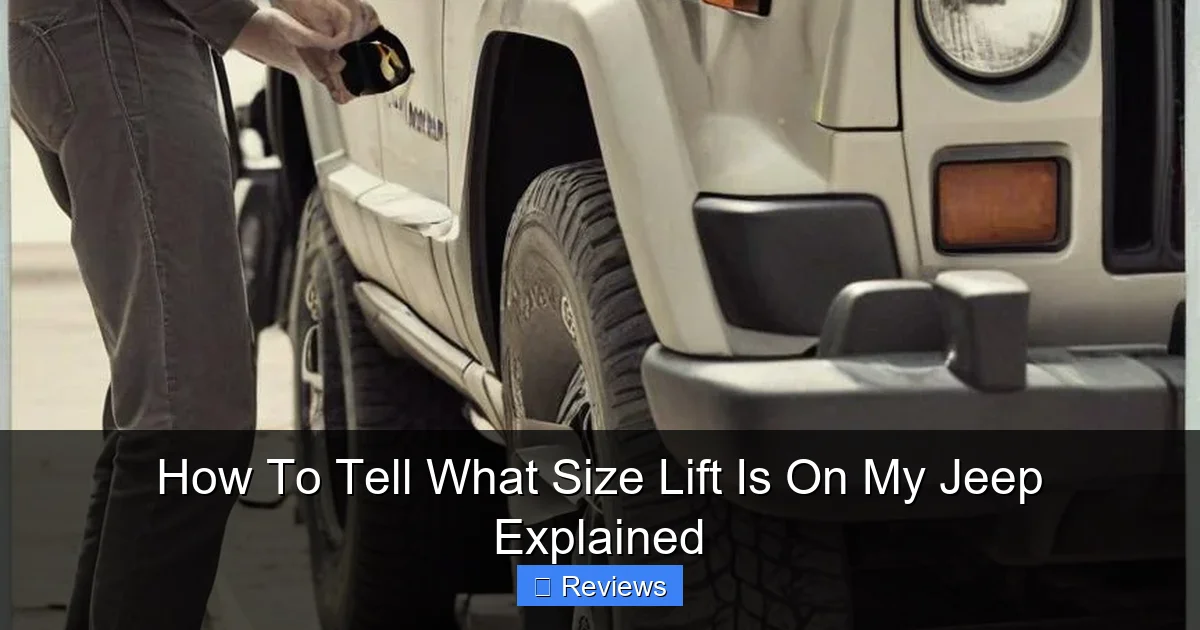
Visual guide about how to tell what size lift is on my jeep
Image source: motorcurious.com
Examining Coil Springs and Leaf Springs
- Coil Springs:
- Color: Stock Jeep coil springs are typically black. If you see springs that are red, blue, yellow, or another distinct color, they are almost certainly aftermarket. Aftermarket springs are generally longer and often have a different wire diameter or coil count than stock.
- Length and Spacing: Visually compare the length of your coil springs to what you know (or can easily look up) to be stock for your specific Jeep model. Longer springs indicate a suspension lift. Also, look at the spacing between the coils; aftermarket springs might have different winding patterns.
- Spacers: Look for large, solid pucks (often black urethane or aluminum) sitting directly on top of (front) or below (rear) the coil springs. These are coil spring spacers, indicating a “budget boost” or a supplementary lift component. Measure their thickness; this directly contributes to the lift height.
- Leaf Springs (Cherokee XJ, Wrangler YJ):
- Arch: Aftermarket leaf springs designed for lift will have a more pronounced upward arch compared to worn-out or stock springs.
- Number of Leaves: Some lift kits add extra leaves to the spring pack (“add-a-leaf”). Count the individual leaves and compare to stock specifications for your model.
- Shackles: Look at the rear shackles (the links connecting the leaf spring to the frame). Aftermarket lift shackles are typically much longer than stock. Measure the difference in length between the bolt holes of your shackle and what you find for stock. This difference contributes to the lift. For every inch of added shackle length (pivot-to-pivot), you typically get about half an inch of lift due to the geometry.
Looking for Aftermarket Control Arms and Shocks
- Control Arms: These link your axles to the frame. Stock control arms are usually relatively thin, stamped steel. Aftermarket control arms, especially for 2.5 inches of lift or more, are often much beefier, made from thicker tubing, and may be adjustable. Adjustable control arms have threaded ends that allow you to change their length. They might also have different colored bushings.
- Shock Absorbers: Like coil springs, aftermarket shocks are frequently brightly colored (e.g., yellow Bilstein, white/red Rancho, silver Fox) and often have larger diameter bodies or external reservoirs. They will also be longer than stock shocks to accommodate the increased suspension travel from a lift. Look for brand names printed on the shock body.
- Track Bar: The track bar (front and rear) keeps the axle centered under the Jeep. With a lift, the stock track bar often needs to be replaced with an adjustable one or relocated using a bracket. Look for an aftermarket, usually beefier and adjustable, track bar, or a bracket mounted to the axle or frame that lowers the track bar’s mounting point.
Checking for Body Lift Blocks
A body lift is one of the easiest to spot visually:
- Look between the Jeep’s frame and the body. You’ll see distinct blocks (pucks) of material, usually black urethane or aluminum, inserted at each body mount point.
- These blocks will be visible in the gap between the bumper and the frame, or between the rocker panel and the frame.
- Measure the height of these blocks; this is the exact body lift amount (e.g., 1 inch, 1.25 inches, 2 inches).
- Also, inspect the steering shaft. With a body lift, a steering shaft extension or an adjustable shaft will be present to accommodate the increased distance between the steering box (on the frame) and the steering column (on the body).
Identifying Drop Brackets and Spacers
- Transfer Case Drop: For older Jeeps (e.g., TJ, XJ) with lifts, you might see spacers between the transfer case skid plate and the frame. These lower the transfer case to correct driveline angles and reduce vibrations. Measure these spacers.
- Bump Stop Extensions: These are usually plastic or metal blocks/extensions mounted on the axle or frame that limit upward suspension travel, preventing tires from rubbing fenders with larger tires. Their presence and length can indicate a lift.
- Sway Bar End Links: Lifted Jeeps require longer sway bar end links to maintain proper sway bar angle. Compare the length of yours to stock images or measurements.
Method 2: The Definitive Measurement – Comparing to Stock Specifications
While visual inspection gives you a good starting point, nothing beats actual measurements when trying to pinpoint your Jeep’s lift size. This method involves carefully measuring various points on your Jeep and comparing them to its original factory specifications. This is the most accurate way to identify the lift size on your Jeep.
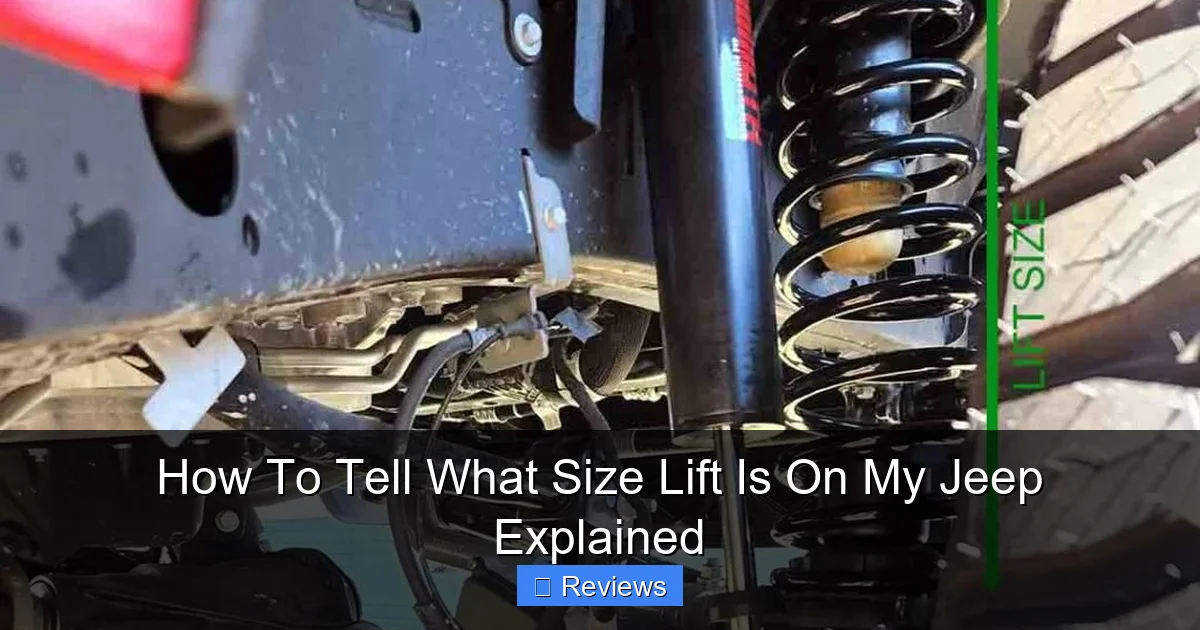
Visual guide about how to tell what size lift is on my jeep
Image source: jeepmaven.com
Gathering Your Tools
- Tape Measure: A good, sturdy, retractable tape measure.
- Pen and Paper: To record your measurements.
- A Level Surface: Crucial for accurate measurements. Park your Jeep on a flat, even surface (e.g., a garage floor, level concrete pad).
- Full Fuel Tank: Or as close to full as possible to account for the weight.
- Standard Tire Pressure: Ensure tires are inflated to the manufacturer’s recommended pressure.
- Empty Vehicle: Remove any heavy cargo or passengers.
- Vehicle Settled: Gently rock the Jeep side-to-side a few times after parking to let the suspension settle.
Measuring Fender-to-Ground (FTG) Height
This is a common and straightforward measurement, but it can be influenced by tire size.
- Locate the center of the wheel hub on each wheel.
- Measure from the ground up to the bottom edge of the fender flare, directly above the center of the wheel hub.
- Record these measurements for all four corners (Front Driver, Front Passenger, Rear Driver, Rear Passenger).
- Example: If your Jeep’s stock FTG was 38 inches and you measure 41 inches, you have roughly a 3-inch increase. Remember, this includes tire size differences.
Measuring Frame-to-Ground (FTG) Height
This measurement gives you actual ground clearance for the frame, independent of tire size (though tires do raise the frame overall).
- Choose a consistent point on the frame, such as directly under the front or rear doors, or at a specific crossmember.
- Measure from the ground to the bottom edge of the frame rail at this point.
- Again, record for both sides if possible.
Measuring Hub-to-Fender (HTF) Height – The Most Reliable Suspension Lift Measurement
This is the gold standard for determining suspension lift because it effectively cancels out variations in tire size, tire pressure, and minor terrain inconsistencies. It measures the distance between the center of the wheel hub and the bottom edge of the fender flare.
- Locate the exact center of the wheel hub (often marked by the center cap).
- Measure straight up from this point to the bottom edge of the fender flare, ensuring the tape measure is perfectly vertical.
- Record these measurements for all four corners: Front Driver, Front Passenger, Rear Driver, Rear Passenger.
- The Calculation: Once you have your HTF measurements, subtract the known *stock* HTF measurement for your specific Jeep model and year from your current measurement.
- Example: If a stock Jeep Wrangler JK front HTF is typically 20 inches, and your measurement is 23 inches, you have approximately a 3-inch suspension lift in the front. Repeat for the rear.
Comparing Your Measurements to OEM Stock Specs (Crucial Step)
This is where the rubber meets the road. You need reliable stock measurements for your specific Jeep model, year, and trim level. These can vary slightly between two-door and four-door Wranglers, or between different engine options and packages (e.g., Rubicon vs. Sport). Online forums, manufacturer specifications, and dedicated Jeep resources are excellent places to find this data. I’ll provide a reference table later, but always try to verify with multiple sources for your exact model.
Important Consideration: Over time, stock springs can sag, especially on older Jeeps or those that have carried heavy loads. So, if your measurement is slightly *below* published stock measurements, it might indicate worn springs rather than a negative lift!
Method 3: Searching for Clues – Aftermarket Components and Documentation
Sometimes, the lift size isn’t immediately obvious from measurements alone, or you want to confirm your findings. This method focuses on identifying specific aftermarket components and leveraging any available documentation related to the Jeep’s history. These clues can tell you not just the lift height, but also the quality and brand of the lift kit.
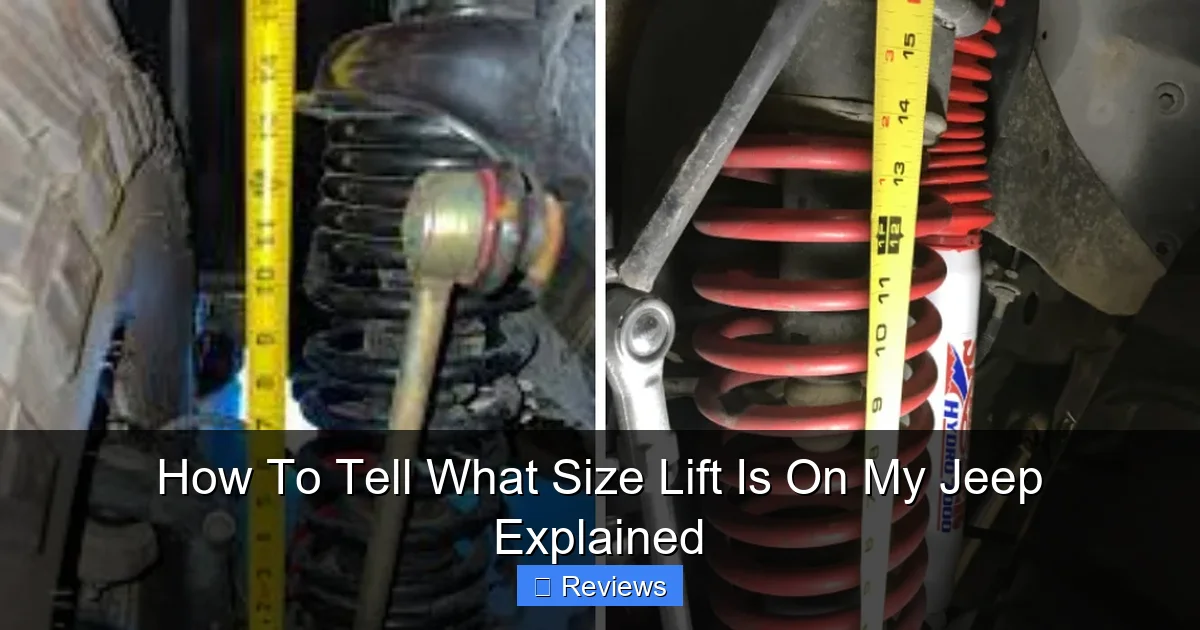
Visual guide about how to tell what size lift is on my jeep
Image source: jeepfixes.com
Identifying Aftermarket Shock Absorbers
- Brand Names: Most quality aftermarket shocks have their brand name (e.g., FOX, Bilstein, Rancho, Old Man Emu, King, Skyjacker) prominently displayed on the body. This is a huge clue, as you can then look up “FOX 2.5-inch lift shocks for Jeep JK” to confirm.
- Part Numbers: Even better, many shocks have a part number printed on a sticker or etched into the body. Searching this part number online will often directly lead you to the specific lift kit or shock application it’s designed for.
- Color and Design: As mentioned in visual inspection, distinctive colors (yellow for Bilstein, silver/blue for FOX, white for Rancho, etc.) are dead giveaways. Also, look for features like external reservoirs or adjustable settings, which are common on higher-end lift-specific shocks.
Locating Branding on Coil Springs, Leaf Springs, or Control Arms
- Coil Springs: Some aftermarket coil springs will have a color code, a small tag, or even the brand name painted on them. Look closely at the top and bottom coils.
- Leaf Springs: Aftermarket leaf springs often have metal tags bolted to the spring pack with brand names or part numbers.
- Control Arms and Other Linkages: Higher quality aftermarket control arms, track bars, and sway bar end links often have the manufacturer’s logo stamped into the metal or printed on heavy-duty stickers. These components are usually much stronger and often adjustable compared to their stock counterparts.
Checking for Manufacturer Tags or Stickers
When a professional shop installs a lift kit, they sometimes leave a sticker under the hood, on the door jamb, or even inside the glove box indicating the brand and size of the lift. While not always present, it’s worth a thorough look. Some smaller components within the lift kit (e.g., brake line extension brackets, bump stop extensions) might also have small manufacturer tags or etchings.
Reviewing Past Service Records or Purchase Documentation
- Original Purchase Agreement: If you bought the Jeep used, check any paperwork that came with it. The original owner might have included receipts or documentation from the lift kit purchase and installation. This is the holy grail of information.
- Service History: If the Jeep was serviced at a particular dealership or independent shop, they might have records of the lift kit installation or subsequent maintenance related to it. It’s a long shot, but sometimes a friendly call with the VIN can yield valuable information.
- Carfax Report: A Carfax or similar vehicle history report *might* mention significant modifications if they were performed by a reputable shop and reported. This is less common for aftermarket lifts but occasionally happens.
The Importance of a Carfax or Dealer Inspection
While a Carfax might not explicitly detail a lift kit, it can provide insights into the vehicle’s past ownership and service history. If a significant lift was installed by a dealership or a recognized off-road shop, there’s a slim chance it could be noted. More reliably, if you’re truly stumped, taking your Jeep to a reputable 4×4 shop or an experienced Jeep mechanic for an inspection is a wise investment. They can quickly identify components, assess the quality of the installation, and tell you exactly what you have.
Method 4: Consulting the Community and Experts – Forums and Mechanics
Sometimes, despite all your efforts, identifying every single component and accurately calculating the lift size remains a challenge. This is where the power of the Jeep community and professional expertise comes into play. You don’t have to figure it all out alone.
Leveraging Online Jeep Forums and Social Media Groups
- Vast Knowledge Base: Online Jeep forums (e.g., JL Wrangler Forums, JK Forum, JeepForum, CherokeeForum) and dedicated social media groups (Facebook groups for specific Jeep models) are treasure troves of information. Thousands of enthusiasts have encountered the same questions you have and are often eager to help.
- Model-Specific Groups: Join groups dedicated to your specific Jeep model (e.g., “Jeep Wrangler JK Owners,” “Jeep Cherokee XJ Enthusiasts”). Members in these groups are highly familiar with stock and common aftermarket setups for their particular vehicle.
- How to Ask for Help: When posting, provide as much detail as possible:
- Your Jeep’s Year, Make, Model, and Trim (e.g., 2015 Jeep Wrangler JK Unlimited Rubicon).
- Clear, well-lit photos of your suspension components: Focus on coil springs/leaf springs, shocks, control arms, track bars, sway bar end links, and any visible spacers or blocks. Take photos from different angles.
- Any measurements you’ve already taken: Especially the Hub-to-Fender (HTF) measurements.
- Any part numbers or brand names you’ve found.
- Example: “Hey everyone, just got this ’08 JK. I’m trying to figure out the lift size. My front HTF is 22 inches, rear is 23 inches. I see some red coil springs and these yellow shocks (see attached photo). Any ideas what lift this might be?”
Posting Photos and Specifics for Community Input
The Jeep community is incredibly visual. A picture is worth a thousand words. High-quality photos often allow experienced members to instantly recognize aftermarket components and even pinpoint the lift kit brand and size. Be patient, and be prepared for a few different opinions, but generally, a consensus will emerge.
Seeking Professional Opinion from Off-Road Shops
- Specialized Expertise: Reputable 4×4 shops or off-road specialty stores deal with lift kits day in and day out. Their technicians are highly experienced in identifying various aftermarket components and assessing installations.
- Comprehensive Assessment: Beyond just identifying the lift size, a professional can also inspect the quality of the installation, identify any missing components (e.g., bump stop extensions, extended brake lines), and warn you about potential issues (e.g., poor driveline angles, worn bushings).
- Cost-Effective in the Long Run: While there might be a diagnostic fee, paying a professional for an hour or two of their time can save you significant money and headaches down the line by preventing incorrect parts purchases or addressing safety concerns early.
- What to Expect: They will likely put your Jeep on a hoist, visually inspect all components, and take their own measurements. They can often tell you not only the lift size but also the brand and type of components used.
Why a Professional Assessment Can Be Worth It
If you’re unsure after using the previous methods, or if your Jeep exhibits strange handling characteristics or vibrations, a professional assessment is highly recommended. It provides peace of mind, accurate information, and often valuable advice on maintenance and future upgrades. They can also tell you if the lift was installed correctly, which is just as important as knowing the size itself for both safety and performance.
Common Stock Jeep Measurements By Model (Reference Data Table)
To accurately determine your Jeep’s lift, comparing your measurements to known stock specifications is paramount. This section provides a reference table of common Hub-to-Fender (HTF) measurements for popular Jeep models. Remember, these are approximate averages and can vary slightly based on trim level (e.g., Sport, Sahara, Rubicon, Overland), two-door vs. four-door, engine choice, and even factory options (e.g., tow package). Always try to find the most specific stock data for your exact vehicle configuration if possible, but this table provides an excellent starting point.
How to Use This Table:
- Measure your Jeep’s Hub-to-Fender (HTF) height for the front and rear, as described in Method 2.
- Find your Jeep model and year range in the table.
- Subtract the “Stock HTF” value from your measured HTF value. The result is your approximate suspension lift amount.
- Example: If you have a Jeep Wrangler JK 4-door, and your front HTF measures 23 inches, while the table shows a stock front HTF of 20.5 inches, you have roughly a 2.5-inch front suspension lift (23 – 20.5 = 2.5).
Note: All measurements are in inches. These are general approximations for typical stock vehicles. Slight variations are normal.
| Jeep Model | Year Range | Approx. Stock Front HTF (inches) | Approx. Stock Rear HTF (inches) | Notes |
|---|---|---|---|---|
| Wrangler JL (2-Door) | 2018-Present | 19.5 – 20.5 | 19.5 – 20.5 | Varies by trim (Sport, Sahara, Rubicon). Rubicon is typically taller stock. |
| Wrangler JL (4-Door Unlimited) | 2018-Present | 20.0 – 21.0 | 20.0 – 21.0 | Varies by trim (Sport, Sahara, Rubicon). Rubicon is typically taller stock. |
| Wrangler JK (2-Door) | 2007-2018 | 19.0 – 20.0 | 18.5 – 19.5 | Varies by trim. |
| Wrangler JK (4-Door Unlimited) | 2007-2018 | 20.0 – 21.0 | 19.5 – 20.5 | Varies by trim (e.g., Rubicon typically 1″ higher). |
| Wrangler TJ (Coil Spring) | 1997-2006 | 17.0 – 18.0 | 17.0 – 18.0 | Often found with sagged springs. |
| Wrangler YJ (Leaf Spring) | 1987-1995 | 18.0 – 19.0 | 18.0 – 19.0 | Measured from spring perch to fender. |
| Cherokee XJ | 1984-2001 | 17.0 – 18.0 | 17.0 – 18.5 | Rear leaf springs are very prone to sag. |
| Grand Cherokee WJ | 1999-2004 | 18.0 – 19.0 | 18.0 – 19.0 | Variations for Up-Country package. |
| Grand Cherokee ZJ | 1993-1998 | 17.5 – 18.5 | 17.5 – 18.5 | Variations for Up-Country package. |
Remember that worn springs or heavy aftermarket bumpers/winches can cause a Jeep to sit lower than its original stock height or even lower than its *intended* lift height. Always consider the vehicle’s age and accessories when interpreting these numbers.
Conclusion
Determining the lift size on your Jeep is more than just a matter of curiosity; it’s a fundamental step in responsible Jeep ownership. Armed with the comprehensive methods outlined in this guide – from visual inspections and precise measurements to component identification and leveraging community knowledge – you are now well-equipped to confidently tell what size lift is on your Jeep. Whether you’re planning your next off-road adventure, looking to upgrade your suspension, or simply aiming to understand your vehicle better, accurate information about your lift kit is invaluable.
Take your time, be thorough with your measurements, and don’t hesitate to seek a second opinion from the vast Jeep community or a professional off-road shop if you encounter any uncertainties. Understanding your Jeep’s current setup ensures you make informed decisions about future modifications, maintain optimal performance, and most importantly, keep your ride safe and enjoyable. Happy Jeeping!
Frequently Asked Questions
How can I determine the size lift on my Jeep?
The most accurate way to tell the size lift on your Jeep is to measure from the center of your wheel hub to the bottom edge of your fender flare. You then compare this measurement to the stock factory height specifications for your specific Jeep model and year. The difference will give you a good indication of your lift size.
What’s the best method to measure the actual size lift on my Jeep?
Park your Jeep on a level surface and measure from the center of the wheel (where the axle bolt is) straight up to the bottom edge of the fender flare for each wheel. Record these measurements. Subtracting the factory stock height from these readings will reveal the approximate size of your lift.
Can I identify the size lift on my Jeep just by looking at the suspension components?
While larger springs, longer shocks, or aftermarket control arms are strong indicators of a lift, visually estimating the exact size is challenging and often inaccurate. These components suggest a lift is present, but precise measurement against stock specifications is still required to determine the actual lift height.
Where can I find the factory stock height specifications for my Jeep model to compare my measurements?
You can typically find your Jeep’s factory stock height specifications in your owner’s manual, on the manufacturer’s official website, or through reputable online Jeep forums and communities. These resources provide the standard measurements for comparison to accurately determine your lift size.
Are there common lift sizes for Jeeps, and how do they generally affect the vehicle?
Yes, common lift sizes for Jeeps range from 1 to 6 inches, with 2-4 inches being very popular for a balance of off-road capability and on-road manners. Larger lifts allow for bigger tires and increased ground clearance, but can also impact handling and require additional modifications like new driveshafts or control arms.
Do I need any special tools to measure the size lift on my Jeep?
No special tools are typically required; a standard tape measure is generally all you need for the hub-to-fender measurement. Ensure your Jeep is on level ground and your tires are properly inflated for the most accurate results when determining your lift size.

At CarLegit, we believe information should be clear, factual, and genuinely helpful. That’s why every guide, review, and update on our website is created with care, research, and a strong focus on user experience.