
The Jeep Wrangler is a versatile off-road SUV with multiple trims, while the Rubicon is a high-performance off-road variant built for extreme terrain. Understanding their differences in capability, features, and price helps you choose the right Jeep for your adventures.
In This Article
- 1 Key Takeaways
- 2 📑 Table of Contents
- 3 Introduction: The Legend of the Jeep Wrangler
- 4 Understanding the Jeep Wrangler Lineup
- 5 Mechanical and Off-Road Differences
- 6 Interior Features and Comfort
- 7 Performance and Fuel Economy
- 8 Cost and Value Comparison
- 9 Who Should Choose Which Model?
- 10 Conclusion: Making the Right Choice
- 11 Frequently Asked Questions
- 11.1 Is the Rubicon a separate model from the Wrangler?
- 11.2 Can a standard Wrangler handle off-roading?
- 11.3 Do Rubicon models have better fuel economy?
- 11.4 Are Rubicon parts more expensive to repair?
- 11.5 Can I upgrade a standard Wrangler to Rubicon level?
- 11.6 Which is better for daily driving: Wrangler or Rubicon?
Key Takeaways
- Rubicon is a trim level of the Wrangler: The Rubicon is not a separate model but the most off-road-capable version of the Jeep Wrangler lineup.
- Enhanced off-road features: Rubicon models come with heavy-duty axles, locking differentials, disconnecting sway bars, and aggressive tires for serious trail performance.
- Higher price point: Rubicon trims cost significantly more than base Wrangler models due to advanced components and specialized engineering.
- Daily driving trade-offs: While Rubicons excel off-road, their stiffer suspension and larger tires can make on-road comfort and fuel economy less ideal for everyday use.
- Customization and resale value: Rubicons hold their value better and are highly sought after by off-road enthusiasts, making them a smart long-term investment.
- Engine and transmission options: Both models offer similar powertrains, but Rubicons often come standard with more robust transmissions and crawl ratios.
- Choose based on your needs: If you’re a weekend warrior or daily commuter, a standard Wrangler may suffice. For serious off-roading, the Rubicon is worth the upgrade.
📑 Table of Contents
Introduction: The Legend of the Jeep Wrangler
Few vehicles carry the same iconic status as the Jeep Wrangler. Born from military roots and refined over decades, the Wrangler has become a symbol of freedom, adventure, and rugged capability. Whether you’re crawling over boulders in Moab, cruising down a coastal highway with the top off, or simply navigating city streets with a sense of style, the Wrangler delivers a unique driving experience that few SUVs can match.
But within the Wrangler family, there’s a standout: the Rubicon. Often mentioned in the same breath as the Wrangler, the Rubicon is actually a high-performance trim level—not a separate model. This distinction is important because it means every Rubicon is a Wrangler, but not every Wrangler is a Rubicon. So what exactly sets them apart? Why do some drivers swear by the Rubicon’s trail prowess while others find the standard Wrangler more than capable for their needs?
In this guide, we’ll break down the differences between the Jeep Wrangler and the Rubicon in detail. From mechanical components and off-road features to comfort, cost, and real-world usability, we’ll help you understand which version of the Wrangler is right for you. Whether you’re a first-time Jeep buyer, an off-road enthusiast, or just curious about what makes these vehicles tick, this article will give you the knowledge you need to make an informed decision.
Understanding the Jeep Wrangler Lineup
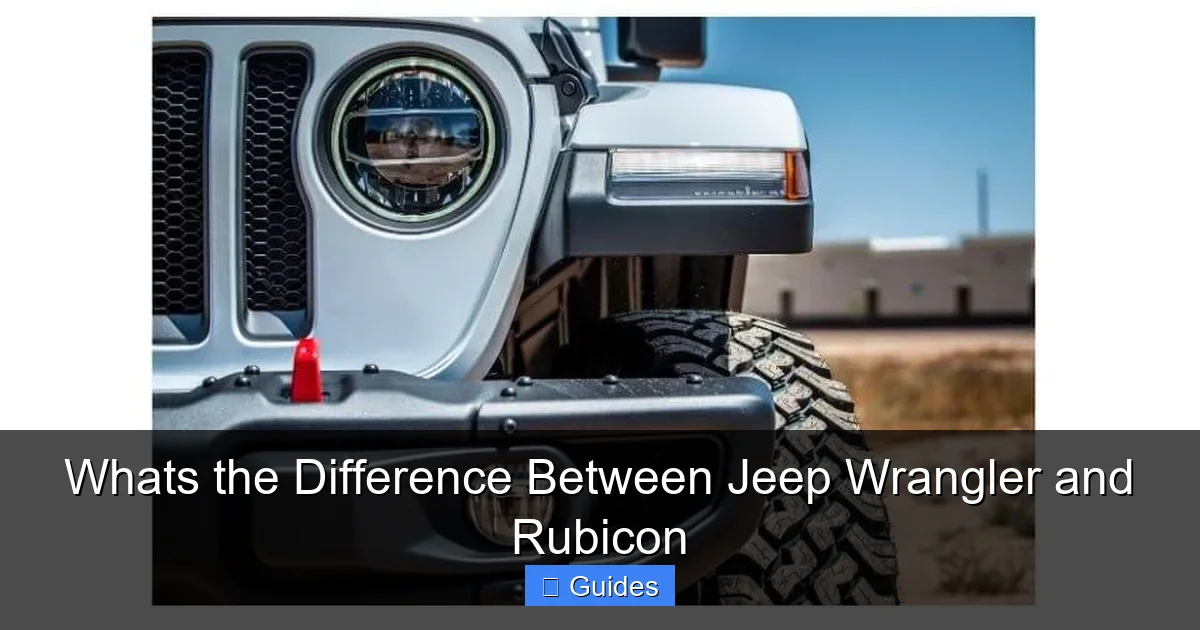
Visual guide about Whats the Difference Between Jeep Wrangler and Rubicon
Image source: jeepmodified.com
Before diving into the Rubicon, it’s essential to understand the broader Wrangler family. The Jeep Wrangler is available in several trim levels, each designed to cater to different driving styles and budgets. The most common trims include the Sport, Sport S, Sahara, and Rubicon. There’s also the high-performance 392 V8 model, but for this comparison, we’ll focus on the core differences between the standard Wrangler and the Rubicon.
Base Models: Sport and Sport S
The Sport and Sport S are the entry-level trims of the Wrangler lineup. These models are built to be affordable and functional, offering the classic Wrangler experience without the premium features. They come with a 3.6-liter Pentastar V6 engine, producing around 285 horsepower and 260 lb-ft of torque. You can opt for a 6-speed manual or an 8-speed automatic transmission.
The Sport models are ideal for drivers who want the open-air freedom of a Wrangler but don’t need extreme off-road capability. They come with part-time four-wheel drive, skid plates, and a basic infotainment system. While they can handle light trails and muddy roads, they lack the specialized components that make the Rubicon a true trail conqueror.
The Sahara: Comfort Meets Capability
Stepping up from the Sport is the Sahara trim. This model bridges the gap between daily driving comfort and off-road readiness. It includes upgraded interior materials, more advanced tech features like an 8.4-inch touchscreen, dual-zone climate control, and available leather seats. The Sahara also offers full-time four-wheel drive, which is great for variable weather and light off-roading.
However, even the Sahara falls short when compared to the Rubicon in terms of pure off-road performance. It doesn’t come with locking differentials or a disconnecting sway bar, and its suspension is tuned more for on-road comfort than rock crawling.
Why the Rubicon Stands Out
That brings us to the Rubicon. As the top-tier off-road trim, the Rubicon is engineered for one purpose: dominating the most challenging terrain. It’s the Wrangler built for those who don’t just drive off the pavement—they live off it. From its reinforced frame to its specialized drivetrain, every aspect of the Rubicon is designed to maximize traction, durability, and control in extreme conditions.
In the next section, we’ll explore the mechanical differences that set the Rubicon apart from other Wrangler trims.
Mechanical and Off-Road Differences
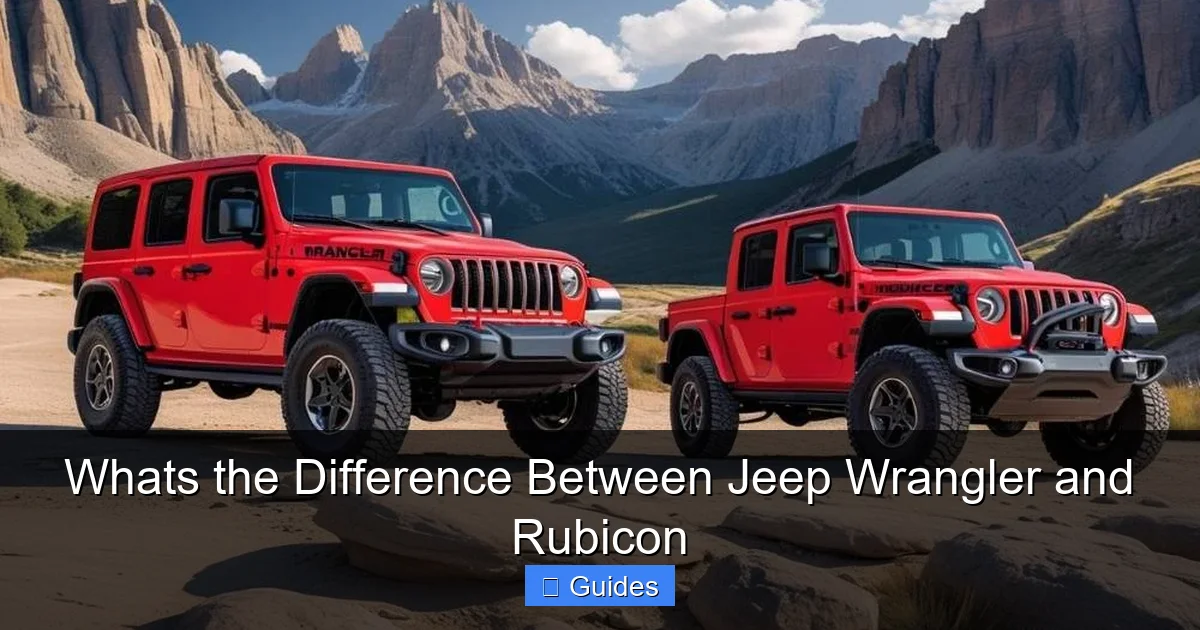
Visual guide about Whats the Difference Between Jeep Wrangler and Rubicon
Image source: jeepoffroads.com
The heart of the Rubicon’s superiority lies in its mechanical enhancements. While all Wranglers share the same basic platform, the Rubicon is packed with components that make it a beast on the trail. Let’s break down the key differences.
Heavy-Duty Axles and Differentials
One of the most significant upgrades in the Rubicon is its Dana 44 front and rear axles. These are significantly stronger than the Dana 30 front axle found in most other Wrangler trims. The Dana 44 axles can handle higher torque loads and are less likely to fail under extreme stress—something that’s crucial when you’re climbing rocks or navigating deep ruts.
Even more impressive are the Rubicon’s locking differentials. Both the front and rear differentials can be locked electronically, ensuring that power is distributed evenly to all wheels, even if one or more are off the ground. This feature is a game-changer when you’re stuck in mud, sand, or on uneven terrain. In contrast, base Wranglers rely on an open differential, which can send all power to the wheel with the least resistance—often the one spinning in the air.
Disconnecting Sway Bar
Another standout feature of the Rubicon is its electronic sway bar disconnect system, known as the Rock-Trac system. The sway bar (or anti-roll bar) helps keep the vehicle stable during normal driving by reducing body roll. However, when off-roading, a rigid sway bar limits wheel articulation—the ability of the wheels to move up and down independently.
The Rubicon’s sway bar can be disconnected with the push of a button, allowing the suspension to flex more freely. This means the wheels stay in contact with the ground longer, improving traction on uneven surfaces. No other Wrangler trim offers this feature, making the Rubicon uniquely capable on technical trails.
Low-Range Gearing and Crawl Ratio
The Rubicon also boasts a lower crawl ratio thanks to its 4:1 low-range transfer case. This means the engine turns four times for every one turn of the wheels in low range, providing immense torque at very slow speeds. It’s like having a built-in winch—perfect for creeping over boulders or descending steep inclines with control.
In comparison, most other Wrangler trims come with a 2.72:1 low-range gear ratio, which is adequate for light off-roading but lacks the precision and power of the Rubicon’s setup.
Tires and Wheels
Rubicon models come standard with 33-inch all-terrain tires mounted on 17-inch wheels. These aggressive tires provide excellent grip on dirt, mud, and rocks. They’re also designed to withstand punctures and sidewall damage. While you can upgrade other Wrangler trims with larger tires, doing so often requires additional modifications and can affect warranty coverage.
Suspension and Ground Clearance
The Rubicon’s suspension is tuned for off-road performance, with longer-travel shocks and higher ground clearance. This allows it to absorb impacts better and navigate obstacles without scraping the undercarriage. The increased articulation also helps maintain traction when one wheel is lifted off the ground.
In contrast, base Wranglers have a more basic suspension setup that prioritizes on-road comfort and cost savings.
Interior Features and Comfort
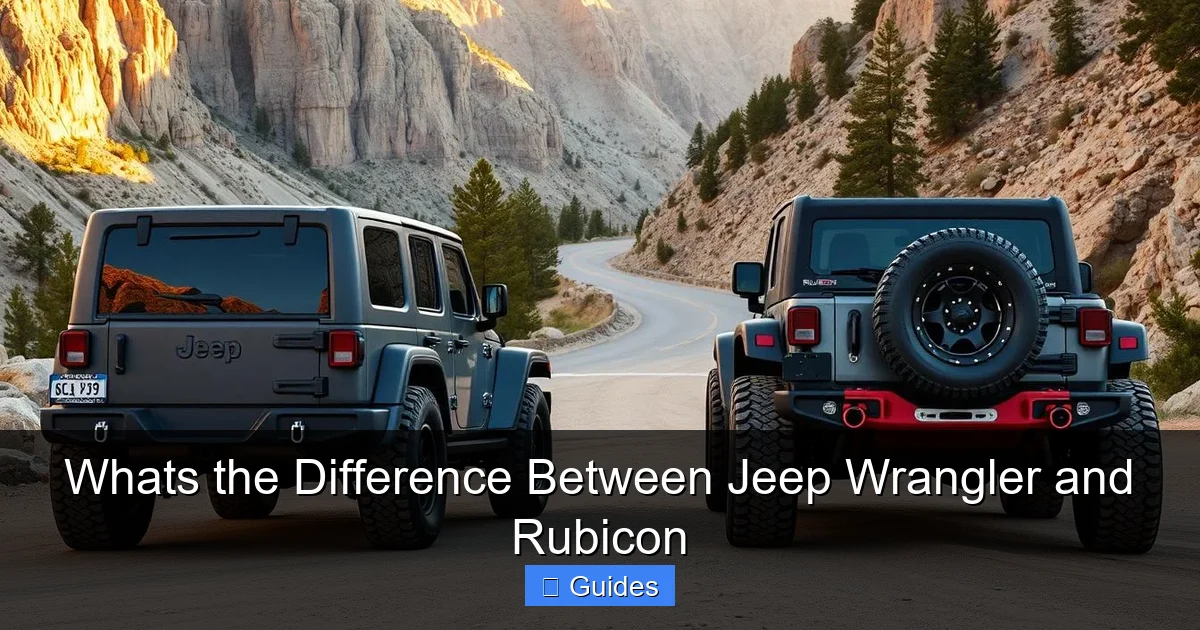
Visual guide about Whats the Difference Between Jeep Wrangler and Rubicon
Image source: vehiclebright.com
While the Rubicon excels off-road, it doesn’t sacrifice much in terms of interior quality. In fact, it often comes with more premium features than lower trims.
Technology and Infotainment
Rubicon models typically include an 8.4-inch Uconnect touchscreen with navigation, Apple CarPlay, Android Auto, and a premium audio system. You’ll also find available features like a Wi-Fi hotspot, wireless charging, and a 7-inch digital instrument cluster. These upgrades make long drives more enjoyable and help you stay connected even in remote areas.
Lower trims like the Sport may only offer a basic 5-inch display with limited functionality. While you can add some tech features as options, the Rubicon often includes them standard.
Seating and Materials
The Rubicon offers available leather-trimmed seats with heating and ventilation, making it more comfortable in extreme temperatures. The seats are also bolstered for better support during off-road maneuvers. Lower trims usually come with cloth seats, though leather is available as an upgrade.
Storage and Practicality
All Wranglers, including the Rubicon, offer removable doors, a fold-down windshield (on some models), and a fold-flat rear seat for maximum cargo flexibility. However, the Rubicon’s larger tires and suspension can slightly reduce interior space and make entry/exit a bit more challenging.
Noise and Ride Quality
Here’s where the Rubicon shows a trade-off. Its larger tires and stiffer suspension contribute to more road noise and a firmer ride on pavement. If you spend most of your time commuting or driving on highways, you might find the standard Wrangler more comfortable. But for off-road enthusiasts, the added noise is a small price to pay for superior capability.
Performance and Fuel Economy
Both the standard Wrangler and the Rubicon offer similar engine options, but performance and efficiency differ due to weight and aerodynamics.
Engine Options
The base engine for both models is the 3.6-liter V6, producing 285 horsepower. You can also opt for a 2.0-liter turbocharged four-cylinder (270 hp) or a 3.0-liter EcoDiesel V6 (260 hp, 442 lb-ft of torque). The Rubicon is available with all these engines, but the V6 and EcoDiesel are most popular for their torque and towing capacity.
Transmission
The Rubicon often comes standard with the 8-speed automatic transmission, which provides smoother shifts and better fuel economy than the 6-speed manual. The automatic also works better with the Rubicon’s low-range gearing for precise off-road control.
Fuel Economy
Due to its heavier components and larger tires, the Rubicon typically gets lower fuel economy than base Wranglers. Expect around 17 mpg city and 25 mpg highway for a V6 Rubicon, compared to 19/24 mpg for a Sport model. The EcoDiesel improves efficiency, offering up to 22/29 mpg, but it comes at a higher upfront cost.
Towing and Payload
Both models can tow up to 3,500 pounds with the proper equipment. However, the Rubicon’s reinforced frame and suspension make it better suited for heavy loads off-road. Payload capacity is similar across trims, around 1,000 pounds.
Cost and Value Comparison
Price is a major factor when choosing between a standard Wrangler and a Rubicon.
Starting Prices
As of 2024, a base Wrangler Sport starts around $32,000. The Rubicon begins at approximately $45,000—over $13,000 more. That’s a significant jump, but it reflects the Rubicon’s advanced features and capabilities.
Resale Value
One advantage of the Rubicon is its strong resale value. Off-road enthusiasts highly prize Rubicon models, and they tend to hold their value better than lower trims. If you plan to sell or trade in your Jeep after a few years, the Rubicon could save you money in the long run.
Maintenance and Repairs
The Rubicon’s specialized components can be more expensive to repair. Locking differentials, heavy-duty axles, and advanced suspension parts require specialized knowledge and parts. However, if properly maintained, these components are built to last.
Insurance and Taxes
Insurance premiums may be slightly higher for the Rubicon due to its higher value and performance capabilities. Sales tax and registration fees will also be greater.
Who Should Choose Which Model?
The decision between a standard Wrangler and a Rubicon ultimately comes down to your lifestyle and driving needs.
Choose the Standard Wrangler If:
- You primarily drive on paved roads or light trails.
- You want a more affordable entry point into the Wrangler family.
- You prioritize fuel economy and on-road comfort.
- You don’t plan to tackle extreme off-road terrain.
- You’re a first-time Jeep owner looking to test the waters.
Choose the Rubicon If:
- You frequently go off-roading on rocky, muddy, or technical trails.
- You want the best possible traction and control in challenging conditions.
- You value durability and are willing to invest in a long-term off-road vehicle.
- You plan to modify your Jeep with aftermarket parts (the Rubicon is a great foundation).
- You want a Jeep that holds its value and stands out from the crowd.
Real-World Example: Weekend Warrior vs. Trail Enthusiast
Imagine two drivers: Sarah and Mike. Sarah uses her Jeep to commute to work, take weekend camping trips, and drive on forest service roads. She doesn’t need locking differentials or a sway bar disconnect. A Wrangler Sahara or even a Sport S would suit her perfectly.
Mike, on the other hand, spends every other weekend on challenging trails in the desert and mountains. He needs maximum traction, durability, and control. For him, the Rubicon is not just a luxury—it’s a necessity.
Conclusion: Making the Right Choice
The difference between the Jeep Wrangler and the Rubicon boils down to capability, cost, and intended use. The Wrangler is a versatile, iconic SUV that delivers open-air freedom and light off-road ability at an accessible price. The Rubicon, as a high-performance trim, takes that foundation and elevates it with specialized components designed for extreme terrain.
If you’re a casual driver who enjoys the Jeep lifestyle but doesn’t need to conquer every trail, a standard Wrangler will serve you well. But if you’re serious about off-roading—whether for recreation, competition, or adventure—the Rubicon is worth the investment. Its enhanced axles, locking differentials, disconnecting sway bar, and aggressive tires make it one of the most capable production SUVs on the planet.
Ultimately, both models embody the spirit of Jeep: rugged, reliable, and ready for anything. The right choice depends on where you want to go—and how you want to get there.
Frequently Asked Questions
Is the Rubicon a separate model from the Wrangler?
No, the Rubicon is not a separate model. It is the highest off-road trim level within the Jeep Wrangler lineup, offering enhanced capabilities over base models.
Can a standard Wrangler handle off-roading?
Yes, base Wranglers can handle light to moderate off-roading, such as dirt roads and muddy trails. However, they lack the specialized features like locking differentials and sway bar disconnect found in the Rubicon.
Do Rubicon models have better fuel economy?
No, Rubicon models typically have slightly lower fuel economy due to heavier components and larger tires. The difference is usually 1-2 mpg less than base Wranglers.
Are Rubicon parts more expensive to repair?
Yes, because Rubicon models use heavy-duty components like Dana 44 axles and locking differentials, repairs can be more costly and may require specialized service.
Can I upgrade a standard Wrangler to Rubicon level?
You can add many Rubicon features through aftermarket parts, but achieving the same level of factory-integrated performance is difficult and often more expensive than buying a Rubicon from the start.
Which is better for daily driving: Wrangler or Rubicon?
The standard Wrangler is generally better for daily driving due to better fuel economy, a smoother ride, and lower cost. The Rubicon’s stiffer suspension and louder tires can make it less comfortable on paved roads.

At CarLegit, we believe information should be clear, factual, and genuinely helpful. That’s why every guide, review, and update on our website is created with care, research, and a strong focus on user experience.