
ECT Power on a Lexus stands for “Electronically Controlled Transmission Power Mode,” a feature designed to boost engine responsiveness and acceleration. It’s ideal for overtaking, climbing hills, or when you need extra power—without permanently affecting fuel efficiency.
In This Article
- 1 Key Takeaways
- 2 📑 Table of Contents
- 3 What Does ECT Power Mean on a Lexus?
- 4 How Does ECT Power Work?
- 5 When Should You Use ECT Power?
- 6 ECT Power vs. Other Drive Modes
- 7 Does ECT Power Affect Fuel Economy?
- 8 Is ECT Power Safe to Use Regularly?
- 9 How to Activate and Deactivate ECT Power
- 10 ECT Power in Different Lexus Models
- 11 Common Misconceptions About ECT Power
- 12 Conclusion: Make the Most of Your Lexus
- 13 Frequently Asked Questions
Key Takeaways
- ECT Power enhances acceleration: It adjusts transmission shift points to keep the engine in a higher RPM range, delivering quicker throttle response.
- It’s not just for sporty driving: Use it for highway merging, towing, or driving uphill—any situation requiring extra power.
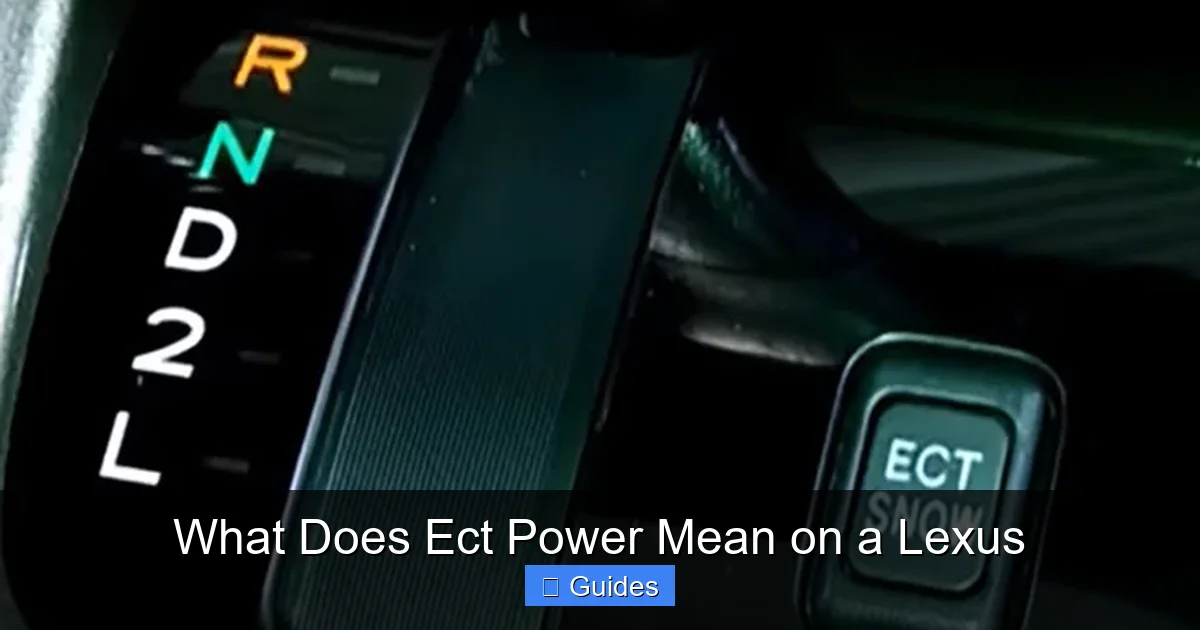
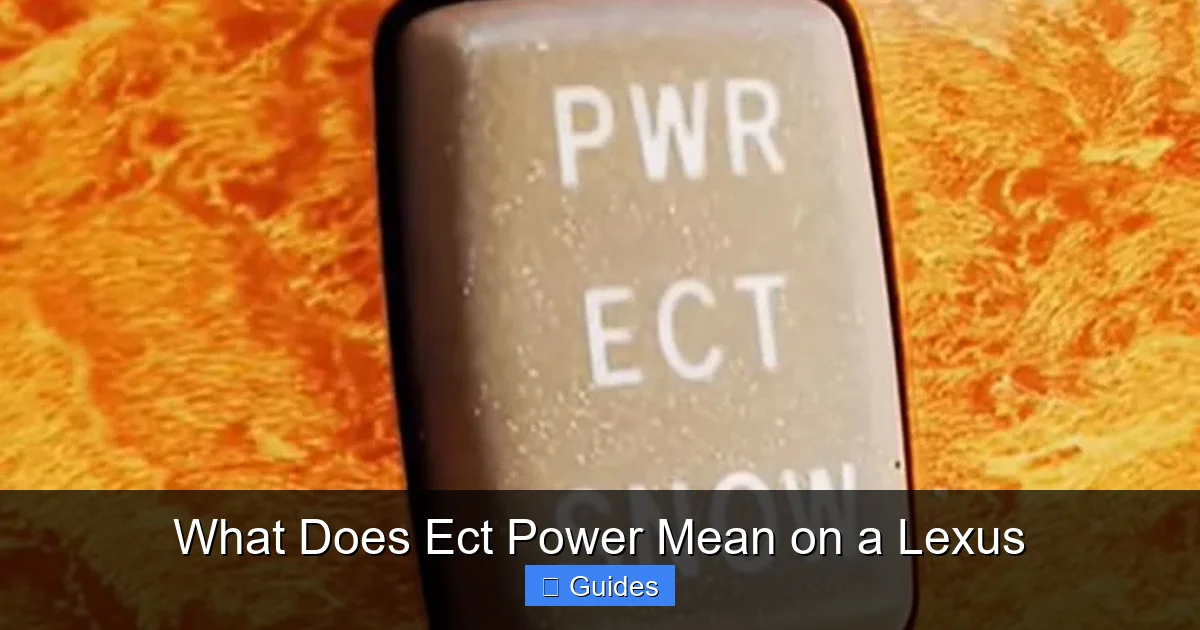
- Easy to activate: Simply press the ECT Power button, usually located near the gear shifter or center console.
- Doesn’t harm your engine: The system is electronically controlled and safe for regular use when needed.
- Improves driving confidence: Especially useful in adverse weather or when carrying heavy loads.
- Automatically disengages: Some models revert to normal mode when you release the button or shift into park.
- Complements other Lexus tech: Works alongside features like Drive Mode Select and adaptive suspension for a balanced ride.
📑 Table of Contents
- What Does ECT Power Mean on a Lexus?
- How Does ECT Power Work?
- When Should You Use ECT Power?
- ECT Power vs. Other Drive Modes
- Does ECT Power Affect Fuel Economy?
- Is ECT Power Safe to Use Regularly?
- How to Activate and Deactivate ECT Power
- ECT Power in Different Lexus Models
- Common Misconceptions About ECT Power
- Conclusion: Make the Most of Your Lexus
What Does ECT Power Mean on a Lexus?
If you’ve ever driven a Lexus—or even just glanced at the center console—you might have noticed a button labeled “ECT PWR.” It stands out with its bold lettering, often illuminated when activated, and it begs the question: What exactly does it do? Is it a performance booster? A secret sports mode? Or just another confusing acronym in the world of automotive tech?
Let’s clear the air. ECT Power stands for “Electronically Controlled Transmission Power Mode.” It’s a smart feature built into many Lexus vehicles to give drivers more control over how their car responds to acceleration and shifting. Think of it as a temporary “power-up” for your transmission—like giving your car a little extra kick when you need it most.
But here’s the best part: It’s not just for speed demons or track-day enthusiasts. ECT Power is a practical tool designed for everyday driving scenarios. Whether you’re merging onto a busy highway, climbing a steep hill, or towing a trailer, this mode helps your Lexus deliver the power you need—when you need it—without permanently altering your driving experience.
In this guide, we’ll break down everything you need to know about ECT Power: how it works, when to use it, how it affects fuel economy, and why it’s one of the most underappreciated features in modern Lexus vehicles. By the end, you’ll feel confident using this feature to enhance your driving—safely and efficiently.
How Does ECT Power Work?

Visual guide about What Does Ect Power Mean on a Lexus
Image source: infinitycartips.com
To understand ECT Power, it helps to first grasp how your Lexus transmission normally operates. Most modern Lexus models use an automatic transmission that’s electronically controlled—meaning a computer (the Transmission Control Module, or TCM) decides when to shift gears based on factors like speed, throttle input, and driving conditions.
Under normal driving conditions, the transmission prioritizes smoothness and fuel efficiency. It shifts up early to keep the engine RPMs low, which reduces noise and saves gas. This is great for cruising around town or on long highway drives.
But when you press the ECT Power button, the system changes its behavior. The TCM adjusts the shift points—delaying upshifts and allowing the engine to rev higher before changing gears. This keeps the engine in its power band longer, delivering stronger acceleration and more responsive throttle input.
The Science Behind the Shift
When you activate ECT Power, the transmission essentially behaves more like a manual gearbox in sport mode. Instead of shifting at, say, 2,500 RPM, it might wait until 3,500 or even 4,000 RPM. This means the engine stays in a range where it produces more torque and horsepower.
For example, imagine you’re driving at 40 mph in 5th gear. In normal mode, the transmission might shift to 6th gear to save fuel. But in ECT Power mode, it stays in 5th, keeping the engine spinning faster and ready to accelerate quickly if you need to pass another car.
This doesn’t mean the car is constantly revving high—only that it’s *ready* to. The system still shifts automatically, but it does so with performance in mind rather than economy.
Electronic Control for Precision
The “ECT” in ECT Power stands for “Electronically Controlled Transmission,” which highlights the role of the car’s onboard computers. These systems monitor dozens of inputs—throttle position, vehicle speed, engine load, even ambient temperature—to make real-time decisions about gear changes.
When ECT Power is engaged, the TCM recalibrates its logic. It becomes more aggressive in holding lower gears and downshifting under braking or deceleration. This creates a more connected, responsive feel behind the wheel.
And because it’s all managed electronically, the transition is seamless. You won’t feel jerky shifts or sudden lurches—just smoother, more immediate power delivery.
When Should You Use ECT Power?
Visual guide about What Does Ect Power Mean on a Lexus
Image source: bryansgarage.com
Now that you know how ECT Power works, the next question is: When should you actually use it? The good news is, it’s not just a gimmick. This feature has real-world applications that can make your driving safer and more enjoyable.
Highway Merging and Overtaking
One of the most common uses for ECT Power is when you need to merge onto a highway or pass another vehicle. In normal mode, your Lexus might hesitate slightly when you press the accelerator hard—especially if the transmission is in a high gear.
But with ECT Power activated, the car responds instantly. The transmission downshifts (if needed) and keeps the engine in the optimal power range, giving you the burst of speed required to merge safely or overtake with confidence.
For example, if you’re driving at 55 mph and need to pass a slow truck, pressing ECT Power ensures your car accelerates quickly without lag. This reduces the time you spend in the oncoming lane—a key safety benefit.
Driving Uphill or Towing
If you live in a hilly area or frequently tow a trailer, boat, or camper, ECT Power is your best friend. Climbing steep grades puts extra strain on your engine and transmission. In normal mode, the car might struggle to maintain speed, causing the transmission to “hunt” between gears.
ECT Power prevents this by keeping the engine in a lower gear where it can produce more torque. This means smoother, more consistent power delivery—even under heavy load.
Imagine towing a 3,000-pound trailer up a mountain pass. Without ECT Power, your Lexus might downshift repeatedly, causing jerky movements and increased wear. With it, the system holds the right gear, reducing stress on the drivetrain and improving control.
Adverse Weather Conditions
ECT Power can also be useful in rain, snow, or icy conditions—though not for the reason you might think. It’s not about going faster; it’s about maintaining control.
In slippery conditions, sudden acceleration can cause wheel spin. But ECT Power helps by delivering power more gradually and predictably. The transmission manages torque delivery more precisely, reducing the chance of losing traction.
Additionally, the system’s tendency to hold lower gears can improve engine braking on descents. This is especially helpful when driving down steep, snowy roads—where you want to slow down without relying too much on the brakes.
Sporty Driving (Responsibly)
Let’s be honest—sometimes you just want to feel the thrill of driving. ECT Power gives you that without switching to a full sport mode (if your Lexus has one).
It’s perfect for winding back roads or open highways where you can enjoy the car’s performance. The enhanced throttle response and delayed upshifts make the car feel more engaging and alive.
Just remember: ECT Power is meant for temporary use. You don’t need to leave it on all the time—especially in stop-and-go traffic, where it can reduce fuel efficiency.
ECT Power vs. Other Drive Modes
Visual guide about What Does Ect Power Mean on a Lexus
Image source: bryansgarage.com
Many newer Lexus models come with multiple drive modes—like Eco, Normal, Sport, and Sport+. So how does ECT Power fit into this lineup?
It’s important to understand that ECT Power is not the same as Sport mode. While they both enhance performance, they do so in different ways.
ECT Power: Transmission-Focused
ECT Power specifically targets the transmission. It changes shift points and throttle response but doesn’t alter other systems like suspension, steering, or engine mapping (unless the car integrates them).
It’s a simpler, more focused tool. Think of it as a “transmission booster” rather than a full performance suite.
Sport Mode: Full-System Enhancement
Sport mode, on the other hand, typically adjusts multiple systems. It might firm up the suspension, sharpen the steering, increase engine responsiveness, and—yes—modify transmission behavior.
In some Lexus models, Sport mode actually *includes* ECT Power functionality. So pressing Sport might automatically activate ECT Power as part of a broader performance package.
When to Choose Which
So which should you use?
– Use **ECT Power** when you need a quick burst of acceleration or better control in specific situations—like merging, towing, or climbing hills.
– Use **Sport mode** when you want a more engaging, performance-oriented driving experience across the board—especially on open roads or during spirited driving.
In short: ECT Power is task-specific. Sport mode is mood-specific.
Does ECT Power Affect Fuel Economy?
This is one of the most common concerns drivers have: “Will using ECT Power hurt my gas mileage?”
The short answer: Yes—but only when it’s active.
Increased Fuel Consumption During Use
Because ECT Power keeps the engine in higher RPM ranges and delays upshifts, it burns more fuel than normal driving. The engine is working harder, and that means more gasoline is consumed per mile.
For example, if you drive with ECT Power engaged for 20 minutes on the highway, you might see a noticeable dip in your average MPG for that trip.
No Long-Term Impact
However, once you turn off ECT Power, your car returns to its normal, fuel-efficient operation. There’s no lasting effect on fuel economy—just a temporary increase during use.
Think of it like turning on the air conditioning. It uses more energy while it’s running, but once you turn it off, everything goes back to normal.
Smart Usage = Minimal Impact
The key is using ECT Power wisely. If you only activate it when needed—say, for a few minutes during highway merging or hill climbing—the overall impact on your fuel economy will be negligible.
But if you leave it on all the time, especially in city driving, you’ll definitely see a drop in MPG.
Real-World Example
Let’s say you drive 1,000 miles per month. If you use ECT Power for 5% of that distance (50 miles), and it reduces your fuel economy by 15% during that time, your total fuel consumption might increase by less than 1%. That’s barely noticeable on your monthly gas bill.
But if you use it for 50% of your driving, the impact could be 5–7% higher fuel use—which adds up over time.
The bottom line: Use ECT Power when it adds value—safety, performance, or control—and turn it off when you don’t need it.
Is ECT Power Safe to Use Regularly?
Another common question: “Can I use ECT Power all the time without damaging my car?”
The answer is: Technically, yes—but it’s not recommended.
Engine and Transmission Are Designed for It
Lexus engineers design their vehicles to handle ECT Power mode safely. The engine, transmission, and cooling systems are built to manage the increased stress.
In fact, many Lexus models are tested extensively in high-load conditions—including towing, mountain driving, and repeated acceleration—to ensure durability.
Increased Wear Over Time
That said, using ECT Power constantly can lead to slightly faster wear on components like the transmission fluid, clutch packs, and engine internals. Higher RPMs generate more heat and friction, which over thousands of miles can contribute to degradation.
It’s similar to driving in stop-and-go traffic all the time—it’s not inherently damaging, but it’s harder on the car than highway cruising.
Best Practice: Use It When Needed
The best approach is to use ECT Power only when it provides a clear benefit. This preserves your vehicle’s longevity while still giving you access to extra power when necessary.
And remember: Modern Lexus vehicles are built to last. As long as you follow the maintenance schedule and use features responsibly, your car will serve you well for many years.
How to Activate and Deactivate ECT Power
Using ECT Power is simple—but the exact method can vary slightly depending on your Lexus model and year.
Locating the Button
In most Lexus vehicles, the ECT Power button is located near the gear shifter—either on the center console or on the side of the shifter itself. It’s usually labeled “ECT PWR” or just “PWR.”
Some newer models integrate it into the Drive Mode Select system, where you press a button or turn a dial to choose between Eco, Normal, and Power modes.
Activating the Mode
To turn on ECT Power:
1. Come to a complete stop or drive at low speed (under 30 mph is ideal).
2. Press the ECT Power button.
3. You’ll usually see a light illuminate on the dashboard or instrument cluster, confirming the mode is active.
Deactivating the Mode
To turn it off:
– Press the button again, or
– Shift into Park (on some models), or
– Turn off the ignition.
In many vehicles, ECT Power automatically deactivates when you shift into Park or turn off the engine—so you don’t have to worry about accidentally leaving it on.
Tips for Smooth Operation
– Don’t activate ECT Power at high speeds unless necessary. It’s designed for use during acceleration, not cruising.
– If your car has a Sport mode, check your owner’s manual—some models combine ECT Power with Sport, so you might not need to press a separate button.
– Always re-check your dashboard to confirm the mode is active or inactive, especially after starting the car.
ECT Power in Different Lexus Models
While ECT Power is a common feature, its implementation can vary across the Lexus lineup.
Entry-Level Models (IS, ES, UX)
In compact and midsize sedans like the IS or ES, ECT Power is often a standalone button. It’s simple and effective—perfect for drivers who want a quick performance boost without complex settings.
SUVs and Crossovers (RX, NX, GX)
In larger vehicles like the RX or GX, ECT Power is especially useful for towing and off-road driving. These models often have higher weight and more demanding driving conditions, making the extra power and control invaluable.
Performance Models (RC F, LC, IS F Sport)
In high-performance variants, ECT Power may be integrated into a broader Sport or Sport+ mode. These models often have additional enhancements like adaptive suspension and dynamic steering, creating a more immersive driving experience.
Hybrid Models (ES Hybrid, RX Hybrid)
Even hybrid Lexus vehicles can have ECT Power—though its function is slightly different. In hybrids, the system may prioritize electric motor assistance during acceleration, while still adjusting transmission behavior for smoother power delivery.
Common Misconceptions About ECT Power
Despite its usefulness, ECT Power is often misunderstood. Let’s clear up a few myths.
Myth 1: ECT Power Is Just for Racing
No—ECT Power is not a track-only feature. It’s designed for real-world driving scenarios like merging, towing, and hill climbing. While it can make driving more fun, its primary purpose is practical.
Myth 2: It Damages the Engine
Not true. The system is electronically controlled and operates within safe parameters. As long as your car is properly maintained, occasional use won’t cause harm.
Myth 3: It’s the Same as “Sport Mode”
They’re related but not identical. ECT Power focuses on the transmission, while Sport mode typically affects multiple systems. Some cars combine them, but they’re not the same.
Myth 4: You Should Leave It On All the Time
Actually, the opposite is true. Constant use can reduce fuel economy and increase wear. Use it only when needed.
Myth 5: Only Experts Can Use It
Absolutely not. ECT Power is designed for everyday drivers. If you can drive a car, you can use this feature safely.
Conclusion: Make the Most of Your Lexus
ECT Power is one of those features that seems small but makes a big difference. It’s not flashy or high-tech in the way a heads-up display or autonomous driving system might be—but it’s incredibly useful.
By understanding what ECT Power does, when to use it, and how it fits into your driving habits, you can get more performance, safety, and confidence from your Lexus—without sacrificing efficiency or longevity.
So the next time you’re merging onto the highway, climbing a steep driveway, or towing a load, don’t hesitate to press that button. Your Lexus is ready to deliver the power you need—exactly when you need it.
And remember: Great driving isn’t just about speed. It’s about control, awareness, and using the tools your car gives you. ECT Power is one of those tools—simple, smart, and surprisingly powerful.
Frequently Asked Questions
What does ECT Power stand for?
ECT Power stands for “Electronically Controlled Transmission Power Mode.” It’s a feature that adjusts your Lexus transmission’s shift points to deliver quicker acceleration and better throttle response.
Does ECT Power use more gas?
Yes, but only while it’s active. Because the engine runs at higher RPMs, it consumes more fuel. However, turning it off returns your car to normal, fuel-efficient operation.
Can I use ECT Power all the time?
You can, but it’s not recommended. Constant use may reduce fuel economy and increase wear on the transmission. Use it only when you need extra power, like for merging or towing.
Is ECT Power the same as Sport mode?
Not exactly. ECT Power focuses only on the transmission, while Sport mode typically adjusts suspension, steering, and engine response in addition to transmission behavior.
Does ECT Power work in hybrid Lexus models?
Yes. In hybrid models, ECT Power still enhances acceleration, often by combining electric motor output with optimized transmission shifts for smoother, stronger performance.
Will using ECT Power damage my Lexus?
No. The system is designed to be safe for regular use when needed. As long as your vehicle is properly maintained, occasional use of ECT Power won’t harm the engine or transmission.

At CarLegit, we believe information should be clear, factual, and genuinely helpful. That’s why every guide, review, and update on our website is created with care, research, and a strong focus on user experience.