
The Bugatti Veyron’s acceleration time is record-breaking thanks to its quad-turbocharged W16 engine, advanced aerodynamics, and cutting-edge engineering. With 1,001 horsepower and a top speed of 253 mph, it redefined what supercars could achieve in the 2000s.
When the Bugatti Veyron roared onto the scene in 2005, it didn’t just break records—it shattered expectations. For decades, car enthusiasts dreamed of a production car that could truly rival race cars in speed and acceleration. Most supercars of the time struggled to crack the 3-second barrier from 0 to 60 mph. Then came the Veyron, hitting that mark in just 2.5 seconds and reaching a top speed of 253 mph. That wasn’t just fast—it was revolutionary. The Veyron didn’t just accelerate quickly; it redefined what was physically possible for a street-legal vehicle.
But what made the Veyron’s acceleration time so extraordinary? It wasn’t just one feature or component. It was the result of a perfect storm of engineering brilliance, relentless innovation, and an almost obsessive attention to detail. From its monstrous engine to its intelligent aerodynamics, every part of the Veyron was designed with one goal in mind: to dominate the road like no car before it. This article dives deep into the science, technology, and passion behind the Bugatti Veyron’s record-breaking acceleration. Whether you’re a car lover, an engineering geek, or just curious about speed, you’ll discover why the Veyron remains a legend more than 15 years after its debut.
In This Article
- 1 Key Takeaways
- 2 📑 Table of Contents
- 3 The Heart of the Beast: The W16 Quad-Turbo Engine
- 4 All-Wheel Drive: Taming the Power
- 5 Aerodynamics: Speed with Stability
- 6 Lightweight Construction: Strength Without the Weight
- 7 The Transmission: Shifting at the Speed of Light
- 8 The Human Factor: Engineering Passion and Perfection
- 9 Legacy and Impact on the Automotive World
- 10 Conclusion: Why the Veyron’s Acceleration Still Matters
- 11 Frequently Asked Questions
- 11.1 What makes the Bugatti Veyron’s acceleration so fast?
- 11.2 How does the Veyron’s transmission contribute to its speed?
- 11.3 Why does the Veyron have 10 radiators?
- 11.4 Can the Veyron be driven daily?
- 11.5 What role does aerodynamics play in the Veyron’s performance?
- 11.6 Has any car surpassed the Veyron’s acceleration time?
Key Takeaways
- Quad-Turbocharged W16 Engine: The Veyron’s 8.0-liter engine produces over 1,000 horsepower, enabling 0-60 mph in just 2.5 seconds.
- Advanced All-Wheel Drive System: Power is distributed efficiently to all four wheels, maximizing traction and minimizing wheel slip during launch.
- Aerodynamic Design: Active aerodynamics adjust downforce and drag in real time, enhancing stability at high speeds.
- Lightweight yet Strong Materials: Carbon fiber and aluminum reduce weight while maintaining structural integrity.
- Precision Transmission: The 7-speed dual-clutch gearbox delivers lightning-fast shifts for seamless acceleration.
- Thermal Management: Sophisticated cooling systems prevent overheating during extreme performance runs.
- Engineering Legacy: Bugatti’s obsession with perfection pushed automotive boundaries, making the Veyron a benchmark for speed.
📑 Table of Contents
- The Heart of the Beast: The W16 Quad-Turbo Engine
- All-Wheel Drive: Taming the Power
- Aerodynamics: Speed with Stability
- Lightweight Construction: Strength Without the Weight
- The Transmission: Shifting at the Speed of Light
- The Human Factor: Engineering Passion and Perfection
- Legacy and Impact on the Automotive World
- Conclusion: Why the Veyron’s Acceleration Still Matters
The Heart of the Beast: The W16 Quad-Turbo Engine
At the core of the Bugatti Veyron’s incredible acceleration lies its engine—a marvel of modern engineering known as the W16. This isn’t your average V8 or even a high-performance V12. The W16 is a unique configuration that combines two narrow-angle V8 engines into a single block, forming a “W” shape. With 16 cylinders and a displacement of 8.0 liters, it’s one of the largest and most powerful engines ever fitted in a production car.
But size alone doesn’t explain the Veyron’s speed. What truly sets this engine apart is its quad-turbocharging system. Each bank of cylinders is fed by two turbochargers, meaning four in total. These turbos force-feed air into the combustion chambers, dramatically increasing power output. Without turbocharging, the engine might produce around 600 horsepower. But with all four turbos spinning at over 180,000 RPM, the Veyron delivers a staggering 1,001 horsepower and 922 lb-ft of torque.
How the Quad-Turbo System Works
The quad-turbo setup operates in stages to eliminate turbo lag—a common issue where there’s a delay between pressing the accelerator and feeling the surge of power. At low engine speeds, only two of the turbos are active, providing quick response. As the engine revs climb, the other two kick in, delivering full boost and unleashing the engine’s full potential. This staged approach ensures smooth, linear power delivery from idle to redline.
Imagine launching from a stoplight. In most high-performance cars, you might feel a slight hesitation as the turbos spool up. But in the Veyron, the initial two turbos respond instantly, giving you immediate thrust. Then, as you push harder, the second pair joins in, pushing you back into your seat with relentless force. It’s like having two engines working in harmony—one for responsiveness, one for raw power.
Thermal Challenges and Cooling Solutions
Generating over 1,000 horsepower produces an enormous amount of heat. If not managed properly, this heat can warp components, reduce efficiency, or even cause engine failure. Bugatti engineers knew they had to solve the thermal puzzle to maintain performance and reliability.
The solution? A cooling system so advanced it’s almost a work of art. The Veyron features 10 radiators—yes, ten—strategically placed throughout the car. These include radiators for the engine oil, transmission, differential, and even the air conditioning system. Air intakes on the sides and rear of the car channel cool air directly to these radiators, while fans kick in when the car is stationary or moving slowly.
During high-speed runs, the sheer airflow helps with cooling, but at a standstill—like at a red light—the fans ensure nothing overheats. This level of thermal management is critical during repeated acceleration runs, where other cars might overheat and lose power. The Veyron, however, stays cool and ready for another sprint.
All-Wheel Drive: Taming the Power
Visual guide about Why Bugatti Veyrons Acceleration Time Is Record Breaking
Image source: automacha.com
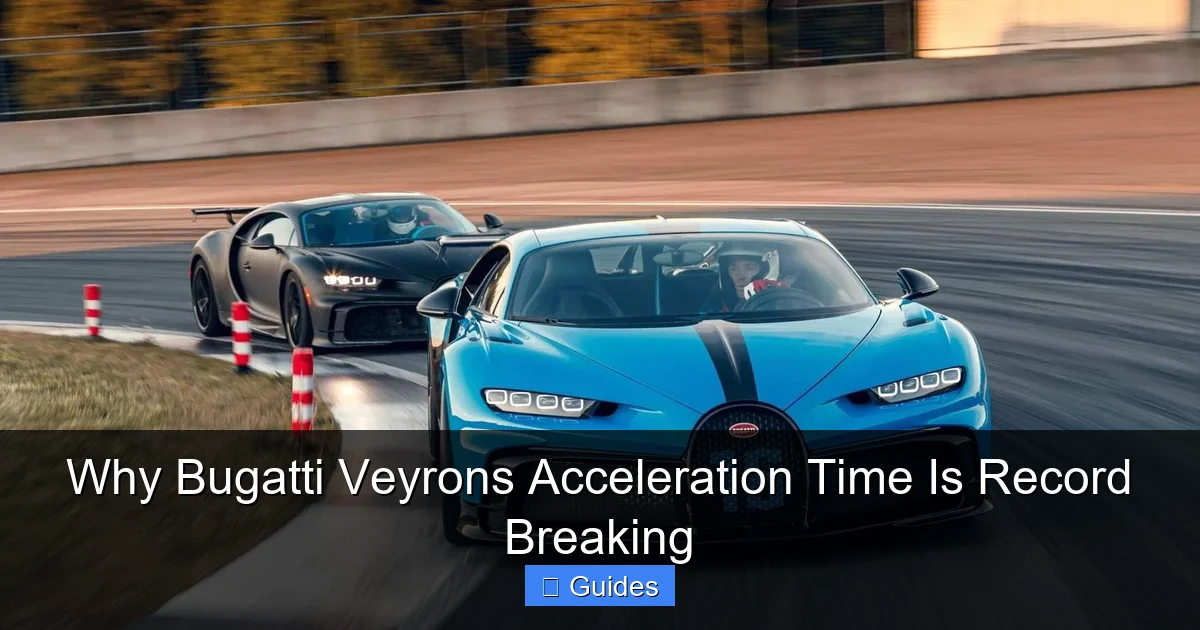
With over 1,000 horsepower on tap, you might think the Veyron would spin its wheels uncontrollably at launch. But thanks to its sophisticated all-wheel drive (AWD) system, it launches with precision and control. The Veyron uses a permanent AWD setup that sends power to all four wheels, maximizing traction and minimizing wheel slip.
How the AWD System Enhances Acceleration
In a rear-wheel-drive car, launching at full throttle can cause the rear tires to lose grip, especially on wet or uneven surfaces. But the Veyron’s AWD system distributes torque between the front and rear axles in real time. Sensors monitor wheel speed, steering angle, and throttle input, adjusting power delivery to keep the car stable and accelerating efficiently.
For example, during a hard launch, the system might send 30% of the power to the front wheels and 70% to the rear. This balance prevents wheel spin while ensuring maximum forward thrust. The result? A 0-60 mph time of just 2.5 seconds—faster than many modern supercars, including some that came years later.
The Role of Traction Control
Even with AWD, managing such immense power requires electronic assistance. The Veyron is equipped with a sophisticated traction control system that works in tandem with the AWD setup. If the system detects wheel slip, it momentarily reduces engine power or applies braking to the slipping wheel, restoring grip.
This system isn’t just for safety—it’s essential for performance. Without it, the Veyron might struggle to put its power down effectively, especially on less-than-perfect roads. But with traction control, drivers can confidently push the car to its limits, knowing the electronics are working behind the scenes to keep everything in check.
Aerodynamics: Speed with Stability

Visual guide about Why Bugatti Veyrons Acceleration Time Is Record Breaking
Image source: autospies.com
Acceleration isn’t just about power—it’s also about control. At high speeds, even small aerodynamic imbalances can cause instability, reducing both safety and performance. The Bugatti Veyron addresses this with an advanced active aerodynamics system that adjusts in real time to changing conditions.
Active Spoilers and Air Brakes
One of the most visible features of the Veyron is its rear spoiler. But this isn’t just for show. The spoiler automatically adjusts its angle based on speed and driving mode. At low speeds, it lies flat to reduce drag. But as the car accelerates, it rises to increase downforce, pressing the car onto the road for better grip.
At speeds above 137 mph, the spoiler deploys to its full height, generating significant downforce. This helps keep the rear tires planted, preventing lift and improving high-speed stability. If the driver suddenly brakes at high speed, the spoiler tilts vertically, acting as an air brake to slow the car more effectively.
Underbody Aerodynamics
While the spoiler gets the most attention, the Veyron’s underbody is equally important. The car features a flat undertray with carefully designed diffusers that accelerate airflow underneath the car. This creates a low-pressure zone, effectively sucking the car toward the road—a principle known as ground effect.
This design reduces lift and drag, allowing the Veyron to maintain stability even at its top speed of 253 mph. Without such advanced aerodynamics, the car would be far less controllable at extreme velocities, making record-breaking runs nearly impossible.
Lightweight Construction: Strength Without the Weight
Visual guide about Why Bugatti Veyrons Acceleration Time Is Record Breaking
Image source: robbreport.com
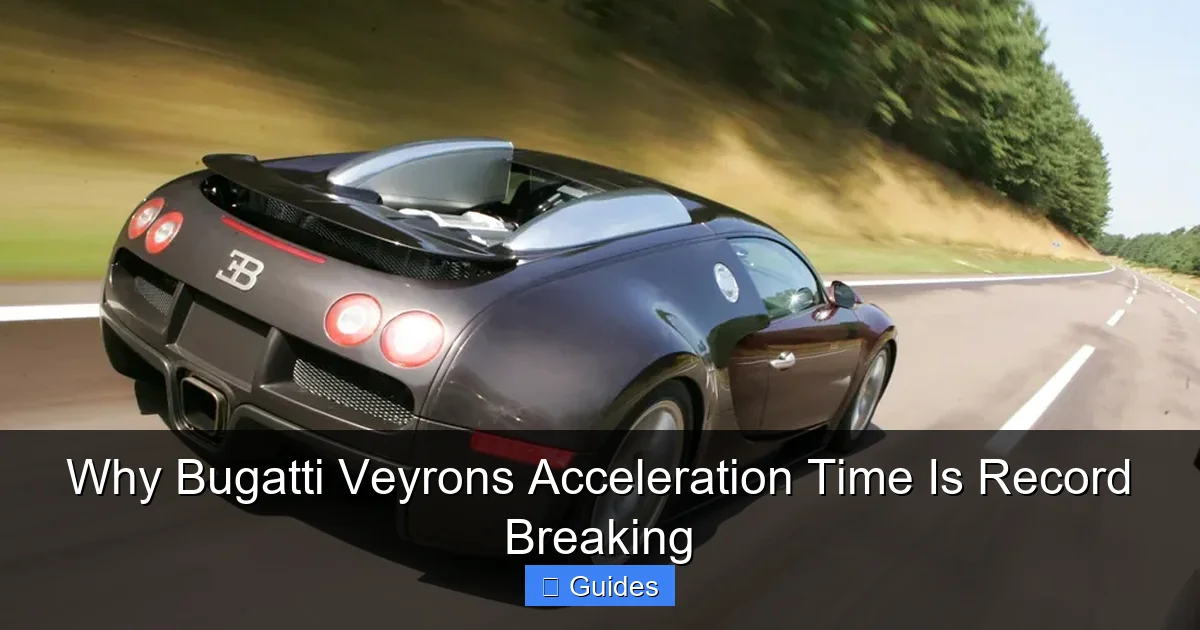
To achieve record-breaking acceleration, a car must not only be powerful but also lightweight. Every extra pound increases inertia, making it harder to accelerate and brake. The Bugatti Veyron strikes a delicate balance between strength and weight, using advanced materials to keep mass down without sacrificing durability.
Carbon Fiber Monocoque
The Veyron’s chassis is built around a carbon fiber monocoque—a single-shell structure that forms the car’s core. Carbon fiber is incredibly strong yet much lighter than steel. It’s also resistant to corrosion and fatigue, making it ideal for high-performance applications.
This monocoque provides exceptional rigidity, which improves handling and allows the suspension to work more effectively. A stiffer chassis means less flex during hard cornering or acceleration, translating to better control and responsiveness.
Aluminum and Titanium Components
In addition to carbon fiber, Bugatti uses aluminum and titanium throughout the Veyron. Aluminum is used for body panels, suspension components, and some engine parts, reducing weight while maintaining strength. Titanium, known for its high strength-to-weight ratio, is used in exhaust systems and other high-stress areas.
The exhaust system, for example, is made entirely of titanium. Not only is it lighter than stainless steel, but it also withstands extreme heat without warping. This attention to material choice extends to every part of the car, from the wheels to the interior trim.
The Transmission: Shifting at the Speed of Light
Even the most powerful engine needs a transmission that can keep up. The Bugatti Veyron uses a 7-speed dual-clutch automatic transmission (DCT) that shifts gears in milliseconds. This transmission is one of the fastest and most advanced of its time, playing a crucial role in the car’s acceleration.
Dual-Clutch Technology
A dual-clutch transmission uses two separate clutches—one for odd-numbered gears and one for even-numbered gears. While one gear is engaged, the next is pre-selected, allowing for near-instant shifts. When you accelerate, the transmission can upshift in as little as 150 milliseconds—faster than a blink of an eye.
This speed is critical for maintaining momentum during acceleration. In a traditional automatic or manual transmission, there’s a brief interruption in power during shifts. But with the DCT, power delivery remains almost uninterrupted, allowing the Veyron to accelerate smoothly and rapidly.
Launch Control
For maximum acceleration from a standstill, the Veyron includes a launch control system. When activated, it optimizes engine RPM, traction control, and clutch engagement for the fastest possible launch. The system holds the engine at the ideal RPM, then releases the clutch precisely to minimize wheel slip and maximize forward thrust.
Using launch control, the Veyron can achieve its 0-60 mph time of 2.5 seconds consistently. It’s a feature typically found only in race cars, but Bugatti brought it to the street, making supercar performance accessible to everyday driving—albeit in a very exclusive way.
The Human Factor: Engineering Passion and Perfection
Behind every record-breaking machine is a team of passionate engineers and designers. The Bugatti Veyron wasn’t just built—it was crafted with an almost obsessive attention to detail. From the hand-assembled engine to the bespoke interior, every element reflects a commitment to excellence.
A 10-Year Development Journey
The Veyron’s development began in the late 1990s under Volkswagen Group ownership. The goal was simple: create the fastest production car in the world. But achieving that goal took nearly a decade of testing, refinement, and innovation.
Engineers faced countless challenges, from cooling the massive engine to ensuring the car could stop as well as it could go. The braking system, for instance, uses massive carbon-ceramic discs and eight-piston calipers to bring the 4,000-pound car to a halt from 200 mph in just a few seconds.
Testing and Validation
Before the Veyron went on sale, it underwent rigorous testing at tracks like Nardò Ring in Italy and Volkswagen’s Ehra-Lessien test facility in Germany. These high-speed tracks allowed engineers to push the car to its limits, validating performance, safety, and reliability.
One famous test involved driving the Veyron at top speed for 12 consecutive hours to ensure it could sustain such performance without failure. The result? Not a single mechanical issue. This level of testing is rare in the automotive world and speaks to the Veyron’s engineering integrity.
Legacy and Impact on the Automotive World
The Bugatti Veyron didn’t just set records—it inspired a new generation of hypercars. Its success proved that extreme performance could be achieved in a road-legal, daily-drivable package. Competitors like the Koenigsegg Agera, McLaren P1, and later the Chiron took cues from the Veyron’s design and engineering.
But more than that, the Veyron changed how people think about speed. It wasn’t just about raw power; it was about balance, control, and innovation. The car’s acceleration time became a benchmark, a standard that other manufacturers aimed to surpass.
Even today, the Veyron remains a symbol of automotive ambition. Its combination of power, precision, and artistry continues to captivate car lovers around the world. And while newer models have surpassed its top speed, few can match the Veyron’s blend of performance and presence.
Conclusion: Why the Veyron’s Acceleration Still Matters
The Bugatti Veyron’s acceleration time is record-breaking not because of one single feature, but because of the perfect integration of engineering, design, and passion. From its quad-turbo W16 engine to its active aerodynamics and lightweight construction, every component was optimized for speed and control.
It wasn’t just a car—it was a statement. A declaration that the limits of performance could be pushed further than anyone thought possible. And in doing so, the Veyron didn’t just break records; it redefined what a supercar could be.
Whether you’re behind the wheel or just watching it streak past, the Veyron’s acceleration is a reminder of what human ingenuity can achieve. It’s not just about going fast. It’s about going fast with precision, power, and purpose. And that’s why the Bugatti Veyron will always be remembered as one of the greatest cars ever made.
Frequently Asked Questions
What makes the Bugatti Veyron’s acceleration so fast?
The Veyron’s acceleration is driven by its 1,001-horsepower W16 quad-turbo engine, advanced all-wheel drive system, and lightweight carbon fiber construction. These components work together to deliver 0-60 mph in just 2.5 seconds.
How does the Veyron’s transmission contribute to its speed?
The 7-speed dual-clutch transmission shifts gears in milliseconds, minimizing power loss during acceleration. Its launch control system optimizes clutch and engine engagement for maximum thrust from a standstill.
Why does the Veyron have 10 radiators?
With over 1,000 horsepower generating extreme heat, the Veyron needs 10 radiators to cool the engine, transmission, differential, and other systems. This ensures consistent performance even during repeated high-speed runs.
Can the Veyron be driven daily?
Yes, the Veyron is street-legal and designed for daily use, though its high maintenance costs and fuel consumption make it more of a weekend or special-occasion car for most owners.
What role does aerodynamics play in the Veyron’s performance?
Active aerodynamics, including an adjustable rear spoiler and underbody diffusers, generate downforce at high speeds to improve stability and traction, allowing the car to maintain control during rapid acceleration.
Has any car surpassed the Veyron’s acceleration time?
Yes, newer hypercars like the Tesla Roadster, Rimac Nevera, and Bugatti Chiron have achieved faster 0-60 mph times, but the Veyron remains iconic for being the first production car to break the 2.5-second barrier.

At CarLegit, we believe information should be clear, factual, and genuinely helpful. That’s why every guide, review, and update on our website is created with care, research, and a strong focus on user experience.