
The Bugatti W16 engine is a marvel of engineering that combines four banks of cylinders into a compact, high-output powerhouse. Its unique layout enables extreme horsepower, lightning-fast acceleration, and unmatched top speeds, making it the heart of some of the world’s fastest production cars.
When you think of hypercars, one name stands above the rest: Bugatti. Known for pushing the limits of speed, luxury, and engineering, Bugatti has consistently redefined what’s possible on four wheels. At the heart of this legacy lies the W16 engine—a powertrain so unique, so powerful, and so meticulously crafted that it’s become synonymous with automotive excellence. From the legendary Veyron to the record-breaking Chiron, the W16 has been the driving force behind some of the fastest production cars ever made.
But what makes the W16 engine so special? Why did Bugatti choose this complex layout over more conventional V8 or V12 configurations? The answer lies in a perfect storm of innovation, ambition, and engineering brilliance. Unlike anything else on the road, the W16 combines the smoothness of a 16-cylinder engine with the compactness of a V8, delivering staggering performance without the bulk. It’s not just about raw power—it’s about how that power is harnessed, controlled, and delivered to the wheels with precision and reliability.
In this guide, we’ll dive deep into how the Bugatti W16 engine layout contributes to performance. We’ll explore its unique design, the science behind its power output, and the advanced technologies that keep it running at peak efficiency. Whether you’re a car enthusiast, an engineering student, or just curious about what makes hypercars tick, this article will give you a behind-the-scenes look at one of the most impressive engines ever built.
In This Article
- 1 Key Takeaways
- 2 📑 Table of Contents
- 3 The Origins of the W16 Engine
- 4 Understanding the W16 Layout
- 5 Power and Performance: The Numbers Behind the W16
- 6 Thermal Management and Cooling Systems
- 7 Engineering Innovations and Materials
- 8 The W16 in Real-World Performance
- 9 Conclusion: The Legacy of the W16 Engine
- 10 Frequently Asked Questions
Key Takeaways
- Compact Design: The W16 layout packs 16 cylinders into a space smaller than a traditional V16, maximizing power without sacrificing engine bay space.
- High Power Output: With over 1,500 horsepower in models like the Chiron, the W16 delivers performance that rivals race cars.
- Improved Balance and Smoothness: The engine’s symmetrical design reduces vibrations and enhances drivetrain stability at high speeds.
- Advanced Forced Induction: Four turbochargers force-feed air into the engine, boosting torque and responsiveness across the rev range.
- Thermal Management: Sophisticated cooling systems manage the immense heat generated, ensuring reliability under extreme conditions.
- Engineering Innovation: The W16 represents a fusion of aerospace and automotive technology, pushing the boundaries of what’s mechanically possible.
- Exclusivity and Prestige: Only a handful of W16-powered Bugattis exist, making them symbols of automotive excellence and innovation.
📑 Table of Contents
The Origins of the W16 Engine
The story of the W16 engine begins in the late 1990s, when Volkswagen Group acquired Bugatti with a bold vision: to create the ultimate supercar. At the time, the automotive world was dominated by V8 and V12 engines, but Bugatti’s engineers wanted something truly revolutionary. They aimed to build a car that could exceed 250 mph—a feat previously thought impossible for a road-legal vehicle.
To achieve this, they needed an engine with immense power, but also one that could fit within the constraints of a production car. A traditional V16 engine, like those used in luxury yachts or vintage race cars, would have been too long and heavy for a sports car chassis. So, Bugatti’s engineers turned to a lesser-known configuration: the “W” engine.
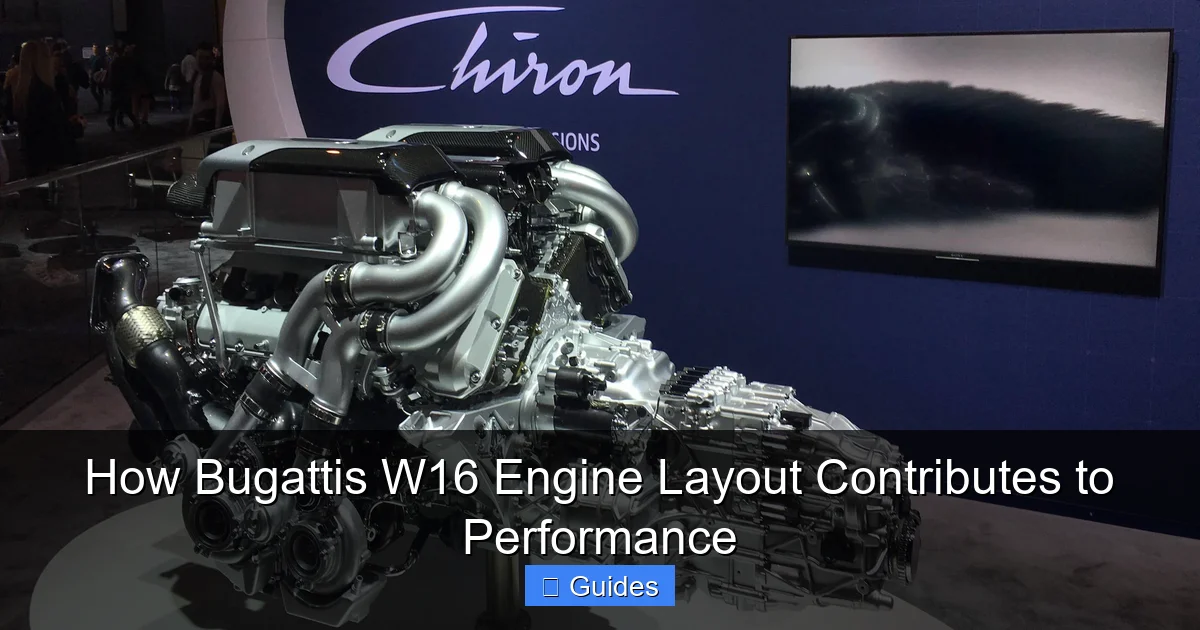
The W16 is essentially three banks of four cylinders arranged in a “W” shape, formed by combining two narrow-angle VR8 engines on a common crankshaft. This design allows 16 cylinders to be packed into a space not much larger than a conventional V8. The result? A compact, lightweight, and incredibly powerful engine that could deliver the performance Bugatti needed.
The first production car to feature the W16 was the Bugatti Veyron in 2005. With 1,001 horsepower and a top speed of 253 mph, it instantly became the fastest production car in the world. But the W16 wasn’t just about speed—it was about redefining what a road car could do. It set new standards for acceleration, braking, and handling, all while maintaining the luxury and comfort expected from a Bugatti.
Understanding the W16 Layout

Visual guide about How Bugattis W16 Engine Layout Contributes to Performance
Image source: thedrive.com
To truly appreciate how the W16 contributes to performance, it helps to understand its unique layout. Unlike a traditional V8 or V12, which arranges cylinders in two banks at a 90-degree angle, the W16 uses a more complex configuration.
The “W” Configuration Explained
The W16 engine gets its name from the shape formed by its cylinder banks. It consists of four rows of four cylinders, arranged in a “W” pattern when viewed from the front. This is achieved by combining two VR8 engines—each with a 15-degree cylinder angle—onto a single crankshaft. The result is a 72-degree “W” shape, with the outer banks angled at 15 degrees and the inner banks at 30 degrees.
This compact layout allows Bugatti to fit 16 cylinders into an engine that’s only slightly longer than a V8. It also reduces the overall weight and improves balance, which is crucial for high-speed stability. The engine measures just 71 centimeters in length and 89 centimeters in width, making it one of the most space-efficient 16-cylinder engines ever built.
Compactness and Packaging Advantages
One of the biggest challenges in hypercar design is packaging—how to fit a massive engine, transmission, cooling systems, and exhaust into a sleek, aerodynamic body. The W16’s compact size gives Bugatti a significant advantage. It allows the engine to be mounted low and centered in the chassis, improving weight distribution and handling.
Additionally, the W16’s narrow profile means it doesn’t interfere with the car’s aerodynamics. Engineers can design tighter bodywork and more efficient airflow channels, which are essential for achieving high speeds. In the Chiron, for example, the engine is positioned behind the driver but ahead of the rear axle, creating a near-perfect 45:55 front-to-rear weight balance.
Smoothness and Vibration Control
Another benefit of the W16 layout is its inherent smoothness. With 16 cylinders firing in a precise sequence, the engine delivers power in a near-continuous stream. This reduces vibrations and creates a driving experience that’s both powerful and refined.
To further enhance smoothness, Bugatti uses advanced balancing techniques and lightweight components. The crankshaft, for instance, is made from high-strength steel and precisely balanced to minimize rotational forces. The engine also features dual overhead camshafts per cylinder bank, ensuring precise valve timing and optimal combustion.
Power and Performance: The Numbers Behind the W16
Visual guide about How Bugattis W16 Engine Layout Contributes to Performance
Image source: zero2turbo.com
When it comes to performance, the W16 engine doesn’t just impress—it dominates. Let’s break down the numbers that make this engine a legend.
Horsepower and Torque Output
The W16 engine in the Bugatti Chiron produces a staggering 1,500 horsepower and 1,180 lb-ft of torque. That’s enough to launch the car from 0 to 60 mph in under 2.4 seconds and reach a top speed of 261 mph (electronically limited). In the Chiron Super Sport 300+, that figure climbs to 1,600 horsepower, making it one of the most powerful production engines ever made.
To put this in perspective, a typical high-performance V8 engine produces around 600–700 horsepower. The W16 delivers more than double that, with torque figures that rival heavy-duty trucks. This immense power allows the Chiron to accelerate faster than many Formula 1 cars, even at high speeds.
Forced Induction: The Role of Turbocharging
So, how does the W16 generate so much power? The answer lies in forced induction—specifically, turbocharging. The engine is equipped with four turbochargers, two for each pair of cylinder banks. These turbos compress incoming air, allowing more fuel to be burned and increasing power output.
Bugatti uses a sequential turbocharging system to eliminate turbo lag. At low engine speeds, only two turbos are active, providing quick response. As engine speed increases, the other two turbos kick in, delivering full boost across the entire rev range. This ensures instant throttle response and smooth power delivery, whether you’re cruising at 50 mph or pushing the car to its limits.
Redline and Rev Range
Despite its massive displacement—8.0 liters—the W16 engine has a relatively low redline of around 6,700 rpm. This is because the engine is designed for torque, not high-revving performance. Peak torque is available as low as 2,000 rpm, meaning the car pulls strongly from a standstill and maintains acceleration even at highway speeds.
This low redline also contributes to engine longevity. By avoiding extreme RPMs, Bugatti reduces stress on internal components, ensuring the engine can withstand the rigors of high-speed driving over thousands of miles.
Thermal Management and Cooling Systems

Visual guide about How Bugattis W16 Engine Layout Contributes to Performance
Image source: engineerine.com
With great power comes great heat—and the W16 engine generates a lot of it. Managing this heat is one of the biggest challenges in hypercar engineering. If not properly controlled, excessive heat can lead to engine knock, reduced performance, and even mechanical failure.
Advanced Cooling Architecture
Bugatti addresses this with a sophisticated cooling system that includes multiple radiators, oil coolers, and coolant circuits. The Chiron, for example, has 10 radiators working in tandem to keep the engine, transmission, and turbochargers at optimal temperatures.
The main radiator is located at the front of the car, but additional radiators are positioned along the sides and rear to maximize airflow. Some are even mounted behind the engine to cool the turbochargers directly. This multi-zone approach ensures that every component stays within its ideal operating range, even during prolonged high-speed runs.
Oil and Lubrication Systems
Heat isn’t the only concern—friction is another enemy of performance. The W16 engine uses a dry-sump lubrication system, which stores oil in a separate tank rather than in the oil pan. This prevents oil starvation during high-G cornering or acceleration, ensuring consistent lubrication under all conditions.
The system also includes multiple oil pumps and coolers, which circulate oil at high pressure to critical components like the crankshaft, pistons, and turbochargers. This reduces wear and extends engine life, even under extreme loads.
Aerodynamic Cooling Features
Bugatti also uses aerodynamics to aid cooling. The Chiron’s body features active air intakes and vents that open and close based on engine temperature and speed. At low speeds, the intakes close to reduce drag. At high speeds, they open to channel cool air to the radiators and brakes.
This intelligent system not only improves cooling but also enhances efficiency. By managing airflow dynamically, Bugatti ensures the engine stays cool without sacrificing aerodynamic performance.
Engineering Innovations and Materials
Building an engine like the W16 requires more than just clever design—it demands cutting-edge materials and manufacturing techniques. Bugatti uses a combination of aerospace-grade alloys, advanced composites, and precision machining to create an engine that’s both powerful and reliable.
Lightweight Construction
Weight is the enemy of performance, especially in a hypercar. To keep the W16 as light as possible, Bugatti uses materials like aluminum, titanium, and carbon fiber. The engine block and cylinder heads are made from aluminum, which offers a great strength-to-weight ratio. Internal components, such as connecting rods and valves, are often made from titanium to reduce rotational mass.
Even the engine covers and intake manifolds are crafted from lightweight composites. This attention to detail shaves off precious pounds, improving acceleration, handling, and fuel efficiency.
Precision Manufacturing
Every W16 engine is hand-assembled by a team of skilled technicians at Bugatti’s headquarters in Molsheim, France. The process takes over 300 hours and includes over 1,000 individual components. Each engine is tested on a dynamometer to ensure it meets strict performance and reliability standards.
This level of craftsmanship ensures that every W16 engine is not only powerful but also built to last. Bugatti offers a 16-year warranty on the engine, a testament to its durability and engineering excellence.
Integration with Transmission and Drivetrain
The W16 engine doesn’t work in isolation—it’s part of a finely tuned system. In the Chiron, it’s paired with a 7-speed dual-clutch transmission that can shift gears in under 150 milliseconds. The transmission is mounted at the rear, connected to the engine via a lightweight carbon fiber driveshaft.
This layout improves weight distribution and reduces rotational inertia, allowing for faster acceleration and better handling. The all-wheel-drive system sends power to all four wheels, ensuring maximum traction and stability, even at speeds over 200 mph.
The W16 in Real-World Performance
So, how does all this engineering translate to real-world driving? The answer is simple: unmatched performance.
Acceleration and Top Speed
The Bugatti Chiron can accelerate from 0 to 100 mph in just 5.1 seconds and reach 200 mph in under 13 seconds. These figures are not just impressive—they’re record-breaking. The Chiron Super Sport 300+ became the first production car to exceed 300 mph, hitting 304.773 mph in 2019.
This level of performance is only possible because of the W16 engine’s combination of power, torque, and responsiveness. Whether you’re merging onto a highway or pushing the car on a track, the W16 delivers instant, relentless acceleration.
Handling and Stability
Despite its size and power, the Chiron handles like a much smaller sports car. The W16’s low center of gravity and balanced weight distribution contribute to precise steering and cornering. Active suspension systems and aerodynamic aids further enhance stability, allowing the car to maintain control at extreme speeds.
Bugatti also uses advanced electronics, including traction control, stability control, and torque vectoring, to manage power delivery. These systems work seamlessly with the W16 engine, ensuring that all that power is used effectively and safely.
Driving Experience and Refinement
One of the most surprising aspects of the W16-powered Bugatti is how refined it feels. Despite its raw power, the car is quiet, comfortable, and easy to drive in everyday conditions. The engine is smooth and responsive, and the cabin is insulated from noise and vibration.
This balance of performance and luxury is what sets Bugatti apart. The W16 engine doesn’t just make the car fast—it makes it a joy to drive.
Conclusion: The Legacy of the W16 Engine
The Bugatti W16 engine is more than just a powerplant—it’s a symbol of human ingenuity and ambition. Its unique layout, advanced engineering, and relentless performance have redefined what’s possible in the automotive world. From the Veyron to the Chiron, the W16 has set records, broken barriers, and inspired a generation of engineers and enthusiasts.
While future hypercars may move toward hybrid or electric powertrains, the W16 will remain a landmark in automotive history. It represents the pinnacle of internal combustion engineering—a masterpiece of design, power, and precision. For those lucky enough to experience it, the W16 isn’t just an engine. It’s a force of nature.
Frequently Asked Questions
What makes the Bugatti W16 engine different from a V16?
The W16 is more compact and efficient than a traditional V16. It uses a “W” layout with four cylinder banks on a single crankshaft, allowing it to fit in a smaller space while delivering similar or greater power.
How many turbochargers does the W16 engine have?
The W16 engine is equipped with four turbochargers—two for each pair of cylinder banks. This sequential turbo system eliminates lag and ensures strong performance across the entire rev range.
What is the horsepower of the Bugatti Chiron’s W16 engine?
The standard Bugatti Chiron’s W16 engine produces 1,500 horsepower. The Chiron Super Sport 300+ version increases this to 1,600 horsepower for even greater performance.
How does Bugatti cool the W16 engine?
Bugatti uses a complex cooling system with 10 radiators, multiple oil coolers, and active aerodynamic vents. This ensures the engine, turbos, and transmission stay at optimal temperatures even at high speeds.
Is the W16 engine reliable?
Yes, the W16 engine is designed for durability. It’s hand-built, rigorously tested, and backed by a 16-year warranty. Advanced materials and cooling systems ensure long-term reliability under extreme conditions.
Will Bugatti continue using the W16 engine?
Bugatti has announced plans to transition to hybrid and electric powertrains in the future. The W16 may be phased out, but its legacy as one of the greatest engines ever built will endure.

At CarLegit, we believe information should be clear, factual, and genuinely helpful. That’s why every guide, review, and update on our website is created with care, research, and a strong focus on user experience.