
The Bugatti W16 engine is a marvel of automotive engineering, designed to deliver explosive acceleration through its unique layout and quad-turbocharged power. By combining four banks of cylinders in a compact “W” formation, this engine generates over 1,500 horsepower, enabling hypercars like the Chiron to reach 60 mph in under 2.4 seconds.
When you think of ultimate speed, one name roars to the forefront: Bugatti. And at the heart of every modern Bugatti hypercar—whether it’s the Veyron, Chiron, or Bolide—lies the legendary W16 engine. This isn’t just another high-performance motor. It’s a masterpiece of engineering that redefines what’s possible in automotive acceleration. But what makes the W16 layout so special? Why does it allow Bugatti to dominate the world of speed with such authority?
The answer lies in a combination of innovative design, precision engineering, and relentless pursuit of power. The W16 isn’t just powerful—it’s smartly configured to deliver that power in the most efficient, responsive, and controllable way possible. Unlike conventional V8 or V12 engines, the W16 uses a unique cylinder arrangement that allows for more combustion events per revolution, resulting in smoother power delivery and faster acceleration. It’s not just about raw horsepower; it’s about how that horsepower is harnessed and unleashed the moment you press the accelerator.
In this guide, we’ll dive deep into the mechanics, design philosophy, and real-world impact of the Bugatti W16 engine layout. You’ll learn how this engineering marvel enhances acceleration, why it outperforms traditional engine configurations, and what it takes to build and maintain such a powerhouse. Whether you’re a car enthusiast, an engineering student, or simply curious about how hypercars achieve mind-bending speeds, this article will give you a front-row seat to one of the most advanced engines ever created.
In This Article
- 1 Key Takeaways
- 2 📑 Table of Contents
- 3 Understanding the W16 Engine Layout
- 4 The Role of Quad-Turbocharging in Acceleration
- 5 Balanced Firing Order and Smooth Power Delivery
- 6 Materials and Construction: Building for Speed
- 7 Electronic Control Systems: The Brain Behind the Brawn
- 8 Real-World Performance: Numbers That Defy Belief
- 9 Conclusion: The W16 as a Benchmark in Automotive Engineering
- 10 Frequently Asked Questions
Key Takeaways
- Compact and Powerful Design: The W16 layout packs 16 cylinders into a smaller space than a traditional V16, improving weight distribution and responsiveness.
- <>Quad-Turbocharging for Instant Thrust: Four turbochargers eliminate lag, delivering immediate power across the entire RPM range for seamless acceleration.
- Balanced Firing Order: The W16’s firing sequence minimizes vibration and enhances smoothness, allowing for higher RPMs and faster revving.
- Optimized Airflow and Cooling: Advanced intake and cooling systems support sustained high performance without overheating during rapid acceleration.
- Lightweight Materials: Use of titanium, carbon fiber, and aluminum reduces overall engine weight, improving power-to-weight ratio.
- Electronic Management Systems: Sophisticated engine control units fine-tune fuel delivery, ignition, and turbo boost for maximum efficiency and thrust.
- Real-World Performance: The W16 enables Bugatti hypercars to achieve 0-60 mph in under 2.5 seconds and top speeds exceeding 300 mph.
📑 Table of Contents
- Understanding the W16 Engine Layout
- The Role of Quad-Turbocharging in Acceleration
- Balanced Firing Order and Smooth Power Delivery
- Materials and Construction: Building for Speed
- Electronic Control Systems: The Brain Behind the Brawn
- Real-World Performance: Numbers That Defy Belief
- Conclusion: The W16 as a Benchmark in Automotive Engineering
Understanding the W16 Engine Layout
To truly appreciate how the W16 enhances acceleration, we first need to understand what makes its layout so unique. At first glance, the name “W16” might seem confusing. After all, most engines use a V-shaped configuration—like V6, V8, or V12. So why a “W”?
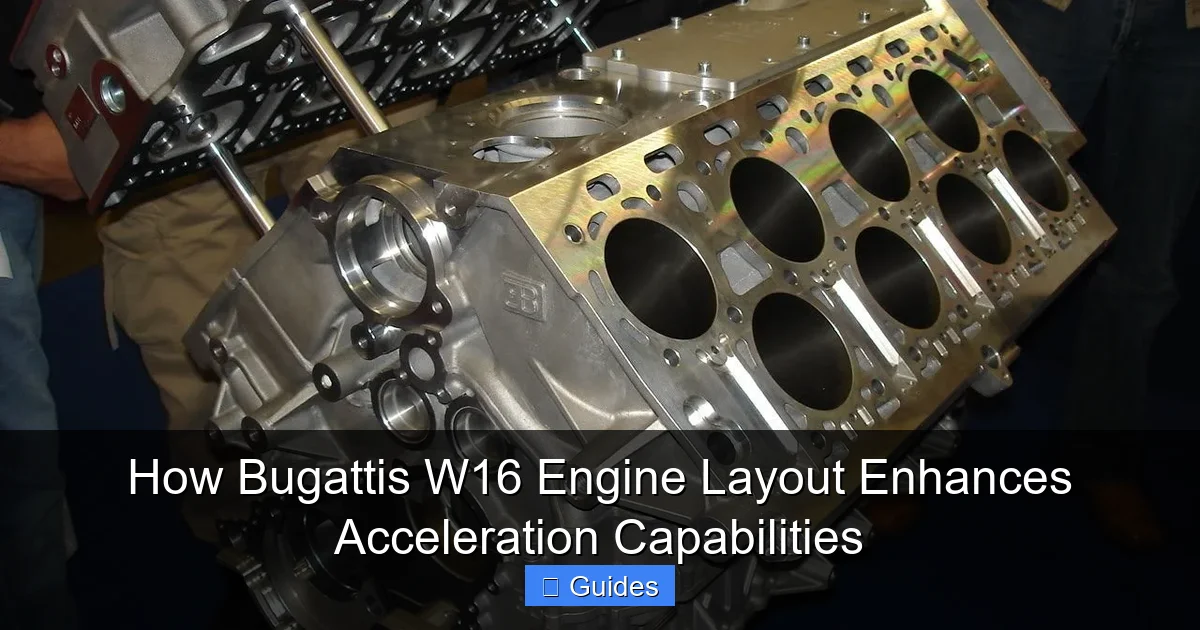
The W16 is essentially a fusion of two narrow-angle V8 engines sharing a common crankshaft. Imagine taking two V8 blocks, tilting them slightly, and joining them at the crank to form a “W” shape when viewed from the front. This creates four rows of four cylinders each, arranged in a compact, space-efficient formation. The angle between the cylinder banks is carefully engineered—typically around 15 degrees per V8 section—to minimize overall width and height while maximizing structural rigidity.
This layout offers several advantages over traditional V16 or flat-16 engines. First, it’s significantly more compact. A V16 engine would be enormous, making it impractical for use in a road car. The W16, by contrast, fits neatly within the chassis of a hypercar like the Chiron, allowing for better weight distribution and aerodynamics. Second, the W16 reduces the number of moving parts compared to a V16. With only one crankshaft and fewer camshafts, the engine is lighter and more reliable.
But perhaps the most important benefit is the firing order. In a W16, the cylinders fire in a precise, overlapping sequence that ensures near-constant power delivery. This means fewer gaps between power strokes, resulting in smoother acceleration and reduced vibration. For a driver, this translates to a more responsive throttle and a sensation of endless thrust—like being pushed back into your seat with every gear shift.
How the W16 Compares to Other Engine Configurations
Let’s put the W16 in context. How does it stack up against other high-performance engines?
A V8 engine, for example, has eight cylinders arranged in a V shape. It’s powerful and widely used in sports cars and trucks, but it can’t match the W16’s output. Even a V12—found in cars like the Lamborghini Aventador or Ferrari 812 Superfast—struggles to reach the 800–850 horsepower range without forced induction. The W16, by contrast, produces over 1,500 horsepower in the Chiron Super Sport.
What about a flat-16 engine, like those used in some racing prototypes? While flat engines offer excellent balance and low center of gravity, they’re wide and heavy. The W16 strikes a better balance between width, height, and weight, making it more suitable for a road-legal hypercar.
And then there’s the V16. Only a handful of V16 engines have ever been built—mostly for luxury cars or experimental prototypes. They’re massive, complex, and expensive. The W16 achieves similar power with greater efficiency and packaging advantages.
In short, the W16 layout is a sweet spot between power, size, and usability. It’s not the only way to make a fast car, but it’s arguably the most effective way to make a hypercar that can accelerate like a rocket and still be driven on public roads.
The Role of Quad-Turbocharging in Acceleration
Visual guide about How Bugattis W16 Engine Layout Enhances Acceleration Capabilities
Image source: engineerine.com
Now that we understand the W16’s layout, let’s talk about what makes it truly explosive: the quad-turbocharging system. Most high-performance engines use one or two turbochargers. Bugatti uses four.
Turbochargers work by forcing more air into the engine’s cylinders, allowing more fuel to be burned and thus generating more power. But there’s a catch: turbo lag. This is the delay between pressing the accelerator and feeling the surge of power, caused by the time it takes for exhaust gases to spin the turbo’s turbine.
Bugatti solves this problem with a sophisticated quad-turbo setup. Each pair of turbochargers is assigned to one of the two V8 sections of the W16. At low RPMs, only one turbo per side is active, reducing lag and improving throttle response. As engine speed increases, the second turbo on each side kicks in, providing a massive boost in power.
This staged activation ensures that the engine delivers instant torque from idle while still having enough airflow to sustain high RPMs. The result? The Chiron can go from 0 to 60 mph in just 2.4 seconds—faster than many Formula 1 cars from just a decade ago.
But it’s not just about speed off the line. The quad-turbo system also allows the W16 to maintain peak power across a wide RPM range. In the Chiron, the engine produces 1,180 lb-ft of torque from 2,000 to 6,000 RPM. That means whether you’re accelerating from a stoplight or passing at highway speeds, the engine is always ready to deliver maximum thrust.
Managing Heat and Airflow
With four turbochargers and 16 cylinders working at full tilt, heat becomes a major challenge. Without proper cooling, the engine would overheat within minutes under heavy load.
Bugatti engineers addressed this with a multi-layered cooling system. The W16 features separate coolant circuits for the cylinder heads and engine block, ensuring even temperature distribution. High-capacity radiators are positioned at the front and sides of the car, with active aerodynamic vents that open and close based on engine temperature.
Airflow is equally critical. The engine’s intake system draws air from multiple sources, including roof-mounted scoops and side intakes. This ensures a constant supply of cool, dense air—even at high speeds. The air is then filtered and compressed by the turbochargers before entering the combustion chambers.
All of this is managed by advanced electronic controls. Sensors monitor temperature, pressure, and airflow in real time, adjusting fuel injection, ignition timing, and turbo boost to maintain optimal performance. It’s a symphony of mechanical and digital precision, all working together to keep the engine running at peak efficiency.
Balanced Firing Order and Smooth Power Delivery

Visual guide about How Bugattis W16 Engine Layout Enhances Acceleration Capabilities
Image source: snaptaste.com
One of the most overlooked aspects of engine performance is the firing order—the sequence in which cylinders ignite. A poorly designed firing order can cause excessive vibration, noise, and even mechanical stress. But in the W16, the firing order is a thing of beauty.
The W16 uses a cross-plane crankshaft with a carefully optimized firing sequence. This means that power strokes are evenly spaced throughout the engine’s rotation, minimizing torsional vibration and ensuring smooth operation. The result is an engine that feels incredibly refined, even when producing over 1,500 horsepower.
This balance is crucial for acceleration. Vibration can interfere with traction, especially at launch. If the engine shakes violently, it can cause the tires to lose grip or the drivetrain to suffer stress. The W16’s smooth power delivery allows for maximum traction and control, enabling the car to put down its immense power without spinning the wheels.
Moreover, a balanced engine can rev higher and more freely. The W16 in the Chiron redlines at 6,700 RPM—not as high as a naturally aspirated V10 or V12, but impressive for a turbocharged 16-cylinder engine. The smoothness allows the engine to reach its power peak quickly and sustain it through the rev range.
Real-World Impact on Driving Experience
So what does this mean for the driver? Imagine standing at a traffic light in a Bugatti Chiron. You press the accelerator, and instead of a sudden jolt, you feel a wave of force pushing you back into the seat. The car launches forward with such urgency that it feels like you’re being launched from a cannon.
But it’s not just the initial burst. As you shift through the 7-speed dual-clutch transmission, each gear change is seamless. There’s no drop in power, no hesitation. The engine just keeps pulling, pulling, pulling—right up to 261 mph (electronically limited).
This kind of acceleration isn’t just about bragging rights. It’s about engineering excellence. Every component—from the crankshaft to the turbochargers to the engine mounts—is designed to work in harmony. The W16 layout is the foundation that makes this possible.
Materials and Construction: Building for Speed
Visual guide about How Bugattis W16 Engine Layout Enhances Acceleration Capabilities
Image source: snaptaste.com
Power is nothing without reliability. And when you’re building an engine that produces over 1,500 horsepower, reliability is paramount. That’s why Bugatti uses some of the most advanced materials in the automotive world.
The W16 engine block is made from high-strength aluminum alloy, which is both lightweight and durable. The cylinder heads are also aluminum, with steel cylinder liners to withstand the extreme heat and pressure of combustion. The connecting rods are forged from titanium—a material more commonly found in jet engines—because it’s incredibly strong yet lightweight.
Even the turbochargers are engineered for extreme conditions. They’re made from Inconel, a nickel-based superalloy that can withstand temperatures over 1,000°C. This allows the turbos to operate efficiently even under continuous full load.
But it’s not just about the engine itself. The entire powertrain is designed to handle the stress. The transmission, differential, and driveshafts are all reinforced to transfer the engine’s power without failure. The cooling system, as mentioned earlier, is oversized and highly efficient.
All of this adds up to an engine that’s not only powerful but also surprisingly durable. Bugatti claims the W16 can run at full power for extended periods without overheating or mechanical failure—something that’s been proven in real-world testing and record runs.
Maintenance and Longevity
Of course, such a complex engine requires careful maintenance. Oil changes must be performed with high-performance synthetic oil, and the turbochargers need regular inspection. But for owners who follow the maintenance schedule, the W16 is designed to last for hundreds of thousands of miles.
In fact, the original Bugatti Veyron’s W16 engine was tested to withstand over 300,000 miles of simulated driving—including extreme acceleration, high-speed cruising, and repeated cold starts. That’s a testament to the engineering that goes into every component.
Electronic Control Systems: The Brain Behind the Brawn
No modern engine operates without a sophisticated electronic control unit (ECU)—and the W16 is no exception. In fact, its ECU is one of the most advanced in the world.
The ECU manages everything from fuel injection and ignition timing to turbo boost and throttle response. It uses data from dozens of sensors to make real-time adjustments, ensuring the engine runs at peak efficiency under all conditions.
For example, when you floor the accelerator, the ECU instantly increases fuel delivery, advances ignition timing, and ramps up turbo boost. It also monitors wheel speed, traction, and lateral G-forces to prevent wheel spin or loss of control.
In the Chiron, the ECU works in tandem with the car’s all-wheel-drive system and active aerodynamics. When launching, the system sends more power to the rear wheels for maximum traction. At high speeds, it adjusts the rear wing and underbody flaps to increase downforce and stability.
This level of integration is what allows the W16 to deliver such consistent, controllable acceleration. It’s not just a brute-force engine—it’s a smart engine.
Real-World Performance: Numbers That Defy Belief
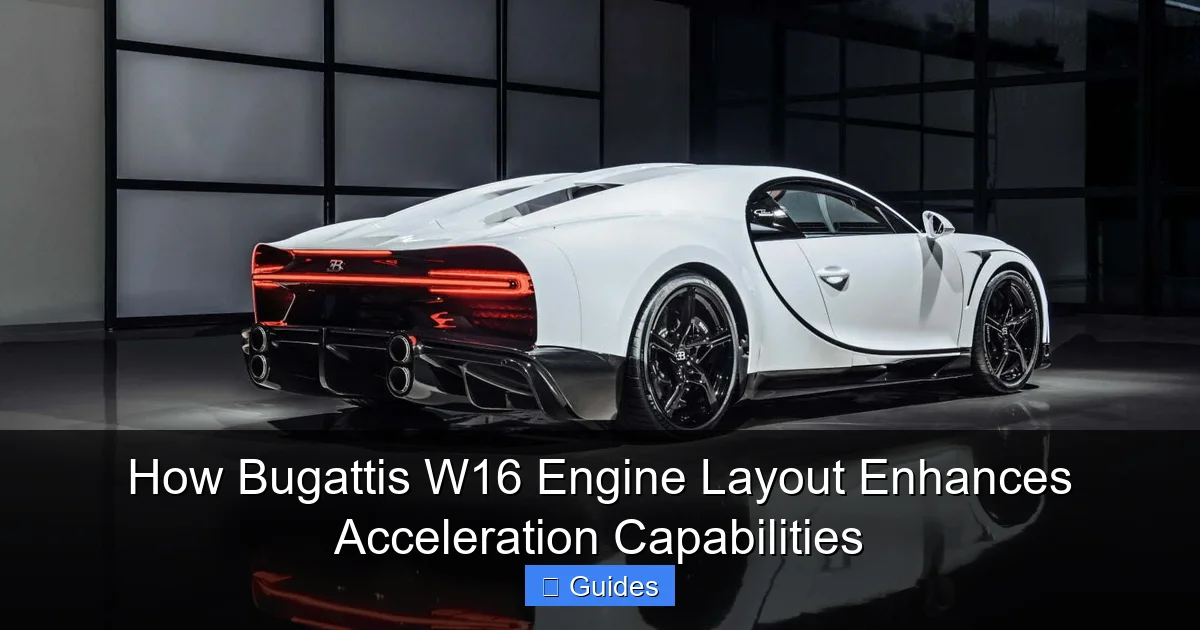
Let’s look at the numbers. The Bugatti Chiron Super Sport 300+ produces 1,600 horsepower and 1,180 lb-ft of torque. It can accelerate from 0 to 60 mph in 2.3 seconds, 0 to 124 mph in 5.8 seconds, and reach a top speed of 304 mph.
These aren’t just impressive stats—they’re benchmarks in the automotive world. Few production cars can even come close. And it’s all made possible by the W16 engine layout.
But performance isn’t just about straight-line speed. The W16’s low center of gravity and balanced weight distribution improve handling and cornering. The engine is mounted behind the front axle, contributing to a near-perfect 45:55 front-to-rear weight distribution.
This balance, combined with the instant torque delivery, allows the Chiron to accelerate out of corners with breathtaking speed. It’s not just fast in a straight line—it’s fast everywhere.
Conclusion: The W16 as a Benchmark in Automotive Engineering
The Bugatti W16 engine layout is more than just a technical achievement—it’s a statement. It represents the pinnacle of what’s possible when engineering, innovation, and passion come together.
By combining a compact W-shaped cylinder arrangement with quad-turbocharging, advanced materials, and intelligent electronics, Bugatti has created an engine that delivers unparalleled acceleration. It’s not just about raw power; it’s about how that power is harnessed, controlled, and delivered to the road.
Whether you’re behind the wheel of a Chiron or simply admiring one from afar, the W16 stands as a testament to human ingenuity. It’s a reminder that the pursuit of speed is also a pursuit of perfection.
And as long as there are engineers willing to push the limits, the W16 will continue to inspire awe—and set new records—for years to come.
Frequently Asked Questions
What makes the W16 engine layout unique?
The W16 layout combines two narrow-angle V8 engines on a single crankshaft, forming a compact “W” shape. This allows for 16 cylinders in a smaller space than a traditional V16, improving power density and weight distribution.
How does quad-turbocharging improve acceleration?
Four turbochargers eliminate lag by using a staged activation system. At low RPMs, smaller turbos provide instant response, while larger turbos kick in at higher speeds, delivering massive power across the entire rev range.
Why is the firing order important in the W16?
A balanced firing order ensures smooth power delivery and reduces vibration. This allows the engine to rev freely and transfer power efficiently to the wheels, enhancing traction and acceleration.
What materials are used in the W16 engine?
The W16 uses lightweight, high-strength materials like aluminum alloy for the block, titanium for connecting rods, and Inconel for turbochargers. These materials reduce weight while withstanding extreme heat and pressure.
How does the ECU enhance performance?
The electronic control unit manages fuel, ignition, turbo boost, and throttle response in real time. It uses sensor data to optimize performance, ensuring maximum power and efficiency under all driving conditions.
Can the W16 engine be driven daily?
While technically road-legal, the W16 is designed for high-performance driving and requires specialized maintenance. Most owners use Bugattis as weekend or track cars rather than daily drivers.

At CarLegit, we believe information should be clear, factual, and genuinely helpful. That’s why every guide, review, and update on our website is created with care, research, and a strong focus on user experience.