
The Bugatti Veyron’s top speed record isn’t just a number—it’s a symbol of human ambition, engineering brilliance, and automotive evolution. Breaking the 250 mph barrier in 2005, it redefined what supercars could achieve and set a benchmark that still inspires manufacturers today.
Few moments in automotive history have captured the world’s imagination quite like the Bugatti Veyron’s record-breaking run. When it roared across the Ehra-Lessien test track in Germany in 2005, hitting a verified top speed of 253.8 mph (408.5 km/h), it didn’t just break a record—it rewrote the rulebook. This wasn’t just another fast car. This was a machine that defied physics, challenged engineering norms, and redefined what a production vehicle could be. The Veyron wasn’t built to win races on a track; it was built to conquer speed itself.
What makes the Veyron’s top speed so iconic isn’t just the number on the speedometer. It’s the story behind it—the years of development, the millions invested, the countless prototypes, and the sheer audacity of the vision. At a time when most supercars topped out around 200 mph, Bugatti aimed for 250+. And not just to say they did it, but to do it safely, reliably, and in a car you could theoretically drive to the grocery store. That ambition, paired with groundbreaking technology, turned the Veyron into more than a car. It became a legend.
In This Article
Key Takeaways
- Revolutionary Engineering: The Veyron combined a quad-turbocharged W16 engine with advanced aerodynamics to achieve unprecedented performance.
- Top Speed Milestone: In 2005, it hit 253.8 mph, becoming the world’s fastest production car and shattering long-standing records.
- Decade-Long Dominance: It held the top speed title for nearly a decade, outpacing rivals and setting new standards.
- Cultural Impact: The Veyron became a pop culture icon, featured in movies, music, and media as the ultimate symbol of speed and luxury.
- Legacy and Influence: Its success paved the way for hypercars like the Chiron and inspired a new era of high-performance vehicles.
- Engineering Challenges Overcome: From cooling to tire durability, Bugatti solved problems no one had tackled at such speeds.
- Symbol of Innovation: The Veyron represents the pinnacle of what’s possible when vision, technology, and craftsmanship unite.
📑 Table of Contents
The Birth of a Speed Demon
The story of the Bugatti Veyron begins not on a racetrack, but in the boardrooms of Volkswagen Group. After acquiring the Bugatti brand in 1998, VW chairman Ferdinand Piëch had a bold vision: create the fastest, most powerful, and most luxurious production car ever made. It wasn’t enough to beat the competition—Piëch wanted to leave them in the dust, both literally and figuratively. The goal? A top speed of at least 250 mph. A car that could accelerate from 0 to 60 mph in under 3 seconds. And all of this, wrapped in a design that honored Bugatti’s storied heritage.
But turning that dream into reality was no small feat. The project, codenamed “Project 16C,” began in 1999, and from the start, it was clear this wouldn’t be a typical supercar. Engineers faced challenges that had never been solved before. How do you cool an engine producing over 1,000 horsepower? How do you keep the car stable at speeds where airflow becomes a violent force? And how do you ensure the tires don’t disintegrate the moment you hit 250 mph? These weren’t theoretical questions—they were real problems that needed real solutions.
The development process was long and expensive. Over seven years and an estimated $1.5 billion, Bugatti built more than 30 prototypes, each one pushing the limits of what was possible. The car went through countless iterations, from engine tuning to aerodynamics to chassis design. There were setbacks—early versions couldn’t reach the target speed, and some prototypes were destroyed in testing. But each failure brought them closer to success. By 2005, after relentless refinement, the Veyron was ready. And when it finally hit 253.8 mph, it wasn’t just a victory for Bugatti—it was a triumph of human ingenuity.
Engineering Marvel: The Heart of the Veyron

Visual guide about Why Bugatti Veyrons Top Speed Record Is Iconic
Image source: i.pinimg.com
At the core of the Veyron’s success is its engine—a masterpiece of mechanical engineering. The 8.0-liter quad-turbocharged W16 engine was unlike anything seen in a production car. With 16 cylinders arranged in a “W” configuration, it produced a staggering 1,001 horsepower in the original Veyron 16.4, later increased to 1,200 hp in the Super Sport variant. To put that in perspective, most high-performance sports cars of the era made between 500 and 700 horsepower. The Veyron didn’t just outpace them—it left them in another dimension.
But raw power alone doesn’t make a car fast. It’s how that power is managed, delivered, and controlled that matters. The Veyron’s engine was paired with a seven-speed dual-clutch transmission, one of the first of its kind in a production car. This allowed for lightning-fast gear shifts, minimizing power loss and maximizing acceleration. The all-wheel-drive system distributed torque intelligently, ensuring maximum grip even under extreme loads. And the aerodynamics? Carefully tuned to generate downforce at high speeds while minimizing drag.
One of the biggest challenges was cooling. With so much power being generated, the engine produced immense heat. Bugatti’s solution? Ten radiators. Yes, ten. These weren’t just tucked under the hood—they were strategically placed throughout the car to manage airflow and temperature. The front grille, side vents, and rear intakes weren’t just for show; they were critical to keeping the engine, transmission, and brakes from overheating. Even the exhaust system was designed to handle extreme temperatures, with titanium components to reduce weight and improve durability.
Then there were the tires. At 250+ mph, conventional rubber would melt or explode. Bugatti partnered with Michelin to develop custom PAX run-flat tires, reinforced with Kevlar and designed to withstand forces no tire had ever faced. These weren’t just high-performance tires—they were aerospace-grade components. And even then, Michelin technicians had to be on-site during top speed runs to ensure they were properly inflated and inspected. It was that serious.
The Record That Changed Everything

Visual guide about Why Bugatti Veyrons Top Speed Record Is Iconic
Image source: i.pinimg.com
On April 19, 2005, the world watched as test driver Pierre-Henri Raphanel took the Bugatti Veyron 16.4 onto the 9-mile-long Ehra-Lessien test track in Germany—a facility originally built for high-speed train testing. The conditions were perfect: dry pavement, minimal wind, and a long, straight stretch of road. With the engine roaring and the car in its highest gear, Raphanel pushed the Veyron to its limits. The speedometer climbed: 200, 220, 240… and then, 253.8 mph.
That number wasn’t just impressive—it was historic. It shattered the previous record held by the McLaren F1 (240.1 mph) and made the Veyron the fastest production car in the world. But Bugatti didn’t stop there. In 2010, the Veyron Super Sport version, with 1,200 horsepower and enhanced aerodynamics, hit 267.857 mph, officially certified by Guinness World Records. This wasn’t just a marketing stunt—it was a verified, repeatable achievement under strict conditions.
What made the record even more remarkable was that it was done in a production car. Not a prototype, not a one-off race car, but a vehicle that could be—and was—purchased by customers. Owners could drive it on public roads, park it in their garage, and take it to car shows. That accessibility, combined with extreme performance, made the Veyron unique. It wasn’t just for the track; it was for the road. And that blurred the line between supercar and hypercar in a way no one had done before.
The record also had a ripple effect across the industry. Suddenly, other manufacturers took notice. Koenigsegg, SSC, and Hennessey began pushing their own limits, aiming to surpass the Veyron. The arms race for speed had begun. But for nearly a decade, no one could catch up. The Veyron remained the benchmark, the gold standard, the car everyone measured themselves against.
Cultural Impact: More Than Just a Car
Visual guide about Why Bugatti Veyrons Top Speed Record Is Iconic
Image source: paultan.org
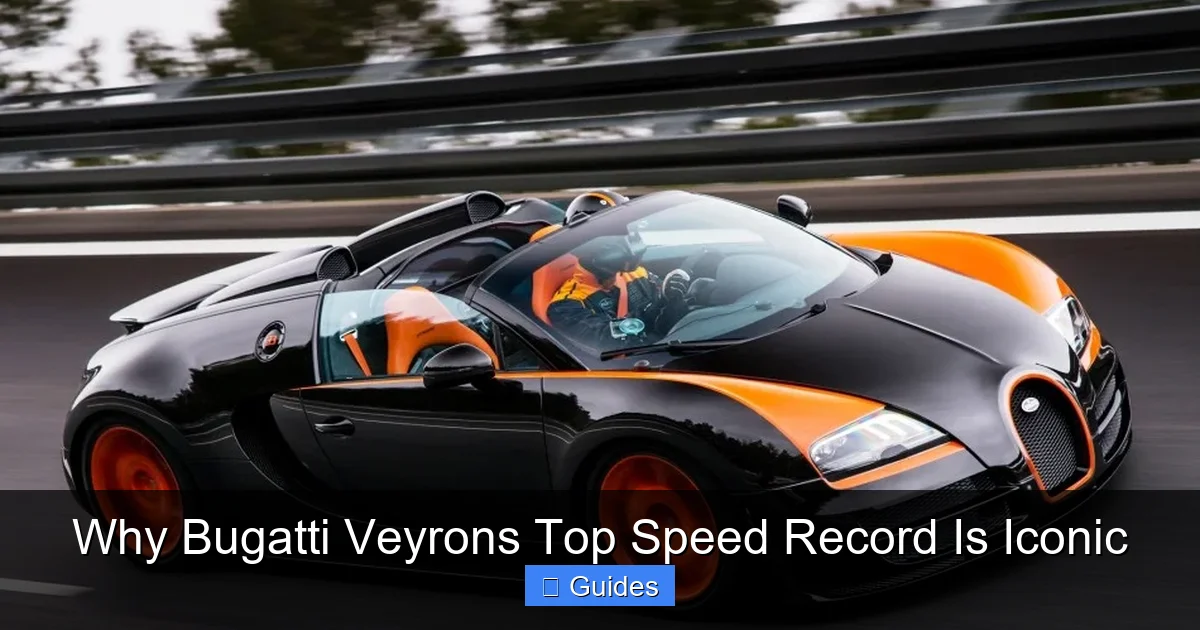
The Bugatti Veyron didn’t just make headlines in automotive magazines—it became a cultural phenomenon. It appeared in movies like “Fast & Furious: Tokyo Drift” and “Iron Man 2,” where Tony Stark’s garage featured a Veyron as a symbol of ultimate wealth and power. Rappers like Jay-Z and 50 Cent referenced it in their lyrics, calling it the “fastest thing on the planet.” Even video games like “Need for Speed” and “Gran Turismo” featured the Veyron as a top-tier vehicle, letting players experience its speed virtually.
But its influence went beyond entertainment. The Veyron became a status symbol. Owning one wasn’t just about having a fast car—it was about being part of an elite club. With a price tag starting around $1.7 million (and later exceeding $3 million for special editions), it was out of reach for all but the wealthiest. Yet, it wasn’t just about money. It was about exclusivity, craftsmanship, and the pursuit of perfection. Each Veyron was hand-built in Molsheim, France, by a team of master engineers and artisans. The attention to detail was unmatched—from the hand-stitched leather interiors to the polished aluminum finishes.
The car also sparked conversations about the future of automotive technology. Could electric cars ever match its performance? Would autonomous vehicles make speed irrelevant? The Veyron stood as a reminder that, for all the advances in efficiency and safety, there’s still something magical about raw, mechanical power. It inspired a generation of engineers, designers, and car enthusiasts to dream bigger.
And let’s not forget the emotional impact. For many, seeing a Veyron in person—or even just hearing its engine roar—was a life-changing moment. It wasn’t just a machine; it was a work of art. A symbol of what humans can achieve when they set their minds to something extraordinary.
Challenges and Criticisms: The Price of Perfection
Of course, the Veyron wasn’t without its critics. Some called it over-engineered, arguing that such extreme performance had little practical use. Others questioned the environmental impact of a car that could burn through a gallon of fuel in under a minute at top speed. And then there was the cost—not just the purchase price, but the maintenance. Tires cost $40,000 a set and needed replacing every few thousand miles. A full service could run into the tens of thousands. Fuel economy? Around 8 mpg in the city, if you were lucky.
But Bugatti never claimed the Veyron was practical. It was a statement. A proof of concept. A machine built not for efficiency, but for excellence. And in that, it succeeded beyond anyone’s expectations. The challenges it faced—cooling, aerodynamics, tire durability—weren’t flaws; they were opportunities to innovate. Every problem solved made the car better, stronger, and more capable.
There were also concerns about safety. At 250+ mph, even a small mistake could be catastrophic. But Bugatti designed the Veyron with multiple safety systems: advanced traction control, electronic stability programs, and a reinforced carbon-fiber monocoque chassis. The car could also lower its ride height at high speeds to improve stability and deploy a rear wing to increase downforce. It wasn’t just fast—it was smart.
And while the Veyron wasn’t designed for racing, it still performed impressively on the track. In 2008, a Veyron completed the Nürburgring Nordschleife in under 7 minutes and 40 seconds—a time that rivaled many dedicated sports cars. It proved that speed and handling weren’t mutually exclusive.
Legacy and the Road Ahead
Today, the Bugatti Veyron is no longer in production, replaced by the even more powerful Chiron and Bolide. But its legacy lives on. The Chiron, with 1,500 horsepower and a top speed of 304 mph (electronically limited), builds directly on the Veyron’s foundation. It uses the same W16 engine architecture, refined aerodynamics, and a focus on luxury and performance. In many ways, the Chiron is the Veyron’s spiritual successor—pushing the boundaries even further.
But the Veyron will always hold a special place in history. It was the first. The pioneer. The car that proved 250 mph was possible in a production vehicle. It inspired a new era of hypercars, where speed, technology, and design converge. And it showed that innovation isn’t just about going faster—it’s about redefining what’s possible.
For car enthusiasts, the Veyron remains a benchmark. A symbol of engineering excellence. A reminder that sometimes, the pursuit of a single number—253.8 mph—can change the world. It’s not just a car. It’s a milestone. A moment in time when humanity reached a little higher, pushed a little harder, and achieved something extraordinary.
And that’s why the Bugatti Veyron’s top speed record isn’t just iconic—it’s immortal.
Frequently Asked Questions
What was the Bugatti Veyron’s top speed?
The Bugatti Veyron 16.4 reached a top speed of 253.8 mph in 2005, making it the fastest production car at the time. The Super Sport version later achieved 267.857 mph, officially recognized by Guinness World Records.
How long did the Veyron hold the top speed record?
The Veyron held the title of world’s fastest production car for nearly a decade, from 2005 until 2010 when its Super Sport variant broke its own record, and eventually being surpassed by the Bugatti Chiron and other hypercars.
What engine did the Bugatti Veyron use?
The Veyron featured an 8.0-liter quad-turbocharged W16 engine, producing 1,001 horsepower in the standard model and 1,200 hp in the Super Sport version. It was one of the most powerful engines ever used in a production car.
Was the Veyron street-legal?
Yes, the Bugatti Veyron was a fully street-legal production car. Owners could drive it on public roads, though its extreme performance and high maintenance costs made it more of a collector’s item than a daily driver.
How much did a Bugatti Veyron cost?
The original Veyron had a starting price of around $1.7 million, with special editions and options pushing the cost well over $3 million. Maintenance, tires, and fuel added significant ongoing expenses.
What made the Veyron’s tires so special?
Bugatti partnered with Michelin to develop custom PAX run-flat tires reinforced with Kevlar. These tires were designed to withstand extreme speeds and forces, requiring specialized inflation and inspection during top speed runs.

At CarLegit, we believe information should be clear, factual, and genuinely helpful. That’s why every guide, review, and update on our website is created with care, research, and a strong focus on user experience.