
The Maserati Granturismo featured a 4.2L, 4.7L, or 4.7L S engine, depending on the model year and trim. These naturally aspirated V8s delivered thrilling performance, blending Italian craftsmanship with raw power for a truly iconic grand touring experience.
In This Article
- 1 Key Takeaways
- 2 📑 Table of Contents
- 3 Introduction: The Heart of a Maserati
- 4 Engine Overview: What Size Motor Was in the Maserati Granturismo?
- 5 Engine Specifications and Technical Details
- 6 Performance and Driving Experience
- 7 Maintenance and Ownership Considerations
- 8 Legacy and Cultural Impact
- 9 Conclusion: More Than Just a Number
- 10 Frequently Asked Questions
- 10.1 What size motor was in the Maserati Granturismo?
- 10.2 Was the Maserati Granturismo engine turbocharged?
- 10.3 Which Maserati Granturismo had the most powerful engine?
- 10.4 What transmission did the Maserati Granturismo use?
- 10.5 How fast was the Maserati Granturismo?
- 10.6 Is the Maserati Granturismo reliable?
Key Takeaways
- Engine Options: The Maserati Granturismo came with three main engine sizes: 4.2-liter, 4.7-liter, and a high-performance 4.7-liter S variant.
- V8 Power: All engines were naturally aspirated V8s, built in collaboration with Ferrari, emphasizing smooth power delivery and a signature exhaust note.
- Horsepower Range: Output ranged from 405 hp in the 4.2L to 454 hp in the 4.7L S, making it a true performance grand tourer.
- Model Year Variations: Engine availability changed over time, with the 4.2L phased out after 2011 and the 4.7L becoming the standard.
- Transmission Choices: Most models used a 6-speed automatic, while the MC Shift version offered paddle-shifted manual control.
- Performance Stats: 0-60 mph times ranged from 5.0 to 4.5 seconds, depending on the engine and drivetrain.
- Legacy and Sound: The Granturismo’s engine wasn’t just about size—it was about emotion, with a sonorous exhaust note that defined the Maserati experience.
📑 Table of Contents
Introduction: The Heart of a Maserati
When you think of Maserati, you don’t just think of sleek Italian design or luxury interiors—you think of sound. That deep, throaty roar that echoes through mountain passes and city streets alike. And at the center of that iconic experience is the engine. So, what size motor was in the Maserati Granturismo? It’s a question that gets to the core of what makes this grand tourer so special.
The Maserati Granturismo, produced from 2007 to 2020, wasn’t just a car—it was a statement. Designed to compete with the likes of the Porsche 911 and Aston Martin Vantage, it combined elegance, performance, and that unmistakable Italian flair. But beneath its sculpted hood lay a range of powerful V8 engines, each with its own character and performance profile. Whether you’re a car enthusiast, a potential buyer, or just curious about high-performance machinery, understanding the engine options in the Granturismo gives you a deeper appreciation for what this car represents.
Engine Overview: What Size Motor Was in the Maserati Granturismo?
So, let’s answer the big question: what size motor was in the Maserati Granturismo? The short answer is that it depended on the model year and trim level. Over its 13-year production run, the Granturismo offered three primary engine displacements: the 4.2-liter V8, the 4.7-liter V8, and the high-performance 4.7-liter S variant. All were naturally aspirated, front-mounted V8 engines, hand-assembled with precision and built to deliver both power and soul.
Visual guide about What Size Motor Was in the Maserati Granturismo
Image source: secure.img1-cg.wfcdn.com
Unlike many modern performance cars that rely on turbocharging or hybrid systems, the Granturismo stayed true to its roots with naturally aspirated engines. This meant no turbo lag, instant throttle response, and a linear power curve that made driving feel intuitive and engaging. The engines were developed in partnership with Ferrari, which explains their high-revving nature and race-bred DNA. Whether you were cruising along the Amalfi Coast or pushing it on a track day, the Granturismo’s engine was designed to deliver a thrilling experience.
The 4.2-Liter V8: The Entry-Level Powerhouse
The original engine offered in the Maserati Granturismo at launch in 2007 was the 4.2-liter V8. This engine produced 405 horsepower and 339 lb-ft of torque, which was impressive for a grand tourer of its era. Built on a 90-degree V8 architecture, it featured a 104 mm bore and 85.5 mm stroke, giving it a slightly oversquare design that favored high-revving performance.
The 4.2L engine was available in the base Granturismo and the Granturismo Sport (introduced in 2009). It was paired with a 6-speed automatic transmission, with an optional MC Shift version offering paddle shifters for a more driver-focused experience. While it was the smallest engine in the lineup, it was far from underwhelming. With a 0-60 mph time of around 5.0 seconds and a top speed of 177 mph, it held its own against competitors and delivered the kind of performance expected from a Maserati.
One of the standout features of the 4.2L was its sound. Even without the larger displacement, it produced a rich, resonant exhaust note that turned heads wherever it went. The engine was mounted behind the front axle, contributing to a near-perfect 52:48 front-to-rear weight distribution, which enhanced handling and balance. For drivers who wanted a more refined, less aggressive experience, the 4.2L was an excellent choice.
The 4.7-Liter V8: More Displacement, More Drama
In 2009, Maserati introduced the 4.7-liter V8 as an upgrade option, and by 2011, it had replaced the 4.2L as the standard engine in the Granturismo. This larger displacement engine delivered 433 horsepower and 361 lb-ft of torque, offering a noticeable bump in performance and responsiveness.
The 4.7L engine shared much of its architecture with the 4.2L but featured a longer stroke (89 mm) and increased displacement, allowing for greater torque and a broader power band. It was available in the Granturismo S and later became the standard engine across most trims. The 0-60 mph time dropped to around 4.7 seconds, and the top speed increased to 180 mph, making it a serious contender in the high-performance GT segment.
One of the key improvements with the 4.7L was the use of variable valve timing (VVT) on both the intake and exhaust camshafts. This allowed for better efficiency at low RPMs and more aggressive valve timing at high RPMs, optimizing both drivability and performance. The engine also featured a revised intake manifold and improved exhaust system, which enhanced airflow and contributed to a more aggressive exhaust note.
The 4.7-Liter S: The Performance King
For those who wanted even more power, Maserati offered the 4.7-liter S engine, introduced in the Granturismo MC Stradale and later available in the Granturismo Sport and Granturismo MC. This high-performance variant produced 454 horsepower and 376 lb-ft of torque, making it the most powerful naturally aspirated V8 ever fitted to a production Maserati at the time.
The “S” stood for “Sport,” and it lived up to the name. The engine featured higher compression ratios, revised cam profiles, and a more aggressive ECU tune. It also included a lightweight flywheel and performance-oriented intake and exhaust systems. The result was a car that could sprint from 0 to 60 mph in just 4.5 seconds and reach a top speed of 185 mph.
The MC Stradale version, in particular, was designed with track performance in mind. It featured a stiffer suspension, carbon-ceramic brakes, and a reduced weight of over 200 pounds compared to the standard Granturismo. The 4.7L S engine was the heart of this performance package, delivering not just speed, but an emotional driving experience that few cars could match.
Engine Specifications and Technical Details
To truly understand what size motor was in the Maserati Granturismo, it helps to look at the technical specifications. All three engines were 90-degree V8s with aluminum blocks and heads, four valves per cylinder, and a dry-sump lubrication system for improved oil control during high-G cornering.
The 4.2L engine had a bore and stroke of 104 mm x 85.5 mm, giving it a total displacement of 4,244 cc. The 4.7L and 4.7L S engines shared the same bore (104 mm) but had a longer stroke of 89 mm, resulting in a displacement of 4,691 cc. Both the 4.7L and 4.7L S used forged steel connecting rods and forged aluminum pistons for durability under high loads.
All engines were naturally aspirated, meaning they relied solely on atmospheric pressure to fill the cylinders—no turbos, no superchargers. This gave them a linear power delivery that many enthusiasts prefer over the sudden surge of forced induction. The redline for the 4.2L was around 7,000 rpm, while the 4.7L and 4.7L S could rev up to 7,500 rpm, making them feel alive and eager at high speeds.
Fuel delivery was handled by a multi-point electronic fuel injection system, and ignition was managed by individual coil-on-plug units for precise spark timing. The engines were designed to run on 95-octane fuel, though 91-octane could be used with a slight reduction in performance.
Transmission and Drivetrain
The Maserati Granturismo was offered with two transmission options: a 6-speed automatic and a 6-speed automated manual known as MC Shift. The automatic was smooth and well-suited for daily driving, with adaptive shift logic that learned driving habits. The MC Shift version, available on the MC Stradale and later models, used paddle shifters and could change gears in as little as 150 milliseconds, offering a more engaging driving experience.
All Granturismos were rear-wheel drive, with power sent through a limited-slip differential for improved traction and cornering stability. The drivetrain was designed to balance performance and refinement, making the car equally at home on a winding road or a long highway cruise.
Performance and Driving Experience
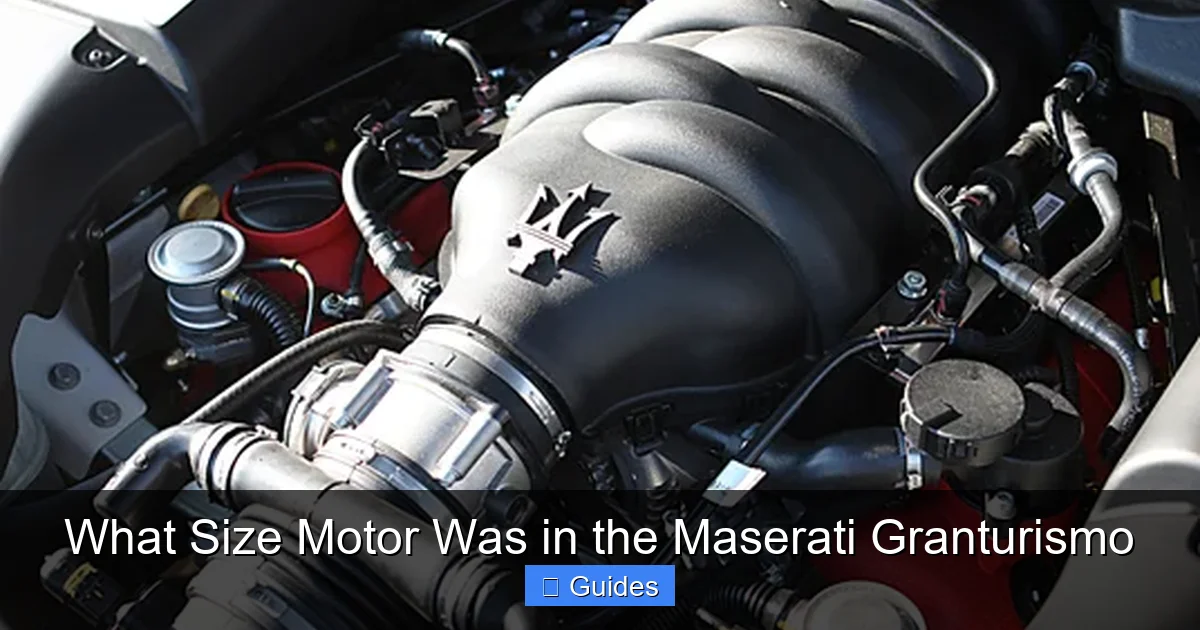
When you ask what size motor was in the Maserati Granturismo, you’re really asking about the driving experience. And the answer is: exhilarating. Whether you were behind the wheel of a 4.2L or a 4.7L S, the Granturismo delivered a blend of power, sound, and handling that few cars could match.
Visual guide about What Size Motor Was in the Maserati Granturismo
Image source: motortrend.com
The 4.2L engine, while the smallest, still offered plenty of punch. It had a smooth, linear power delivery that made it easy to drive in traffic, yet it could still thrill when pushed. The 4.7L and 4.7L S engines, on the other hand, were more aggressive. They pulled strongly from low RPMs and sang as the revs climbed, with a soundtrack that was pure Italian opera.
One of the standout features of the Granturismo was its exhaust system. Maserati engineers spent countless hours tuning the exhaust note to be both deep and melodic, with a crackle on overrun that became a signature trait. The sound wasn’t just noise—it was part of the experience.
Handling was another strong point. With near-perfect weight distribution and a double-wishbone front suspension, the Granturismo felt planted and responsive. The steering was precise, and the chassis offered a great balance between comfort and sportiness. It wasn’t as razor-sharp as a Porsche 911, but it was more comfortable on long drives—exactly what a grand tourer should be.
Real-World Performance Examples
Let’s put it into perspective. A 2010 Maserati Granturismo S with the 4.7L engine could accelerate from 0 to 60 mph in 4.7 seconds. That’s faster than a contemporary BMW M6 or Mercedes-Benz SL550. The MC Stradale, with the 4.7L S engine, could do it in 4.5 seconds—on par with many supercars of the time.
In real-world driving, the Granturismo felt effortless. Whether you were merging onto a highway or carving through mountain roads, the engine responded instantly. The automatic transmission was smooth, but the MC Shift version added a layer of driver involvement that made every drive feel special.
Maintenance and Ownership Considerations
Owning a Maserati Granturismo is a dream for many, but it comes with responsibilities. The engines, while powerful and reliable when properly maintained, require regular care. Oil changes should be done every 5,000 miles using high-quality synthetic oil, and the dry-sump system means oil levels must be checked carefully.
The timing chains are designed to last the life of the engine, but it’s still wise to have them inspected during major services. The cooling system should be checked regularly, especially if the car is driven hard or in hot climates. The exhaust manifolds and headers can develop cracks over time, so listen for any unusual noises.
One common issue with the Granturismo is the electrical system. The CAN bus network can develop faults, leading to warning lights or malfunctions. Regular diagnostics and software updates can help prevent problems. Also, the MC Shift transmission, while fast, can be sensitive to low fluid levels or improper maintenance.
Despite these considerations, many owners find the Granturismo to be a rewarding car to own. The engines are robust, and with proper care, they can last well over 100,000 miles. The key is to use a knowledgeable mechanic familiar with Maserati and Ferrari engines.
Legacy and Cultural Impact
The Maserati Granturismo wasn’t just a car—it was a cultural icon. It appeared in movies, music videos, and even video games, cementing its place in popular culture. But more than that, it represented a commitment to tradition in an age of electrification and downsizing.
While many manufacturers were turning to turbocharged four-cylinders or hybrid systems, Maserati stuck with the naturally aspirated V8. It was a bold choice, and one that resonated with enthusiasts who valued sound, response, and emotion over raw efficiency. The Granturismo’s engine wasn’t just about size—it was about soul.
Even as production ended in 2020, the Granturismo remains a sought-after classic. Its combination of Italian design, Ferrari-built engines, and grand touring capability ensures its legacy will endure. And for those who ask what size motor was in the Maserati Granturismo, the answer is simple: it was the perfect size for the experience it delivered.
Conclusion: More Than Just a Number
So, what size motor was in the Maserati Granturismo? The answer isn’t just a number—it’s a story. It’s the story of a 4.2-liter V8 that started it all, a 4.7-liter that brought more power, and a 4.7-liter S that pushed the limits. It’s the story of naturally aspirated engines that sang with every rev, of transmissions that responded to your touch, and of a car that made every drive feel like an event.
The Granturismo wasn’t just about displacement or horsepower. It was about emotion, craftsmanship, and the joy of driving. It was a car that reminded us why we love cars in the first place. And while newer models may offer more technology or efficiency, few will ever match the raw, unfiltered experience of a Maserati Granturismo and its legendary V8 engine.
Frequently Asked Questions
What size motor was in the Maserati Granturismo?
The Maserati Granturismo came with three engine sizes: a 4.2-liter V8, a 4.7-liter V8, and a high-performance 4.7-liter S V8. The specific engine depended on the model year and trim level.
Was the Maserati Granturismo engine turbocharged?
No, all engines in the Maserati Granturismo were naturally aspirated V8s. They relied on atmospheric pressure rather than turbocharging or supercharging for power.
Which Maserati Granturismo had the most powerful engine?
The Granturismo MC Stradale and later MC models featured the 4.7-liter S V8, producing 454 horsepower—the most powerful naturally aspirated engine ever used in a production Maserati.
What transmission did the Maserati Granturismo use?
Most models used a 6-speed automatic transmission, while the MC Shift version offered paddle shifters for faster, manual-style gear changes.
How fast was the Maserati Granturismo?
Depending on the engine, 0-60 mph times ranged from 5.0 seconds (4.2L) to 4.5 seconds (4.7L S), with top speeds reaching up to 185 mph.
Is the Maserati Granturismo reliable?
With proper maintenance, the Granturismo can be reliable. However, it requires regular care, especially for the electrical system and dry-sump engine, and should be serviced by a knowledgeable mechanic.

At CarLegit, we believe information should be clear, factual, and genuinely helpful. That’s why every guide, review, and update on our website is created with care, research, and a strong focus on user experience.