
The Ford F150 fuel tank capacity varies by model year, cab configuration, and bed length, typically ranging from 23 to 36 gallons. Understanding your truck’s specific tank size helps you plan long trips, calculate fuel costs, and optimize driving range—especially important for work, towing, or off-road adventures.
If you’re driving a Ford F150—or thinking about buying one—you’ve probably asked yourself: “How many gallons does a Ford F150 hold?” It’s a simple question, but the answer isn’t always straightforward. Unlike some vehicles with a single standard fuel tank size, the F150 comes in multiple configurations, and each can have a different capacity. Whether you’re hauling lumber, towing a camper, or just commuting to work, knowing your truck’s fuel tank size helps you plan better, save money, and avoid those stressful “low fuel” moments.
The Ford F150 has been America’s best-selling truck for over four decades, and for good reason. It’s powerful, versatile, and built to handle everything from city streets to rugged job sites. But with so many engine options, cab styles, bed lengths, and trim levels, fuel tank sizes can vary widely. A regular cab with a short bed might have a smaller tank, while a crew cab with a long bed could come equipped with one of the largest tanks in the light-duty truck segment. Plus, advancements in fuel efficiency and hybrid technology mean that even trucks with similar tank sizes can deliver very different driving ranges.
In this guide, we’ll break down everything you need to know about Ford F150 fuel tank capacities. We’ll cover model years from the early 2000s to the latest 2024 releases, explain how different configurations affect tank size, and share practical tips for maximizing your fuel economy. Whether you’re a seasoned F150 owner or a first-time buyer, this article will help you understand exactly how many gallons your truck holds—and how far you can go on a full tank.
In This Article
- 1 Key Takeaways
- 2 📑 Table of Contents
- 3 Understanding Ford F150 Fuel Tank Variations
- 4 Ford F150 Fuel Tank Sizes by Model Year
- 5 How Engine Type Affects Fuel Range
- 6 Practical Tips for Maximizing Fuel Range
- 7 Real-World Examples and Scenarios
- 8 Conclusion
- 9 Frequently Asked Questions
- 9.1 What is the largest fuel tank available on a Ford F150?
- 9.2 Does the Ford F150 hybrid have a larger fuel tank?
- 9.3 Can I upgrade my F150’s fuel tank to hold more gallons?
- 9.4 How does towing affect fuel range in an F150?
- 9.5 Is it safe to run my F150 on E85 ethanol blend?
- 9.6 How can I check my F150’s exact fuel tank size?
Key Takeaways
- Fuel tank sizes vary significantly: Depending on the model year and configuration, Ford F150s hold between 23 and 36 gallons of gasoline or diesel.
- Newer models offer larger tanks: Recent F150s (2021–2024) often come with 26–36 gallon tanks, especially in crew cab and long-bed setups.
- EcoBoost and hybrid engines impact range: While tank size matters, engine efficiency plays a big role in how far you can go on a full tank.
- Towing and payload affect fuel economy: Heavier loads reduce miles per gallon, so even a large tank may not guarantee extended range under heavy use.
- Flex-fuel and diesel options exist: Some F150s support E85 ethanol blends or diesel fuel, which have different energy densities and range implications.
- Fuel gauge and low-fuel warnings help: Modern F150s include digital displays and alerts to prevent running out of gas unexpectedly.
- Plan refueling stops wisely: Knowing your truck’s range helps avoid getting stranded, especially in rural or remote areas.
📑 Table of Contents
Understanding Ford F150 Fuel Tank Variations
One of the first things to understand about the Ford F150 is that it’s not a one-size-fits-all vehicle. Ford offers the F150 in multiple cab configurations—Regular Cab, SuperCab, and SuperCrew—each with different interior space and seating capacity. Bed lengths also vary, typically coming in 5.5-foot, 6.5-foot, and 8-foot options. These design choices directly impact how much room is available under the truck for a fuel tank.
Because of this, Ford engineers have designed different fuel tank sizes to fit various combinations of cab and bed. For example, a Regular Cab with an 8-foot bed has more underbody space than a SuperCrew with a 5.5-foot bed, allowing for a larger fuel tank. Additionally, newer models often prioritize fuel efficiency and long-range capability, so Ford has gradually increased tank sizes over the years.
Another factor is the engine type. The F150 offers a range of powertrains, including the 3.3L V6, 2.7L EcoBoost V6, 5.0L V8, 3.5L EcoBoost V6, and the hybrid 3.5L PowerBoost V6. Some of these engines are more fuel-efficient than others, which can influence how Ford configures the fuel system. For instance, the hybrid PowerBoost engine is often paired with a larger tank to maximize the benefits of its electric assist and regenerative braking.
It’s also worth noting that Ford has introduced different fuel types over the years. Most F150s run on regular unleaded gasoline, but some models are flex-fuel capable, meaning they can use E85 (a blend of 85% ethanol and 15% gasoline). There have also been diesel options, like the 3.0L Power Stroke V6, which require a separate diesel fuel tank. Each fuel type has different energy content, so even with the same tank size, your range will vary depending on what you’re burning.
How Cab and Bed Configuration Affects Tank Size
Let’s take a closer look at how cab and bed choices influence fuel tank capacity. The Regular Cab, which seats two or three people, is the most compact option. It’s often used for work trucks and commercial applications. Because it has the shortest wheelbase and the most underbody space, it can accommodate larger fuel tanks—especially when paired with an 8-foot bed.
The SuperCab, which adds rear-hinged doors and extra seating, offers a balance between passenger space and cargo capacity. It’s a popular choice for contractors and families who need both hauling power and room for passengers. SuperCabs typically come with 6.5-foot or 8-foot beds, and their fuel tanks are usually mid-sized—larger than a Regular Cab with a short bed but smaller than a SuperCrew with a long bed.
The SuperCrew is the largest cab option, featuring four full-size doors and spacious rear seating. It’s ideal for families or anyone who frequently transports passengers. However, because the SuperCrew takes up more space, it often requires a compromise in bed length—most come with 5.5-foot or 6.5-foot beds. This can limit underbody space for the fuel tank, though Ford has worked around this by designing more efficient tank shapes and using advanced materials.
In general, the longer the bed and the smaller the cab, the larger the fuel tank can be. That’s why you’ll often see the largest tanks—up to 36 gallons—on Regular Cab or SuperCab models with 8-foot beds. Conversely, SuperCrew models with 5.5-foot beds may have smaller tanks, sometimes as low as 23 gallons, especially in older model years.
The Role of Model Year in Fuel Tank Capacity
Fuel tank sizes have evolved significantly over the years. In the early 2000s, most F150s came with tanks ranging from 22 to 26 gallons. These were adequate for the time, but as fuel prices rose and drivers demanded longer range, Ford began increasing tank sizes.
By the 2015 model year, Ford introduced larger tanks across many configurations, with some models offering up to 36 gallons. This was especially true for trucks equipped with the 3.5L EcoBoost engine, which was marketed for its towing power and efficiency. The 2018 refresh brought further improvements, including better aerodynamics and more efficient engines, allowing Ford to maximize range even with slightly smaller tanks.
The 2021 model year marked a major shift with the introduction of the hybrid PowerBoost engine. This system combines a 3.5L V6 with an electric motor and a 1.5 kWh battery, delivering impressive fuel economy for a full-size truck. To support this, Ford equipped many PowerBoost models with 36-gallon tanks, giving them a potential range of over 700 miles on a single fill-up—something unheard of in the pickup truck world just a decade ago.
Today’s 2024 F150s continue this trend, with most trims offering 26 to 36 gallon tanks depending on configuration. Ford has also improved fuel tank materials, using high-strength steel and composite plastics to reduce weight and increase durability. These advancements mean that modern F150s not only hold more fuel but also do so more safely and efficiently.
Ford F150 Fuel Tank Sizes by Model Year
Visual guide about How Many Gallons Does a Ford F150 Hold
Image source: appgecet.co.in
To give you a clearer picture, let’s break down the typical fuel tank capacities for the Ford F150 across different model years. Keep in mind that these are general ranges—actual sizes can vary based on trim, engine, and options.
2004–2008 Ford F150
During this period, the F150 was in its tenth generation. Most models came with a 26-gallon fuel tank, though some Regular Cab and long-bed configurations could have slightly larger tanks. The 5.4L Triton V8 was the most popular engine, offering strong towing but modest fuel economy. With a 26-gallon tank and around 14–16 mpg combined, drivers could expect a range of roughly 360–420 miles.
2009–2014 Ford F150
The eleventh-generation F150 introduced more engine options, including the first EcoBoost V6. Fuel tank sizes remained similar, with most trucks holding 26 to 28 gallons. The 3.5L EcoBoost, introduced in 2011, offered better fuel economy than the V8, allowing for longer range despite similar tank sizes. Some heavy-duty or commercial models could have larger tanks, but these were less common.
2015–2020 Ford F150
This generation brought a major redesign, including an aluminum body to reduce weight. Fuel tank sizes increased, with many models now offering 23 to 36 gallons depending on configuration. The 2.7L and 3.5L EcoBoost engines became popular for their balance of power and efficiency. Trucks with 8-foot beds and Regular or SuperCab configurations often had the largest tanks—up to 36 gallons. With improved aerodynamics and engine tech, range improved significantly, with some models achieving over 500 miles on a tank.
2021–2024 Ford F150
The current generation features the most advanced powertrains and the largest fuel tanks. Most 2021–2024 F150s come with 26 to 36 gallon tanks. The hybrid PowerBoost engine, available on Lariat, King Ranch, and Platinum trims, is often paired with a 36-gallon tank. Even non-hybrid models benefit from larger tanks and better efficiency. For example, a 2023 F150 with the 2.7L EcoBoost and a 36-gallon tank can achieve over 600 miles of range under ideal conditions.
It’s also worth noting that Ford offers a “Max Tow” package on many trims, which includes a larger fuel tank (usually 36 gallons) to support long-distance towing. This package is ideal for RVers, boaters, and anyone who needs to pull heavy loads over long distances.
How Engine Type Affects Fuel Range
Visual guide about How Many Gallons Does a Ford F150 Hold
Image source: roadmomentum.com
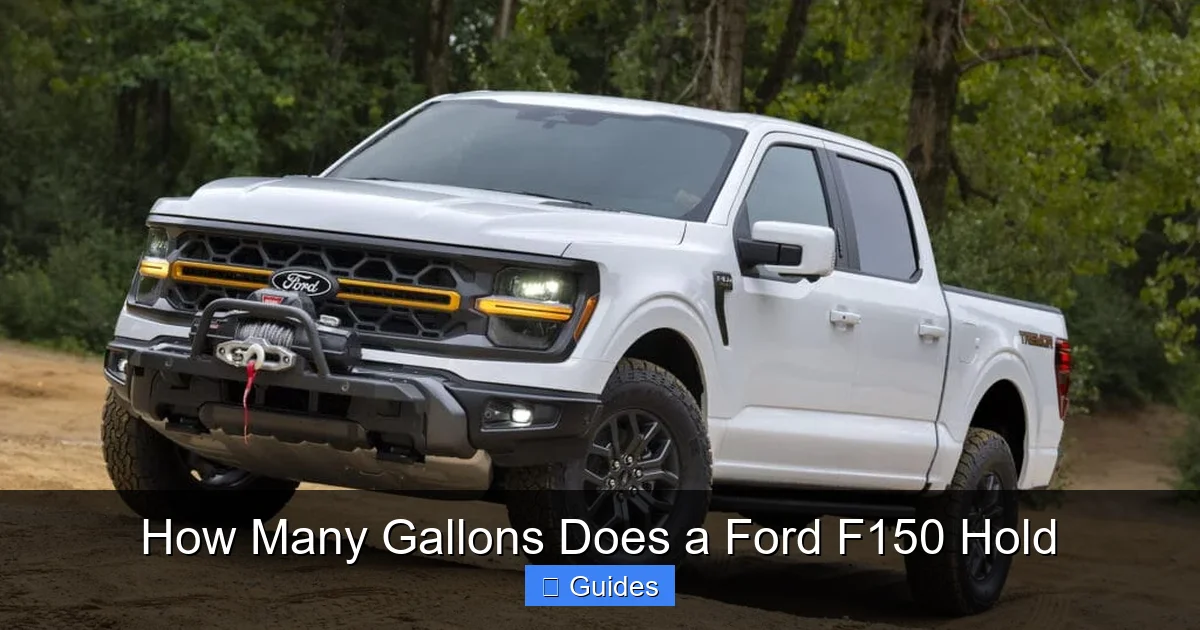
While fuel tank size is important, it’s only half the story. The engine you choose plays a huge role in how far you can go on a full tank. Let’s compare a few popular F150 engines and their real-world fuel economy.
The 3.3L Ti-VCT V6 is the base engine on many F150s. It’s reliable and efficient, delivering around 20–22 mpg combined. With a 26-gallon tank, that gives you a range of about 520–570 miles. It’s a great choice for daily driving and light hauling.
The 2.7L EcoBoost V6 offers more power and slightly better efficiency, with around 21–24 mpg combined. Paired with a 36-gallon tank, it can easily exceed 800 miles of range—perfect for long road trips or remote work sites.
The 5.0L V8 is a favorite among traditionalists. It delivers strong low-end torque and a satisfying exhaust note, but fuel economy is lower—around 17–19 mpg combined. With a 26-gallon tank, expect a range of 440–500 miles. It’s best for those who prioritize power over efficiency.
The 3.5L EcoBoost V6 is the towing champion, capable of pulling over 13,000 pounds. It gets around 18–22 mpg combined, depending on load. With a 36-gallon tank, range can reach 650–790 miles, making it ideal for long towing trips.
Finally, the 3.5L PowerBoost hybrid combines a V6 with an electric motor. It delivers up to 25 mpg combined and can travel over 700 miles on a 36-gallon tank. It’s the most efficient F150 yet, especially in stop-and-go traffic where the electric motor shines.
Flex-Fuel and Diesel Options
Some F150s are flex-fuel capable, meaning they can run on E85 ethanol blend. While E85 is cheaper per gallon, it has about 25–30% less energy than gasoline, so your range will drop significantly. For example, a truck that gets 20 mpg on gasoline might only get 14–16 mpg on E85. If you frequently use E85, you’ll need to refuel more often, even with a large tank.
Diesel options, like the 3.0L Power Stroke V6 (available 2018–2021), offer excellent fuel economy—up to 25 mpg combined. Diesel has more energy per gallon than gasoline, so even with a slightly smaller tank, range can be impressive. However, diesel fuel is more expensive, and maintenance costs are higher.
Practical Tips for Maximizing Fuel Range
Visual guide about How Many Gallons Does a Ford F150 Hold
Image source: datamyte.com
Knowing how many gallons your Ford F150 holds is just the beginning. To get the most out of every tank, follow these practical tips:
Maintain Proper Tire Pressure
Underinflated tires increase rolling resistance, which reduces fuel economy. Check your tire pressure monthly and keep it at the recommended level (usually listed on the driver’s door jamb). Properly inflated tires can improve mileage by up to 3%.
Reduce Weight and Drag
Remove unnecessary items from your bed and cab. Extra weight burns more fuel. Also, avoid using bed covers or racks unless needed—they can increase aerodynamic drag, especially at highway speeds.
Use Cruise Control on Highways
Cruise control helps maintain a steady speed, which improves fuel efficiency. On long trips, it can make a noticeable difference in your overall mileage.
Plan Your Routes
Use GPS apps that show traffic and fuel prices. Avoiding congestion and choosing routes with fewer stops can save fuel. If you’re towing, plan for gas stations along the way—some remote areas have limited options.
Keep Up with Maintenance
Regular oil changes, air filter replacements, and spark plug checks keep your engine running efficiently. A well-maintained F150 will always outperform a neglected one in terms of fuel economy.
Use the Right Fuel
Unless your truck is flex-fuel or diesel capable, stick to regular unleaded gasoline. Using premium fuel in a non-turbo engine won’t improve performance or efficiency—it’s just a waste of money.
Real-World Examples and Scenarios
Let’s look at a few real-world scenarios to see how fuel tank size and engine choice affect range.
Imagine you’re driving a 2022 Ford F150 SuperCrew with the 2.7L EcoBoost and a 36-gallon tank. You’re taking a cross-country trip from Denver to Chicago—about 1,000 miles. With an average of 22 mpg, you’ll use about 45 gallons of fuel. That means you’ll need to stop for gas at least twice, even with a full tank. But if you start with a full tank and refuel when you hit half, you’ll have plenty of buffer.
Now consider a 2016 F150 Regular Cab with the 5.0L V8 and a 26-gallon tank. You’re towing a 7,000-pound trailer on a 300-mile trip. Towing reduces fuel economy to around 12 mpg. That means you’ll burn about 25 gallons—almost your entire tank. You’ll need to refuel before the trip or plan a stop along the way.
Finally, picture a 2023 F150 PowerBoost hybrid with a 36-gallon tank. You’re commuting 60 miles round-trip daily in mixed city and highway driving. With 25 mpg, you’ll use about 2.4 gallons per day. That means you can go over a week without refueling—even with a full household and weekend errands.
These examples show why knowing your truck’s fuel capacity and efficiency is so important. It helps you plan trips, budget for fuel, and avoid getting stranded.
Conclusion
So, how many gallons does a Ford F150 hold? The answer depends on your model year, cab configuration, bed length, and engine choice—but most modern F150s hold between 23 and 36 gallons. Newer models, especially those with hybrid engines or long beds, tend to have the largest tanks, offering impressive range for both daily driving and long-haul towing.
Understanding your F150’s fuel capacity isn’t just about numbers—it’s about peace of mind. Whether you’re heading out on a family road trip, hauling equipment to a job site, or exploring remote trails, knowing how far you can go on a full tank helps you drive with confidence.
By choosing the right configuration, maintaining your truck, and driving efficiently, you can maximize every gallon and get the most out of your Ford F150. After all, this isn’t just a truck—it’s a tool, a companion, and for many, a way of life.
Frequently Asked Questions
What is the largest fuel tank available on a Ford F150?
The largest fuel tank available on a Ford F150 is 36 gallons. This is typically found on newer models (2021–2024) with long beds, Regular Cab or SuperCab configurations, and certain trims like the PowerBoost hybrid or Max Tow package.
Does the Ford F150 hybrid have a larger fuel tank?
Yes, many Ford F150 PowerBoost hybrid models come equipped with a 36-gallon fuel tank—the largest available. This, combined with the hybrid system’s efficiency, allows for exceptional range, often exceeding 700 miles on a single tank.
Can I upgrade my F150’s fuel tank to hold more gallons?
Ford does not offer factory upgrades to increase fuel tank size beyond the standard options. However, some aftermarket companies sell larger auxiliary tanks, though these may require professional installation and could affect warranty coverage.
How does towing affect fuel range in an F150?
Towing significantly reduces fuel economy—sometimes by 30–50% depending on weight and terrain. Even with a large tank, you may need to refuel more often when towing heavy loads over long distances.
Is it safe to run my F150 on E85 ethanol blend?
Only if your F150 is flex-fuel capable. Running E85 in a non-flex-fuel engine can damage fuel system components. Check your owner’s manual or the gas cap for the flex-fuel logo before using E85.
How can I check my F150’s exact fuel tank size?
Your owner’s manual is the best source for your specific model’s fuel tank capacity. You can also check Ford’s official website or contact a dealership with your VIN for precise information.

At CarLegit, we believe information should be clear, factual, and genuinely helpful. That’s why every guide, review, and update on our website is created with care, research, and a strong focus on user experience.