
The Nissan Rogue and Nissan Kicks each offer unique strengths depending on your needs. The Rogue is ideal for families wanting more space and power, while the Kicks shines as a fuel-efficient, budget-friendly city SUV with modern tech.
If you’re in the market for a reliable, stylish, and practical SUV from Nissan, you’ve probably come across two popular models: the Nissan Rogue and the Nissan Kicks. Both are designed to meet the needs of modern drivers, but they cater to very different lifestyles. Whether you’re a busy parent shuttling kids to school, a young professional navigating city streets, or someone who loves weekend adventures, choosing between these two can feel overwhelming.
The good news? You don’t have to guess. In this detailed comparison, we’ll break down every important aspect—from size and performance to tech, safety, and value—so you can make an informed decision. We’ll look at real-world driving experiences, ownership costs, and which model fits your daily routine best. By the end, you’ll know exactly whether the Rogue or the Kicks is the right Nissan for you.
Let’s dive in.
In This Article
- 1 Key Takeaways
- 2 📑 Table of Contents
- 3 Size and Interior Space: Room to Grow or Compact Convenience?
- 4 Performance and Driving Experience: Power vs. Efficiency
- 5 Technology and Infotainment: Staying Connected
- 6 Safety Ratings and Reliability: Peace of Mind on the Road
- 7 Pricing and Value: Which Offers More for Your Money?
- 8 Which One Is Right for You?
- 9 Final Thoughts
- 10 Frequently Asked Questions
- 10.1 Is the Nissan Rogue bigger than the Nissan Kicks?
- 10.2 Which gets better gas mileage, the Rogue or the Kicks?
- 10.3 Does the Nissan Kicks have all-wheel drive?
- 10.4 Which SUV has more advanced safety features?
- 10.5 Is the Nissan Rogue worth the extra cost over the Kicks?
- 10.6 Can the Nissan Kicks seat seven passengers?
Key Takeaways
- Size & Space: The Rogue is a midsize SUV with three rows (optional) and ample cargo room, while the Kicks is a compact crossover with seating for five and less interior volume.
- Performance: The Rogue offers a more powerful engine and available all-wheel drive, making it better for highways and rough weather, whereas the Kicks focuses on fuel efficiency with a smaller engine and front-wheel drive only.
- Fuel Economy: The Kicks leads in fuel efficiency, averaging up to 31 mpg combined, compared to the Rogue’s 28–29 mpg, making it a smarter choice for daily commuters.
- Technology & Safety: Both come with Nissan’s Safety Shield 360, but the Rogue offers more advanced driver aids and a larger infotainment screen in higher trims.
- Pricing: The Kicks starts significantly lower, making it a great entry-level option, while the Rogue offers more premium features at a higher price point.
- Driving Experience: The Rogue feels more refined and stable on the road, while the Kicks is nimble and easy to park in tight urban spaces.
- Best For: Families and road-trippers should lean toward the Rogue; city dwellers and first-time buyers will love the Kicks.
📑 Table of Contents
- Size and Interior Space: Room to Grow or Compact Convenience?
- Performance and Driving Experience: Power vs. Efficiency
- Technology and Infotainment: Staying Connected
- Safety Ratings and Reliability: Peace of Mind on the Road
- Pricing and Value: Which Offers More for Your Money?
- Which One Is Right for You?
- Final Thoughts
Size and Interior Space: Room to Grow or Compact Convenience?
One of the first things you’ll notice when comparing the Nissan Rogue and Nissan Kicks is the difference in size. The Rogue is a midsize SUV, while the Kicks is a subcompact crossover. This distinction affects everything from passenger comfort to cargo capacity.
Passenger Comfort and Seating
The Nissan Rogue offers seating for five, with an optional third row in some trims (though it’s quite tight and best suited for small children). The second row is spacious, with plenty of legroom and headroom—ideal for taller passengers or long road trips. The seats are supportive and well-padded, making the Rogue a comfortable ride for families or frequent travelers.
In contrast, the Nissan Kicks seats five as well, but the rear seat is noticeably tighter. It’s fine for kids or short adults on short drives, but taller passengers might feel cramped on longer journeys. The front seats are comfortable, and the driving position is upright, which many drivers find helpful for visibility in city traffic.
If you regularly carry three or more passengers—especially adults—the Rogue is the clear winner in terms of comfort and space.
Cargo Capacity and Flexibility
Cargo space is another major differentiator. The Rogue offers up to 36.5 cubic feet of cargo space behind the second row, and that expands to 74.1 cubic feet when the rear seats are folded down. That’s enough room for strollers, luggage, groceries, or even a weekend’s worth of camping gear.
The Kicks, while smaller, still offers a respectable 25.3 cubic feet behind the rear seats and 53.1 cubic feet with the seats folded. That’s plenty for daily errands, a few suitcases, or a small dog. But if you’re planning road trips, moving furniture, or hauling sports equipment regularly, the Rogue’s extra space will be a big advantage.
Both SUVs feature 60/40 split-folding rear seats, so you can carry longer items while still seating passengers. The Rogue also offers underfloor storage in some trims, adding a bit of hidden space for valuables or emergency supplies.
Interior Quality and Materials
Inside, the Rogue feels more upscale. Higher trims feature soft-touch materials, available leather upholstery, and a more refined dashboard layout. The cabin is quieter, with better insulation against road and wind noise—especially noticeable on highways.
The Kicks, while not luxurious, has a clean, modern interior with durable materials. It’s designed for practicality and ease of use. The dashboard is simple, with physical buttons for climate control (a plus for many drivers), and the overall feel is youthful and energetic. It won’t wow you with luxury, but it’s well-built and functional.
If interior comfort and a more premium feel matter to you, the Rogue wins. But if you’re looking for a no-fuss, easy-to-clean cabin that gets the job done, the Kicks holds its own.
Performance and Driving Experience: Power vs. Efficiency
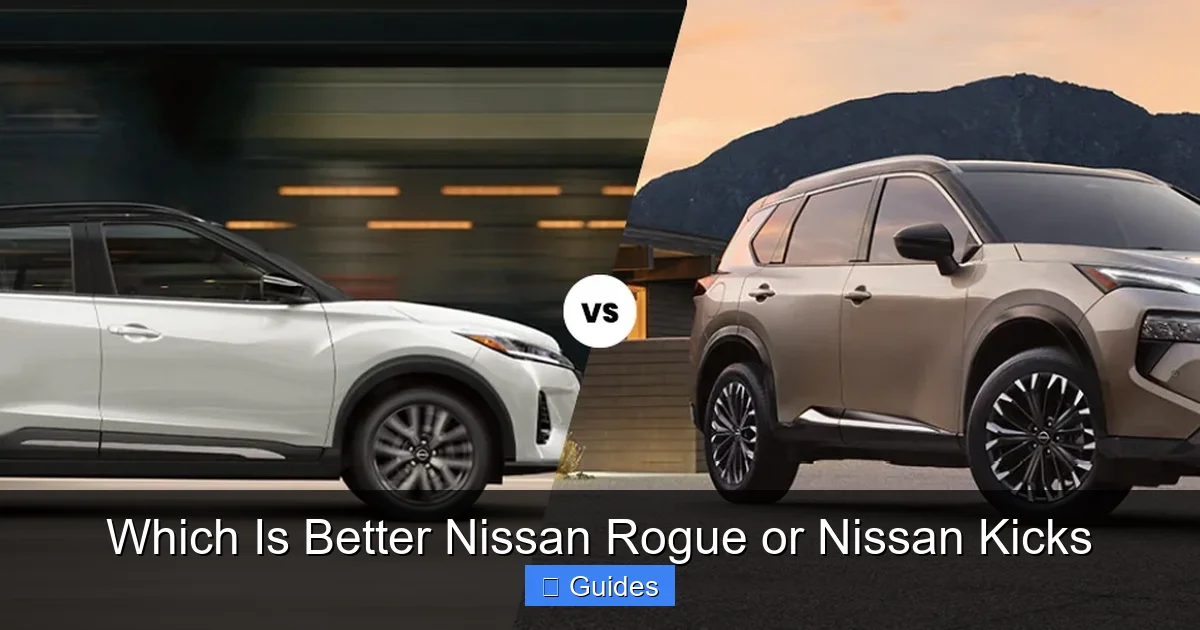
Visual guide about Which Is Better Nissan Rogue or Nissan Kicks
Image source: dealerinspire-image-library-prod.s3.us-east-1.amazonaws.com
When it comes to how these SUVs drive, the differences are significant. The Rogue and Kicks are built for different kinds of driving—so your lifestyle will heavily influence which one suits you better.
Engine and Power Output
The Nissan Rogue comes with a 1.5-liter turbocharged three-cylinder engine that delivers 201 horsepower and 225 lb-ft of torque. It’s paired with a continuously variable transmission (CVT) and offers front-wheel drive (FWD) or optional all-wheel drive (AWD). This engine provides strong acceleration, especially from a stop, and handles highway merging and passing with confidence.
The Kicks, on the other hand, uses a 1.6-liter four-cylinder engine that produces 122 horsepower and 114 lb-ft of torque. It’s also paired with a CVT, but only front-wheel drive is available. While it’s not the most powerful engine on the market, it’s smooth and adequate for city driving and light highway use.
If you need power for towing, mountain driving, or frequent highway travel, the Rogue’s turbocharged engine is a major advantage. The Kicks is best suited for flat terrain and stop-and-go traffic.
Fuel Economy: Saving at the Pump
Here’s where the Kicks shines. Thanks to its smaller engine and lighter weight, the Kicks achieves excellent fuel economy. It averages up to 31 mpg combined (28 city / 34 highway), making it one of the most fuel-efficient SUVs in its class.
The Rogue, while still efficient for a midsize SUV, averages around 28–29 mpg combined (26–27 city / 32–33 highway), depending on the drivetrain. That’s still good, but not quite as impressive as the Kicks.
If you drive a lot—especially in the city—the Kicks will save you money at the gas pump over time. For example, driving 15,000 miles a year at $3.50 per gallon, the Kicks could save you over $100 annually compared to the Rogue. Over five years, that adds up to more than $500 in fuel savings.
Handling and Ride Quality
The Rogue offers a more composed and stable ride, especially at higher speeds. It handles well on curvy roads and feels planted during lane changes. The steering is responsive, and the suspension absorbs bumps and potholes effectively.
The Kicks is nimble and easy to maneuver, perfect for tight parking spots and narrow streets. Its smaller size makes it feel agile in traffic, but it can feel a bit floaty at highway speeds, and crosswinds may affect stability more than in the Rogue.
If you do a lot of highway driving or live in an area with rough roads, the Rogue’s superior ride quality and stability are worth considering. But if you’re mostly driving in the city, the Kicks’ agility and ease of parking are major pluses.
All-Wheel Drive: Traction When You Need It
Another key difference: the Rogue offers optional all-wheel drive, which improves traction in rain, snow, or light off-road conditions. This makes it a better choice for drivers in colder climates or areas with unpredictable weather.
The Kicks is front-wheel drive only. While FWD is fine for most city and suburban driving, it can struggle in heavy snow or slippery conditions. If you live where winter weather is a concern, the Rogue’s AWD capability could be a deciding factor.
Technology and Infotainment: Staying Connected
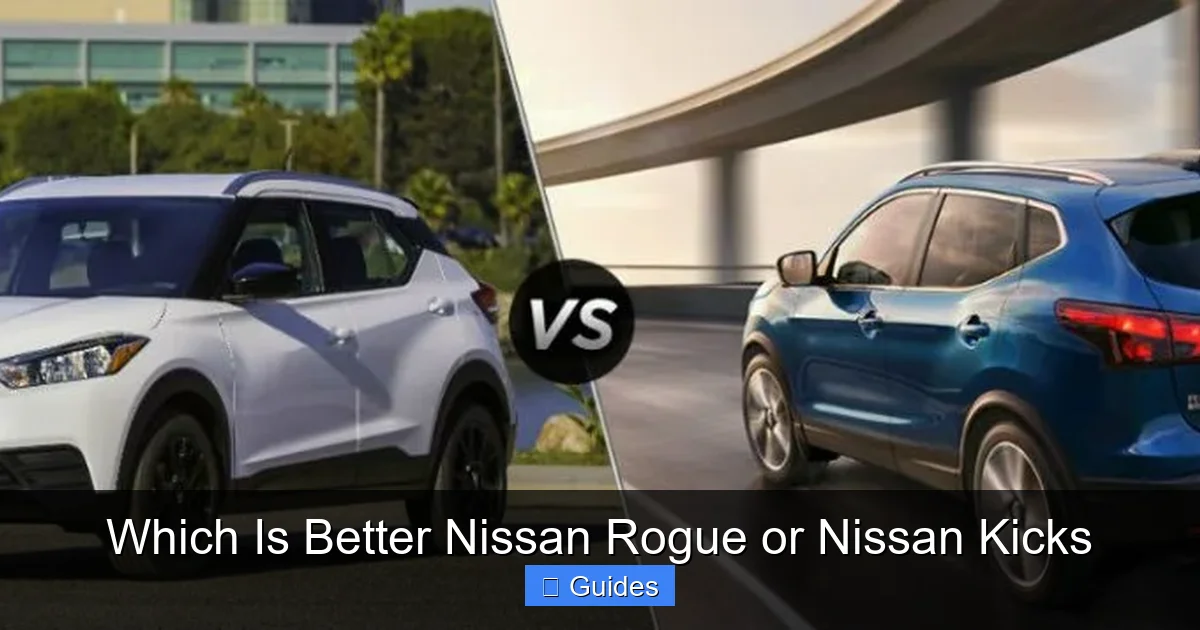
Visual guide about Which Is Better Nissan Rogue or Nissan Kicks
Image source: blogmedia.dealerfire.com
Both the Rogue and Kicks come well-equipped with modern tech, but the Rogue offers more advanced options, especially in higher trims.
Infotainment Systems
The base Kicks comes with a 7-inch touchscreen, Apple CarPlay, Android Auto, Bluetooth, and a four-speaker audio system. Higher trims add an 8-inch screen, a six-speaker audio system, and available navigation.
The Rogue starts with an 8-inch touchscreen on most trims, with Apple CarPlay and Android Auto standard. Higher trims offer a 9-inch display, wireless smartphone integration, a premium Bose audio system, and built-in navigation.
If you want a larger screen, better sound, or wireless connectivity, the Rogue delivers. But for basic smartphone integration and daily use, the Kicks is perfectly capable.
Driver Assistance and Safety Tech
Both SUVs come standard with Nissan’s Safety Shield 360, a suite of advanced driver aids that includes:
– Automatic Emergency Braking with Pedestrian Detection
– Blind Spot Warning
– Rear Cross Traffic Alert
– Lane Departure Warning
– High Beam Assist
– Rear Automatic Braking
These features are impressive for the price and help both models earn high safety ratings.
The Rogue goes further with available upgrades like:
– ProPILOT Assist (adaptive cruise control with lane centering)
– Traffic Sign Recognition
– Around View Monitor (360-degree camera)
– Intelligent Driver Alertness
These features make highway driving less tiring and add an extra layer of safety, especially on long trips.
The Kicks doesn’t offer ProPILOT Assist, so if you want semi-autonomous driving features, the Rogue is the better choice.
Connectivity and Convenience Features
Both models offer keyless entry, push-button start, and available heated front seats. The Rogue adds more convenience options like a hands-free power liftgate, dual-zone automatic climate control, and available heated rear seats.
The Kicks keeps things simple but functional. It’s a great option if you don’t need all the bells and whistles and prefer a straightforward, no-nonsense approach.
Safety Ratings and Reliability: Peace of Mind on the Road
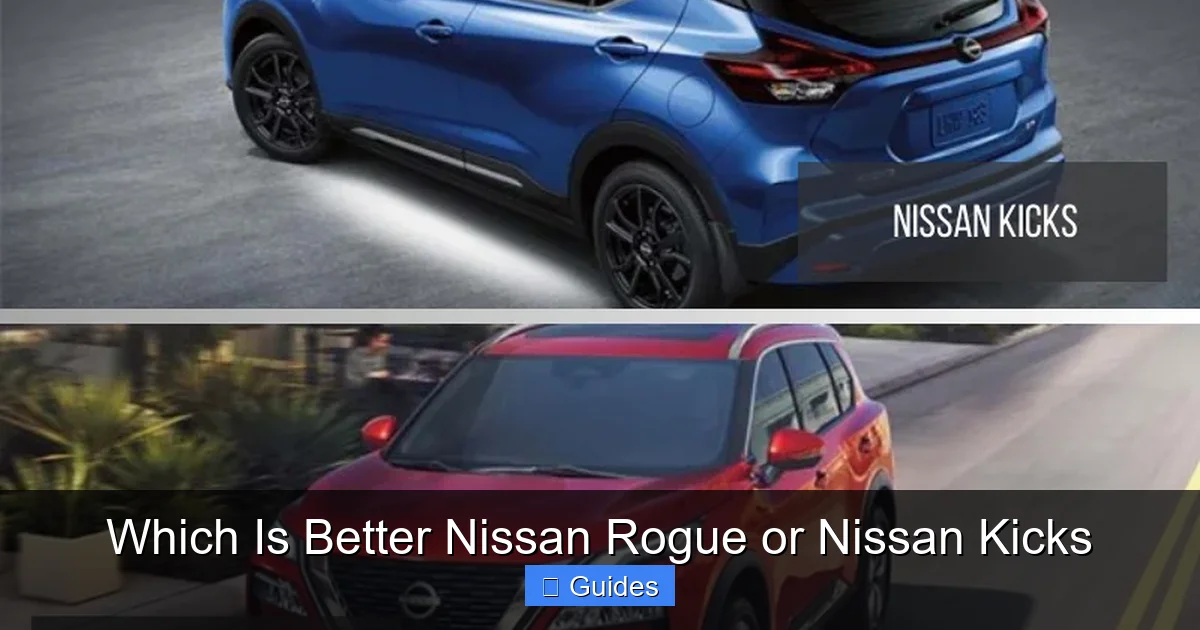
Visual guide about Which Is Better Nissan Rogue or Nissan Kicks
Image source: darcarsnissan.com
Safety is a top priority for most SUV buyers, and both the Rogue and Kicks perform well in this area.
Crash Test Ratings
The Nissan Rogue earned a Top Safety Pick+ award from the Insurance Institute for Highway Safety (IIHS) in recent years, with “Good” ratings in all crash tests and high scores for front crash prevention.
The Kicks also earned strong marks, with “Good” ratings in most categories, though it hasn’t achieved the same Top Safety Pick+ status. Still, its standard Safety Shield 360 suite helps it stand out in its class.
Both models come with a 10-year/100,000-mile powertrain warranty and a 3-year/36,000-mile basic warranty, giving you confidence in long-term reliability.
Real-World Reliability
According to consumer reports and owner reviews, both SUVs are generally reliable. The Rogue has a solid track record, with few major mechanical issues reported. The Kicks, being newer to the lineup, has fewer long-term data points, but early feedback is positive.
One thing to note: the Rogue’s turbocharged engine is more complex than the Kicks’ naturally aspirated engine, which could mean higher maintenance costs down the line. However, with proper care, both engines should last well over 150,000 miles.
Pricing and Value: Which Offers More for Your Money?
Let’s talk money. The Kicks starts at around $21,000, making it one of the most affordable new SUVs on the market. The Rogue starts closer to $27,000, with higher trims pushing past $35,000.
Trim Levels and Options
The Kicks comes in three trims: S, SV, and SR. Even the base S trim includes Apple CarPlay, Android Auto, and Safety Shield 360. The SR adds sporty styling, larger wheels, and a few extra features.
The Rogue offers more trim levels: S, SV, SL, and Platinum. Higher trims add leather, premium audio, advanced safety tech, and luxury touches. If you want a more upscale experience, the Rogue gives you more options.
Long-Term Value
The Kicks wins on upfront cost and fuel savings. It’s ideal for buyers on a tight budget or those who want a new car without a big monthly payment.
The Rogue costs more upfront but offers more space, power, and features. If you plan to keep the vehicle for many years or need the extra capability, the higher price may be justified.
Depreciation is similar for both, but the Rogue may hold its value slightly better due to its popularity and larger size.
Financing and Incentives
Nissan often offers special financing deals, cashback incentives, or lease promotions on both models. The Kicks typically has lower monthly payments, while the Rogue may qualify for loyalty or conquest bonuses if you’re coming from another brand.
Be sure to check current offers at your local dealership—these can make a big difference in affordability.
Which One Is Right for You?
So, which is better: the Nissan Rogue or the Nissan Kicks? The answer depends on your needs.
Choose the **Nissan Rogue** if you:
– Need more passenger and cargo space
– Want a more powerful engine and available AWD
– Frequently drive on highways or in bad weather
– Value advanced safety and tech features
– Are willing to pay more for a premium experience
Choose the **Nissan Kicks** if you:
– Live in the city and need a compact, easy-to-park SUV
– Prioritize fuel efficiency and low operating costs
– Want an affordable new car with modern features
– Don’t need AWD or a lot of cargo room
– Are a first-time buyer or downsizing from a larger vehicle
Both are excellent choices, but they serve different purposes. The Rogue is the family-friendly, all-weather workhorse. The Kicks is the stylish, efficient city companion.
Final Thoughts
The Nissan Rogue and Nissan Kicks are both strong contenders in the competitive SUV market. They share Nissan’s reputation for reliability, safety, and value, but they’re built for different lifestyles.
If you’re looking for a spacious, capable, and feature-rich SUV that can handle everything from school drop-offs to cross-country trips, the Rogue is the way to go. It’s the more versatile and powerful option, ideal for growing families or active individuals.
On the other hand, if you want an affordable, fuel-efficient, and easy-to-drive crossover that fits perfectly in urban environments, the Kicks is a smart, stylish choice. It proves that you don’t need a big SUV to enjoy modern tech and safety.
Ultimately, the “better” SUV is the one that fits your life. Take both for a test drive, compare your must-have features, and consider your long-term needs. Whether you choose the Rogue or the Kicks, you’re getting a dependable, well-equipped vehicle from a trusted brand.
And remember: the best car isn’t always the biggest or most expensive—it’s the one that makes every drive feel right.
Frequently Asked Questions
Is the Nissan Rogue bigger than the Nissan Kicks?
Yes, the Nissan Rogue is significantly larger. It’s a midsize SUV with more passenger and cargo space, while the Kicks is a compact crossover designed for city driving.
Which gets better gas mileage, the Rogue or the Kicks?
The Nissan Kicks gets better fuel economy, averaging up to 31 mpg combined, compared to the Rogue’s 28–29 mpg. The Kicks is more efficient for daily commuting.
Does the Nissan Kicks have all-wheel drive?
No, the Nissan Kicks is front-wheel drive only. The Rogue offers optional all-wheel drive, making it better for snowy or wet conditions.
Which SUV has more advanced safety features?
Both come with Nissan Safety Shield 360, but the Rogue offers more advanced options like ProPILOT Assist and a 360-degree camera, especially in higher trims.
Is the Nissan Rogue worth the extra cost over the Kicks?
It depends on your needs. If you need more space, power, and features, the Rogue is worth the investment. For city driving and budget-conscious buyers, the Kicks offers great value.
Can the Nissan Kicks seat seven passengers?
No, the Kicks seats five. The Rogue offers an optional third row in some trims, but it’s very small and best for children. Most buyers use it as a five-seater.

At CarLegit, we believe information should be clear, factual, and genuinely helpful. That’s why every guide, review, and update on our website is created with care, research, and a strong focus on user experience.