
The Nissan Leaf does not come standard with a heat pump across all trims and model years, but some newer versions—especially in colder climates—offer it as an optional or region-specific feature. This impacts winter efficiency, range, and comfort, making it a key consideration for buyers in colder regions.
If you’re considering buying a Nissan Leaf—or you already own one—you’ve probably wondered how it handles the cold. Electric vehicles (EVs) are known for their efficiency, but winter weather can seriously impact range and comfort. One of the biggest questions drivers ask is: *Does the Nissan Leaf have a heat pump?* The answer isn’t a simple yes or no. It depends on the model year, trim level, and even where the car was sold.
The Nissan Leaf, launched in 2010, was one of the first mass-market electric cars. Over the years, it’s evolved with better batteries, more range, and smarter technology. But when it comes to cabin heating—especially in freezing temperatures—the Leaf has taken a somewhat inconsistent approach. Unlike some competitors like the Tesla Model 3 or Hyundai Kona Electric, which come standard with heat pumps, the Leaf’s adoption of this energy-efficient technology has been gradual and selective.
So, what exactly is a heat pump, and why does it matter for an EV like the Leaf? Simply put, a heat pump is a more efficient way to heat the cabin than traditional electric resistance heaters. Instead of generating heat by passing electricity through a coil (which uses a lot of battery power), a heat pump moves heat from the outside air into the cabin—even when it’s cold. It works similarly to an air conditioner but in reverse. This process uses far less energy, which means less drain on the battery and better range in winter.
Now, let’s dive into the details. Whether you’re shopping for a used Leaf or deciding between trims on a newer model, understanding the heating system can make a big difference in your ownership experience—especially if you live somewhere with snowy winters or frequent sub-zero temperatures.
In This Article
- 1 Key Takeaways
- 2 📑 Table of Contents
- 3 What Is a Heat Pump and Why Does It Matter for EVs?
- 4 Does the Nissan Leaf Have a Heat Pump? Model-by-Model Breakdown
- 5 Why Nissan Was Slow to Adopt Heat Pumps
- 6 How to Maximize Winter Efficiency Without a Heat Pump
- 7 Should You Buy a Leaf with a Heat Pump?
- 8 The Future of Heating in the Nissan Leaf
- 9 Conclusion
- 10 Frequently Asked Questions
Key Takeaways
- Not all Nissan Leaf models include a heat pump: Availability varies by year, trim, and market, with higher trims and newer models more likely to offer it.
- Heat pumps improve cold-weather efficiency: They use less energy than traditional resistive heaters, helping preserve EV range in winter.
- Pre-conditioning helps reduce energy loss: Warming the cabin while plugged in minimizes battery drain during driving.
- Early Leaf models rely on resistive heating: These systems consume significant battery power, reducing range in cold weather.
- Check your specific model and VIN: Use Nissan’s official tools or consult a dealer to confirm if your Leaf has a heat pump.
- Aftermarket solutions are limited: Retrofitting a heat pump is not practical or recommended due to system complexity.
- Climate and driving habits matter: If you live in a cold region, a heat pump-equipped Leaf can make a noticeable difference in daily usability.
📑 Table of Contents
- What Is a Heat Pump and Why Does It Matter for EVs?
- Does the Nissan Leaf Have a Heat Pump? Model-by-Model Breakdown
- Why Nissan Was Slow to Adopt Heat Pumps
- How to Maximize Winter Efficiency Without a Heat Pump
- Should You Buy a Leaf with a Heat Pump?
- The Future of Heating in the Nissan Leaf
- Conclusion
What Is a Heat Pump and Why Does It Matter for EVs?
Before we get into whether the Nissan Leaf has a heat pump, it’s important to understand what a heat pump is and why it’s such a big deal for electric vehicles.
A heat pump is a device that transfers thermal energy from one place to another. In the context of an EV, it pulls heat from the outside air—even when it’s cold—and uses it to warm the cabin. This is much more efficient than using a resistive heater, which essentially turns electricity into heat through a heating element, like the coils in a toaster.
How Heat Pumps Work in Cold Weather
You might be thinking: *How can a heat pump pull heat from cold air?* It sounds counterintuitive, but it’s based on the same principle as your home’s air conditioner or refrigerator. These systems use refrigerants that can absorb heat even at low temperatures. The heat pump compresses the refrigerant, raising its temperature, and then releases that heat into the cabin.
For example, even at 20°F (-7°C), there’s still thermal energy in the air. A heat pump can extract that energy and amplify it to provide warm air inside the car. This process uses about one-third to one-half the energy of a resistive heater, which means less strain on the battery and better range.
Impact on EV Range and Efficiency
In cold weather, EV range can drop by 20% to 40%, and much of that loss is due to cabin heating. Without a heat pump, the Leaf relies on a resistive heater that draws significant power from the battery. This not only reduces how far you can drive on a single charge but also increases charging frequency and time.
A heat pump-equipped EV, on the other hand, maintains more of its range in winter. For instance, a Nissan Leaf with a 40 kWh battery might lose 30 miles of range in cold weather with a resistive heater. With a heat pump, that loss could be cut in half. Over time, that adds up to more convenience, fewer charging stops, and lower electricity costs.
Comparison with Other EV Heating Systems
Not all EVs use the same heating technology. Here’s a quick breakdown:
– **Resistive heating:** Uses electric coils to generate heat. Simple and cheap but inefficient. Found in many older or budget EVs.
– **Heat pump:** Transfers heat from outside air. More complex and costly but far more efficient.
– **Hybrid systems:** Combine a heat pump with a resistive heater for extreme cold. Used in some premium EVs.
The Nissan Leaf has historically leaned toward resistive heating, especially in earlier models. But as efficiency demands grew, Nissan began introducing heat pumps in select models—particularly in regions with harsh winters.
Does the Nissan Leaf Have a Heat Pump? Model-by-Model Breakdown
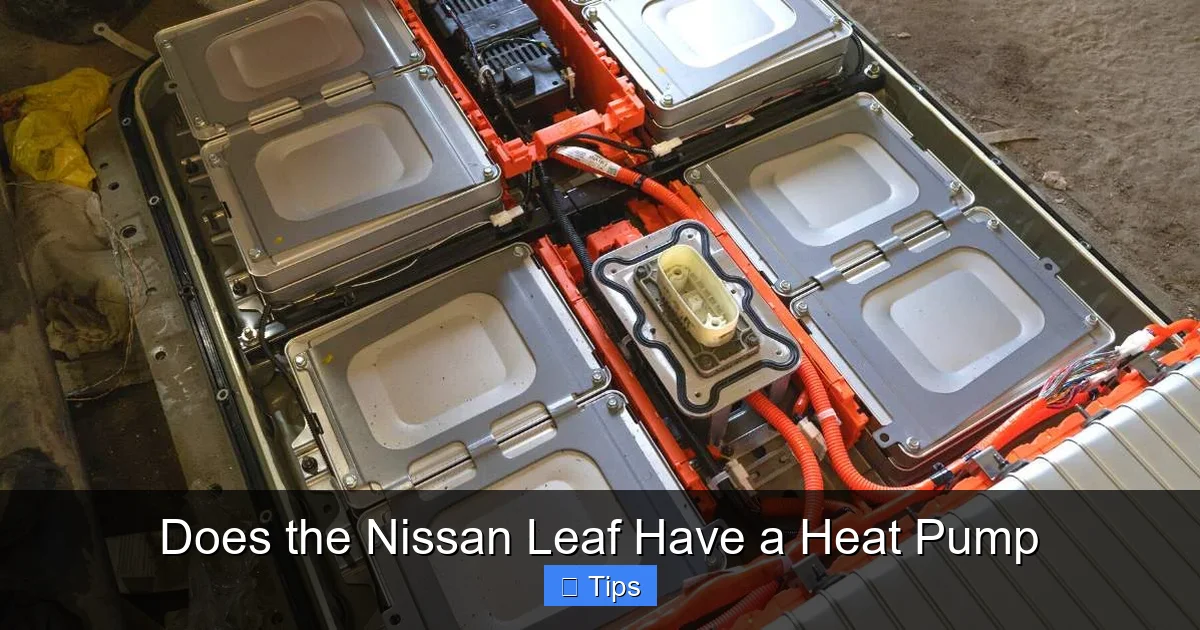
Visual guide about Does the Nissan Leaf Have a Heat Pump
Image source: speedsmartly.com
Now for the million-dollar question: *Does the Nissan Leaf have a heat pump?* The answer depends on several factors, including the model year, trim level, and market.
Let’s break it down by generation and region.
First Generation (2011–2017)
The original Nissan Leaf (2011–2017) did not come with a heat pump. These models used a resistive heater for cabin warming. While effective at producing heat, this system was a major drain on the battery, especially in cold climates.
For example, a 2015 Leaf with a 24 kWh battery might see its range drop from 84 miles to around 50 miles in freezing weather—partly due to heating demands. Owners in places like Minnesota or Canada often reported needing to charge daily, even for short commutes.
There were no factory-installed heat pumps in this generation. Some aftermarket companies experimented with retrofits, but these were unreliable and not recommended by Nissan.
Second Generation (2018–2022)
The second-generation Leaf (introduced in 2018) brought significant upgrades, including a larger 40 kWh or 62 kWh battery and improved efficiency. However, the heating system remained inconsistent.
In most markets, including the U.S., the 2018–2022 Leaf still used a resistive heater as standard. But here’s the twist: in colder regions like Scandinavia, Canada, and parts of Northern Europe, Nissan offered a heat pump as an option—or even standard on higher trims.
For instance, the 2020 Leaf SV Plus in Canada often came with a heat pump, while the same model in Florida might not. This regional variation can make it confusing for buyers, especially when shopping for used vehicles across state or national borders.
2023 and Newer Models
As of 2023, Nissan has not made the heat pump standard across all Leaf models globally. However, there are signs of progress. In Europe and Canada, newer Leafs are more likely to include a heat pump, especially in the higher trims like the SL or SV Plus.
In the U.S., the situation is still mixed. Some 2023 Leaf models—particularly those sold in colder states—may include a heat pump, but it’s not guaranteed. The best way to confirm is to check the vehicle’s window sticker, owner’s manual, or use Nissan’s VIN decoder tool.
How to Tell If Your Leaf Has a Heat Pump
If you’re unsure whether your Nissan Leaf has a heat pump, here are a few ways to find out:
1. **Check the owner’s manual:** Look for terms like “heat pump” or “efficient heating system.”
2. **Review the window sticker (Monroney label):** This lists all factory-installed options.
3. **Use the VIN decoder:** Visit Nissan’s official website and enter your Vehicle Identification Number.
4. **Look under the hood:** A heat pump system includes additional components like an expansion valve and refrigerant lines. (Note: This requires some mechanical knowledge.)
5. **Ask a Nissan dealer:** They can look up your vehicle’s build sheet.
If your Leaf doesn’t have a heat pump, don’t panic. There are still ways to improve winter efficiency—more on that later.
Why Nissan Was Slow to Adopt Heat Pumps

Visual guide about Does the Nissan Leaf Have a Heat Pump
Image source: images-stag.jazelc.com
You might be wondering why Nissan didn’t include heat pumps in the Leaf from the start, especially when other automakers were doing so. There are several reasons for this delay.
Cost and Complexity
Heat pumps are more expensive to manufacture and install than resistive heaters. They require additional components, including compressors, refrigerants, and control systems. For a budget-focused EV like the Leaf, Nissan may have prioritized affordability over advanced thermal management—at least initially.
Market Priorities
When the Leaf launched, the primary markets were milder climates like California and Japan. In these regions, cold-weather range loss wasn’t as big a concern. Nissan may have assumed that resistive heating would be sufficient for most buyers.
It wasn’t until EVs gained popularity in colder regions—and competitors began highlighting heat pumps as a key feature—that Nissan started to rethink its strategy.
Technical Challenges
Heat pumps are less effective in extremely cold temperatures (below 15°F or -9°C). In such conditions, they may need to rely on a backup resistive heater anyway. Nissan may have been cautious about overpromising performance in harsh winters.
Additionally, integrating a heat pump into an existing platform requires significant engineering. The Leaf’s design evolved over time, and retrofitting older models wasn’t practical.
Competitive Pressure
As EVs like the Tesla Model 3, Chevrolet Bolt, and Hyundai Ioniq 5 began offering heat pumps as standard, Nissan faced increasing pressure to catch up. While the Leaf remains a strong value option, the lack of a standard heat pump has been a point of criticism among EV enthusiasts.
How to Maximize Winter Efficiency Without a Heat Pump

Visual guide about Does the Nissan Leaf Have a Heat Pump
Image source: t10540747.p.clickup-attachments.com
If your Nissan Leaf doesn’t have a heat pump, all is not lost. There are several strategies you can use to reduce energy consumption and maintain comfort in cold weather.
Pre-Conditioning the Cabin
One of the most effective tips is to pre-condition the cabin while the car is still plugged in. This means turning on the heater (and seat warmers) before you unplug and drive.
Most Leafs allow you to schedule pre-conditioning via the NissanConnect app or the car’s timer. For example, set it to warm up 30 minutes before your usual departure time. Since the car is drawing power from the grid, not the battery, this doesn’t reduce your driving range.
Use Seat and Steering Wheel Heaters
Instead of heating the entire cabin, focus on heating yourself. The Leaf’s seat and steering wheel heaters use far less energy than the main cabin heater. They warm you directly and can make a big difference in comfort—even if the air feels cool.
Tip: Turn on the seat heater first, then gradually increase cabin heat only if needed.
Dress Warmly
This might sound obvious, but wearing layers, a warm coat, gloves, and a hat can reduce your reliance on the heater. Think of it like wearing a sweater at home instead of cranking the thermostat.
Park in a Garage or Sheltered Area
Cold batteries are less efficient. Parking in a garage—even an unheated one—can keep the battery warmer than leaving the car outside in the snow. If you don’t have a garage, consider using a car cover or parking in a sunny spot.
Limit Use of Accessories
Heated mirrors, rear defrosters, and high-speed fans all draw extra power. Use them only when necessary. For example, clear snow and ice manually before relying on the defroster.
Drive Efficiently
Aggressive acceleration and high speeds reduce range in any weather. In winter, smooth, steady driving can help you go further on a single charge. Use Eco mode and regenerative braking to maximize efficiency.
Should You Buy a Leaf with a Heat Pump?
If you’re shopping for a Nissan Leaf, especially in a cold climate, the presence of a heat pump can be a deciding factor.
Pros of a Heat Pump-Equipped Leaf
– **Better winter range:** Less energy used for heating means more miles per charge.
– **Faster cabin warm-up:** Heat pumps can warm the cabin more quickly than resistive heaters.
– **Lower operating costs:** Reduced electricity consumption over time.
– **Improved comfort:** More consistent heating, even in cold weather.
Cons and Considerations
– **Higher upfront cost:** Models with heat pumps may be more expensive.
– **Limited availability:** Not all trims or regions offer it.
– **Diminished returns in extreme cold:** Below 15°F, the heat pump may need backup heating.
Who Should Prioritize a Heat Pump?
– Drivers in cold climates (e.g., Canada, Northern U.S., Scandinavia).
– Those with long commutes or limited charging access.
– Buyers who prioritize efficiency and long-term savings.
If you live in a mild climate, a resistive heater may be perfectly adequate. But for anyone facing regular winter driving, a heat pump can make the Leaf a much more practical choice.
The Future of Heating in the Nissan Leaf
As EV technology evolves, we can expect Nissan to continue improving the Leaf’s thermal management. While the 2024 model still doesn’t offer a heat pump as standard in all markets, the trend is moving in that direction.
Rumors suggest that future iterations—possibly under Nissan’s new EV platform—may include more advanced heat pump systems, possibly even integrating battery thermal management for even greater efficiency.
In the meantime, the Leaf remains one of the most affordable and reliable EVs on the market. Whether or not it has a heat pump, it’s a solid choice for eco-conscious drivers.
Conclusion
So, does the Nissan Leaf have a heat pump? The short answer is: *sometimes*. It depends on the model year, trim, and region. While early Leafs relied solely on inefficient resistive heaters, newer models—especially in colder markets—are increasingly likely to include a heat pump.
This feature can make a significant difference in winter driving, helping preserve range and improve comfort. If you’re buying a Leaf, especially in a cold climate, it’s worth checking whether your specific model has this technology.
Even without a heat pump, smart habits like pre-conditioning, using seat heaters, and driving efficiently can help you get the most out of your Leaf year-round. As EVs continue to evolve, features like heat pumps will likely become standard—making electric driving even more practical in all seasons.
Frequently Asked Questions
Does every Nissan Leaf have a heat pump?
No, not every Nissan Leaf has a heat pump. Availability depends on the model year, trim level, and market. Newer models in colder regions are more likely to include one.
Can I add a heat pump to my Nissan Leaf?
No, retrofitting a heat pump is not practical or recommended. The system is complex and requires integration with the vehicle’s HVAC and battery management systems.
How much does a heat pump improve winter range?
A heat pump can reduce winter range loss by 10% to 20% compared to resistive heating, depending on temperature and driving conditions.
What years of Nissan Leaf have heat pumps?
Some 2018 and newer models—especially in Canada, Europe, and cold U.S. states—may include a heat pump, particularly in higher trims like SV Plus or SL.
Is a heat pump worth it for mild climates?
In mild climates, the benefit is smaller, but a heat pump can still improve efficiency and comfort during cooler months or unexpected cold snaps.
How do I check if my Leaf has a heat pump?
Check the owner’s manual, window sticker, or use Nissan’s VIN decoder tool. You can also consult a Nissan dealer with your vehicle’s VIN.

At CarLegit, we believe information should be clear, factual, and genuinely helpful. That’s why every guide, review, and update on our website is created with care, research, and a strong focus on user experience.