
Knowing where the starter on a Nissan Titan is located can save you time, money, and frustration when diagnosing starting problems. This guide walks you through the exact location, removal steps, and troubleshooting tips for both 4×4 and 4×2 models.
If you’ve ever turned the key in your Nissan Titan and heard nothing—or just a faint click—you know how frustrating it can be. Your truck won’t start, and you’re left wondering: “What’s wrong now?” One of the most common culprits behind a no-start condition is a failing starter motor. But before you can even think about replacing it, you need to know where it’s located. That’s where this guide comes in.
The starter on a Nissan Titan isn’t exactly hiding, but it’s not sitting out in the open either. It’s tucked away under the engine, near the transmission, and accessing it requires some disassembly. Whether you’re driving a 2005 model or a brand-new 2024 Titan, the general location remains consistent—but the exact steps to reach it can vary depending on your truck’s configuration. This article will walk you through everything you need to know: from identifying the starter’s location, to safely removing it, diagnosing common issues, and even tips for choosing a replacement.
We’ll cover both 4×2 (two-wheel drive) and 4×4 (four-wheel drive) models, because let’s be honest—Titan owners love their off-road capability, and that extra gear can make a difference when it comes to maintenance. By the end of this guide, you’ll have a clear roadmap for tackling starter-related problems with confidence. Whether you’re a DIY enthusiast or just trying to understand what your mechanic is talking about, this information will empower you to make smarter decisions about your Titan’s performance and reliability.
In This Article
- 1 Key Takeaways
- 2 📑 Table of Contents
- 3 Understanding the Nissan Titan Starter System
- 4 Where Is the Starter Located on a Nissan Titan?
- 5 Step-by-Step Guide to Accessing the Starter
- 6 Common Starter Problems and How to Diagnose Them
- 7 Tips for Replacing the Starter on a Nissan Titan
- 8 When to Call a Professional
- 9 Conclusion
- 10 Frequently Asked Questions
- 10.1 Where exactly is the starter located on a Nissan Titan?
- 10.2 Do I need to remove the skid plate to access the starter?
- 10.3 Can I replace the starter myself?
- 10.4 What are the signs of a bad starter on a Nissan Titan?
- 10.5 How much does it cost to replace a starter on a Nissan Titan?
- 10.6 Is the starter the same on all Nissan Titan models?
Key Takeaways
- Starter location varies slightly by model year and drivetrain: On most Nissan Titan models (2004–2024), the starter is mounted on the passenger side of the engine block, near the transmission bell housing.
- Access requires removing components: You’ll typically need to remove the air intake duct, battery cables, and sometimes the skid plate or heat shield to reach the starter.
- 4×4 models may need additional steps: Four-wheel-drive Titans often require lowering the front differential or removing the transfer case skid plate for full access.
- Symptoms of a bad starter include clicking noises, slow cranking, or no response when turning the key: These signs often point to electrical or mechanical failure in the starter motor.
- Always disconnect the battery before working on the starter: This prevents accidental shorts, sparks, or electrical damage during removal or installation.
- Use proper tools and safety gear: A socket wrench set, jack stands, and gloves are essential for a safe and efficient repair.
- Consider professional help if unsure: If you’re not confident in your mechanical skills, a certified mechanic can diagnose and replace the starter safely.
📑 Table of Contents
Understanding the Nissan Titan Starter System
Before diving into the physical location of the starter, it’s helpful to understand what the starter actually does—and why it’s so important. The starter motor is a small but powerful electric motor that cranks the engine when you turn the ignition key. It engages with the flywheel (or flexplate in automatic transmissions) to spin the engine fast enough for combustion to begin. Without a functioning starter, your Titan simply won’t start, no matter how good the battery or fuel system is.
In the Nissan Titan, the starter is part of a larger starting system that includes the battery, ignition switch, starter relay, and wiring harness. When you turn the key to the “start” position, the ignition switch sends a signal to the starter relay, which then sends a high-current electrical signal directly to the starter motor. This causes the starter’s pinion gear to engage with the engine’s flywheel and spin the engine.
The Titan uses a gear-reduction starter design, which means it uses a set of internal gears to increase torque while reducing motor speed. This allows the starter to generate enough force to turn over the V8 engine, even in cold weather or when the engine is under load. These starters are generally reliable, but like any mechanical component, they can wear out over time.
Common signs that your Titan’s starter is failing include:
– A loud clicking noise when you turn the key
– The engine cranks slowly or not at all
– Intermittent starting—sometimes it works, sometimes it doesn’t
– A burning smell or smoke near the starter area (indicating electrical overload)
If you notice any of these symptoms, it’s time to inspect the starter. But first, you need to know where to look.
Where Is the Starter Located on a Nissan Titan?

Visual guide about Where Is the Starter on a Nissan Titan
Image source: nissanpartsdeal.com
Now for the main question: Where is the starter on a Nissan Titan? The short answer is: on the passenger side of the engine block, bolted directly to the transmission bell housing. It’s positioned just below the intake manifold and behind the oil pan, making it somewhat hidden but still accessible with the right tools and approach.
Let’s break this down by model year and drivetrain to give you the most accurate picture.
Starter Location on 2004–2015 Nissan Titans
For first-generation Titans (2004–2015), the starter is consistently mounted on the passenger side of the 5.6L V8 engine. It’s secured with two or three bolts (usually 14mm or 17mm) and connected to the engine via a thick power cable from the battery and a smaller control wire from the starter relay.
To access it, you’ll typically need to:
– Remove the air intake duct and air filter housing
– Disconnect the negative battery cable (always do this first!)
– Remove the starter heat shield (if equipped)
– Unbolt the starter from the transmission bell housing
On these models, the starter is relatively easy to reach from underneath the truck, especially if you have a lift or jack stands. However, the proximity to the oil pan and exhaust manifold means you’ll need to work carefully to avoid damaging nearby components.
Starter Location on 2016–2024 Nissan Titans
Second-generation Titans (2016–2024) retain the same basic layout, but with some refinements. The 5.6L V8 engine is still used, and the starter remains on the passenger side. However, newer models may have additional shielding, updated wiring, and slightly different bracket designs.
One key difference is the increased use of plastic engine covers and aerodynamic underbody panels. These can make access a bit trickier, especially on trucks with full skid plates or off-road packages. You may need to remove the front skid plate or lower the front differential slightly on 4×4 models to get a clear shot at the starter.
Despite these changes, the core location hasn’t moved. The starter is still bolted to the transmission bell housing, just behind the oil pan. The power cable runs from the battery through a fuse box and down to the starter, while the control wire connects to a solenoid on top of the starter motor.
4×2 vs. 4×4: Does Drivetrain Affect Starter Access?
Yes—but only slightly. On two-wheel-drive (4×2) Titans, the starter is generally easier to access because there’s no front differential or transfer case in the way. You can usually reach it from underneath with minimal disassembly.
On four-wheel-drive (4×4) models, the presence of the transfer case and front differential can block direct access. In some cases, you may need to:
– Remove the transfer case skid plate
– Loosen or lower the front differential (requires a jack and support)
– Remove the front driveshaft (on some models)
This doesn’t mean the job is impossible—it just takes a bit more time and patience. If you’re not comfortable working under the truck or handling suspension components, it’s wise to consult a professional.
Step-by-Step Guide to Accessing the Starter
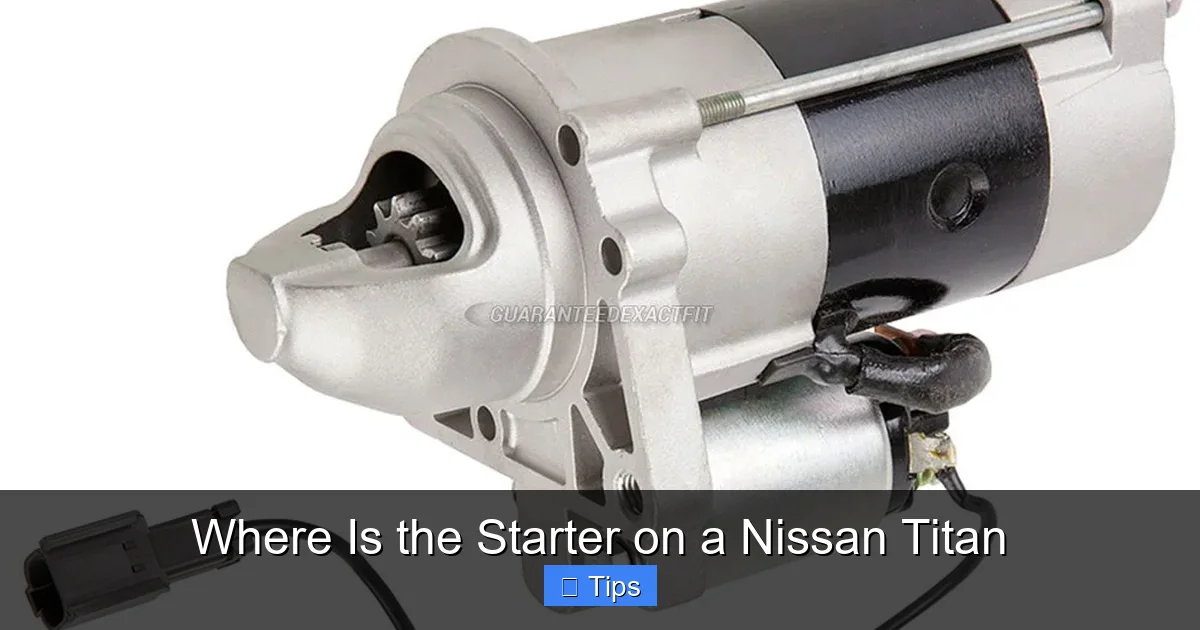
Visual guide about Where Is the Starter on a Nissan Titan
Image source: buyautoparts.com
Now that you know where the starter is, let’s walk through the actual process of accessing it. Whether you’re replacing a faulty unit or just inspecting it, these steps will help you do the job safely and efficiently.
Step 1: Safety First—Disconnect the Battery
Before touching anything under the hood or under the truck, disconnect the negative terminal of the battery. Use a 10mm wrench to loosen the clamp and remove the cable. This prevents accidental shorts, sparks, or electrical shocks while working on the starter.
Pro tip: Tape the cable to the fender or another non-conductive surface so it doesn’t accidentally touch the battery terminal while you’re working.
Step 2: Lift the Vehicle Safely
You’ll need to get under the truck to reach the starter. Use a hydraulic jack to lift the front end and place it securely on jack stands. Never rely on just the jack—always use stands for safety.
If you have a 4×4 model, you may need to lift the entire front end or even the side of the truck to access the transfer case area. Make sure the vehicle is stable and the parking brake is engaged.
Step 3: Remove Obstructions
Depending on your Titan’s configuration, you may need to remove:
– The air intake duct and air filter box (use a screwdriver or socket to remove clamps and bolts)
– The starter heat shield (usually held by two 10mm bolts)
– The front skid plate (on off-road packages, held by 10–12 bolts)
– The transfer case skid plate (on 4×4 models)
Keep track of all bolts and hardware in a magnetic tray or labeled bag so you don’t lose anything.
Step 4: Locate and Identify the Starter
Once the obstructions are removed, look for a cylindrical component bolted to the side of the transmission bell housing. It’s usually about the size of a large coffee can and has two wires connected to it:
– A thick red cable (positive power from the battery)
– A smaller black or yellow wire (control signal from the ignition)
This is your starter. Take a photo or make a note of the wiring before disconnecting anything.
Step 5: Disconnect Wiring and Remove Bolts
Use a socket wrench to remove the two bolts securing the starter to the transmission. These are typically 14mm or 17mm and may be tight due to corrosion or age.
Next, disconnect the wiring:
– Loosen the nut on the large power cable and remove it
– Unplug the smaller control wire (may have a clip or connector)
Once everything is disconnected, carefully wiggle the starter out. It may be snug due to age or gasket material, so take your time.
Step 6: Inspect and Replace
With the starter removed, inspect it for signs of damage:
– Burned or melted wiring
– Corroded terminals
– Oil or coolant leaks (indicating a seal failure)
– Worn or chipped gear teeth
If the starter is faulty, replace it with a new or remanufactured unit. Make sure the replacement matches your Titan’s year, engine size, and part number.
Common Starter Problems and How to Diagnose Them
Even if you’ve located the starter, you still need to confirm that it’s the actual cause of your no-start issue. Many symptoms of a bad starter can also be caused by a weak battery, faulty ignition switch, or bad relays.
Clicking Noise When Turning the Key
A single loud click usually means the starter solenoid is engaging, but the motor isn’t spinning. This could be due to:
– A dead or weak battery
– Corroded battery terminals
– A faulty starter motor
– Loose or damaged wiring
Test the battery voltage with a multimeter. It should read at least 12.6 volts when the engine is off. If it’s below 12 volts, charge or replace the battery first.
Slow or No Cranking
If the engine turns over slowly or not at all, the starter may be drawing too much current due to internal wear. This can also be caused by:
– A failing alternator (not charging the battery)
– Bad ground connections
– Excessive engine resistance (e.g., cold oil, seized components)
Check the ground cable from the battery to the engine block. Clean any corrosion and ensure it’s tight.
Intermittent Starting
If your Titan starts sometimes but not others, the issue could be:
– A loose starter connection
– A failing ignition switch
– A bad starter relay
Try wiggling the key while turning it. If the engine starts, the ignition switch may be worn.
Burning Smell or Smoke
This is a serious sign of electrical overload. Immediately disconnect the battery and inspect the starter and wiring. A shorted starter can overheat and damage surrounding components.
Tips for Replacing the Starter on a Nissan Titan
Replacing the starter isn’t the hardest job on a Titan, but it does require attention to detail. Here are some pro tips to make the process smoother:
– Use a torque wrench when reinstalling the starter bolts. Over-tightening can crack the transmission housing.
– Apply dielectric grease to the electrical connections to prevent corrosion.
– Consider replacing the starter relay at the same time—it’s inexpensive and often overlooked.
– If you’re using a remanufactured starter, check the warranty and ensure it’s compatible with your model.
– Label all wires and take photos before disconnecting anything. This makes reassembly much easier.
When to Call a Professional
While many Titan owners can handle starter replacement themselves, there are times when it’s best to leave it to the experts:
– If you’re not comfortable working under the vehicle
– If the starter is seized or extremely difficult to remove
– If you suspect additional issues like a bad alternator or wiring problems
– If your Titan is still under warranty
A certified mechanic can diagnose the issue accurately and ensure the job is done safely and correctly.
Conclusion
Knowing where the starter on a Nissan Titan is located is the first step toward solving starting problems and maintaining your truck’s reliability. Whether you drive a 2005 model or a 2024 beast, the starter sits on the passenger side of the engine, bolted to the transmission bell housing. Accessing it requires some disassembly, especially on 4×4 models, but with the right tools and precautions, it’s a manageable DIY task.
By following the steps in this guide—disconnecting the battery, lifting the vehicle safely, removing obstructions, and carefully disconnecting the wiring—you can inspect, test, or replace the starter with confidence. And if you’re ever in doubt, don’t hesitate to consult a professional. Your Titan is a powerful, capable truck, and keeping its starting system in top shape ensures it’s ready for whatever adventure comes next.
Frequently Asked Questions
Where exactly is the starter located on a Nissan Titan?
The starter on a Nissan Titan is mounted on the passenger side of the engine block, bolted directly to the transmission bell housing. It’s positioned below the intake manifold and behind the oil pan, accessible from underneath the vehicle.
Do I need to remove the skid plate to access the starter?
On most 4×2 models, you don’t need to remove the skid plate. However, on 4×4 Titans with off-road packages, the transfer case skid plate may need to be removed for full access to the starter.
Can I replace the starter myself?
Yes, many DIYers can replace the starter with basic tools, a jack, and jack stands. However, if you’re not comfortable working under the vehicle or handling electrical components, it’s best to hire a professional.
What are the signs of a bad starter on a Nissan Titan?
Common signs include a clicking noise when turning the key, slow or no cranking, intermittent starting, or a burning smell near the starter. These symptoms often indicate electrical or mechanical failure.
How much does it cost to replace a starter on a Nissan Titan?
The cost varies, but a new or remanufactured starter typically ranges from $150 to $400. Labor costs at a shop can add another $100 to $200, depending on accessibility and location.
Is the starter the same on all Nissan Titan models?
While the location is consistent across model years, the exact part number may vary. Always verify compatibility by checking your VIN or consulting a parts diagram before purchasing a replacement.

At CarLegit, we believe information should be clear, factual, and genuinely helpful. That’s why every guide, review, and update on our website is created with care, research, and a strong focus on user experience.